Hubbry Logo
TchortTchortMain
Open search
Tchort
Community hub
Tchort
logo
8 pages, 0 posts
0 subscribers
Be the first to start a discussion here.
Tchort
Tchort
from Wikipedia

Key Information

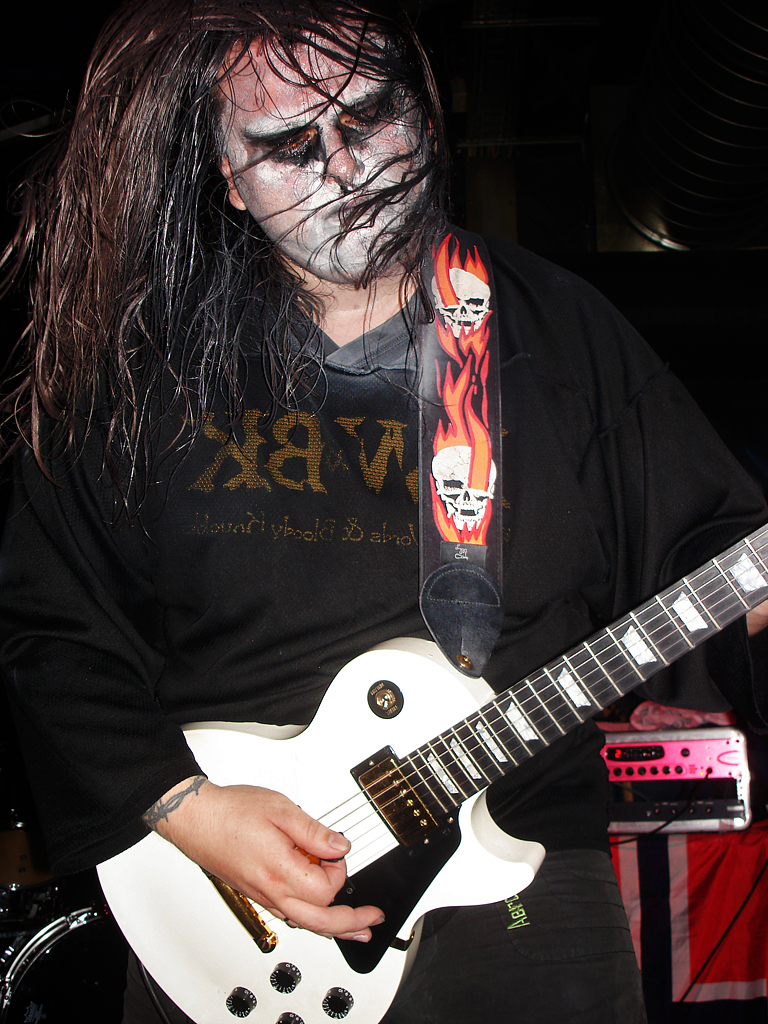
Terje Vik Schei (born 7 July 1974), better known by his stage name Tchort, is a Norwegian musician. He is known for his time spent playing bass for the black metal band Emperor and for leading the progressive metal band Green Carnation. He has also played with Carpathian Forest and Blood Red Throne, Satyricon and Einherjer. Tchort is known to be married and to have a son and a daughter.

Tchort is a Slavonic word (Russian Чёрт, Czech and Slovak Čert, Ukrainian and Belarusian Чорт, Polish Czort or Czart) meaning Devil.

He was arrested in the early/mid 1990s for assault[1] and was in prison for two years.

Tchort with fellow Green Carnation performer Kjetil Nordhus, established his own record label, Sublife Productions in Kristiansand, Norway, on 1 July 2005. The label has already signed Green Carnation, Chain Collector, and Harm, and are looking to sign more.

Sublife Productions also acts as a booking agent for these artists as well as Carpathian Forest and Blood Red Throne.

The company is also turning its eye to cover design, and has stated that "various artists will present their work on Sublifeproductions.com in the near future".

Discography

[edit]

References

[edit]
[edit]
Revisions and contributorsEdit on WikipediaRead on Wikipedia
from Grokipedia
Tchort (born Terje Vik Schei; June 7, 1974) is a Norwegian recognized for his contributions to the and genres, particularly as the bassist for Emperor's debut album (1994) and as the founder of . Born in , , Schei adopted the stage name Tchort and began his career in the late 1980s with early acts before forming in 1989, one of 's pioneering bands. His tenure with was brief but influential, providing bass for the album that helped define the second wave of , after which he was imprisoned for two years in the 1990s due to an . Following his release, Tchort reformed , shifting its sound toward progressive and elements, while also joining as guitarist and bassist from 1999 onward, contributing to albums like Strange Old Brew (2000). In 2000, he founded the death metal band , further expanding his role in Norway's scene. Tchort co-manages Sublife Productions and, in 2014, departed to form The 3rd Attempt with former bandmate BloodPervertor.

Early Life

Upbringing in

Terje Vik Schei, better known by his stage name Tchort, was born in 1974 in , a coastal city in southern Norway's region. His early life unfolded in this locale, where the local music community would later influence his path into . By 1990, at age 16, Schei had formed as a outfit in , recruiting local musicians including brothers Christopher and Anders Kobro (initially under the Botteri ). This early endeavor, which released a demo titled Hallucinations of Despair in 1991, reflected his nascent compositional drive amid the nascent Norwegian underground scene. Schei's activities during this period were rooted in Kristiansand's regional metal circles, predating his relocation for broader opportunities.

Initial Musical Interests

Terje Vik Schei, known professionally as Tchort, exhibited early enthusiasm for during his teenage years in , gravitating toward the visceral intensity of as it gained traction in the late underground scene. This genre's emphasis on technical brutality and low-tuned aggression resonated with him, reflecting a preference for the "more brutal side" of metal. Influences from American pioneers shaped these interests, including bands like Suffocation and , whose complex riff structures and relentless ferocity informed the raw, technical sound Schei explored locally. By the early , his dedication to 's foundational elements—characterized by blast beats, guttural vocals, and intricate guitar work—positioned him within Norway's nascent community, distinct from the contemporaneous developments in .

Entry into Extreme Metal

Formation of Green Carnation

Green Carnation was established in 1990 in , , by guitarist Terje Vik Schei, professionally known as Tchort, who acted as the band's founder and primary creative force. The original lineup consisted of Tchort on guitar, Chris Botteri on bass, Kjetil "X"-Botteri on guitar, and Anders Kobro on drums, drawing from the local community. Initially rooted in death metal, the group reflected the aggressive, riff-driven style prevalent in early Norwegian underground acts. The band's formative output materialized with the self-released demo Hallucinations of Despair in February 1992, recorded over five days from February 3 to 7 at Midgards Studio in . This cassette featured five tracks—"Laudate Dominum," "Deceased (Ashes to Ashes)," "Incubus," "Open the Gates," and "Path of Emotions"—characterized by guttural vocals, fast-paced drumming, and technical guitar work emblematic of mid-1990s . Limited to pro-printed tapes with minimal circulation, the demo garnered attention within niche circles but did not lead to a full-length album at the time. These early efforts positioned as a short-lived death metal entity amid Tchort's rising commitments elsewhere in the scene, though the project's inception foreshadowed its later stylistic expansions.

Joining Emperor and Black Metal Involvement

Terje Vik Schei, known professionally as Tchort, joined the Norwegian band in late 1992 as bassist, replacing Mortiis following the latter's departure to embark on a solo career. This move came shortly after Tchort had co-founded the project in 1990, which he placed on indefinite hold to commit to 's rising profile in the nascent second-wave scene. Tchort's tenure with , spanning 1993 to 1994, centered on contributing to the band's foundational recordings that solidified their reputation for atmospheric and aggressive . He performed bass duties on all tracks of Emperor's debut full-length album, , recorded during July and August 1993 at HM Studio in , , with production handled by the band alongside engineer Kaj Chmielowski. The album, released on February 21, 1994, via Candlelight Records, featured Tchort alongside core members (guitars, vocals, keyboards), (guitars), and (drums), marking a pivotal evolution toward elements through layered keyboards and epic structures. Through , Tchort immersed himself in the Norwegian milieu, which emphasized anti-Christian imagery, raw sonic intensity, and a DIY amid the early and scenes. His bass work provided a grounding foundation to the band's complex compositions, supporting riff-driven assaults and blast-beat rhythms that influenced subsequent acts in the genre. Tchort also participated in promotional activities and interviews, such as a discussion with band members conducted by fellow musician Bård Guldvik Eithun (), where Emperor reflected on their creative trajectory post-arrests in the scene. His brief but impactful role underscored Emperor's shift from raw demo material to a more orchestrated sound, though external legal pressures curtailed further contributions.

Imprisonment Period

Arrest, Charges, and Incarceration

Terje Vik Schei, professionally known as Tchort, was arrested in the mid-1990s shortly after contributing bass to Emperor's debut album In the Nightside Eclipse (1994). He faced charges of assault, with some reports specifying a knife assault, alongside burglary and grave desecration. Schei was convicted and sentenced to a two-year term of for these offenses, serving time in a Norwegian facility during a period when multiple Norwegian black metal figures encountered legal consequences for violent crimes. His incarceration, which began around 1994–1995, isolated him from musical activities and contributed to lineup instability in amid concurrent arrests of bandmates and for and , respectively.

Impact on Career and Band Associations

Tchort's two-year imprisonment for , commencing shortly after Emperor's 1994 album , forced his immediate exit from the band and halted any potential contributions to subsequent recordings or tours. This conviction compounded Emperor's instability, as concurrent incarcerations of bassist for and drummer for left vocalist/guitarist as the only free member, prompting an indefinite hiatus and lineup overhaul without Tchort. His brief tenure with , following his stint, similarly dissolved upon arrest, severing early affiliations and precluding collaborative opportunities within the Norwegian scene during incarceration. The period enforced a total cessation of musical output and networking, stalling career momentum gained from 's critical acclaim and limiting Tchort to isolated reflection rather than active production or performance. These disruptions redirected post-release focus toward , originally formed in 1990 but dormant during his imprisonment, enabling a stylistic pivot away from upon resumption in the late . No formal band associations persisted through the incarceration, isolating Tchort from the evolving landscape and underscoring the Norwegian scene's vulnerability to legal repercussions on personnel stability.

Post-Release Career

Revival and Evolution of Green Carnation

Following his release from a two-year prison sentence in the mid- for , Tchort reunited in 1998, leading to the recording and release of the band's debut album Journey to the End of the Night on May 2, 2000, via Prophecy Productions. This effort marked a significant evolution from the band's original roots in the early 1990s, incorporating gothic and progressive elements with extended song structures and atmospheric doom influences, as Tchort shifted focus toward more introspective and experimental compositions. The band's sound further developed with Light of Day, Day of Darkness on October 23, 2001, a single 60-minute progressive epic blending doom, gothic, and passages, which solidified Green Carnation's reputation for ambitious, narrative-driven works. This was followed by A Blessing in Disguise on February 3, 2003, through , featuring shorter, more varied tracks that retained progressive complexity while introducing cleaner vocals and melodic hooks, reflecting Tchort's growing emphasis on emotional depth over aggression. By 2005's Quiet Offspring, the band had leaned further into with symphonic and infusions, but internal tensions, including a 2007 split after a disorganized U.S. tour, led to a hiatus. Green Carnation reformed in the mid-2010s, culminating in the release of Leaves of Yesteryear on May 8, 2020, their first full-length in 15 years, which revisited gothic progressive metal with melancholic lyrics and intricate arrangements, earning acclaim for recapturing the band's early-2000s essence while incorporating modern production. Tchort temporarily stepped away in 2022 due to personal commitments but rejoined on May 16, 2025, after a four-year absence, coinciding with the announcement of the album trilogy A Dark Poem. The first installment, A Dark Poem, Part I: The Shores of Melancholia, was released on September 5, 2025, via Season of Mist, drawing inspiration from Arthur Rimbaud's poetry and emphasizing epic, gloomy progressive structures with atmospheric metal and occasional extreme elements. This ongoing evolution underscores Tchort's vision of sincerity and emotional expression in progressive metal, prioritizing tortured, personal narratives over genre conventions.

Contributions to Blood Red Throne and Carpathian Forest

Tchort co-founded the Norwegian death metal band in 1998 with guitarist Daniel "Død" Olaisen, both of whom had prior ties to . As the band's primary guitarist from its inception until 2010, he shaped its sound by infusing elements drawn from his tenure, emphasizing brutal riffs and thematic focus on gore and murder. His contributions extended beyond performance to include lyrics on early releases such as the Deathmix 2000 demo and the A Taste for Blood EP (2002), where he also handled bass on select tracks. Tchort participated in Blood Red Throne's core discography, providing guitars on albums including Monument of Death (2001), Affiliated with the Suffering (2003), Altered Genesis (2005), Come Death (2007), and Souls of Damnation (2009). On the latter, he received explicit songwriting credits for tracks 4 and 9, contributing to the band's evolution toward more structures while maintaining raw aggression. Additional roles encompassed , co-production, , and concepts, underscoring his multifaceted involvement in the band's production process. In parallel, Tchort joined in 1999 as bassist, transitioning to guitars from 2001 onward, with intermittent activity through 2009 and a return in 2012–2014. His bass work appears on early releases like the He's Turning Blue / single (2000) and Morbid Fascination of Death (2001), bolstering the band's raw foundation amid its shift toward punk-infused chaos. On guitar, he featured in live and studio efforts such as Live at Inferno '01 (2001, including backing vocals), Defending the Throne of Evil (2003), and Fuck You All!!!! (2006), where he co-wrote tracks 2, 3, 5, 7, and 10, helping integrate misanthropic themes with experimental edges.
Tchort's tenure with aligned with its prolific phase under Nattefrost's leadership, contributing to compilations like We're Going to Hell for This (2002) and video releases such as We're Going to Hollywood for This (2004 and 2009 editions). These efforts reinforced the band's cult status in Norwegian , blending Tchort's technical precision with the group's irreverent, ethos, though his role remained supportive rather than leading.

Recent Developments and 2025 Return

In May 2025, Tchort rejoined Green Carnation on guitar following a four-year hiatus attributed to personal commitments. This return coincided with the band's announcement of an ambitious album trilogy, an concept originated by Tchort himself to explore progressive metal themes of melancholy and introspection. The first installment, A Dark Poem, Part I: The Shores of Melancholia, was released on September 5, 2025, via Season of Mist, marking Green Carnation's first full-length output since 2006's Acoustic Verses. Tchort contributed guitar work across the album, which features vocalist Kjetil Nordhus and emphasizes atmospheric progressive structures with key-shifting dynamics and layered instrumentation. The release included a promotional video for the title track, highlighting Tchort's role in the band's revived creative direction. No further updates on Tchort's involvement with or emerged in 2025, with his focus remaining on 's ongoing trilogy project, slated for completion between 2025 and 2026.

Musical Style and Innovations

Shift from to Progressive Elements

, founded by Tchort (real name Terje Vik Schei) in 1990, initially operated as a outfit, with the band's name evoking imagery of "rotten flesh" aligned with the genre's thematic and sonic aggression. Following Tchort's temporary departure to join and a subsequent reunion around 1998, the band released their debut album Journey to the End of the Night in 2000, which retained roots through heavy riffs and growled vocals but introduced extended song structures exceeding 10 minutes, foreshadowing a departure from rigid genre boundaries toward more experimental forms. The decisive transition materialized on the 2001 follow-up Light of Day, Day of Darkness, a singular 66-minute composition eschewing verse-chorus conventions in favor of symphonic progression, featuring orchestral strings, choirs, and ambient samples to evoke an operatic narrative arc. Tchort composed the bulk of this material in approximately two months, drawing from pre-existing ideas but infusing them with personal stemming from the death of his daughter and the birth of his son, which prompted a holistic reflection on life's dualities rather than sustained extremity. This album marked Green Carnation's pivot to , prioritizing emotional depth, dynamic shifts, and conceptual unity over death metal's velocity and brutality, a change Tchort attributed to creative liberty post-reunion rather than external pressures. Subsequent releases amplified these progressive tendencies: A Blessing in Disguise (2003) incorporated rock influences like while maintaining metallic edges through diverse songwriting contributions, and The Quiet Offspring (2005) further leaned into mature structures with reduced doom-death heaviness. Tchort emphasized that such evolutions arose organically from the band's multi-writer dynamic and commitment to heartfelt expression, explicitly rejecting stylistic alterations for commercial viability or broader appeal, as authenticity underpinned their appeal to niche audiences. This trajectory reflected Tchort's vision of music as an evolving personal outlet, continuously lightening from the band's origins toward introspective, structurally ambitious works.

Bass Techniques and Songwriting Approach

Tchort's songwriting approach in emphasizes personal introspection and emotional depth, often inspired by life events such as the birth of his son, which fueled a burst of creativity resulting in the 60-minute single-track album Light of Day, Day of Darkness (2001). He composed and arranged much of it rapidly, stating, "I was very creative during this period and I wrote the rest of the song/album and arranged it within a couple of months - one month before, and one month after the birth of my son." This solo-driven process contrasted with later collaborative efforts, as seen in A Blessing in Disguise (2003), where he penned six of nine songs but valued band input for added layers: "The advantage is of course the depth you bring into your music because the three of us who wrote this album have very different musical backgrounds." Influences from 1970s , including , inform his shift from roots to atmospheric, gothic-tinged progressivism, evoking childhood memories of his father's record collection. Tchort planned intricate structures meticulously, as with Light of Day, Day of Darkness, where most instruments and ideas were rehearsed six months prior, though elements like his son's improvised vocals added spontaneity. By 2004, he began writing extensions like "Parts 2 & 3" for the track, signaling an ongoing evolution toward expansive, narrative-driven compositions. Regarding bass techniques, documentation remains sparse, but Tchort's work in from 1991–1994 focused on aggressive, riff-supportive lines that reinforced the intensity of (1994), integrating with symphonic keyboards and raw production to form a dense sonic foundation. In Green Carnation's reformed , his multi-instrumental role extended to dynamic bass contributions amid complex arrangements, prioritizing support over flashy solos to underscore emotional narratives.

Controversies in the Black Metal Scene

Association with Criminal Acts and Ideology

Tchort, whose real name is Terje Vik Schei, was convicted and imprisoned in the mid-1990s for , knife assault, and , serving approximately two years in prison for these offenses. These crimes occurred amid the broader Norwegian scene's wave of arsons and violence, though Tchort's acts did not include church burnings or . In a 1996 interview, he emphasized that media coverage had overemphasized criminal elements at the expense of musical contributions, stating, "There is much more to than church-burning and ." As bassist for Emperor during the recording of their 1994 debut album , Tchort was associated with a band whose other members faced direct involvement in high-profile crimes: guitarist was convicted of for burning a church, and drummer was imprisoned for murder and additional arsons. Tchort's tenure ended shortly after the album's release, with his and subsequent leading him to quit the band while incarcerated. Despite not participating in Emperor's more extreme acts, his presence linked him to the scene's cult of notoriety, where criminality was sometimes glorified as authentic rebellion against societal norms, particularly . Ideologically, Tchort's work aligned with black metal's prevailing anti-Christian and themes, reflected in his "Tchort," derived from a Slavic term for the , and contributions to evoking darkness and misanthropy on . However, unlike some contemporaries who espoused explicit or pagan , Tchort's public statements prioritized artistic expression over ideological , critiquing the scene's fixation on as a distraction from innovation. This stance contributed to his ousting from , as the remaining members sought greater alignment with the genre's radical fringes.

Broader Implications for the Genre

The entanglement of 's formative years with criminal acts, including Tchort's 1993 imprisonment for two years on charges of , assault, and grave desecration, highlighted the genre's early fusion of artistic provocation and real-world transgression, influencing its trajectory toward greater scrutiny and diversification. These incidents, occurring amid a cluster of over a dozen church arsons and two murders by scene affiliates between 1992 and 1993, amplified media coverage that both mythologized as a symbol of cultural rebellion and imposed lasting reputational burdens. The resulting public and legal backlash prompted Norwegian authorities to intensify investigations into the Oslo-based "inner ," fostering a scene-wide reckoning that separated ideologically driven —such as anti-Christian and —from outright felonies, though the association persisted in popular narratives. This scrutiny catalyzed black metal's evolution from insular extremism to a more resilient subgenre, as imprisoned figures like Tchort and bandmates such as 's and emerged to prioritize musical innovation over provocation, evident in Tchort's post-release pivot to Green Carnation's progressive explorations by 2000. The controversies underscored causal tensions within the genre: whether the music's emphasis on and isolation precipitated antisocial behavior among alienated youth in early-1990s , or if pre-existing personal pathologies merely co-opted the aesthetic for notoriety. Empirical patterns suggest the latter, as crimes were confined to a small cadre rather than diffused across participants, yet the fallout reinforced black metal's cult allure for marginal subcultures while alienating broader audiences and inspiring derivative scenes wary of replicating Norwegian excesses. Long-term, these implications manifested in bifurcated genre discourses, pitting defenders of artistic autonomy—arguing that Tchort's bass contributions to Emperor's 1994 landmark retain value independent of his convictions—against critics decrying the normalization of ethical lapses, which echoed in later Nazi-sympathizing fringes and prompted self-policing among purists. This duality propelled black metal's commercialization, with festivals and labels distancing from overt criminal glorification to emphasize sonic extremity, yet preserved ideological undercurrents that sustain debates on authenticity versus . The Norwegian model's exportation thus embedded a cautionary , where initial accelerated global dissemination but necessitated maturation to evade .

Reception and Legacy

Critical Acclaim for Key Works

Light of Day, Day of Darkness (2001), Green Carnation's second album and a Tchort-led project structured as a single 60-minute track, garnered significant praise for its innovation, emotional narrative on loss, and seamless integration of heavy riffs, melodies, and atmospheric shifts. Critics lauded Tchort's songwriting as the driving force, noting his success in sustaining engagement across the epic length with brilliant ideas and strong performances from the lineup. The album's thematic realism, rooted in personal tragedy, was highlighted as grounding its ambitious scope, distinguishing it from typical metal fare. Metal publications recognized it as a seminal work, one of the longest metal songs recorded, blending doom, roots, and progressive elements into a cohesive masterpiece that influenced the genre's boundaries. Reviewers emphasized its replay value despite the runtime, with chunky riffs and melodic warmth earning descriptions of it as heavy yet accessible. Tchort's contributions to , including bass on albums like Monument of Death (2005) and Come Death (2007), received positive notices within circles for pummeling blast beats, technical riffs, and song construction that elevated the band's brutal sound. Monument of Death was deemed the group's strongest release to date for its intensity and grandeur. Later efforts like (2019) were commended for mid-tempo depth and solo work amid the aggression, though acclaim remained genre-specific rather than broadly transformative. Early involvement with on releases such as the Through Chasm, Caves and Titan Woods EP (1995) drew approval for raw execution, with Tchort's guitar and bass underpinning the band's grim, morbid aesthetic that became a in Norwegian scenes. However, critical focus on these works often centered on the band's overall ferocity over individual roles, with later albums like Defending the Throne of Evil (2003)—post-Tchort's primary tenure—praised for riffs and composition but not directly attributing acclaim to his foundational input.

Influence on Metal Subgenres and Debates on Artistic vs. Ethical Value

Tchort's bass performance on Emperor's debut album , released on February 21, 1994, helped shape the raw, atmospheric archetype of second-wave Norwegian , with his contributions providing rhythmic drive beneath the album's tremolo-picked riffs and keyboard layers. The record's enduring status as a genre cornerstone stems from its fusion of aggression and orchestration, influencing later acts in and broadly. Drawing from his earlier experience in during the early 1990s, Tchort bridged subgenres by incorporating technical precision and groove-oriented elements into 's chaotic framework. In , co-founded with vocalist Død in 1998, Tchort's guitar riffs emphasized brutal structures akin to and , while infusing blackened tones that distinguished the band's sound within Norway's scene. Albums like Monumental Possession (2005) showcased his ability to blend subgenres, contributing to the emergence of hybrid styles such as . Similarly, his guitar work in from the early 2000s added riff-driven intensity to their black 'n' roll aesthetic, evident in releases like Defending the Throne of Evil (2003), further exemplifying his role in evolving toward punk-infused accessibility without diluting extremity. Tchort's trajectory intersects with ongoing debates in metal circles regarding the separation of artistic innovation from ethical considerations, particularly amid black metal's historical ties to , , and ideological extremism in the early Norwegian scene. Though imprisoned for burglary unrelated to genre-specific crimes following , his associations with —whose other members faced convictions for church burnings and —prompt scrutiny over whether musical excellence justifies engagement with tainted legacies. Proponents of artistic primacy argue Tchort's genre-spanning output, including progressive shifts in Green Carnation's Light of Day, Day of Darkness (2001), prioritizes sonic exploration over ideology, a stance echoed in broader discussions favoring aesthetic value independent of personal or subcultural ethics. Critics, however, contend that ignoring contextual controversies risks normalizing problematic undercurrents, though Tchort's avoidance of explicit political or Satanic advocacy in interviews underscores a focus on craft. This tension mirrors metal's causal divide: empirical musical impact versus in artist evaluation.

References

Add your contribution
Related Hubs
User Avatar
No comments yet.