Hubbry Logo
TelemachyTelemachyMain
Open search
Telemachy
Community hub
Telemachy
logo
8 pages, 0 posts
0 subscribers
Be the first to start a discussion here.
Telemachy
Telemachy
from Wikipedia

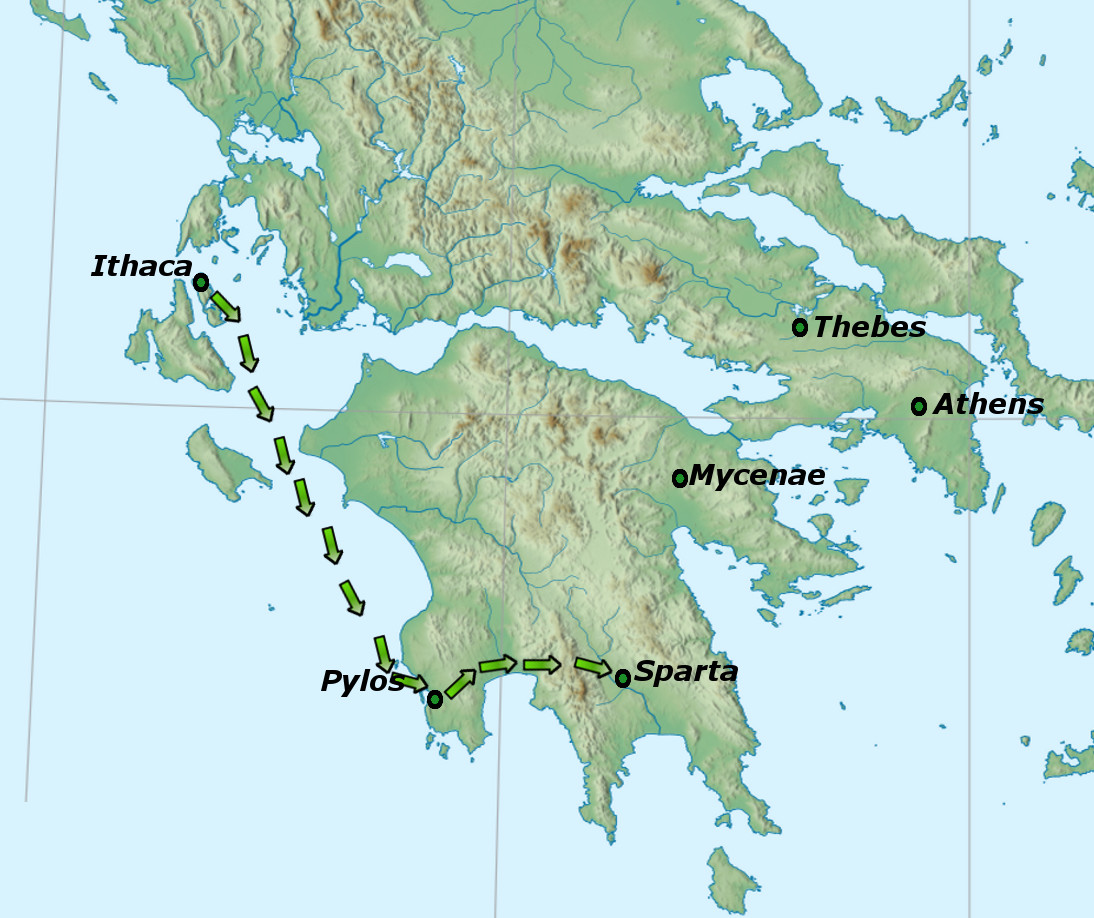
The voyage of Telemachus

The Telemachy (from Greek Τηλεμάχεια, Tēlemacheia) is a term traditionally applied to the first four books of Homer's epic poem the Odyssey. They are named so because, just as the Odyssey tells the story of Odysseus, they tell the story of Odysseus's son Telemachus as he journeys from home for the first time in search of news about his missing father.

The Telemachy as an introduction to the Odyssey

[edit]

The Odyssey is a nostos that recalls the story of Odysseus' journey home to Ithaca, finally completed twenty years after the Trojan War began. Odysseus, however, does not directly appear in the narrative until Book 5. Instead, the Telemachy's subject is the effect of Odysseus' absence on his family, Telemachus in particular. The first four books of the Odyssey give the reader a glimpse of the goings-on at the palace in Ithaca. There are a multitude of suitors vying for Penelope's hand in marriage, consuming the absent king's estate. They have been a terrible drain on the family's wealth, as they have been nearly permanent houseguests while Penelope put off her choice for three to four years. A brooding Telemachus wants to eject the suitors, and in fact announces his intention to do so; but he is not strong enough to act on the threat. Homer thus provides Telemachus with a motive for leaving Ithaca, and the reader with this portrait of Ithaca to place Odysseus' homecoming in context and to underscore the urgency of his journey.

Telemachus' Rites of Passage

[edit]
The Sorrow of Telemachus (Angelica Kauffman, 1783)

Homeric scholarship generally recognizes the Telemachy as the story of its eponymous hero's journey from boyhood to manhood.[1] It is only after having gone through this journey that Telemachus will be equipped to help Odysseus kill the suitors in Book 22. His first step toward Homer's ideal of manhood is a figurative one: in Book 1 Penelope tries to dictate what songs a bard should sing for the suitors. Telemachus (345ff.) admonishes her, and directs her to go back to her room; this signals the first time that Telemachus asserts himself as the head of the household in the Odyssey.

In Book 2 Telemachus further tries to assert his authority when he calls an Assembly and demands that the suitors leave his estate. But since Telemachus is, in his own words (61-2), "a weakling knowing nothing of valor," the suitors refuse, blaming Penelope for their staying so long. Telemachus then announces his intention to visit Sparta and Pylos in search of news about his father. This first journey away from home is an important part of the figurative journey from boyhood to manhood.

In Book 3 Telemachus is schooled in the ancient Greek social contract between hosts and their houseguests. The concept, called xenia, is simple: the host should offer the houseguest anything he wants, and the houseguest should not abuse this generosity, for he might find himself playing the part of host in the future. Nestor, the king of Pylos, exemplifies this social contract. Furthermore, Nestor's storytelling allows Homer to relate myths that fall outside of the Odyssey's purview. He reflects on the Trojan War, praising Odysseus for his cunning. Telemachus begins to learn and appreciate what kind of man his father was. The story Nestor tells of Orestes in particular serves as a role model for Telemachus to emulate: just as Orestes killed the overbearing suitor who occupied his father Agamemnon's estate, so should Telemachus kill the suitors and reclaim his own father's estate.

Telemachus in the palace of Menelaus (c. 1886)

In Book 4 Telemachus visits Menelaus in Sparta. Through the story-telling of Menelaus, Homer further narrates myths of the Trojan War that are not strictly the Odyssey's purview. Menelaus tells Telemachus of his own detour in Ancient Egypt on his way home from the Trojan War, during which he learned that Odysseus is still alive, a virtual captive of the nymph Calypso. His wife Helen recalls one of Odysseus' exploits during the war, which prompts Menelaus to tell his own story about Odysseus' heroism in the war. These tales of bravery and cunning both further educate Telemachus about his father, and serve as further examples of heroism to which he should aspire. The story of Orestes is revisited, again, to inspire Telemachus to take action against the suitors. Telemachus takes his own steps toward manhood when he leaves Sparta. Whereas he arrived at Pylos afraid to even speak to Nestor, upon leaving Menelaus he has enough confidence in himself to ask for a gift more appropriate for an inhabitant of rocky Ithaca. Menelaus obliges, and exchanges the chariot and team of horses he had given him for a wine bowl made by Hephaestus. Telemachus then begins his journey back home. But in Ithaca, the suitors have decided to ambush and kill Telemachus before he reaches his (669) "measure of manhood" and begin making trouble for them: in Book 2 Telemachus is considered a boy who poses no threat; by the end of Book 4 they fear his becoming a man who could stand up to them. The Telemachy abruptly draws to a close with this cliffhanger, the Suitors setting an ambush for Telemachus at a harbour.

Athena, disguised as Mentor, and Telemachus.

Typically, in the hero's journey he will receive occasional aid from a mentor figure. In the Odyssey, Athena serves as mentor to both Odysseus and Telemachus. In Book 1 she visits Telemachus disguised as the mortal Mentes to spur the young man to action. She alternately advises Telemachus in the guise of a man actually named Mentor—hence the word "mentor" in English.

Capstone to Telemachy

[edit]

Near the end of the Odyssey, Telemachus demonstrates his decisiveness and independence by hanging the disloyal women slaves, instead of killing them by sword, for the sake of his honor.

Foreshadowing in the Telemachy

[edit]

The Orestes paradigm treated above is perhaps the most overt example of foreshadowing events in the Odyssey's later books. The stories told about Odysseus serve a similar purpose. In the Telemachy both Nestor and Menelaus praise Odysseus for his cunning. In telling of his own detour in Egypt, Menelaus emphasizes how the use of cunning and subterfuge were instrumental in his return to Sparta. It was only by hiding under a seal skin that he was able to ambush and capture Proteus, the only one who can direct Menelaus how to reach home. Although the scheme was not of Menelaus' devising, it does demonstrate that while the battlefield inspires bravery from its heroes, wily cunning also has its place when the situation demands. These recollections of stealth and subterfuge point to the tactics that Odysseus will eventually employ upon his return to Ithaca.

See also

[edit]

Notes

[edit]
Revisions and contributorsEdit on WikipediaRead on Wikipedia
from Grokipedia
The Telemachy is the traditional name given to the first four books of Homer's epic poem the Odyssey, which center on the maturation and quest of , the young son of the hero . In these opening sections, , living amid the chaos of suitors who overrun his household in Ithaca while awaiting his father's return from the , receives divine encouragement from the goddess to embark on a journey of self-discovery. He assembles a crew, sails to to consult the aged king Nestor, and then proceeds to to seek information from and Helen, thereby learning fragments of 's fate and gaining insights into heroic conduct and kingship. This narrative arc not only establishes the domestic crisis on but also parallels and foreshadows 's own (homecoming), highlighting themes of growth from passivity to agency. Scholars interpret the Telemachy as a deliberate structural device in the Odyssey, serving to delay the main protagonist's appearance while building tension and developing secondary characters. It functions as a for , transforming him from a hesitant youth overshadowed by the suitors into a more assertive figure capable of contributing to his father's eventual restoration of order. Key events include Athena's disguised visit in Book 1, where she incites Telemachus to convene an assembly and reject the suitors; the sacrificial rituals and counsel in in , emphasizing piety and eloquence; and the revelations in in Book 4, where recounts Odysseus's exploits at , underscoring the value of (glory) through storytelling. These episodes also introduce motifs of xenia (guest-friendship) and divine intervention that permeate the entire epic. The Telemachy's significance extends to its role in unifying the Odyssey's dual narratives of father and son, with 's travels mirroring Odysseus's wanderings on a smaller scale and preparing the ground for their reunion in Book 16. While some analyses view it as an independent early composition later integrated into the poem, its placement achieves dramatic irony, as the audience knows Odysseus's survival while does not, heightening anticipation. This section also critiques social disruptions in the absence of a (king), portraying 's growth as essential to Ithaca's stability and the transmission of heroic legacy. Modern scholarship continues to explore its educational dimensions, seeing it as a model of (upbringing) in Homeric society.

Overview and Context

Definition and Etymology

The Telemachy refers to the first four books (Books 1–4) of Homer's , an epic poem traditionally dated to the 8th century BCE, centering on the journey of , son of , as he seeks news of his long-absent father amid the suitors' encroachment on his household. The term "Telemachy" derives from the Greek Τηλεμάχεια (Tēlemacheia), formed by combining Τηλέμαχος (Tēlemakhos), the name of the protagonist—etymologically from τῆλε (tēle, "far off") and μάχη (machē, "battle" or "fight"), signifying "fighting from afar"—with the epic suffix -εία (-eia), which denotes a poem or cycle, paralleling titles like and . This introductory segment is attributed to Homer, the presumed author of the Odyssey, and has been recognized as a distinct unit since antiquity through scholia and commentaries analyzing its structural role. Distinct from the Odyssey's core narrative, which chronicles Odysseus' adventures and nostos (homecoming), the Telemachy establishes the Ithacan crisis and Telemachus' nascent heroism, providing essential context for the epic's unfolding drama.

Position Within the Odyssey

The Telemachy constitutes Books 1–4 of Homer's Odyssey, functioning as an introductory arc that precedes the hero's own narrative beginning in Book 5. This opening segment establishes the precarious situation in Ithaca, marked by the suitors' invasion of the household and their depletion of Odysseus' resources, while underscoring Telemachus' initial inexperience in asserting authority. By depicting these elements, the Telemachy motivates the epic's central conflict: the restoration of paternal rule and the expulsion of the interlopers, thereby framing the stakes for Odysseus' impending return. Scholarly analysis has long debated the Telemachy's compositional unity within the Odyssey. In the , analysts such as Friedrich August and Adolf Kirchhoff posited that Books 1–4 originated as a separate entity, potentially interpolated into an earlier core narrative centered on ' wanderings to provide and motivation. In contrast, unitarian scholars like Karl Reinhardt emphasized its organic integration, arguing that the section's thematic and structural coherence—such as parallel divine assemblies in Books 1 and 5—demonstrates a unified poetic design by a single author. These debates highlight the Telemachy's role in bridging domestic prelude and heroic adventure, with unitarians prevailing in modern assessments of its inseparability from the whole. The Telemachy transitions to the main body of the Odyssey by deliberately postponing ' direct appearance, employing ring composition to heighten anticipation. This delay, achieved through the second in Book 5 echoing the first in Book 1, shifts focus from Ithaca's turmoil and ' preparatory journey—where he serves as the arc's protagonist—to the revelation of ' location and trials. Such structuring not only builds narrative tension but also contrasts the stasis in Ithaca with the external adventures, propelling the epic toward resolution.

Narrative Elements

Plot Summary

The Telemachy comprises the first four books of Homer's and centers on the young prince of Ithaca as he seeks information about his long-absent father, . In Book 1, the goddess , disguised as the Taphian lord Mentes, visits Telemachus in his family's palace in , where the hall is overrun by unruly suitors vying for the hand of his mother, . urges Telemachus to take action by convening a public assembly to denounce the suitors' exploitation of his household and to embark on a journey to and for news of , assuring him that his father lives and will return. That night, inspired by the goddess, Telemachus confronts the suitors in the hall, but they dismiss his complaints and continue their feasting. In , calls the Ithacan assembly in the town square, publicly rebuking the suitors for their lawlessness and announcing his intent to sail in search of , despite their mockery and threats led by . With now appearing as the trusted elder Mentor, secures a ship and crew from the disguised and departs at dawn, leaving his nurse Eurycleia in secret confidence about his plans. They sail southward through the night, reaching the shores of by the following day. Book 3 depicts and Athena's arrival in , where they join Nestor and his sons amid a grand sacrifice to on the beach. Nestor, the aged king and veteran of the , hospitably receives the visitors and, upon learning of Telemachus's quest, recounts the Greeks' troubled homecomings after : the deaths of Achilles, Ajax, and others; the discord between and ; and 's murder by , avenged by his son . Lacking direct news of , Nestor advises to continue to and sends his son Peisistratus as a companion, while Athena departs in the form of a bird, revealing her divine nature to . In Book 4, and Peisistratus arrive in at the palace of and Helen, who are hosting a double wedding feast. The hosts recognize 's resemblance to and welcome him warmly, sharing stories of the over dinner; Helen describes 's cunning in , and recounts his own delayed return. To reveal 's fate, narrates how the shape-shifting god informed him in that lives, detained unwillingly by the nymph Calypso on her remote island. Meanwhile, back in Ithaca, the suitors discover 's voyage and plot his murder upon his return, with proposing an ambush at sea near the rocky islet of Asteris. These events span key locations from Ithaca to the Peloponnesian mainland, underscoring the scope of 's journey under Athena's subtle guidance.

Key Characters and Their Roles

Telemachus is the central figure of the Telemachy, portrayed as the young son of Odysseus and Penelope who initially appears passive and uncertain in the face of the suitors' disruption of his household in Ithaca. Overwhelmed by doubt about his father's fate and his own identity, he is motivated by a desire to seek news of Odysseus and assert his nascent authority, culminating in his decision to embark on a journey to Pylos and Sparta. In Book 2, he boldly convenes an assembly to denounce the suitors' excesses, demonstrating emerging agency as he rallies support for his quest. Athena, the goddess of wisdom, plays a pivotal divine role by disguising herself as Mentor, Odysseus's old friend, to provide with encouragement and practical guidance throughout the arc. Her motivations stem from her favor toward and a strategic intent to propel his son's maturation, urging Telemachus in Book 1 to confront the suitors and undertake the voyage for information on his father ( 1.88–95). She reappears as Mentor in to help secure a ship and crew, ensuring the journey proceeds despite opposition, and her interventions subtly foreshadow Odysseus's eventual return through prophetic hints. Nestor, the aged king of and a veteran of the , serves as a hospitable mentor figure who receives upon his arrival in Book 3. Motivated by longstanding alliances and a sense of duty to the younger generation, he offers lavish xenia, recounts tales of the war's heroes, and advises to emulate ' vengeance against usurpers ( 3.202–209), while directing him onward to in . His role underscores the importance of and counsel in guiding 's quest. and Helen, the royal couple in , act as generous hosts who provide with crucial insights in Book 4, motivated by their own experiences of loss and return from as well as the cultural imperative of xenia. shares a prophecy from about 's survival and entrapment, emphasizing themes of endurance, while Helen recounts recognizing in disguise during the war ( 4.291–295), both interactions bolstering 's resolve and connection to his father's legacy. Antinous and Eurymachus, the most prominent among the suitors besieging Odysseus's palace, embody antagonism and entitlement, driven by ambitions to wed and seize control of Ithaca. leads the mockery of at the assembly in , defending their feasting as justified by Penelope's delays (Odyssey 2.85–86), while Eurymachus questions Telemachus's maturity and right to rule in Book 1 (Odyssey 1.402–404), their actions escalating the household's chaos and prompting Telemachus's departure. Penelope appears briefly but crucially as the loyal wife managing the household amid the suitors' pressure, her motivations rooted in unwavering fidelity to and preservation of the family's honor. In Book 1, she descends to the hall and pleads with the Phemius, in the presence of the suitors, to cease singing a song of the Achaeans' returns from Troy, revealing her ongoing grief. The shroud-weaving ruse, which she employs to delay remarriage, is described in , which indirectly fuels Telemachus's sense of urgency in his quest.

Thematic Analysis

Telemachus' Coming of Age

In the Telemachy, is initially portrayed as an inexperienced youth, approximately twenty years old, who remains overshadowed by the suitors encroaching on his household and reliant on his mother and the nurse Eurykleia for guidance. He expresses doubt about his own lineage, questioning whether he truly is Odysseus's son amid the chaos of his father's prolonged absence. This depiction underscores his naivety and lack of agency, as he is confined to Ithaca, raised primarily among women, and unable to assert control over his . Catalysts for Telemachus's transformation begin with Athena's inspiration, disguised as Mentes, who urges him to take action and seek news of his father, thereby instilling courage for his first public speech at the assembly in Ithaca. This oration marks a pivotal shift, as he boldly denounces the suitors and announces his intent to journey abroad, confronting his helplessness head-on. Encounters with elders, such as Nestor in , further propel his development by providing models of heroic conduct and paternal advice. Key milestones in Telemachus's growth include his visit to , where he gains confidence by questioning Nestor about and participating in rituals that affirm his emerging status among men. In , he demonstrates further maturity by navigating Menelaus's opulent court with composure, absorbing tales of his father's exploits that solidify his sense of identity and purpose. Preparations for his return to Ithaca signal his newfound independence and readiness to confront the situation at home. Scholars interpret Telemachus's arc as a classic "rites of passage" narrative, structured according to Arnold van Gennep's anthropological model of separation, initiation (or ), and return. The separation phase occurs as he departs Ithaca, breaking from the suitors and maternal influence; initiation unfolds during his travels to and , where he undergoes trials of social interaction and gains wisdom through exposure to heroic exempla; and return reaggregates him as a mature figure prepared to aid . This framework highlights his transition from nepios (childish inexperience) to pepnumenos (endowed with understanding), though some analyses note the process remains incomplete due to his father's reemergence. A capstone symbol of this authority is the speaking staff Telemachus acquires, representing his claim to leadership and rhetorical power during key moments like the assembly and his interactions with Nestor.

Divine Intervention and Guidance

In the Telemachy, plays a central role through her multiple disguises and direct interventions, guiding Telemachus toward maturity and action. Appearing first as Mentes, a family friend from Taphos, she visits Ithaca in Book 1 to inspire Telemachus to confront the suitors and embark on his journey, emphasizing the importance of asserting his rights as Odysseus's son. Later, as Mentor, an old companion of Odysseus, she accompanies him to in , advising on proper during sacrifices and assemblies, and protects his ship from harm during the voyage by calming the seas and ensuring safe passage. These interventions underscore Athena's role as a divine mentor, subtly directing human events without overt force. Beyond , other divine elements shape the narrative's progression. In Book 1, convenes an assembly of the gods on Olympus, authorizing Odysseus's release from Calypso's island and setting the epic's divine machinery in motion, which indirectly empowers Telemachus's quest by addressing the broader cosmic order disrupted by Poseidon's wrath. Prophetic omens further illustrate divine involvement, such as the eagle carrying a in Book 15 at ; interpreted by Helen as a sign of Odysseus's imminent return and the suitors' doom, this portent reinforces the gods' signaling of fate to mortals. These instances highlight the gods' orchestration of events, blending signs with human interpretation. Thematically, these divine actions portray the gods as facilitators of human agency, enabling mortals like to navigate their limitations amid uncertainty and fate. By intervening selectively, the Olympians contrast their and power with human vulnerability, yet they do not supplant ; instead, they amplify it, tying into the epic convention of divine machinery that propels heroic narratives. This dynamic illustrates how divine guidance bridges the gap between predestined outcomes and individual initiative, a core tension in Homeric poetry. Scholars have traced these divine-human interactions to influences from Near Eastern epics, particularly the Epic of Gilgamesh, where gods similarly mentor and intervene in heroic quests, shaping mortal destinies through counsel and omens. In Gilgamesh, divine figures like Shamash guide the hero's journey, mirroring Athena's role and suggesting a shared tradition of gods as active participants in human growth and cosmic balance that informed Homeric composition. This comparative perspective reveals how Homer adapted Near Eastern motifs to emphasize Greek ideals of agency within divine oversight.

Literary Devices and Significance

Foreshadowing and Structural Role

The Telemachy employs prophetic elements to anticipate Odysseus' eventual return and the downfall of the suitors. In Book 4, recounts the prophecy delivered by the shape-shifting god , who reveals that Odysseus remains alive but endures prolonged suffering on Calypso's island, foretelling his imminent homecoming after further trials. Similarly, in , Nestor's narratives about the returns of other Achaean heroes, particularly the tragic fate of and ' vengeful response, subtly parallel Odysseus' predicament and hint at a heroic restoration in . Symbolic reinforces these predictions through omens and emblems. During the assembly in , the appearance of two fighting eagles overhead serves as a portent of conflict, interpreted by the seer Halitherses as signaling ' swift return and the suitors' destruction. Likewise, when addresses the assembly, the herald bestows upon him the scepter—a traditional of —marking his emerging role as a leader capable of confronting the suitors and upholding his father's legacy. Structurally, these foreshadowing devices establish central themes of (homecoming) and xenia (guest-hospitality) that permeate the entire epic, contrasting the disorder in Ithaca with the idealized hospitality at and . By delaying ' direct appearance and focusing on ' preparatory journey, the Telemachy heightens narrative tension, framing the hero's return as the fulfillment of embedded prophecies. Scholarly debates center on whether such contributes to the Odyssey's perceived unity or exemplifies techniques of oral composition. Proponents of oral theory, following Milman Parry's analysis of formulaic structures, argue that these prophetic motifs and recurring type-scenes reflect the improvisational methods of traditional bards, integrating disparate elements into a cohesive performance without requiring a single authorial vision. Unitarian scholars, however, view the Telemachy's anticipatory role as evidence of deliberate artistic design, unifying the epic through symmetrical ring compositions that echo across books.

Influence on Epic Tradition

The Telemachy exerted a notable influence on classical epic literature, particularly in Roman adaptations where the motif of a young hero's maturation under divine guidance echoed in Virgil's . Virgil draws on as a prototype for , the youthful son of , portraying him as an emerging figure who embodies filial loyalty and potential leadership amid his father's wanderings, though Ascanius remains less active than his Homeric counterpart. This parallel underscores the Telemachy's role in establishing a template for the "pius" youth in epic narratives, adapting Homeric themes of paternal absence and heroic inheritance to Roman imperial ideals. In Hellenistic traditions, the Telemachy's key events were condensed in mythological compendia, such as ' (Epitome 7), which summarizes ' assembly of the Ithacans, his consultations with Nestor and , and his collaboration with against the suitors, preserving the arc as a foundational element of the Odyssean mythos. During the medieval and Renaissance periods, the Telemachy's themes of filial duty resonated in Christian epic poetry, with Dante Alighieri referencing Telemachus in the Divine Comedy to illustrate ideals of piety forsaken. In Inferno 26, Ulysses recounts abandoning "the affection due my son Telemachus" alongside reverence for his father Laertes and wife Penelope, positioning Telemachus as an exemplar of the familial bonds that contrast Ulysses' transgressive quest for knowledge, thereby integrating Homeric motifs into Dante's exploration of sin and redemption. John Milton, while primarily drawing on biblical sources for Paradise Lost, incorporated broader Homeric epic structures, evident in themes of divine guidance and moral awakening. In modern literature, the Telemachy's structure of youthful searching profoundly shaped James Joyce's Ulysses, where the opening "" episode (chapters 1–3) reimagines through , a fatherless artist grappling with intellectual exile and surrogate "suitors" in the form of and Haines, contrasting Homeric heroism with modernist alienation. This adaptation highlights the Telemachy's enduring framework for coming-of-age narratives, emphasizing psychological depth over physical quest. Film adaptations have similarly emphasized youth quests inspired by the Telemachy, as in Alexander Nally's 2012 indie drama The Telemachy, which transposes Telemachus' search for his father to a contemporary Anglo-Greek boy's self-discovery journey across , underscoring themes of identity and heritage in a globalized context. The Telemachy's scholarly legacy in Homeric studies has been revitalized through 21st-century approaches, particularly in analyzing its unique oral formulas that distinguish it from the rest of the Odyssey. Computational models applied to the epic's language, such as statistical authorship analysis of the Odyssey's books 1–4, reveal formulaic patterns indicative of oral composition, including epithets for that evolve to mark his maturation, supporting neoanalytical views of the Telemachy's distinct performative origins. These digital tools, building on Milman Parry's foundational work, enable quantitative mapping of thematic repetitions and multiformity in the arc, illuminating its role in the broader oral epic tradition.

References

Add your contribution
Related Hubs
User Avatar
No comments yet.