Hubbry Logo
TeleostomiTeleostomiMain
Open search
Teleostomi
Community hub
Teleostomi
logo
8 pages, 0 posts
0 subscribers
Be the first to start a discussion here.
Teleostomi
Teleostomi
from Wikipedia
Teleostomes
Temporal range: 445–0 Ma OrdovicianPresent
an acanthodian
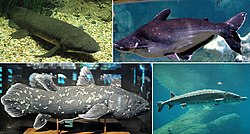
Four species of bony fish
Scientific classification Edit this classification
(obsolete as paraphyletic)
Kingdom: Animalia
Phylum: Chordata
Clade: Eugnathostomata
Clade: Teleostomi
C. L. Bonaparte, 1836
Subgroups

Teleostomi (from Greek τελεος, complete + Greek στόμα, mouth) is an obsolete taxon[1] of jawed vertebrates that supposedly includes the tetrapods, bony fish, and the wholly extinct acanthodian fish. Key characters of this group include an operculum and a single pair of respiratory openings, features which were lost or modified in some later representatives. The teleostomes include all jawed vertebrates except the chondrichthyans and the extinct class Placodermi.

Recent studies indicate that Osteichthyes evolved from placoderms like Entelognathus, while acanthodians are more closely related to modern chondrichthyes. Teleostomi, therefore, is not a valid, natural clade, but a paraphyletic group of species.[1]

Origins

[edit]

The origins of the teleostomes are obscure. They are traditionally assumed to be descendants of the acanthodians ("spiny sharks") from the Early Silurian Period; however, more recent discoveries show that the "spiny sharks" are actually a paraphyletic assemblage leading to Chondrichthyes, and that placoderms like Entelognathus are more closely related to true bony fish.[1] Living teleostomes constitute the clade Euteleostomi, which includes all osteichthyans and tetrapods. Even after the acanthodians perished at the end of the Permian, their euteleostome relatives flourished such that today they comprise 99% of living vertebrate species.

Physical characteristics

[edit]

Teleostomes have two major adaptations that relate to aquatic respiration. First, the early teleostomes probably had some type of operculum; however, it was not the one-piece affair of living fish. The development of a single respiratory opening seems to have been an important step. The second adaptation, the teleostomes also developed a primitive lung with the ability to use some atmospheric oxygen. This developed, in later species, into the lung and (later) the swim bladder, used to keep the fish at neutral buoyancy.[citation needed]

Acanthodians share with actinopterygians the characteristic of three otoliths, the sagitta in the sacculus, the asteriscus in the lagena, and the lapillus in the utriculus. In dipnoans there are only two otoliths and in Latimeria there is only one.[2]

However, most of the above synapomorphies can ultimately be found in several chondrichthyan groups.[3]

Relationships

[edit]
Gnathostomata
Teleostomi

References

[edit]
Revisions and contributorsEdit on WikipediaRead on Wikipedia
from Grokipedia
Teleostomi is a traditional but now largely obsolete taxonomic grouping of jawed vertebrates () that historically encompassed the extinct acanthodian fishes () and the bony vertebrates (), the latter including all ray-finned fishes (), lobe-finned fishes (), and tetrapods. This assemblage represents the overwhelming majority of vertebrate diversity, with over 70,000 extant species (including approximately 35,000 bony fishes and 35,000 tetrapods) as of 2023. In contemporary phylogenetic classifications based on molecular and morphological data, Teleostomi is considered redundant with when focusing on living taxa and is rejected as a valid due to the paraphyletic or polyphyletic nature of , many of which are now positioned as stem-group chondrichthyans (cartilaginous fishes) rather than stem osteichthyans. The term "Teleostomi," derived from Greek roots meaning "complete mouth," originally highlighted shared anatomical features such as the presence of a bony operculum covering the slits and a single dorsal external nares (), distinguishing these vertebrates from more primitive jawed fishes like placoderms and chondrichthyans. These traits facilitated advanced ventilation and sensory adaptations, contributing to the evolutionary success of the group during the period (approximately 419–359 million years ago), when early teleostomes diversified rapidly in aquatic environments. Acanthodians, often called "spiny sharks," were small, shark-like fishes with prominent fin spines and lightweight scales, ranging from the to the Permian (about 443–252 million years ago), but their exact relationships remain debated, with recent tomographic and analyses supporting their dispersal across gnathostome lineages rather than a unified stem to bony vertebrates. Within , the core of what was once Teleostomi, dominates with over 35,000 species of ray-finned fishes as of 2023, characterized by lightweight, fan-like fins supported by lepidotrichia (fin rays) and adaptations for diverse aquatic habitats, from deep oceans to freshwater streams. , the sister group, includes fewer extant forms like coelacanths and lungfishes but gave rise to tetrapods, marking a pivotal transition to terrestrial through fleshy, lobed fins with internal skeletal support. Modern phylogenomic studies, incorporating genomic from thousands of species, have refined these relationships, emphasizing the monophyly of Osteichthyes while underscoring the need to exclude Acanthodii to maintain cladistic rigor. This shift reflects broader advances in vertebrate , where integrated and molecular evidence continues to reshape understandings of early gnathostome .

History and Taxonomy

Etymology and Original Definition

The term Teleostomi derives from the Greek words teleos (complete or perfect) and (mouth), alluding to the fully formed, terminal jaws that distinguish members of this group from more primitive jawed vertebrates with incomplete or ventral mouth structures. introduced the name Teleostomi in 1836 as a subclass within the jawed vertebrates (), encompassing all forms possessing bony skeletons while excluding the cartilaginous fishes (). Bonaparte's original definition grouped the acanthodians (extinct spiny sharks), actinopterygians (ray-finned fishes), and sarcopterygians (lobe-finned fishes ancestral to tetrapods) under Teleostomi, emphasizing shared traits like ossified skeletal elements and advanced mechanics. This taxonomic framework emerged in the early , when paleontological knowledge was constrained by sparse discoveries, leading to classifications reliant on observable features such as jaw completeness and bone development in extant and limited ancient specimens.

Current Taxonomic Status

Teleostomi has been recognized as a paraphyletic or polyphyletic assemblage with the rise of cladistic methods in the late 20th century, owing to the failure of acanthodians to form a monophyletic lineage closely allied exclusively with osteichthyans; instead, they represent a paraphyletic grade of early gnathostomes. This recognition stemmed from applications of phylogenetic methods to jawed vertebrate evolution. Cladistic analyses from the 1990s onward revealed the paraphyly of acanthodians, and studies since the 2010s, incorporating advanced morphological and molecular data, have positioned most acanthodians as stem-group chondrichthyans (e.g., Davis et al. 2012), definitively rendering Teleostomi invalid as a clade. In modern cladistic taxonomy, Teleostomi is no longer recognized as a valid taxon and has been supplanted by monophyletic subgroups within Gnathostomata, such as Chondrichthyes (encompassing stem-group acanthodians) and Osteichthyes. While the term occasionally appears in older literature or informal discussions of vertebrate evolution, it is absent as an accepted category in major taxonomic databases like GBIF as of 2025.

Anatomy and Characteristics

Defining Physical Traits

Teleostomi, now largely synonymous with in modern classifications excluding acanthodians, are distinguished by a predominantly bony , including ossified upper and lower jaws composed of dermal bones, enabling effective prey capture and manipulation. This skeletal framework contrasts with the cartilaginous of chondrichthyans and supports adaptations for aquatic locomotion. The presence of an operculum—a bony flap covering the s—creates a single external respiratory opening, streamlining water flow over the gill arches for efficient oxygen extraction. A key sensory feature of is the containing three s—, lapillus, and asteriscus—which aid in balance and orientation by detecting and , differing from the otoconial structures (small crystals) typically found in chondrichthyans, which lack discrete otoliths. This tripartite otolith system enhances vestibular function, contributing to precise maneuvering in diverse aquatic environments. Many osteichthyan taxa feature homocercal or nearly homocercal fins, where the vertebral column terminates symmetrically near the fin's base, promoting balanced and stability during . These fins often incorporate dermal bones, manifesting as ganoid scales in primitive forms or /ctenoid scales in more derived groups, along with fin spines for structural support and defense. In early osteichthyans, dental structures typically consist of enameloid-capped teeth, a hypermineralized tissue formed through collaborative ameloblast and activity, providing durability against wear. The in these primitive forms often includes calcified cartilage that undergoes perichondral , gradually evolving into fully bony elements in later lineages for enhanced rigidity and weight support.

Respiratory and Adaptations

Osteichthyes, the core of historical Teleostomi, exhibit specialized respiratory systems centered on gills supported by bony arches that facilitate efficient oxygen extraction from . The gill arches, typically four pairs per side, provide rigid bony frameworks that anchor gill filaments and lamellae, maintaining a large surface area for while allowing unidirectional flow. This bony support enables the opercular mechanism, where coordinated movements of the buccal cavity and operculum create pressure gradients to draw over the gills, enhancing ventilation efficiency compared to earlier vertebrates. A key soft tissue innovation in Osteichthyes is the primitive or , an outpocketing of the gut-derived pharyngeal region that serves dual roles in air breathing and control. In early forms, this structure functioned as a for supplemental aerial respiration in oxygen-poor environments, with systems aiding expansion and stability. Over time, in actinopterygian lineages, it evolved into a dorsal primarily for hydrostatic regulation, adjusting by gas volume changes without active swimming. In contrast, sarcopterygian descendants retained lung-like structures for bimodal respiration, highlighting the organ's versatility. Recent phylogenetic studies, including tomographic analyses as of 2019, confirm the exclusion of acanthodians from , positioning them as stem chondrichthyans with distinct respiratory adaptations like spiracles, unrelated to teleostome traits. The respiratory profile of shifted evolutionarily from dual water-air modes in primitive taxa to predominantly aquatic specialization in most modern descendants. Early relied on bimodal via gills and gut-derived lungs to cope with variable oxygen levels, but subsequent diversification saw the loss of air- capacity in many actinopterygians, with swim bladders repurposed solely for buoyancy. This transition optimized energy use for fully aquatic lifestyles, though some lineages like preserved bimodal traits.

Evolutionary Origins

Fossil Record and Earliest Forms

The fossil record of Teleostomi, encompassing early jawed vertebrates with bony elements, includes potential indications from the Late Ordovician, approximately 445 million years ago (Ma), based on ambiguous fin spines recovered from Scottish strata that may represent primitive acanthodians or related forms. However, these remains are fragmentary and their attribution to Teleostomi remains tentative, as they could alternatively belong to jawless fishes. Confirmed records of acanthodians, now considered a polyphyletic group including stem chondrichthyans and possibly some stem osteichthyans though their exact relationships remain debated, emerge in the Early around 443 Ma, initially as isolated scales and fin spines from deposits in and , marking the onset of unequivocal gnathostome diversification. A pivotal early specimen is Fanjingshania renovata, a stem-chondrichthyan "acanthodian" from the lower Rongxi Formation in , dating to about 439 Ma; this represents the oldest near-complete "acanthodian" body fossil worldwide, preserving dentigerous jaw bones, spiny fins, and a skeletal structure indicative of agile . Another significant early find is Nerepisacanthus denisoni, a small ischnacanthiform acanthodian from the Late Bertie Formation Konservat-Lagerstätte in southern Ontario, , dating to about 422 Ma, preserving similar features. Such fossils highlight the rapid establishment of teleostome-like traits, including reinforced spines and reduced armor, in shallow marine environments during the . Although acanthodians exhibit in modern analyses, their early forms provide critical evidence for the basal radiation of gnathostomes, with representing the surviving bony vertebrate lineage. Teleostomi, particularly acanthodians, achieved peak abundance in Devonian seas from 419 to 358 Ma, with over 100 genera documented across diverse marine and freshwater settings, reflecting explosive diversification amid global anoxic events and habitat expansions. Stratigraphically, their distribution shows a marked increase through the Early to Middle Devonian, followed by sustained presence into the Carboniferous where taxonomic richness peaked in Pennsylvanian stages, before a progressive decline in the Permian due to environmental shifts and competition from advanced osteichthyans. Acanthodians ultimately vanished from the fossil record by the late Permian or early Triassic, approximately 252 Ma, leaving their bony-finned descendants—the Osteichthyes—as the surviving lineage of Teleostomi.

Key Evolutionary Transitions

The transition from acanthodian-like ancestors to the first osteichthyans occurred during the Late Silurian to , marking a pivotal shift in characterized by enhanced skeletal and refined mechanics. Acanthodians, early jawed fishes with spiny fins and lightweight scales, represented a basal gnathostome grade, but emerging osteichthyans developed more robust endoskeletons and specialized dermal bones that supported improved feeding efficiency. A key was the of a more efficient suspension, including the hyomandibula's role in facilitating wider gape and stronger bite forces, as evidenced by comparisons between acanthodian braincases and those of primitive osteichthyans like Cheirolepis. This adaptation likely enabled osteichthyans to exploit a broader range of prey, contributing to their diversification in shallow marine and freshwater environments around 419–400 million years ago. During the Period, actinopterygians (ray-finned fishes) underwent a significant radiation, adapting to diverse aquatic niches through innovations in fin structure and locomotion. The development of lepidotrichia—segmented, jointed fin rays—provided greater flexibility and maneuverability compared to the simpler spines of acanthodians, allowing actinopterygians to occupy varied habitats from reefs to open waters. Fossils such as Meemannia from deposits illustrate this early diversification, with over 20 actinopterygian genera recorded by the Late Devonian, reflecting adaptations for schooling, predation, and evasion. This burst in morphological variety, including elongated bodies and specialized sensory systems, positioned actinopterygians as dominant aquatic vertebrates, setting the stage for their later dominance in post-Paleozoic oceans. In parallel, sarcopterygians (lobe-finned fishes) embarked on an evolutionary trajectory toward during the Late , approximately 375 million years ago, exemplified by transitional forms like Tiktaalik roseae. This species retained fish-like gills and scales but possessed robust pectoral fins with skeletal elements homologous to tetrapod limbs, including a , , and that supported weight-bearing and rudimentary "walking" on substrates. Such limb precursors facilitated shallow-water foraging and navigation, bridging aquatic and terrestrial lifestyles amid changing environments with emerging vegetation. This transition underscores the stepwise acquisition of terrestrial adaptations within sarcopterygians, ultimately leading to the origin of limbed vertebrates. Acanthodians, once diverse alongside early osteichthyans, gradually declined and became extinct by the Late Permian around 252 million years ago, primarily outcompeted by more specialized bony fishes and chondrichthyans. Their simpler structures and feeding mechanisms proved less competitive against the advanced and buoyancy innovations of osteichthyans, particularly as environmental shifts during the and Permian favored versatile aquatic predators. Permian records, such as scales from Brazilian deposits, represent some of the last acanthodian remnants, highlighting their vulnerability to ecological pressures culminating in the end-Permian mass extinction.

Phylogenetic Relationships

Traditional Classification

In the traditional 20th-century classification systems of vertebrate paleontology, Teleostomi was positioned as a major subclass within the superclass , standing alongside the subclass , which encompassed cartilaginous fishes such as sharks and rays. This arrangement reflected a Linnaean hierarchical approach that emphasized morphological grades rather than strict phylogenetic branching, grouping Teleostomi as the primary lineage of jawed vertebrates with bony skeletons. The subclass Teleostomi was subdivided into several key groups to capture evolutionary progression among bony fishes. These included the basal , characterized by spiny fins and considered primitive members; the , or ray-finned fishes, which further branched into the (primitive forms like sturgeons and paddlefishes with largely cartilaginous skeletons) and the more advanced Physostomi and Teleostei (higher teleosts with refined mechanisms); and the , or lobe-finned fishes, including coelacanths and lungfishes as closer relatives to tetrapods. This subdivision aimed to organize the diversity of osteichthyans based on increasing complexity in skeletal and locomotor adaptations. Influential textbooks, such as Alfred Sherwood Romer's Vertebrate Paleontology (1966), exemplified this framework by treating Teleostomi as a grade of advanced gnathostomes, bridging placoderms and modern bony vertebrates through shared innovations like . The underlying rationale prioritized observable traits such as the extent of in the —ranging from lightly ossified in basal forms to heavily in advanced ones—and fin morphology, distinguishing ray-supported fins in actinopterygians from fleshy, lobed fins in sarcopterygians, while overlooking potential stem-group .

Modern Cladistic Revisions

Modern cladistic analyses have revealed that acanthodians, once considered a key component of , are polyphyletic, with different subgroups aligning more closely with chondrichthyans or osteichthyans rather than forming a unified within bony vertebrates. Specifically, the Climatiiformes exhibit affinities to stem chondrichthyans, sharing features such as shark-like braincase conditions and fin spine that support their placement on the chondrichthyan stem. In contrast, certain acanthodian orders like the Ischnacanthiformes are positioned as stem chondrichthyans. The 419-million-year-old fossil Entelognathus primordialis (a maxillate placoderm) possesses osteichthyan-like marginal bones ( and ) alongside placoderm-grade armor, representing an early stem gnathostome that bridges placoderms and bony vertebrates. The core of the original Teleostomi concept persists in the monophyletic clade Euteleostomi, encompassing (bony fishes) and tetrapods while excluding acanthodians, as corroborated by integrated morphological and genomic datasets that resolve Euteleostomi as the sister group to within crown . Seminal studies, including Zhu et al. (2012) on Acanthodes braincase morphology supporting chondrichthyan affinities for certain acanthodians, Zhu et al. (2016) revisiting early gnathostome consensus phylogenies that affirm acanthodian , and Brazeau et al. (2022) assessing acanthodian completeness, which supports the evaluation of stem-group placements in existing phylogenies, have driven these revisions through matrix-based cladistic methods. Subsequent analyses as of 2024 continue to support this paraphyletic arrangement of acanthodians as a stem group to chondrichthyans without significant revisions. These phylogenetic rearrangements integrate former Teleostomi elements into a broader tree, where placoderms emerge as paraphyletic stem gnathostomes and Euteleostomi represents the dominant living radiation. Consequently, euteleostomes account for approximately 99% of extant vertebrate species diversity, underscoring their evolutionary success post-Permian extinction of acanthodians.

References

Add your contribution
Related Hubs
User Avatar
No comments yet.