Temple of Music
Temple of Music
Main page
1372064

Temple of Music

logo
Community Hub0 subscribers
Read side by side
from Wikipedia
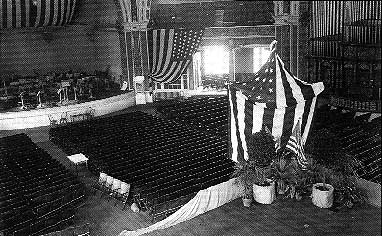
Temple of Music at night, photograph, 1901.
"Temple of Music, Buffalo, N.Y. (Where Pres. McKinley was shot)," historical postcard.

The Temple of Music was a concert hall and auditorium built for the Pan-American Exposition which was held in Buffalo, New York in 1901. United States President William McKinley was assassinated inside the building on September 6, 1901 by Leon Czolgosz. The structure, like most of the other buildings at the exposition, was demolished when the fair ended.

The building

[edit]

The Temple of Music was designed by architects August Esenwein and James A. Johnson for the Pan-American Exhibition, to serve as a concert hall and ceremonial stage. It was built at a cost of $85,000 (over $2,800,000 in 2022 dollars). It was an eclectic combination of various architectural elements. Its major influence was the Italian Renaissance style, and it complied with the Exposition's Board of Architects' overall plan for the exhibition, called the Free Renaissance style. Like most of the major structures at this World Fair, the Temple of Music was extensively electrified, both internally and externally.

Style

[edit]

The Temple's dome rose 180 feet (54.86 m) above the ground floor and the hall itself had seating for over 2,000 people. According to Chuck LaChiusa, a Buffalo native and retired City Honors English teacher, "The building was colored in light yellows, with gold and red trimmings, and the panels in the dome were in light blue, producing an extremely beautiful effect."[1] Four ornate sculptures, representing sacred music, lyric music, music of the dance, and heroic music, executed by Isodore Konti, graced the four entrance portals into the building. The Temple's appeal lay in its spacious interior and new use of lighting. Although the exterior was a great sight, the interior[2] was also impressive. The Temple of Music had seating for over 2,000 people and possessed a pipe organ of 52 ranks built by Emmons Howard & Son. The organ was built for St. Louis Roman Catholic Church in Buffalo, but at the end of the exposition, it was found to be physically too big to be installed there. Buffalo businessman J. N Adams bought it and had it installed in the city music hall, which stood on the corner of Virginia St. & Elmwood Avenue. Demolished when replaced by Kleinhan's Music Hall, the organ was put in storage, deteriorated, and was finally sold for scrap. The myth that the organ in St. Louis Church is the Expo organ still persists, but it is a myth.

A popular local legend holds that a stained glass dome in the now-vacant J.N. Adam Memorial Hospital in Perrysburg, New York, was salvaged from the Temple of Music. However, a visual comparison between the hospital's dome[3] and this rendering[4] of the Temple of Music shows no resemblance between the two.

Creator

[edit]

August Esenwein was born in Esenwein-Virnsberg, Württemberg, in 1856. The family moved to the United States in 1861 and returned to Germany in 1871, where August went to private elementary schools. He attended the University of Stuttgart for five years, studying architecture and engineering. After graduation, Esenwein went to Paris, where he worked as a drafter.

After two years in Paris, Esenwein emigrated to the United States and settled in Buffalo, where he worked as an architect. The Temple of Music was Esenwein's submission to an architectural competition for the Pan-American Exposition and it won first place. He went on to design three more buildings for the Exposition: the Administration Building, Alt Nurnberg, and the brick-art gallery. Esenwein also served on the Pan-American Board of Architects.[5]

Assassination

[edit]
The assassination site as it appears today

The Temple of Music is primarily remembered today as the site of the assassination of United States President William McKinley. On September 5, 1901, McKinley delivered a speech on tariffs and foreign trade at the exposition. The following day, designated as "President's Day" at the exposition, McKinley was shot by Leon Czolgosz while greeting the public at the Temple of Music. McKinley died one week later in Buffalo.

Location

[edit]

After the Exposition closed, the Temple of Music and the other plaster buildings were torn down, and the area between Delaware Avenue and Elmwood Avenue was turned into a residential subdivision bisected by the Lincoln Parkway. The Buffalo and Erie County Historical Society placed a stone and marker on a traffic island dividing Fordham Drive, near that parkway, to mark the area where the Temple of Music was located. "But the spot where the assassination actually took place has been the subject of speculation for much of the century," a reporter would write more than 87 years after the event, adding, "Some say it's a toss-up between 30 and 34 Fordham Drive, while others say it occurred across the street at 29 Fordham or at the end of the island." [6]

Footnotes

[edit]

References

[edit]
Revisions and contributorsEdit on WikipediaRead on Wikipedia
from Grokipedia
The Temple of Music was a neoclassical concert hall and auditorium erected for the Pan-American Exposition in Buffalo, New York, in 1901, designed by architect August Esenwein of the firm Esenwein & Johnson.[1][2] Measuring 150 feet square with a central dome rising 180 feet exteriorly and seating up to 2,200 in its auditorium, the structure housed one of the largest pipe organs built in the United States at the time and hosted daily musical performances that drew large crowds.[2][1] It achieved lasting notoriety as the site of the assassination of President William McKinley by anarchist Leon Czolgosz on September 6, 1901, during a public reception, an event that precipitated McKinley's death and elevated Theodore Roosevelt to the presidency.[3] The temporary building, like most of the exposition's structures, was demolished following the fair's closure in November 1901.[1]

Design and Construction

Architectural Features and Style

The Temple of Music exemplified the Italian Renaissance style prevalent in select Pan-American Exposition structures, characterized by classical proportions, ornate detailing, and a monumental dome. Designed by the architectural firm Esenwein & Johnson, the building adopted a square footprint with truncated corners that imparted an octagonal silhouette, enhancing its temple-like grandeur. The exterior facade, constructed from staff—a temporary plaster composite of gypsum, water, and fiber resembling carved stone—was reinforced with a wooden framework supported by cast-iron connections and steel tension rods, allowing for rapid assembly typical of exposition architecture. Lower walls incorporated concrete reinforcement for stability.[1][4][2] Measuring approximately 180 feet per side with truncated corners each 30 feet wide, the structure rose to a height of 180 feet, crowned by a prominent blue-green dome that harmonized with adjacent buildings like the Ethnology Building. The main entrance faced eastward toward the Court of the Tribes, flanked by decorative elements including sculptures by Isidore Konti representing categories of music—heroic, dance, sacred, and lyric. Electric lighting adorned the exterior, accentuating its light yellow base with gold and red trimmings during evening illuminations. Internally, the auditorium accommodated 2,200 seated visitors across floor level and balconies, centered around a large stage and one of the era's largest pipe organs, the $18,000 Emmons-Howard instrument with extensive pipe ranks for orchestral accompaniment.[2][1][4] This design prioritized acoustic performance and visual spectacle within a temporary framework costing $85,000 to erect, reflecting the exposition's emphasis on ephemeral yet impressive architecture to evoke cultural and technological progress. The use of staff, pioneered at earlier international exhibitions like Paris in 1878, enabled intricate bas-reliefs and columnar motifs at a fraction of permanent stone costs, though the material's fragility limited longevity post-event.[1][2]

Creators and Engineering

The Temple of Music was designed by the Buffalo architectural firm Esenwein & Johnson, with August Esenwein serving as the primary architect and one of the eight official architects for the Pan-American Exposition.[1][2] Esenwein drew inspiration from Italian Renaissance style, incorporating a square plan with truncated corners to evoke a rounded appearance, exterior ornamentation in light yellows, gold, and red trimmings, and a blue-green dome.[1] Exterior sculptures symbolizing categories of music—heroic, dance, sacred, and lyric—were created by New York sculptor Isidore Konti.[2] Engineering for the temporary structure emphasized rapid assembly and cost efficiency, utilizing a wooden framework reinforced with cast-iron connections and steel tension rods for structural integrity, while lower walls were bolstered with concrete.[1] The facade employed "staff," a composite of Plaster of Paris and jute cloth applied in 1/2-inch-thick layers to mimic cut stone or masonry; this material was water-impervious and approximately one-tenth the cost of actual stone, enabling the building's ornate appearance despite its impermanence.[1] Construction costs totaled $85,000, with the seating contract for 1,850 chairs (part of a total capacity for 2,200 including balconies) awarded to Randolph McNutt on February 23, 1901; unlike other exposition buildings, it featured a fully finished interior.[2] The building measured 150 feet per side, with the central dome reaching 180 feet exterior height and 53 feet 9 inches interior clearance from the floor, accommodating large audiences and an $18,000 Emmons-Howard pipe organ—one of the largest in the United States at the time.[2] These specifications supported its role as the exposition's premier auditorium, completed in time for the fair's opening on May 1, 1901.[1]

Materials and Specifications

The Temple of Music utilized temporary construction materials typical of exposition buildings, emphasizing speed and cost-efficiency over permanence. The structural framework comprised wooden members connected with cast-iron fittings and steel tension rods for stability. Exterior facades were finished with staff, a plaster-based composite formed by mixing plaster of Paris with water and molding it onto a fibrous jute cloth reinforcement, producing panels roughly 1/2 inch thick. This off-white, water-resistant material mimicked stone at approximately one-tenth the cost and allowed for intricate ornamental detailing. Lower wall sections incorporated concrete reinforcement to enhance durability.[1] The building featured a square footprint of 150 feet per side, with truncated corners imparting a circular aesthetic from certain angles, and a prominent central dome reaching 180 feet in external height. Internally, the space from floor to dome base measured 53 feet 9 inches, accommodating tiered seating and a large stage. Coloration included light yellow tones for the main body with gold and red accents, while dome panels were rendered in light blue as part of the fair's coordinated palette.[2][1] Designed for musical performances, the auditorium seated 2,200 patrons across floor-level and balcony areas. It housed an Emmons Howard pipe organ, the largest constructed in the United States to date, valued at $18,000. Overall construction expenses totaled $85,000.[2][1]

Context Within the Pan-American Exposition

Intended Purpose and Programming

The Temple of Music served as the primary concert hall and auditorium within the Pan-American Exposition, designed to host musical performances, organ recitals, and public addresses amid the fair's emphasis on cultural and artistic displays.[2][1] Equipped with a stage, seating for 2,200 visitors across floor and balcony levels, and one of the largest pipe organs ever constructed in the United States—at a cost of $18,000 by the Emmons Howard firm—it functioned as a venue for both scheduled entertainment and ceremonial events, including national holiday observances like Flag Day.[2][1] The structure's interior, finished in ornate detail unlike many temporary exposition buildings, also allowed it to double as a resting space for fairgoers when no performances were underway.[2] Programming centered on daily organ recitals at 4:00 p.m., featuring celebrated organists from the United States and Canada performing on the custom-built instrument, which drew crowds for its scale and tonal capabilities.[2][1] The venue hosted 25 instrumental ensembles, including John Philip Sousa's Band, Victor Herbert's orchestra, and the Royal Mexican Artillery Band, alongside 71 individual artists specializing in organ and solo repertoire.[5][1] Additional events encompassed band concerts, musical festivals tied to patriotic themes, and speeches by prominent figures such as President William McKinley, Vice President Theodore Roosevelt, Secretary of State John Hay, and Senator Henry Cabot Lodge, integrating auditory spectacle with oratory to enhance the exposition's promotional atmosphere.[5][1] This schedule positioned the Temple as the exposition's hub for live musical programming throughout the summer months, complementing outdoor band performances and midway attractions while underscoring the fair's goal of fostering hemispheric cultural exchange through accessible, high-profile entertainment.[5][2] Admission to recitals and concerts was typically included in the general fair entry fee, making the events a key draw for the exposition's estimated 8 million visitors from May 1 to November 3, 1901.[2]

Integration with the Fairgrounds

The Temple of Music occupied a prominent position within the Pan-American Exposition's 350-acre fairgrounds, situated on the Esplanade—a central axial promenade that served as the fair's symmetrical spine, linking major exhibit courts and facilitating pedestrian circulation from the southern entrance near Delaware Park to northern attractions.[4] Specifically, it stood west of the Esplanade's central fountain and south of the Court of Lilies, positioning it amid key cultural and machinery exhibits while allowing direct access via broad walkways that converged on the structure from surrounding lagoons and gardens.[1] This placement enhanced its role as a hub for daily programming, with visitors flowing seamlessly from nearby buildings like the Ethnology Building—located directly across—and the Graphic Arts Building to the west, creating a cohesive cluster for artistic and performative displays.[2][4] Architecturally, the Temple integrated with the fairgrounds through its Italian Renaissance style, echoing the motifs of adjacent structures such as the Ethnology Building, while its red base with gold trimmings and blue-green dome panels aligned with the exposition's evolving color gradient—from deeper tones in southern "primitive" zones to lighter pastels northward—fostering visual harmony across the inverted-T shaped site bounded by Delaware Avenue to the east and Elmwood Avenue to the west.[4] Functionally, its 150-by-150-foot footprint and capacity for 2,200 seated attendees complemented the fair's emphasis on hemispheric unity, with interior organ recitals and exterior bandstands drawing crowds along interconnected paths that tied musical events to broader exhibits in horticulture, government, and machinery halls.[2] The structure's corner orientation and truncated sides further promoted accessibility, enabling it to serve as a shaded respite and event anchor without obstructing the Esplanade's open vistas toward the dominant Electric Tower.[1]

The Assassination of William McKinley

Prelude to the Event

President William McKinley arrived in Buffalo, New York, on September 5, 1901, to participate in events at the Pan-American Exposition, a world's fair showcasing industrial and cultural achievements from the Western Hemisphere.[6] Accompanied by First Lady Ida McKinley, the presidential party entered the exposition grounds that morning via the Triumphal Causeway in an open carriage, escorted by troops and followed by a procession of officials.[6] The visit aligned with McKinley's tour to promote American commerce and innovation, amid a fair that had opened on May 1 and attracted millions despite financial strains from economic recovery post-1893 depression.[7] During the day on September 5, McKinley delivered a major address at the Court of Fountains, advocating for reciprocal trade policies to expand U.S. markets and highlighting the era's shift toward global commerce over isolationism; the speech drew an estimated crowd exceeding 116,000.[8][9] The president and first lady toured exhibits, including the Electricity Building and horticultural displays, before retiring to the residence of exposition president John G. Milburn.[10] On September 6, McKinley and his entourage departed early for Niagara Falls via special train, viewing the cascades and power plants symbolizing industrial progress, before returning to the fairgrounds by mid-afternoon.[9] The day's centerpiece was a scheduled public reception in the Temple of Music, a 3,000-seat auditorium designed for concerts and gatherings, where McKinley planned to stand at the entrance and shake hands with visitors in a moving line to foster goodwill and accessibility, a common practice reflecting the era's minimal presidential protections.[11][10]

Sequence of the Shooting

On September 6, 1901, at approximately 4:07 p.m., President William McKinley entered the Temple of Music at the Pan-American Exposition in Buffalo, New York, to conduct a public reception, shaking hands with visitors in a receiving line. Leon Czolgosz, a 28-year-old self-proclaimed anarchist who had arrived about an hour earlier, positioned himself in the line after concealing a .32-caliber Iver Johnson revolver wrapped in a white handkerchief to mimic a bandaged hand.[12] As Czolgosz reached McKinley, he pushed aside the president's outstretched hand and fired two shots in rapid succession from point-blank range through the handkerchief.[13] [12] The first bullet struck McKinley's upper right chest, deflected by his sternum and a shirt button; the second penetrated his abdomen, passing through the stomach. Czolgosz attempted a third shot but was immediately tackled and wrestled to the ground by Secret Service agent George Foster, aide George Cortelyou, and bystander James Benjamin Parker, preventing further discharge. [13] McKinley, reeling from the wounds but remaining conscious, collapsed forward slightly and urged the crowd, "Don't let them hurt him," referring to Czolgosz, before expressing concern for his wife: "Be careful how you tell my wife." [13] The entire sequence unfolded in seconds amid the crowded hall, with Czolgosz later confessing the act was premeditated and intended to kill with the initial shots.[12]

Immediate Response and Casualties

Following the shooting at approximately 4:07 p.m. on September 6, 1901, Secret Service agents and nearby bystanders immediately seized Leon Czolgosz, the assassin, preventing further attacks as an angry crowd surged forward.[14] McKinley, wounded by two point-blank shots to the abdomen from a .32-caliber Iver Johnson revolver, did not collapse but was assisted out of the Temple of Music by aides and walked to an electric chair within the building before being transported by electric ambulance to the exposition's first-aid station.[14] [15] At the first-aid station, Dr. Matthew D. Mann, a prominent Buffalo gynecologist, performed emergency surgery under rudimentary conditions, suturing wounds to McKinley's stomach and pancreas but failing to locate or remove the bullets or fully address potential infection sites due to the era's limited medical technology, including the absence of X-rays or antibiotics.[14] McKinley was then moved to the Milburn House, residence of exposition president John G. Milburn, for recovery, where he initially appeared to improve, reassuring observers with statements such as "It is a mere scratch" and expressing concern for his wife.[15] Czolgosz, meanwhile, was taken into police custody after confessing his anarchist motives and was protected from lynching attempts by authorities.[14] [15] The incident resulted in no immediate fatalities beyond McKinley's critical injuries, with the president succumbing on September 14, 1901, at 2:15 a.m. to gangrene and septic shock from the untreated bacterial infection in his wounds, marking the only death directly attributable to the shooting.[11] [14] Czolgosz was tried, convicted of first-degree murder on September 23, and executed by electric chair on October 29, 1901, in Auburn Prison, New York.[11]

Security and Controversies

Pre-Event Security Measures

The Pan-American Exposition maintained its own police force to manage the large crowds and ensure order across the fairgrounds, with additional support from the Buffalo Police Department and U.S. Army troops deployed for the event's duration. For President William McKinley's scheduled public reception in the Temple of Music on September 6, 1901, security planning involved deploying dozens of police officers, exposition guards, and soldiers to patrol the immediate area surrounding the building.[16] [17] These measures focused primarily on crowd control rather than individual screening, reflecting the era's limited presidential protection protocols, as the U.S. Secret Service had no formal mandate for such duties until after the assassination.[7] McKinley's private secretary, George B. Cortelyou, repeatedly advised against open public receptions due to prior presidential assassinations, including those of Abraham Lincoln in 1865 and James A. Garfield in 1881, urging a more controlled format with ropes or barriers to limit close access.[7] Despite these warnings, McKinley insisted on the traditional handshake line inside the Temple of Music to engage directly with fairgoers, with the reception organized to allow orderly queuing without prior vetting of participants. The intended protocol required individuals to extend empty, open hands for the greeting, but this was relaxed amid the September heat, permitting handkerchiefs and other coverings that bypassed effective visual checks for concealed weapons.[16] No routine pat-downs or armament inspections were conducted, as systematic search procedures were not standard practice for public events at the time.[7]

Failures and Criticisms

The security arrangements at the Temple of Music during President William McKinley's public reception on September 6, 1901, suffered from the absence of mandatory weapon searches for attendees, enabling assassin Leon Czolgosz to approach undetected with a .32-caliber Iver Johnson revolver concealed in a white handkerchief draped over his right hand.[18] This lapse stemmed from reliance on visual observation rather than physical inspections, a common practice at expositions where crowd flow prioritized accessibility over rigorous vetting, despite prior anarchist threats noted in intelligence briefings to McKinley's staff.[19] The receiving line's high throughput—McKinley greeting roughly 50 individuals per minute—further exacerbated vulnerabilities by limiting time for guards to assess suspicious behavior, such as Czolgosz's hesitant demeanor and bandaged hand, which had earlier drawn attention but prompted no intervention beyond verbal warnings from bystanders.[18] Local Buffalo police and exposition security personnel were deployed around the perimeter and within the hall, yet their positioning often impeded rather than enhanced close-quarters protection, allowing Czolgosz to fire two shots at point-blank range before being subdued.[18] Post-assassination inquiries highlighted the ad hoc nature of presidential protection, which depended on uncoordinated local forces without formal Secret Service mandate, a deficiency criticized by officials including McKinley's secretary George Cortelyou for ignoring recommendations to restrict public access amid rising anarchist activities.[19] Czolgosz's prior exclusion from other exposition events for erratic conduct underscored failures in threat tracking and inter-agency communication, with no centralized protocol to flag repeat offenders across fairgrounds venues.[20] The immediate response relied on civilian intervention when James B. Parker, a 6-foot-6-inch African American waiter unaffiliated with security, tackled Czolgosz and dislodged the weapon to prevent a third shot, after which soldiers and police overwhelmed the assassin—exposing the inadequacy of trained personnel in the critical moment.[20][21] These shortcomings drew sharp contemporary rebuke in newspapers and congressional debates, attributing the tragedy to overconfidence in public goodwill and insufficient perimeter controls, ultimately catalyzing the 1906 congressional directive formalizing Secret Service protective duties to avert future vulnerabilities.[19][18]

Ideological Motives of the Assassin

Leon Czolgosz, a self-proclaimed anarchist, assassinated President William McKinley on September 6, 1901, driven by ideological opposition to hierarchical authority and perceived economic oppression of the working class.[22] In his confession shortly after the shooting, Czolgosz stated that he intended to kill McKinley because he rejected the concept of presidents exercising power over the people, viewing such figures as symbols of systemic inequality where "one man should have so much service and another man should have none."[23] He described the act as fulfilling a personal duty to eliminate leaders who, in his view, perpetuated exploitation of laborers, aligning with anarchist tenets that condemned government as an instrument of elite control over the masses.[24] Czolgosz's radicalization stemmed from exposure to anarchist ideas amid personal hardships, including unemployment during the Panic of 1893, which deepened his resentment toward industrial capitalism and political elites.[15] He drew inspiration from recent "propaganda of the deed" actions, such as Gaetano Bresci's 1900 assassination of King Umberto I of Italy, interpreting these as models for striking against authority to awaken public consciousness.[25] Although Czolgosz attended anarchist gatherings and sought contact with figures like Emma Goldman, he operated as a lone actor, rejected by organized groups like Cleveland's Liberty Club due to suspicions of his motives, underscoring his idiosyncratic commitment to anarchism rather than coordinated revolutionary effort.[22] [25] During his September 1901 trial, Czolgosz reiterated that McKinley represented "the enemy of the people, the good working people," framing the assassination as a direct challenge to state power that enabled class disparities.[11] Anarchist ideology, emphasizing the abolition of coercive institutions to achieve voluntary cooperation, informed his rationale, though contemporaries debated whether mental instability amplified his adherence to these principles. No evidence linked him to broader conspiracies, confirming the act as an individual expression of anarchist anti-authoritarianism prevalent in late-19th-century radical circles.[26]

Demolition and Site History

Post-Exposition Fate

The Pan-American Exposition concluded on November 2, 1901, after which the Temple of Music, constructed primarily from temporary materials including staff—a mixture of plaster, cement, and fibers applied over wooden lath—was systematically dismantled along with most other fairground structures.[27][1] The Chicago House Wrecking Company secured a contract on November 15, 1901, to oversee the demolition, with salvageable elements auctioned off to offset the exposition's financial losses exceeding $3 million.[27] Efforts prioritized reusable components like steel framing and lumber, but the Temple's ornate facade and interior proved unsuitable for relocation, leading to its complete teardown by early 1902.[28][27] One notable exception to the destruction was the Temple's Emmons-Howard pipe organ, a massive instrument with over 6,000 pipes that had anchored daily concerts during the fair. Donated by Buffalo businessman J.N. Adam, the organ was carefully dismantled in late October 1901—prior to the formal closing—and relocated for preservation rather than auctioned like many exhibits.[29] It was subsequently installed in a local venue, ensuring its survival beyond the exposition's temporary nature.[30] By mid-1902, the Temple site within the 342-acre fairgrounds had been fully cleared, with no physical remnants retained due to the exposition's design for impermanence and the need to restore the land, originally part of Delaware Park, to urban use.[27] The area evolved into a mix of residential neighborhoods, commercial buildings, industrial facilities, and parking lots, erasing visible traces of the structure amid Buffalo's post-exposition development.[27]

Location and Modern Traces

The Temple of Music stood on the grounds of the Pan-American Exposition in Buffalo, New York, positioned west of the central fountain in the Esplanade and south of the Machinery and Electricity Building.[1] The exposition site encompassed approximately 350 acres in what was then a semi-rural area north of the city center, bounded roughly by present-day Delaware Avenue to the west, Main Street to the east, and extending northward from North Street.[27] After the exposition concluded on November 2, 1901, the Temple of Music was dismantled in November 1901, along with most other temporary structures, to clear the land for redevelopment.[31] No original architectural elements or foundations of the building survive today.[27] The precise site of the assassination now lies in a residential neighborhood, marked solely by a modest boulder in the median of Fordham Drive bearing a bronze plaque installed on June 28, 1921.[32] [33] The plaque succinctly records the event: "At this site on September 6, 1901, President William McKinley was shot by Leon Czolgosz while visiting the Pan-American Exposition. President McKinley died on September 14, 1901."[34] The surrounding exposition grounds have been fully repurposed into a mix of upscale residential areas, commercial properties, industrial zones, and parking lots, with no other visible remnants of the 1901 fair.[27]

Historical Significance and Legacy

Impact on Presidential Protection

The assassination of President William McKinley on September 14, 1901, directly catalyzed the formalization of federal presidential protection in the United States. Prior to this event, security for presidents was inconsistent and largely ad hoc, involving local law enforcement, private detectives, or occasional Treasury Department agents focused primarily on counterfeiting rather than personal safeguarding. McKinley's death, the third such presidential assassination in 36 years—following Abraham Lincoln in 1865 and James A. Garfield in 1881—underscored the inadequacies of these arrangements, particularly the lack of systematic screening for public interactions like the handshake line at the Temple of Music.[35][19] In direct response, Congress in late 1901 requested that the United States Secret Service, established in 1865 under the Treasury Department, assume responsibility for presidential protection on a full-time basis. This informal directive evolved into structured operations under President Theodore Roosevelt, McKinley's successor, with dedicated Secret Service agents accompanying him starting in 1902. The shift marked the inception of a permanent protective detail, expanding from sporadic assignments—such as those provided part-time to Grover Cleveland beginning in 1894—to continuous coverage that included advance threat assessments and close-quarters guarding.[36][7] Further legislative reinforcement came in 1906 via the Sundry Civil Expenses Act, which appropriated funds specifically for the Secret Service's protective duties, solidifying its dual role in law enforcement and security. This framework laid the groundwork for modern protocols, including formalized training, intelligence gathering, and restrictions on unrestricted public access to the president, though vulnerabilities persisted in subsequent decades. The McKinley incident thus transitioned presidential security from reactive improvisation to proactive federal mandate, influencing expansions like candidate protection (authorized in 1963) and family coverage.[37][38]

Cultural and Architectural Remembrance

The Temple of Music, designed in an Italian Renaissance style by the architectural firm of Esenwein & Johnson, featured a prominent blue-green dome and an auditorium seating 2,200 people, equipped with one of the largest pipe organs constructed in the United States at the time.[4][1] As a temporary exposition structure, it exerted no direct influence on subsequent architectural developments, with its materials largely demolished following the event's closure on November 1, 1901.[2] Surviving visual records, including photographs by Charles D. Arnold and postcards, preserve its neoclassical facade and interior grandeur, serving as primary references in historical analyses of exposition architecture.[39] Culturally, the Temple endures in collective memory less for its intended role as a venue for daily concerts and organ performances than as the site of President William McKinley's assassination on September 6, 1901, which overshadowed its musical and aesthetic contributions.[1] This event has anchored its depiction in historical narratives focused on anarchism and political violence, with traces like a 1921 plaque marking the exact location in Buffalo's Delaware Park providing a tangible, if modest, memorial.[32] Modern artistic engagements, such as Kate Rhoades' 2025 exhibition "Propaganda of the Deed," reinterpret the assassination through experimental videos, paintings, and comics, drawing on the Temple's spatial context to explore themes of propaganda and historical violence.[40] Architectural remembrance is further limited to scholarly discussions of temporary exposition pavilions, where the Temple exemplifies the era's use of staff (plaster and fiber mix) for rapid, ornate construction mimicking permanent stonework, a technique common to world's fairs but rarely replicated post-event due to its impermanence.[2] Buffalo's Pan-American Exposition tours occasionally highlight its footprint amid the city's park system, underscoring a legacy tied to urban planning rather than enduring built heritage.[41]

References

User Avatar
No comments yet.