Hubbry Logo
TensionerTensionerMain
Open search
Tensioner
Community hub
Tensioner
logo
8 pages, 0 posts
0 subscribers
Be the first to start a discussion here.
Tensioner
Tensioner
from Wikipedia
Chain tensioner on a single-speed bicycle
Belt tensioner on a belt-drive bicycle

A tensioner is a device that applies a force to create or maintain tension. The force may be applied parallel to, as in the case of a hydraulic bolt tensioner, or perpendicular to, as in the case of a spring-loaded bicycle chain tensioner, the tension it creates. The force may be generated by a fixed displacement, as in the case of an eccentric bicycle bottom bracket, which must be adjusted as parts wear, or by stretching or compressing a spring, as in the case of a spring-loaded bicycle chain tensioner; by changing the volume of a gas, as in the case of a marine riser tensioner; by hydraulic pressure, as in the case of a hydraulic bolt tensioner; or by gravity acting on a suspended mass, as in the case of a chair lift cable tensioner.

Applications

[edit]
  • Bolt tensioners are devices designed to apply a specific tension to a bolt. The device may be either removed once the actual nut is threaded into place or left in place, in the case of a hydraulic nut.[1]
  • The belt or chain tension on a single-speed bicycle can be maintained by either setting the fixed horizontal position of the rear sprocket or the front chainring horizontally, or by a separate tensioner that pushes perpendicular to the chain with either a fixed position or spring tension.[2]
  • The chain tension of a chainsaw may be adjusted with a chain tensioner.[4]
  • A marine riser tensioner is a device used on an offshore drilling vessel that provides a near-constant upward force on the drilling riser independent of the movement of the floating drill vessel.
  • A guideline tensioner is a hydropneumatic device used on an offshore drilling rig that keeps a positive pulling force on the guidelines from the platform to a template on the seabed.
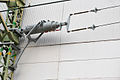
  • Overhead electrical wires may be kept in tension by springs or weights.
  • Conveyor belts
  • Chair lift and gondola lift cables
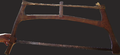
  • Certain wood trusses, such as the beam tensioner truss picture below.[5][6]
  • Fencing made of wire, such as electric fences, barbed-wire fences, and chainlink fences often include tensioning devices to keep them taut.
  • Belt sanders have a mechanism, often a spring-loaded idler drum, to apply the proper tension to the sanding belt, which can be released to allow for changing belts.[7]
[edit]

See also

[edit]

References

[edit]
[edit]
Revisions and contributorsEdit on WikipediaRead on Wikipedia
from Grokipedia
A tensioner is a mechanical device that applies and maintains a controlled force to create or sustain tension in flexible elements such as belts, chains, and cables, or to rigid components such as bolts in fastening applications, ensuring reliable , preventing slippage, and compensating for factors like wear, temperature fluctuations, or vibrations. In contexts, tensioners are essential components in various systems, including automotive engines for timing belts and chains, industrial machinery for drive systems, and conveyor setups for , where they optimize efficiency and extend equipment lifespan by reducing premature wear and synchronization issues. Tensioners operate through mechanisms that automatically or manually adjust tension levels, with common types including mechanical tensioners—such as spring-loaded or eccentric designs that use elastic forces or adjustable pivots—and hydraulic tensioners, which employ fluid-filled pistons for vibrations and precise control in high-load environments like timing systems. For belt drives, tensioners often incorporate idler pulleys or lever arms to guide and press against the belt, while tensioners typically feature rollers or guides to handle lateral forces and elongation over time. These variants are selected based on application demands, such as dusty conditions favoring robust belt tensioners or precision needs in systems suiting hydraulic models. The design and implementation of tensioners significantly influence system performance, as improper tension can lead to energy loss, noise, or failure; for instance, in accessory drives, they enable easy belt replacement by allowing temporary tension release. Overall, tensioners enhance operational reliability across sectors like and automotive, with ongoing advancements focusing on materials for and integration with sensors for real-time monitoring.

Overview

Definition and Purpose

A tensioner is a mechanical device designed to apply and maintain a controlled force, creating or sustaining tension in flexible elements such as belts, chains, cables, or bolts to prevent issues like slippage, , or failure in mechanical systems. In , tension refers to the internal pulling force within a or element that resists elongation and ensures structural under load. The core purpose of a tensioner is to optimize this force for reliable operation, enabling efficient , minimizing component wear, preserving alignment, and prolonging system durability. By consistently regulating tension, these devices address dynamic changes like material stretching or environmental factors, as seen in preventing belt slippage in engines or chain sagging in conveyors. Overall, tensioners deliver key benefits including heightened system reliability, decreased noise from vibrations, and improved energy efficiency through reduced frictional losses.

Historical Development

The origins of tensioners trace back to primitive methods employed in ancient machinery for maintaining force in mechanical systems. As early as the 4th century BCE, ancient Greek engineers under developed catapults that relied on torsion tension created by twisting cords of sinew, horsehair, or gut to store and release energy for launching projectiles. Similar tensioning principles were used in looms dating to around 2000 BCE in ancient civilizations, where warp threads were kept taut using weights or the weaver's body weight in backstrap designs to ensure even . These early techniques laid the groundwork for controlled force application in larger-scale devices. The transition to industrial applications occurred during the Industrial Revolution in the 18th and 19th centuries, as steam engines revolutionized power transmission. Pioneers like James Watt adapted early steam engines to drive machinery via leather belts connected to pulleys, necessitating reliable tensioning to prevent slippage and maintain efficiency. By the late 19th century, the invention of spring-loaded mechanisms—building on the 1763 patent for coil springs—enabled more automatic belt tensioners for early automobiles, improving drive reliability as vehicles like those from Benz in 1886 incorporated belt-driven systems. Key advancements in the focused on hydraulic and automatic designs to meet demands in high-precision fields. Hydraulic tensioners for bolting emerged in the 1970s, pioneered by engineers like Fred Heaton for uniform preload in industrial applications. Post-World War II, automatic tensioners advanced for high-speed machinery, driven by in , including innovations like transfer lines in the 1950s for . In the , tensioners have increasingly incorporated electronic controls and sensors for dynamic adjustment and real-time monitoring. Recent innovations since 2020 include AI-driven and smart tension control systems, enhancing efficiency in Industry 4.0 environments. Recent post-2000 innovations, such as refined multi-jackbolt tensioners, evolved from the original 1974 design by Superbolt, offering simplified tightening for large industrial bolts through multiple smaller jacks. These developments reflect tensioners' evolution to support growing demands for reliability in engines and high-performance systems.

Principles of Operation

Basic Mechanics

A tensioner operates on the fundamental principle that tension functions as a vector force aligned along the flexible element, such as a belt or chain, to ensure consistent contact with drive components and facilitate power transmission without slippage or disengagement. This force direction is critical for maintaining system integrity under varying operational conditions. According to Newton's third law of motion, the tensioner exerts a force on the element that is equal in magnitude but opposite in direction to the reactive force from the element itself, thereby sustaining the required tension level across the system. Equilibrium is established when this applied tension precisely counters the dynamic and static loads imposed by the system, preventing unwanted elongation of the element or the development of slack that could lead to inefficiency or failure. Key to the mechanics is the elastic deformation exhibited by belts and chains, which allows controlled stretching under load while remaining within the material's elastic limit to avoid permanent distortion. This deformation enables the element to adapt to load variations while transmitting effectively. Friction plays a pivotal role in , where the difference between tight-side tension T1T_1 and slack-side tension T2T_2 is governed by the equation T1T2=eμθ\frac{T_1}{T_2} = e^{\mu \theta}, with μ\mu the coefficient of and θ\theta the wrap angle; this ensures the frictional grip between the element and the drive surfaces—such as pulleys or sprockets—prevents relative motion. Additionally, damping mechanisms within the tensioner absorb vibrational , mitigating oscillations that arise from rotational imbalances or load fluctuations, thus stabilizing tension and reducing . In spring-based tensioning systems, the restorative force is governed by , expressed as F=kx,F = -kx, where FF is the force exerted by the spring, kk is the spring constant representing the , and xx is the displacement from the equilibrium position. This equation models how the spring responds proportionally to deflection, providing the necessary counterforce to maintain tension. To calculate the required tension for a given system, follow these steps: first, identify the maximum anticipated load TloadT_{\text{load}}, which includes , , and environmental factors acting on the element. Next, apply to determine the spring response, ensuring the tensioner can generate a force exceeding this load within allowable limits. Finally, solve for the spring constant kk such that k>Tload/xmaxk > T_{\text{load}} / x_{\max}, where xmaxx_{\max} is the maximum permissible displacement to keep T>TloadT > T_{\text{load}}, thereby verifying equilibrium and preventing slack. This approach ensures the tensioner maintains stability without excessive deformation.

Force Application Techniques

Tensioners apply force through various techniques to maintain optimal tension in belts, chains, or other flexible elements, distinguishing between parallel application—such as axial stretching along a bolt or —and perpendicular application, where force acts transversely to redirect or compress the element, as seen in belt idler systems. Parallel methods ensure direct elongation for uniform stress distribution, while perpendicular approaches leverage for efficient force transmission without axial alignment. Tension maintenance can be constant, using fixed mechanisms to sustain steady regardless of operational variations, or variable, allowing dynamic adjustments to accommodate wear, , or load changes. These techniques rely on elastic principles for force balance, where stored in deformable components counters applied loads. Specific methods include spring-loaded systems, which utilize pre-tensioned coil springs to provide automatic adjustment by exerting a restorative force proportional to displacement, compensating for elongation in belts or s during operation. In idler systems, force is redirected via pivoting arms that position the against the belt's slack side, applying perpendicular pressure through the arm's leverage to increase wrap and prevent slippage. Cam-based mechanisms, common in drives, employ rotational cams to adjust tension by converting angular motion into linear force on the , enabling precise control over engagement and disengagement for high-load applications. Advanced techniques incorporate to mitigate oscillations, using viscous elements like fluid-filled chambers or frictional interfaces at pivot points to dissipate energy and stabilize the against from cyclic loads. Frictional provides resistance to limit excessive arm swing, while viscous offers opposition proportional to . Feedback loops in automatic systems employ sensors to monitor tension in real time, with control modules adjusting positions—such as hydraulic pistons or motorized —many times per second to maintain equilibrium under varying conditions. For pulley tensioner leverage, TT is calculated as T=rFsinθT = r F \sin \theta, where rr is the arm radius from pivot to center, FF is the applied spring or , and θ\theta is between the vector and the radial line. To arrive at the solution, first identify parameters: measure rr and FF from design specs, then determine θ\theta based on arm position (e.g., θ=90\theta = 90^\circ for yields sinθ=1\sin \theta = 1, maximizing ). Optimal pivot position minimizes rr while maximizing effective sinθ\sin \theta, solved by iterating θ\theta values to balance output against stability—typically positioning the pivot such that θ6090\theta \approx 60^\circ - 90^\circ for peak efficiency in belt s, verified through dynamic simulation where must exceed belt preload by 20-50%. This step-by-step approach ensures the tensioner arm delivers sufficient rotational without overstressing components.

Types of Tensioners

Mechanical Tensioners

Mechanical tensioners are devices that apply and maintain consistent force to belts, chains, or cables using mechanical components such as springs, levers, and linkages, without reliance on fluids or external power sources. They are categorized into subtypes including manual adjustable tensioners, which utilize or slot-based mechanisms to set and lock a fixed level of tension, and automatic spring tensioners, which incorporate torsion or extension springs to dynamically adjust tension in response to operational changes. For example, in automotive applications, automatic tensioners for serpentine belts are spring-based devices that maintain constant tension automatically, without any adjustment screws or bolts for permanent tightening. In operation, mechanical tensioners employ physical deformation of elastic elements, such as the compression or extension of springs, to generate and sustain the required through interconnected linkages that transmit this to the tensioned member. For instance, tensioners often integrate mechanisms where return springs deform to keep the chain taut, compensating for variations in length due to pedaling or gear shifts. These tensioners offer advantages in simplicity and cost-effectiveness, as they require no auxiliary equipment like pumps, enabling straightforward installation and operation in various setups. However, they demand greater operator effort for adjustments and are less suitable for high-load or variable-speed conditions, where fatigue can compromise performance. Mechanical tensioners are commonly employed in low-to-medium power systems, such as conveyor belts and light-duty drives, where their components provide reliable performance within defined limits. Fatigue in these systems is governed by the material's yield strength, with springs typically rated for loads up to 1000 N before risking permanent deformation or failure. For heavier loads, hydraulic alternatives may be preferred where mechanical designs prove insufficient.

Hydraulic and Pneumatic Tensioners

Hydraulic tensioners for belt and drives, particularly in timing systems, use or another incompressible fluid in a piston-cylinder assembly with a and damper to automatically maintain tension. The system relies on from the to extend the , compensating for elongation and absorbing for smoother operation. These are common in automotive applications, providing precise control without manual adjustment. In high-load bolting and offshore riser applications, hydraulic tensioners pump fluid into the to extend a , generating tensile forces up to 21,750 psi (150 MPa) for large fasteners over 1.5 inches or to support risers against environmental loads. Pneumatic tensioners, often as hydro-pneumatic systems, use (up to 500 ) in accumulators to drive hydraulic , suited for dynamic offshore riser tensioning (e.g., loads around 1,000 kN) or lighter tasks. These provide faster response and adjustability via control valves. The operation of both subtypes involves installing the tensioner over the target component, pressurizing the system to induce controlled elongation or lift, and securing the nut or connection while under load before releasing pressure to transfer the force to the joint. Advantages include exceptional force capacity for heavy-duty scenarios, uniform load distribution across multiple points via simultaneous operation, and remote control capabilities that enhance safety by eliminating direct wrenching. However, these systems necessitate regular maintenance to prevent fluid or air leaks, require reliable power sources like pumps or compressors, and involve higher initial setup complexity than mechanical alternatives. Hydraulic tensioners evolved from early 20th-century hydraulic systems, with modern variants incorporating integrated sensors for real-time monitoring of pressure and elongation, enabling automated adjustments and improved precision.

Applications

Automotive and Engine Systems

In automotive and engine systems, tensioners play a critical role in maintaining optimal power transmission by ensuring consistent tension in belts and chains that synchronize engine components and drive accessories. Serpentine belt tensioners, commonly used in front-end accessory drives (FEAD), apply force to a single, multi-ribbed belt that powers essential peripherals such as the alternator, air conditioning compressor, power steering pump, and water pump. This setup replaces older multiple V-belt systems, improving efficiency and reducing the need for manual adjustments. Similarly, timing chain tensioners in the valvetrain maintain tension on the chain that links the crankshaft to the camshaft, ensuring precise valve timing for combustion efficiency and preventing slippage or rattle during operation. These tensioners are essential for reliable engine performance across various vehicle types, from passenger cars to light trucks. Modern vehicles increasingly employ automatic hydraulic tensioners, which utilize oil pressure combined with a spring mechanism to dynamically adjust tension and dampen vibrations. For instance, Ford's EcoBoost engines, such as the 3.5L V6 in the 2014 F-150, integrate hydraulic timing chain tensioners with (VCT) systems introduced in the early to optimize operation under varying loads. These systems feature check valves and ratcheting mechanisms to accommodate chain elongation over time. Common failure modes include pulley bearing wear in tensioners, which can cause wobbling, noise, and eventual belt misalignment or snapping, often exacerbated by insufficient or . The typical solution for a failing automatic tensioner on a serpentine belt is to replace the entire tensioner unit, as individual components such as bearings are not serviceable. In timing chain applications, low oil pressure or restricted flow can lead to tensioner collapse, resulting in chain slack and potential damage. With the rise of hybrid and electric vehicles as of 2025, tensioners continue to play a role in auxiliary drive systems. Specialized tensioners in hybrids handle varying torque demands during transitions between electric and internal combustion modes, while some EVs use belt-driven accessories for components like cooling pumps or air conditioning, requiring durable designs to manage thermal and vibrational stresses. Proper tensioning directly impacts engine performance by sustaining forces typically in the range of 200-500 N, which supports efficient accessory operation across RPM ranges while minimizing slip and wear. This controlled tension also contributes to noise, vibration, and harshness (NVH) reduction by damping oscillations in the belt or chain system, enhancing overall vehicle refinement. Industry standards, such as SAE J2436 for accessory drive tensioner testing, outline durability protocols including endurance cycling and environmental exposure to ensure components withstand operational stresses; OEM specifications often target a lifespan of approximately 150,000 km under normal conditions.

Industrial and Manufacturing Processes

In industrial and processes, tensioners play a crucial role in maintaining consistent tension in moving components, particularly in high-throughput environments like conveyor systems and production lines. Chain tensioners are essential for conveyor belts used in , where they reduce slack to ensure uniform transmission, minimize , and prevent slippage under varying loads. Similarly, web tensioners are widely applied in and mills to control the unwind of continuous materials, regulating tension zones to avoid wrinkles, tears, or uneven during rolling and feeding operations. Specific applications highlight the versatility of tensioners in precision manufacturing. Pneumatic tensioners, for instance, are employed in printing presses to sustain constant tension on films and substrates, using air pressure to adjust dancer arms or brakes for stable web handling and high-quality output. Bolt tensioners find use in assembly lines for securing structural joints, such as wind turbine flanges, where hydraulic systems apply precise preload to ensure joint integrity under high stresses. Operationally, industrial tensioners are designed for adjustability, with force outputs typically ranging from 20 N to 2500 N, tailored to operational speed and load demands to optimize performance without excessive wear. Many systems integrate with programmable logic controllers (PLCs) for automated monitoring, employing amplifiers to provide real-time feedback and enable dynamic adjustments in response to process variations. The adoption of advanced tensioners, such as hydraulic variants in conveyor systems since the mid-20th century, has demonstrated significant economic benefits by enhancing reliability in demanding environments. For example, proper tension management in these setups reduces production downtime and energy losses associated with belt or failures, which represent a substantial portion of issues in industrial applications. In high-volume , this leads to improved efficiency and lower maintenance costs, though exact reductions vary by implementation.

Design and Maintenance

Key Components and Materials

Tensioners typically consist of four core components: the base or , which provides structural support and mounting; the , such as a spring or , that generates and maintains tension; the contact element, often a or , that directly engages the belt or ; and the adjustment mechanism, like a screw or , allowing for precise tension calibration. Materials selection for these components emphasizes durability, with high-carbon steel or alloy steels used for springs and pistons. Pulleys and idlers often incorporate polymers or composites, such as or glass-fiber-reinforced plastics, for reduced weight and , while hydraulic variants employ seals for fluid containment and resistance to oils. Key selection criteria include corrosion resistance, where is preferred for marine or humid environments to prevent degradation, and fatigue life, evaluated through testing aligned with ISO 1099 standards for axial force-controlled cyclic loading. Innovations since the include self-lubricating bearings in pulleys, which embed lubricants like PTFE to minimize maintenance, and composite materials in housings that achieve significant weight reduction in automotive applications without compromising strength. Recent developments as of 2025 incorporate sensors for real-time tension monitoring, enhancing in automotive and industrial systems.

Installation

Installation of a tensioner begins with thorough of all related components to ensure compatibility and . For belt drive systems, sheaves or pulleys must be checked for cleanliness, damage, and proper groove dimensions using specialized gauges, while shafts and mounting hardware are verified for alignment within tolerances such as 1/4° or 1/16 inch per foot. Power to the system should be disconnected before proceeding, and for tensioners in automotive accessory belt drives, the tensioner arm is released using a spanner to allow belt routing without force. Belts are slipped into grooves by temporarily reducing center distance if needed—for instance, by 2.1 inches for certain Torque Team V-belts—and hardware like QD or Taper-Lock bushings is d to manufacturer specifications in stages (e.g., one-third, two-thirds, and full ). In industrial synchronous belt applications, sprockets are aligned using tools, and the assembly is secured before initial tensioning. For timing belt tensioners in engines, such as those in Hyundai models, the tensioner is positioned with its mounting bolt loosely fitted, the belt installed around sprockets, and the assembly rotated twice to verify timing before final torquing.

Adjustment

Adjustment ensures optimal tension to prevent slippage or excessive , typically set to the lowest level that handles peak loads without over-tensioning, which can reduce belt life by up to 50%. Manual tensioners in V-belt systems are adjusted by altering center distance to achieve a deflection of 1/64 inch per inch of belt span, measured with a force gauge applying 10 kg per rib for new belts or 6 kg for used ones, often using sonic tension testers like the Gates STT-1. Automatic spring-loaded tensioners, common in automotive engines, self-adjust via internal mechanisms and require no manual intervention post-installation, though positioning ensures the moves freely without binding. For Poly-V or synchronous belts in industrial settings, tension is verified using meters that measure belt vibration (e.g., 50-100 Hz depending on belt type) or elongation methods calculating from modulus factors, such as 25,622 lbs/in/in for specific V-belts, with rechecks recommended after 24-48 hours of operation or 8 hours for synchronous types. Alignment tools, like laser alignment kits, are essential during adjustment to maintain parallelism and angular accuracy, reducing uneven .

Troubleshooting

Troubleshooting tensioners involves systematic diagnostics to identify issues like slippage, noise, or premature failure, often stemming from improper tension, misalignment, or component wear. In automotive systems, a stuck or loose tensioner is diagnosed by engine-off checks for arm oscillation (should move 30-40° smoothly) and on-vehicle tests for pulley wobble or excessive belt bounce under load, indicating weak springs or worn bushings that necessitate replacement every 100,000 km or 4 years. Common industrial V-belt problems include cracking from under-tension (slippage under load) or sheave wear, resolved by increasing tension per deflection tables and filing rough pulley surfaces, while synchronous belts may exhibit ratcheting from low tension, fixed by adjusting to specified forces in Table 17 of engineering manuals. Noise or vibration points to misalignment (check with straightedge or laser) or contamination like oil/dirt, which erodes belts; cleaning and guarding prevent recurrence. For hydraulic or pneumatic tensioners, leaks or pressure loss are tested via gauge readings, with seals replaced if below operational thresholds, and all wear parts (tensioner, belt, idlers) swapped simultaneously to avoid cascading failures.

References

Add your contribution
Related Hubs
User Avatar
No comments yet.