


Community hub
Recent from talks
Contribute something
Nothing was collected or created yet.
Geodetic datum
View on Wikipedia
| Geodesy |
|---|
 |
A geodetic datum or geodetic system (also: geodetic reference datum, geodetic reference system, or geodetic reference frame, or terrestrial reference frame) is a global datum reference or reference frame for unambiguously representing the position of locations on Earth by means of either geodetic coordinates (and related vertical coordinates) or geocentric coordinates.[1] Datums[note 1] are crucial to any technology or technique based on spatial location, including geodesy, navigation, surveying, geographic information systems, remote sensing, and cartography. A horizontal datum is used to measure a horizontal position, across the Earth's surface, in latitude and longitude or another related coordinate system. A vertical datum is used to measure the elevation or depth relative to a standard origin, such as mean sea level (MSL). A three-dimensional datum enables the expression of both horizontal and vertical position components in a unified form.[2] The concept can be generalized for other celestial bodies as in planetary datums.
Since the rise of the global positioning system (GPS), the ellipsoid and datum WGS 84 it uses has supplanted most others in many applications. The WGS 84 is intended for global use, unlike most earlier datums. Before GPS, there was no precise way to measure the position of a location that was far from reference points used in the realization of local datums, such as from the Prime Meridian at the Greenwich Observatory for longitude, from the Equator for latitude, or from the nearest coast for sea level. Astronomical and chronological methods have limited precision and accuracy, especially over long distances. Even GPS requires a predefined framework on which to base its measurements, so WGS 84 essentially functions as a datum, even though it is different in some particulars from a traditional standard horizontal or vertical datum.
A standard datum specification (whether horizontal, vertical, or 3D) consists of several parts: a model for Earth's shape and dimensions, such as a reference ellipsoid or a geoid; an origin at which the ellipsoid/geoid is tied to a known (often monumented) location on or inside Earth (not necessarily at 0 latitude 0 longitude); and multiple control points or reference points that have been precisely measured from the origin and physically monumented. Then the coordinates of other places are measured from the nearest control point through surveying. Because the ellipsoid or geoid differs between datums, along with their origins and orientation in space, the relationship between coordinates referred to one datum and coordinates referred to another datum is undefined and can only be approximated. Using local datums, the disparity on the ground between a point having the same horizontal coordinates in two different datums could reach kilometers if the point is far from the origin of one or both datums. This phenomenon is called datum shift or, more generally, datum transformation, as it may involve rotation and scaling, in addition to displacement.
Because Earth is an imperfect ellipsoid, local datums can give a more accurate representation of some specific area of coverage than WGS 84 can. OSGB36, for example, is a better approximation to the geoid covering the British Isles than the global WGS 84 ellipsoid.[3] However, as the benefits of a global system often outweigh the greater accuracy, the global WGS 84 datum has become widely adopted.[4]
History
[edit].svg)
The spherical nature of Earth was known by the ancient Greeks, who also developed the concepts of latitude and longitude, and the first astronomical methods for measuring them. These methods, preserved and further developed by Muslim and Indian astronomers, were sufficient for the global explorations of the 15th and 16th Centuries.
However, the scientific advances of the Age of Enlightenment brought a recognition of errors in these measurements, and a demand for greater precision. This led to technological innovations such as the 1735 Marine chronometer by John Harrison, but also to a reconsideration of the underlying assumptions about the shape of Earth itself. Isaac Newton postulated that the conservation of momentum should make Earth oblate (wider at the equator than the corresponding sphere), while the early surveys of Jacques Cassini (1720) led him to believe Earth was prolate (narrower at the equator). The subsequent French geodesic missions (1735-1739) to Lapland and Peru corroborated Newton, but also discovered variations in gravity that would eventually lead to the geoid model.
A contemporary development was the use of the trigonometric survey to accurately measure distance and location over great distances. Starting with the surveys of Jacques Cassini (1718) and the Anglo-French Survey (1784–1790), by the end of the 18th century, survey control networks covered France and the United Kingdom. More ambitious undertakings such as the Struve Geodetic Arc across Eastern Europe (1816-1855) and the Great Trigonometrical Survey of India (1802-1871) took much longer, but resulted in more accurate estimations of the shape of the Earth ellipsoid. The first triangulation across the United States was not completed until 1899.
The U.S. survey resulted in the North American Datum (horizontal) of 1927 (NAD 27) and the Vertical Datum of 1929 (NAVD29), the first standard datums available for public use. This was followed by the release of national and regional datums over the next several decades. Improving measurements, including the use of early satellites, enabled more accurate datums in the later 20th century, such as NAD 83 in North America, ETRS89 in Europe, and GDA94 in Australia. At this time global datums were also first developed for use in satellite navigation systems, especially the World Geodetic System (WGS 84) used in the U.S. global positioning system (GPS), and the International Terrestrial Reference System and Frame (ITRF) used in the European Galileo system.
Dimensions
[edit]Horizontal datum
[edit]A horizontal datum is a model used to precisely measure positions on Earth; it is thus a crucial component of any spatial reference system or map projection. A horizontal datum binds a specified reference ellipsoid, a mathematical model of the shape of the earth, to the physical earth. Thus, the geographic coordinate system on that ellipsoid can be used to measure the latitude and longitude of real-world locations. Regional horizontal datums, such as NAD 27 and NAD 83, usually create this binding with a series of physically monumented geodetic control points of known location. Global datums, such as WGS 84 and ITRF, are typically bound to the center of mass of the Earth (making them useful for tracking satellite orbits and thus for use in satellite navigation systems.
A specific point can have substantially different coordinates, depending on the datum used to make the measurement. For example, coordinates in NAD 83 can differ from NAD 27 by up to several hundred feet. There are hundreds of local horizontal datums around the world, usually referenced to some convenient local reference point. Contemporary datums, based on increasingly accurate measurements of the shape of Earth, are intended to cover larger areas. The WGS 84 datum, which is almost identical to the NAD 83 datum used in North America and the ETRS89 datum used in Europe, is a common standard datum.[citation needed]
Vertical datum
[edit]A vertical datum is a reference surface for vertical positions, such as the elevations of Earth features including terrain, bathymetry, water level, and human-made structures.
An approximate definition of sea level is the datum WGS 84, an ellipsoid, whereas a more accurate definition is Earth Gravitational Model 2008 (EGM2008), using at least 2,159 spherical harmonics. Other datums are defined for other areas or at other times; ED50 was defined in 1950 over Europe and differs from WGS 84 by a few hundred meters depending on where in Europe you look. Mars has no oceans and so no sea level, but at least two martian datums have been used to locate places there.
Geodetic coordinates
[edit]
In geodetic coordinates, Earth's surface is approximated by an ellipsoid, and locations near the surface are described in terms of geodetic latitude (), longitude (), and ellipsoidal height ().[note 2]


Earth reference ellipsoid
[edit]Defining and derived parameters
[edit]The ellipsoid is completely parameterised by the semi-major axis and the flattening .


| Parameter | Symbol |
|---|---|
| Semi-major axis | |
| Reciprocal of flattening |

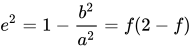
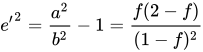
From and it is possible to derive the semi-minor axis , first eccentricity and second eccentricity of the ellipsoid


| Parameter | Value |
|---|---|
| Semi-minor axis | |
| First eccentricity squared | |
| Second eccentricity squared |

Parameters for some geodetic systems
[edit]The two main reference ellipsoids used worldwide are the GRS 80[5] and the WGS 84.[6]
A more comprehensive list of geodetic systems can be found here.
Geodetic Reference System 1980 (GRS 80)
[edit]| Parameter | Notation | Value |
|---|---|---|
| Semi-major axis | 6378137 m | |
| Reciprocal of flattening | 298.257222101 |
World Geodetic System 1984 (WGS 84)
[edit]The Global Positioning System (GPS) uses the World Geodetic System 1984 (WGS 84) to determine the location of a point near the surface of Earth.
| Parameter | Notation | Value |
|---|---|---|
| Semi-major axis | 6378137.0 m | |
| Reciprocal of flattening | 298.257223563 |
| Constant | Notation | Value |
|---|---|---|
| Semi-minor axis | 6356752.3142 m | |
| First eccentricity squared | 6.69437999014×10⁻³ | |
| Second eccentricity squared | 6.73949674228×10⁻³ |


Datum transformation
[edit]The difference in co-ordinates between datums is commonly referred to as datum shift. The datum shift between two particular datums can vary from one place to another within one country or region, and can be anything from zero to hundreds of meters (or several kilometers for some remote islands). The North Pole, South Pole and Equator will be in different positions on different datums, so True North will be slightly different. Different datums use different interpolations for the precise shape and size of Earth (reference ellipsoids). For example, in Sydney there is a 200 metres (700 feet) difference between GPS coordinates configured in GDA (based on global standard WGS 84) and AGD (used for most local maps), which is an unacceptably large error for some applications, such as surveying or site location for scuba diving.[7]
Datum conversion is the process of converting the coordinates of a point from one datum system to another. Because the survey networks upon which datums were traditionally based are irregular, and the error in early surveys is not evenly distributed, datum conversion cannot be performed using a simple parametric function. For example, converting from NAD 27 to NAD 83 is performed using NADCON (later improved as HARN), a raster grid covering North America, with the value of each cell being the average adjustment distance for that area in latitude and longitude. Datum conversion may frequently be accompanied by a change of map projection.
Discussion and examples
[edit]A geodetic reference datum is a known and constant surface which is used to describe the location of unknown points on Earth. Since reference datums can have different radii and different center points, a specific point on Earth can have substantially different coordinates depending on the datum used to make the measurement. There are hundreds of locally developed reference datums around the world, usually referenced to some convenient local reference point. Contemporary datums, based on increasingly accurate measurements of the shape of Earth, are intended to cover larger areas. The most common reference Datums in use in North America are NAD 27, NAD 83, and WGS 84.
The North American Datum of 1927 (NAD 27) is "the horizontal control datum for the United States that was defined by a location and azimuth on the Clarke spheroid of 1866, with origin at (the survey station) Meades Ranch (Kansas)." ... The geoidal height at Meades Ranch was assumed to be zero, as sufficient gravity data was not available, and this was needed to relate surface measurements to the datum. "Geodetic positions on the North American Datum of 1927 were derived from the (coordinates of and an azimuth at Meades Ranch) through a readjustment of the triangulation of the entire network in which Laplace azimuths were introduced, and the Bowie method was used."[8] NAD 27 is a local referencing system covering North America.
The North American Datum of 1983 (NAD 83) is "The horizontal control datum for the United States, Canada, Mexico, and Central America, based on a geocentric origin and the Geodetic Reference System 1980 ([[GRS 80]]). "This datum, designated as NAD 83…is based on the adjustment of 250,000 points including 600 satellite Doppler stations which constrain the system to a geocentric origin." NAD 83 may be considered a local referencing system.
WGS 84 is the World Geodetic System of 1984. It is the reference frame used by the U.S. Department of Defense (DoD) and is defined by the National Geospatial-Intelligence Agency (NGA) (formerly the Defense Mapping Agency, then the National Imagery and Mapping Agency). WGS 84 is used by the DoD for all its mapping, charting, surveying, and navigation needs, including its GPS "broadcast" and "precise" orbits. WGS 84 was defined in January 1987 using Doppler satellite surveying techniques. It was used as the reference frame for broadcast GPS Ephemerides (orbits) beginning January 23, 1987. At 0000 GMT January 2, 1994, WGS 84 was upgraded in accuracy using GPS measurements. The formal name then became WGS 84 (G730), since the upgrade date coincided with the start of GPS Week 730. It became the reference frame for broadcast orbits on June 28, 1994. At 0000 GMT September 30, 1996 (the start of GPS Week 873), WGS 84 was redefined again and was more closely aligned with International Earth Rotation Service (IERS) frame ITRF 94. It was then formally called WGS 84 (G873). WGS 84 (G873) was adopted as the reference frame for broadcast orbits on January 29, 1997.[9] Another update brought it to WGS 84 (G1674).
The WGS 84 datum, within two meters of the NAD 83 datum used in North America, is the only world referencing system in place today. WGS 84 is the default standard datum for coordinates stored in recreational and commercial GPS units.
Users of GPS are cautioned that they must always check the datum of the maps they are using. To correctly enter, display, and to store map related map coordinates, the datum of the map must be entered into the GPS map datum field.
Examples
[edit]Examples of map datums are:
- WGS 84, 72, 66 and 60 of the World Geodetic System
- NAD 83, the North American Datum which is very similar to WGS 84
- NAD 27, the older North American Datum, of which NAD 83 was basically a readjustment [1]
- OSGB36 of the Ordnance Survey of Great Britain
- ETRS89, the European Datum, related to ITRS
- ED50, the older European Datum
- GDA94, the Australian Datum[10]
- JGD2011, the Japanese Datum, adjusted for changes caused by 2011 Tōhoku earthquake and tsunami[11]
- Tokyo97, the older Japanese Datum[12]
- KGD2002, the Korean Datum[13]
- TWD67 and TWD97, different datum currently used in Taiwan.[14]
- BJS54 and XAS80, old geodetic datum used in China[15]
- GCJ-02 and BD-09, Chinese encrypted geodetic datum.
- PZ-90.11, the current geodetic reference used by GLONASS[16]
- Galileo Terrestrial Reference Frame (GTRF), the geodetic reference used by Galileo; currently defined as ITRF2005[17]
- CGCS2000, or CGS-2000, the geodetic reference used by BeiDou Navigation Satellite System; based on ITRF97[17][18][19]
- International Terrestrial Reference Frames (ITRF88, 89, 90, 91, 92, 93, 94, 96, 97, 2000, 2005, 2008, 2014), different realizations of the ITRS.[20][21]
- Hong Kong Principal Datum, a vertical datum used in Hong Kong.[22][23]
- SAD69 - South American Datum 1969
Plate movement
[edit]The Earth's tectonic plates move relative to one another in different directions at speeds on the order of 50 to 100 mm (2.0 to 3.9 in) per year.[24] Therefore, locations on different plates are in motion relative to one another. For example, the longitudinal difference between a point on the equator in Uganda, on the African Plate, and a point on the equator in Ecuador, on the South American Plate, increases by about 0.0014 arcseconds per year.[citation needed] These tectonic movements likewise affect latitude.
If a global reference frame (such as WGS 84) is used, the coordinates of a place on the surface generally will change from year to year. Most mapping, such as within a single country, does not span plates. To minimize coordinate changes for that case, a different reference frame can be used, one whose coordinates are fixed to that particular plate. Examples of these reference frames are "NAD 83" for North America and "ETRS89" for Europe.
See also
[edit]


- Axes conventions
- ECEF
- ECI (coordinates)
- Engineering datum
- Figure of the Earth
- Geoid
- Geographic coordinate conversion
- Grid reference
- International Terrestrial Reference System
- Kilometre zero
- Local tangent plane coordinates
- Ordnance Datum
- Milestone
- Planetary coordinate system
- Reference frame
- Timeline of Earth estimates
- World Geodetic System
Footnotes
[edit]- ^ The plural is not "data" in this case
- ^ About the right/left-handed order of the coordinates, i.e., or , see Spherical coordinate system#Conventions.


References
[edit]- ^ Jensen, John R.; Jensen, Ryan R. (2013). Introductory Geographic Information Systems. Pearson. p. 25.
- ^ "NOAA/NOS's VDatum: A tutorial on datums". NOAA/NOS's VDatum 4.7. 2014-03-14. Retrieved 2024-08-11.
- ^ "Geoid—Help". ArcGIS for Desktop. Archived from the original on 2017-02-02. Retrieved 2017-01-23.
- ^ "Datums—Help". ArcGIS for Desktop. Archived from the original on 2017-02-02. Retrieved 2017-01-23.
- ^ "Geocentric Datum of Australia Technical Manual" (PDF). Intergovernmental Committee on Surveying and Mapping. 2 December 2014. Archived from the original (PDF) on 2018-03-20. Retrieved 2017-02-20.
- ^ "NGA: DoD World Geodetic System 1984". Archived from the original on 2017-07-04. Retrieved 2007-03-01.
- ^ McFadyen. "GPS - An Explanation of How it Works". Michael McFadyen's Scuba Diving Web Site. Archived from the original on 2006-08-19.
- ^ "National Geodetic Survey - Frequently Asked Questions FAQ".
- ^ "Frequently Asked Questions". National Geodetic Survey. Archived from the original on 2011-10-19.
- ^ Craven, Alex. "GDA94 : Frequently Asked Questions". Geoproject Solutions. Archived from the original on 2016-08-15.
- ^ "日本測地系2011(JGD2011)とは? - 空間情報クラブ". club.informatix.co.jp. 2015-08-20. Archived from the original on 2016-08-20.
- ^ "座標変換ソフトウェア TKY2JGD|国土地理院". www.gsi.go.jp. Archived from the original on 2017-11-05.
- ^ Yang, H.; Lee, Y.; Choi, Y.; Kwon, J.; Lee, H.; Jeong, K. (2007). "The Korean Datum Change to a World Geodetic System". AGU Spring Meeting Abstracts. 2007: G33B–03. Bibcode:2007AGUSM.G33B..03Y.
- ^ 台灣地圖夢想家-SunRiver. "大地座標系統與二度分帶座標解讀 - 上河文化". www.sunriver.com.tw. Archived from the original on 2016-08-20.
- ^ Analysis of Conversion Method and Map Merging from BJS54 XA80 Surveying and Mapping Results to CGCS2000 Archived 2016-09-18 at the Wayback Machine
- ^ "The transition to using the terrestrial geocentric coordinate system "Parametry Zemli 1990" (PZ-90.11) in operating the GLObal NAvigation Satellite System (GLONASS) has been implemented". www.glonass-iac.ru. Archived from the original on 2015-09-07.
- ^ a b "Use of international references for GNSS operations and applications" (PDF). unoosa.org. Archived (PDF) from the original on 2017-12-22.
- ^ Handbook of Satellite Orbits: From Kepler to GPS, Table 14.2
- ^ BeiDou Navigation Satellite System Signal In Space Interface Control Document, Open Service Signal (Version 2.0) Archived 2016-07-08 at the Wayback Machine section 3.2
- ^ "Archived copy" (PDF). Archived (PDF) from the original on 2017-01-26. Retrieved 2016-08-19.
{{cite web}}: CS1 maint: archived copy as title (link) - ^ "General concepts". itrf.ensg.ign.fr. Archived from the original on 2008-12-04.
- ^ "Vertical Datum used in China – Hong Kong – onshore". Archived from the original on 2012-11-13.
- ^ "Explanatory Notes on Geodetic Datums in Hong Kong" (PDF). geodetic.gov.hk. Archived from the original (PDF) on 2016-11-09. Retrieved 2016-08-19.
- ^ Read HH, Watson Janet (1975). Introduction to Geology. New York: Halsted. pp. 13–15.
Further reading
[edit]- Soffel, Michael; Langhans, Ralf (2012-06-20). "Terrestrial Reference System". Space-Time Reference Systems. Berlin, Heidelberg: Springer Berlin Heidelberg. doi:10.1007/978-3-642-30226-8_8. ISBN 978-3-642-30225-1. ISSN 0941-7834.
- Babcock, Alice K.; Wilkins, George A. (1988) The Earth's Rotation and Reference Frames for Geodesy and Geodynamics Springer ISBN 9789027726582
- List of geodetic parameters for many systems from University of Colorado
- Gaposchkin, E. M. and Kołaczek, Barbara (1981) Reference Coordinate Systems for Earth Dynamics Taylor & Francis ISBN 9789027712608
- Kaplan, Understanding GPS: principles and applications, 1 ed. Norwood, MA 02062, USA: Artech House, Inc, 1996.
- GPS Notes
- P. Misra and P. Enge, Global Positioning System Signals, Measurements, and Performance. Lincoln, Massachusetts: Ganga-Jamuna Press, 2001.
- Peter H. Dana: Geodetic Datum Overview – Large amount of technical information and discussion.
- US National Geodetic Survey
External links
[edit]
- GeographicLib includes a utility CartConvert which converts between geodetic and geocentric (ECEF) or local Cartesian (ENU) coordinates. This provides accurate results for all inputs including points close to the center of Earth.
- A collection of geodetic functions that solve a variety of problems in geodesy in Matlab Archived 2020-08-07 at the Wayback Machine.
- NGS FAQ – What is a geodetic datum?
- About the surface of the Earth on kartoweb.itc.nl
Geodetic datum
View on GrokipediaDefinition and Fundamentals
Definition and Purpose
A geodetic datum is an abstract coordinate system that defines a reference framework for specifying positions on Earth's surface, typically based on a reference ellipsoid that approximates the planet's irregular shape, along with parameters for origin, orientation, and scale.[2] This framework establishes a consistent set of coordinates, such as latitude, longitude, and height, to represent locations accurately relative to the chosen reference.[3] The primary purpose of a geodetic datum is to enable precise geospatial measurements and representations, serving as a foundational starting point for activities like surveying, navigation, and geographic information systems (GIS).[1] By providing standardized reference points, it ensures that positions can be mapped and integrated reliably across applications, including GPS positioning and the creation of topographic maps, thereby supporting engineering, environmental monitoring, and global logistics.[5] Without such a datum, inconsistencies in coordinate assignments could lead to significant positional errors, potentially compromising safety and efficiency in real-world uses.[6] Geodetic datums are distinguished by their scope: global datums, which cover the entire Earth and align with international standards for worldwide consistency, versus local datums, which are adjusted to better fit regional variations in Earth's shape for higher accuracy in specific areas.[7] This distinction arises from the necessity of accounting for Earth's oblate spheroid form—flattened at the poles and bulging at the equator—which requires tailored references to minimize distortions in position calculations and avoid errors exceeding hundreds of meters in mismatched systems.[3] The reference ellipsoid in a datum models this spheroidal shape mathematically, while the geoid provides a complementary surface approximating mean sea level for height measurements.[2]Reference Surfaces
The reference ellipsoid serves as a smooth mathematical approximation of Earth's shape in geodetic datums, modeled as an oblate spheroid where the equatorial radius exceeds the polar radius due to rotational flattening. This model simplifies computations for positioning and mapping by providing a regular surface defined by two primary parameters: the semi-major axis (equatorial radius) and the semi-minor axis (polar radius). The surface of the ellipsoid is given by the equation where the coordinates are Cartesian, aligned with the Earth's rotation axis along the -direction.[8][9] In contrast, the geoid represents a physical reference surface defined as the equipotential surface of Earth's gravity field that best approximates global mean sea level in a least-squares sense. Unlike the idealized ellipsoid, the geoid undulates irregularly—typically by tens of meters—due to variations in mass distribution beneath the surface, such as denser oceanic crust or lighter continental interiors. This undulation causes the geoid to deviate from mean sea level locally, but it plays a crucial role in defining orthometric heights, which measure elevation relative to the geoid as a proxy for sea level.[10] The key distinction between the ellipsoid and geoid lies in their nature: the ellipsoid is a geometric construct for computational efficiency, while the geoid is a dynamic, gravity-based surface reflecting Earth's true gravitational potential. The separation between these surfaces, known as geoid undulation , quantifies this difference and relates ellipsoidal height (measured from the ellipsoid) to orthometric height (measured from the geoid) through the formula . This relationship enables the conversion of satellite-derived heights to practical elevations used in surveying and navigation.[11][12]Historical Development
Early Datums
The earliest concepts of geodetic datums emerged in ancient times with approximations of the Earth as a sphere. Around 240 BCE, the Greek scholar Eratosthenes calculated the Earth's circumference by measuring the angle of the sun's rays at Alexandria and Syene (modern Aswan) on the summer solstice, estimating it at approximately 252,000 stadia, or about 40,000 kilometers, which remarkably approximated the modern value of 40,075 kilometers.[13] This work laid foundational ideas for spherical Earth models used in early mapping and navigation, though it assumed a perfect sphere without accounting for the planet's oblate shape.[14] In the 18th and 19th centuries, advancements shifted toward ellipsoidal models based on precise arc measurements. During the 1790s, French astronomers Jean-Baptiste Delambre and Pierre Méchain conducted a geodetic survey along the Paris meridian from Dunkirk to Barcelona, measuring a 9-degree arc to determine the length of a meridian quadrant and define the meter for the metric system; their data also provided key observations for refining Earth's ellipsoidal figure.[15] This effort influenced subsequent ellipsoid developments, including Friedrich Wilhelm Bessel's 1841 ellipsoid, derived from arc measurements in East Prussia and other regions, which featured a semi-major axis of 6,377,397 meters and a flattening of 1/299.15, offering improved fit for European and Asian territories.[16] Similarly, in 1830, George Biddell Airy proposed an ellipsoid tailored to the British Isles, with a semi-major axis of 6,377,563.396 meters and flattening of 1/299.324, optimized for local gravity data from the region.[17] Early datums were inherently local, anchored to regional surveys and reference points, which introduced distortions when applied beyond their intended areas. These systems, reliant on ground-based triangulation and astronomical observations, often exhibited inconsistencies of several hundred meters over continental scales due to unmodeled crustal variations and incomplete network coverage.[18] The lack of a unified global framework meant datums like those based on Bessel or Airy ellipsoids provided high accuracy locally—typically within 1-2 meters—but suffered from offsets up to 300 meters relative to distant regions, complicating international mapping and navigation.[19] A significant milestone in early 20th-century consolidation was the establishment of the North American Datum of 1927 (NAD27), which adjusted over 26,000 triangulation stations across the continent using the Clarke 1866 ellipsoid, with its origin fixed at Meades Ranch in Kansas (latitude 39°13'26.686" N, longitude 98°32'30.506" W, and an assumed elevation of zero).[20] This datum aimed to minimize distortions in North American surveys but still reflected pre-satellite era limitations, with position errors accumulating to tens of meters in peripheral areas like Alaska and Hawaii.[21]Modern Advancements
The launch of Sputnik 1 in 1957 marked the onset of the satellite era in geodesy, enabling space-based measurements that revolutionized the field by overcoming the limitations of terrestrial methods such as triangulation, which were constrained by Earth's curvature.[22] This event facilitated the development of satellite Doppler positioning and other techniques, allowing for global observations with accuracies improving from meters to centimeters over subsequent decades.[22] Key 20th-century milestones included the establishment of the Geodetic Reference System 1967 (GRS67) at the International Association of Geodesy (IAG) General Assembly in Berkeley in 1963, specifically tailored for satellite geodesy with defined parameters for Earth's semi-major axis, dynamical form factor, gravitational constant, and angular velocity.[23] This system was refined into GRS80 in 1980, providing a foundational reference for subsequent global datums.[24] Similarly, the North American Datum of 1983 (NAD83) represented a major advancement through a simultaneous least-squares adjustment of over 266,000 stations, incorporating Doppler satellite observations from the Transit system alongside traditional data to achieve higher precision and alignment with emerging global standards.[25] International efforts, led by the IAG—formalized as a key scientific body under the International Union of Geodesy and Geophysics since 1919 and renamed in 1946—drove the adoption of unified global frameworks, culminating in the World Geodetic System 1984 (WGS84) developed by the U.S. Department of Defense and established as the reference for the Global Positioning System (GPS) in 1984.[23][26] WGS84 integrated satellite data to define an Earth-centered, Earth-fixed coordinate system, supporting navigation and positioning worldwide.[26] Techniques like Very Long Baseline Interferometry (VLBI), which measures radio signal delays from quasars to determine station positions with millimeter accuracy, and Satellite Laser Ranging (SLR), which tracks satellite orbits to refine Earth orientation parameters, became integral to these efforts starting in the 1970s and 1980s, enhancing the International Terrestrial Reference Frame (ITRF).[27][28] This period witnessed a fundamental shift from static local datums, tied to fixed regional networks, to dynamic global reference frames that account for temporal variations such as Earth orientation changes, tectonic motions, and post-glacial rebound, enabled by continuous satellite observations and IAG-coordinated services like the International Earth Rotation and Reference Systems Service.[29][23] These advancements, realized through ITRF realizations since 1988, provided a consistent, evolving basis for international geospatial applications.[23]Reference Ellipsoids
Defining Parameters
The defining parameters of a reference ellipsoid establish its size and shape, serving as the foundation for geodetic computations. The primary parameters are the semi-major axis , which represents the equatorial radius, and the flattening , defined as , where is the semi-minor axis or polar radius.[30] Alternatively, the inverse flattening is often used for precision in numerical representations, as it avoids small fractional values and reduces rounding errors in calculations.[31] These two parameters suffice to fully specify the ellipsoid, with typically on the order of 6,378 km and around 1/300 for Earth models.[32] From these primary parameters, several derived quantities are computed to facilitate geodetic analysis. The semi-minor axis is given by , while the squared first eccentricity is , quantifying the deviation from a sphere.[33] The linear eccentricity measures the distance from the center to a focus along the major axis.[32] Additionally, the radii of curvature are essential for local approximations: the meridional radius at latitude is , and the prime vertical radius is .[34] These derived parameters enable the evaluation of distances and directions on the ellipsoid surface. The flattening relation can also be expressed inversely as , highlighting the direct geometric link between axes.[35] Selection of these parameters for a reference ellipsoid involves fitting the model to observed data, such as minimizing residuals between the ellipsoidal gravity field and measured gravity anomalies or achieving a best regional fit to the geoid.[36] This process ensures the ellipsoid provides an optimal smooth approximation to Earth's irregular surface for global or local geodetic purposes.Specific Systems
The Geodetic Reference System 1980 (GRS80) defines a reference ellipsoid with a semi-major axis of 6,378,137 meters and an inverse flattening of 298.257222101. This system serves as the foundational ellipsoid for several European geodetic frameworks, including the European Terrestrial Reference System 1989 (ETRS89).[37] The World Geodetic System 1984 (WGS84) employs a closely related ellipsoid, featuring a semi-major axis of 6,378,137 meters and an inverse flattening of 298.257223563. It forms the basis for the Global Positioning System (GPS) and adopts an Earth-centered, Earth-fixed coordinate origin to ensure global consistency in satellite-based positioning.[26] An earlier historical ellipsoid, Clarke 1866, has a semi-major axis of 6,378,206.4 meters and an inverse flattening of 294.9786982; it was primarily developed to fit measurements in North America and influenced legacy datums like the North American Datum of 1927.| Ellipsoid | Semi-major axis (m) | Inverse flattening |
|---|---|---|
| Clarke 1866 | 6,378,206.4 | 294.9786982 |
| GRS80 | 6,378,137 | 298.257222101 |
| WGS84 | 6,378,137 | 298.257223563 |