Hubbry Logo
Théodore RousseauThéodore RousseauMain
Open search
Théodore Rousseau
Community hub
Théodore Rousseau
logo
8 pages, 0 posts
0 subscribers
Be the first to start a discussion here.
Contribute something
Théodore Rousseau
Théodore Rousseau
from Wikipedia

Étienne Pierre Théodore Rousseau (French pronunciation: [etjɛn pjɛʁ teɔdɔʁ ʁuso]; 15 April 1812 – 22 December 1867) was a French painter of the Barbizon school.

Key Information

Les chênes d'Apremont (Oak Grove, Apremont), 1850–1852

Life

[edit]

Youth

[edit]

He was born in Paris, France in a bourgeois family. At first he received a basic level of training, but soon displayed aptitude for painting. Although his father regretted the decision at first, he became reconciled to his son forsaking business, and throughout the artist's career (for he survived his son) was a sympathizer with him in all his conflicts with the Paris Salon authorities. Théodore Rousseau shared the difficulties of the romantic painters of 1830, in securing for their pictures a place in the annual Paris exhibition. The influence of classically trained artists was against them, and not until 1848 was Rousseau presented adequately to the public.[1]

The Fisherman, 1848–49
The Charcoal Burner's Hut, c. 1850, Dallas Museum of Art

He had exhibited six works in the Salons of 1831, 1833, 1834 and 1835, but in 1836 his great work Paysage du Jura [La descente des vaches] was rejected by the Salon jury. He sent a total of eight further works to the Salon between 1836 and 1841; and yet none of them were accepted. Thereafter, he ceased sending work to the Salon until 1849, when all three of his submissions were accepted. He was not without champions in the press, and with the title of "le grand refusé" he became known through the writings of his friend Théophile Thoré, the critic who afterwards resided in England and wrote using the name Burger.[1]

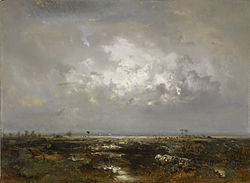
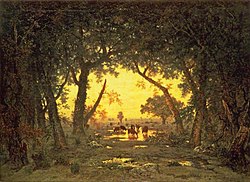
During these years of artistic exile Rousseau produced some of his best pictures: The Chestnut Avenue, The Marsh in the Landes (now in the Louvre), Hoar-Frost (now in America); and in 1851, after the reorganization of the Salon in 1848, he exhibited his masterpiece, The Edge of the Forest (also in the Louvre), a picture similar in treatment to, but slightly varied in subject from, the composition called A Glade in the Forest of Fontainebleau, in the Wallace Collection at Hertford House, London.[1]

Barbizon and maturity

[edit]

Until this period Rousseau had lived only occasionally at Barbizon, but in 1848 he took up his residence in the forest village, and spent most of his remaining days in the vicinity. He was now able to obtain fair sums for his pictures (but only about one-tenth of their value thirty years after his death), and the number of his admirers increased. He was still ignored by the authorities, even while his mentee Narcisse Virgilio Diaz was made Chevalier of the Legion of Honour in 1851.[2] Rousseau was left undecorated, but was nominated and awarded the Cross soon afterwards. He would eventually become an Officer of the Legion of Honor.[1]

At the Exposition Universelle of 1855, where all Rousseau's rejected pictures of the previous twenty years were gathered together, his works were acknowledged to form one of the best of the many splendid groups there exhibited. But, after an unsuccessful sale of his works by auction in 1861, he contemplated leaving Paris for Amsterdam or London, or even New York.[1]

Hoarfrost, 1845 – this painting by Rousseau shows the effects of frost on the sloping terrain.[3] The Walters Art Museum.

Later years

[edit]
Barbizon landscape, c. 1850

Rousseau then suffered a series of misfortunes. His wife's mental health had worsened; his aged father became dependent on him for pecuniary assistance; his patrons were few. Moreover, while he was temporarily absent with his ill wife, a youth living in his home (a friend of his family) committed suicide in his Barbizon cottage. When he visited the Alps in 1863, making sketches of Mont Blanc, he became dangerously ill with inflammation of the lungs; and when he returned to Barbizon he suffered from insomnia and became gradually weakened.[1]

He was elected president of the fine-art jury for the 1867 Exposition; however, his disappointment at being denied the better awards may have affected his health, for in August he became paralyzed. He recovered slightly, but was again attacked several times during the autumn. In November his condition worsened, and he died in the presence of his lifelong friend, Jean-François Millet, on 22 December 1867. Millet, the peasant painter, for whom Rousseau had the greatest regard, had been much with him during the last years of his life, and at his death Millet assumed charge of Rousseau's ill wife.[1]

Rousseau's other friend and neighbor, Jules Dupré, himself an eminent landscape painter of Barbizon, relates the difficulty Rousseau experienced in knowing when his picture was finished, and how he, Dupré, would sometimes take away from the studio some canvas on which Rousseau was laboring too long. Rousseau was a good friend to Diaz, teaching him how to paint trees, for until a certain point in his career Diaz considered he could only paint figures.

Work

[edit]

Rousseau's pictures are always grave in character, with an air of exquisite melancholy. They are well finished when they profess to be completed pictures, but Rousseau spent so much time developing his subjects that his absolutely completed works are comparatively few. He left many canvases with parts of the picture realized in detail and with the remainder somewhat vague; and also a good number of sketches and water-color drawings. His pen work in monochrome on paper is rare. There are a number of good pictures by him in the Louvre, and the Wallace collection contains one of his most important Barbizon pictures. There is also an example in the Ionides collection at the Victoria and Albert Museum in London.[1]

Paintings

[edit]

References

[edit]

Further reading

[edit]
[edit]
Revisions and contributorsEdit on WikipediaRead on Wikipedia
from Grokipedia
Pierre-Étienne-Théodore Rousseau (April 15, 1812 – December 22, 1867) was a French landscape painter renowned as a central figure in the , which emphasized direct observation of nature and realistic depictions of rural scenes, challenging the academic traditions of the time. [](https://www.theartstory.org/artist/rousseau-theodore/) [](https://www.getty.edu/art/exhibitions/rousseau/) Born in to a bourgeois family with roots in the Jura region, Rousseau displayed an early passion for art, inspired by a formative trip to the at age fourteen, where he sketched landscapes that shaped his lifelong dedication to painting. [](https://www.theartstory.org/artist/rousseau-theodore/) [](https://www.jillnewhouse.com/artists/theodore-rousseau) Rousseau began his formal training under neoclassical artists in but quickly rejected their idealized styles, favoring instead a more truthful and emotive representation of the natural world, often infusing his works with a contemplative, melancholic atmosphere. [](https://www.bates.edu/museum/exhibitions/theodore-rousseau-biography/) [](https://www.theartstory.org/artist/rousseau-theodore/) His innovative approach led to rejections from the Salon in the 1830s and 1840s due to unconventional compositions and large-scale formats, prompting him to exhibit independently and settle in the artist colony of Barbizon in 1848, where he became a mentor to younger painters like . [](https://www.jillnewhouse.com/artists/theodore-rousseau) [](https://www.getty.edu/art/exhibitions/rousseau/) Key works such as The Descent of the Cows from the High Plateaus of the Jura (1836), The Avenue of Chestnuts (c. 1837–1841), and The Great Oaks of Bas-Bréau (1864) exemplify his meticulous attention to light, texture, and the grandeur of forests like , which he passionately defended against deforestation by petitioning in the 1850s. [](https://www.theartstory.org/artist/rousseau-theodore/) [](https://www.bates.edu/museum/exhibitions/theodore-rousseau-biography/) As an early environmental advocate and influential theorist, Rousseau elevated from a subordinate genre to a profound expression of human connection to nature, paving the way for and movements. [](https://www.theartstory.org/artist/rousseau-theodore/) [](https://www.getty.edu/art/exhibitions/rousseau/) Despite personal struggles with recognition during his lifetime, he was elected to the in 1861 and posthumously celebrated, with major exhibitions at institutions like the in 1967 and the Getty Museum in 2016. [](https://www.jillnewhouse.com/artists/theodore-rousseau) [](https://www.bates.edu/museum/exhibitions/theodore-rousseau-biography/) His legacy endures in collections worldwide, including the and the , underscoring his role in bridging and Realism. [](https://www.nga.gov/artists/1846-theodore-rousseau) [](https://www.bates.edu/museum/exhibitions/theodore-rousseau-biography/)

Biography

Early Life

Étienne-Pierre Théodore Rousseau was born on April 15, 1812, in Paris, into a modest bourgeois family of provincial origins from the Jura region. His father worked as a tailor, managing a tailor's shop, while the family maintained connections to artistic circles through relatives, including his mother's cousin, the landscape painter Alexandre Pau de Saint-Martin, who encouraged Rousseau's early fascination with nature and drawing. From a young age, Rousseau demonstrated a strong interest in art, sketching landscapes and copying works by masters, which set the foundation for his lifelong dedication to depicting the natural world. At around age fourteen, Rousseau was sent to the Jura region, his family's native province, for office work, but spent his free time sketching the mountain landscapes, which profoundly influenced his artistic direction. Around 1826, he began formal artistic training by entering the studio of the Neoclassical historical landscape painter Joseph Rémond, where he honed his skills in rendering nature with academic precision. Dissatisfied with the rigid conventions of the studio, he soon transitioned to the atelier of Guillaume Lethière at the École des Beaux-Arts, though he increasingly rejected the academic emphasis on idealized compositions in favor of direct observation. This period marked his initial forays into independent works, such as early studies of urban scenes like the , reflecting his growing independence as an artist. His training was briefly interrupted by an unsuccessful bid for the in 1829, further solidifying his aversion to conventional paths. A pivotal moment came in 1830 when Rousseau undertook an extended trip to the region, where he conducted intensive plein-air studies of volcanic landscapes and rural scenery. This journey represented a decisive shift toward a more authentic representation of natural landscapes, prioritizing unmediated encounters with the environment over studio fabrication. Upon returning, he produced his first notable independent work, Paysage, site d’Auvergne, based on these sketches. Rousseau's early career gained initial visibility through submissions to the Paris Salon. In , his Paysage, site d’Auvergne was accepted, earning modest attention for its fresh approach to but no significant awards. He submitted again in with Vue prise des côtes à Granville and Étude d’après nature, which received minor notice from critics who noted their unconventional style, though they too failed to secure major recognition. These early exhibitions highlighted Rousseau's emerging voice in while underscoring the challenges of breaking from established norms.

Move to Barbizon and Artistic Maturity

Rousseau faced repeated rejections from the Paris Salon between 1836 and 1841, with his unconventional landscapes deemed too bold and naturalistic for the jury's tastes, leading him to withdraw submissions voluntarily from 1842 to 1848. These setbacks earned him the moniker "le grand refusé," coined by the critic Théophile Thoré in recognition of his talent despite official exclusion, which highlighted the growing tension between academic standards and emerging realist tendencies in . The rejections intensified his financial struggles, as limited Salon exposure hindered sales and patronage, forcing him to rely on private dealers and occasional auctions for income. To seek fresh inspiration amid these hardships, Rousseau undertook temporary travels to regions like the in 1830 and in the early 1840s, where the rugged terrains and coastal scenes informed his evolving approach to capturing nature's raw vitality through on-site sketches. These excursions, spanning 1842 to 1846 across various parts of France, allowed him to amass studies that deepened his commitment to plein-air painting, though they offered only partial relief from economic pressures. By 1847, he established a more permanent base in the village of Barbizon on the edge of the , renting a house and studio that became a hub for like-minded artists. There, he joined the nascent , collaborating closely with figures such as , who arrived in 1849, and Narcisse Diaz de la Peña, whose explorations of the forest alongside Rousseau reinforced their shared emphasis on unidealized rural landscapes. Rousseau's persistence culminated in a at the 1851 Salon, where he exhibited The Edge of the Forest (also known as Edge of the Forest at , Setting Sun), a state-commissioned work that showcased his matured vision of twilight filtering through dense foliage, earning widespread acclaim and signaling his reintegration into official art circles. This success paved the way for further recognition at the 1855 Exposition Universelle in , where he presented thirteen paintings, including variations on forest themes, receiving a first-class medal for his contributions to landscape art and appointment as Chevalier of the Legion of Honor, which solidified his status as a leading figure in French .

Later Years and Death

In the years following his recognition at the 1855 Exposition Universelle, Théodore Rousseau's health began to decline significantly, exacerbated by decades of painting in harsh weather conditions, which contributed to respiratory ailments and a leg injury sustained during a 1863 trip to the for his panoramic landscape studies. Despite his growing fame and sales of works fetching up to 100,000 francs through dealers in 1866, Rousseau grappled with financial instability, including mounting debts that prompted exhibitions and auctions between 1861 and 1863 to alleviate his burdens. Rousseau faced profound personal losses during this period, notably the death of his wife in 1855 after years of her mental illness, which left him to navigate the challenges of raising their children amid his own emotional and financial strains; his marriage had been marked by unhappiness, with her condition described as an incurable lunacy that he refused to treat medically. Among his final major projects, Rousseau completed the ambitious panoramic View of Mont Blanc, Seen from La Faucille (ca. 1863–1867), commissioned in 1862–1863 by the industrialist Alfred-Emile André for 24,000 francs and destined for the Musée Historique de France; this monumental oil on canvas, measuring over 4 meters wide, was exhibited at the 1867 Salon as one of his last works, showcasing his innovative layering techniques to capture the alpine vista's atmospheric depth despite his worsening pain. He also finished Forest Interior (ca. 1865–1867), another large-scale piece displayed at the same Salon, reflecting his enduring commitment to detailed naturalism. In his final years, Rousseau remained in Barbizon, where he continued to mentor younger artists of the , including guiding figures like in their shared pursuit of plein-air landscape techniques, while harboring lingering grievances from earlier Salon rejections that led him to view state honors with skepticism—though he accepted promotion to Officier of the Legion of Honor in 1867 shortly before his death. Rousseau's health deteriorated rapidly in 1867, afflicted by , a paralytic , fits of excitement, and , culminating in his on December 22, 1867, at 9 a.m. in Barbizon from softening of the brain; Millet and his wife nursed him through his last weeks, remaining at his bedside until the end. A was held, reflecting his late acclaim under Napoléon III, and he was buried on December 25, 1867, at 1 p.m. in the new cemetery at Chailly-en-Bière, where Millet later erected a simple monument of rocks, trees, and a wooden cross to honor his friend.

Artistic Style and Techniques

Landscape Painting Approach

Théodore Rousseau demonstrated a profound commitment to plein-air painting, venturing into natural settings such as the to observe and capture the directly from life, ensuring an authenticity that distinguished his work from more idealized traditions. This on-site engagement allowed him to infuse his canvases with the unmediated vitality of the environment, prioritizing empirical truth over studio invention. In his compositions, Rousseau employed earthy tones and meticulous detailing of foliage to achieve balanced structures that evoked the grandeur and inherent melancholy of , creating immersive scenes where elements like trees and undergrowth formed harmonious, interlocking planes. He focused on the diffusion of light through canopies and the subtle play of shadows to heighten atmospheric depth, while rendering textural specifics—such as the rough bark of ancient oaks or the dense layering of —to convey an emotional tied to nature's contemplative . Seasonal variations, from the starkness of winter to the lush density of summer growth, further enriched these depictions, underscoring the transient beauty and quiet power of the rural French countryside. Rousseau favored expansive, large-scale canvases to encompass vast panoramas of meadows and wooded expanses, deliberately minimizing or excluding figures to let the itself dominate and assert its sublime presence. His technical process involved initial on-site sketching to record immediate impressions, followed by studio elaboration where he applied layered glazes to build luminous depth and tonal gradation, refining broad washes and textured strokes over extended periods to achieve a sense of enduring natural .

Innovations and Influences

Théodore Rousseau drew significant inspiration from 17th-century landscape painters such as the Dutch artist and the French artist , whose works emphasized atmospheric realism through subtle effects of light, mist, and expansive skies in natural settings. These influences are evident in Rousseau's adoption of low horizons and detailed rendering of foliage and weather, blending 17th-century naturalism with contemporary French sensibilities. Additionally, shaped his approach through the emotive landscapes of English painter , whose plein-air techniques and fresh observations of nature encouraged Rousseau to infuse emotional depth into direct environmental studies. Early works by Camille Corot further impacted him, promoting a harmonious blend of subjective feeling and objective depiction that bridged Romantic idealism with emerging realism. Rousseau innovated by rejecting the idealized classical landscapes favored by the French Academy, which prioritized mythological or historical narratives over unadorned nature. Instead, he championed raw, unromanticized portrayals of the natural world, capturing its untamed and "unruly" aspects to pioneer modern environmental themes that highlighted nature's intrinsic power and variability. As a principal founder of the , Rousseau instilled an anti-academic ethos, advocating for on-site sketching and direct study of nature in the rather than studio-based invention or contrived compositions. This emphasis on empirical observation over academic conventions positioned the school as a precursor to later realist and impressionist movements. In terms of , Rousseau advanced subtle gradations of greens and browns to evoke the nuanced play of forest , creating tonal that conveyed depth and atmospheric mood without relying on dramatic contrasts. He layered thin washes of these earthy tones over preparatory grounds, allowing exposed areas to reflect and simulate the dappled illumination filtering through dense canopies, an approach that influenced subsequent ists in achieving realistic yet emotive natural scenes.

Major Works

Early and Mid-Career Paintings

Rousseau's early paintings from the 1830s, such as in the (1830), demonstrate his initial experiments with plein-air painting during a sketching expedition in the region at age 18. This oil on paper mounted on canvas, measuring 13 3/4 × 21 inches, captures a panoramic view of an unidentified hamlet nestled at the base of a steep cliff amid swelling hills, elevating the French countryside through a frank, vernacular style that established his reputation among Romantic circles in . Similarly, The Valley of Saint-Vincent (1830), an oil on paper mounted on canvas sized 18.2 × 32.4 cm, depicts a grassy outcrop overlooking the river Mars and distant peaks like Puy Mary in the region, painted directly outdoors during several months spent in . Key works from this period include The Descent of the Cows from the High Plateaus of the Jura (1836), an oil on canvas portraying cattle descending mountainous terrain inspired by his Jura travels, which was rejected by the 1836 Salon and contributed to his growing frustration with academic standards. The Avenue of Chestnuts (c. 1837–1841), oil on canvas now in the , features a shaded path lined with ancient trees in the region, emphasizing atmospheric depth and natural forms that foreshadowed his Barbizon style. In his mid-career, Rousseau developed dramatic lighting effects in works like Under the Birches, Evening (1842–1843), an oil on panel measuring 42.2 × 64.5 cm, now at the . The painting portrays a partially obscured parish on horseback traversing a country lane amid birch trees illuminated by the fiery glow of fading autumn light, exemplifying the Barbizon School's emphasis on natural tranquility. Hoarfrost (1845), an oil on canvas housed at the Walters Art Museum, further highlights his sensitivity to seasonal subtlety, depicting frost-covered terrain near l'Îsle-Adam where he shared quarters with Jules Dupré during the winter of 1844–1845; unusually, it was completed entirely on a larger scale than typical sketches. Rousseau's breakthrough came with large-scale forest scenes like The Forest of Fontainebleau: Morning (1849–1851), an oil on canvas measuring 97.5 × 134 cm in the Wallace Collection, which secured his Salon acceptance after years of exclusion. This expansive view of the Fontainebleau woods reflects his opposition to tree harvesting and pursuit of realism, endowing the landscape with poetic expressiveness. Les Chênes d'Apremont (1850–1852), an oil on canvas of 64 × 101 cm at the Musée du Louvre, portrays monumental oaks in the Forest of Fontainebleau symbolizing nature's enduring strength, signed "Th. Rousseau" and exhibited at the 1855 Exposition Universelle. These works were created amid persistent Salon rejections, including a pivotal 1836 exclusion of Paysage du Jura that prompted Rousseau's relocation to Barbizon in the forest, where he spent summers painting outdoors with peers like despite further refusals, such as in 1841. This period of isolation and determination in Barbizon underscored his commitment to unidealized landscapes, fostering the Barbizon School's revolutionary approach.

Late Works and Notable Commissions

In 1848, Théodore Rousseau received his first major state commission for the Musée du Luxembourg, resulting in Edge of the Forest at Fontainebleau: Setting Sun (1848–1849), an oil on canvas (142 × 198 cm) depicting the forest edge at dusk, acquired by the museum in 1850–1851 and now in the Louvre. This marked a turning point in his official recognition after earlier rejections, though he continued to exhibit independently. A related pastoral work, Cattle at the Trough (1850–1860), oil on wood panel (41.7 × 63.7 cm) at the Musée des Beaux-Arts de Reims, shows cows drinking at a pond with subtle human figures, emphasizing harmony between nature and rural life. In the 1860s, Rousseau undertook ambitious panoramic compositions, including the monumental View of Mont Blanc, Seen from La Faucille (ca. 1863–1867), a wide oil on canvas (91.4 × 118.4 cm) capturing the distant alpine peak under dramatic storm clouds from the , worked on over four years and exhibited posthumously at the 1867 Salon. This piece, now in the , reflects his late fascination with vast, atmospheric vistas inspired by earlier Jura travels, though not a formal series, it connects to related studies he developed for potential public display. Another significant late effort was a commission-related panoramic exploration for historical contexts, though details remain tied to his broader output for institutions like the Musée Historique, underscoring his role in elevating landscape for national collections. Among his final masterpieces, The Great Oaks of Bas-Bréau (1864), an oil on canvas now at the , portrays towering ancient oaks in the forest bathed in golden light, highlighting path-like compositions that draw the viewer into the scene's depth and grandeur. In his declining health during the last years, Rousseau revisited earlier studies for The Forest in Winter at Sunset (ca. 1846–1867), an oil on canvas (162.6 × 260 cm) in the , perfecting subtle atmospheric effects of frost and fading light on snow-covered trees, though left somewhat unfinished at his death in 1867. Many of these late works reside in major collections, including the , the (A Meadow Bordered by Trees, ca. 1845–1860), and the Walters Art Museum (The Banks of the Bouzanne River, 1860–1869), for its serene riverside composition.

Critical Reception and Legacy

Contemporary Recognition

During the 1830s and 1840s, Théodore Rousseau faced significant rejection from the Paris Salon jury, with his landscapes dismissed for their raw, realistic depiction of nature that deviated from classical ideals and academic polish. His submission Descent of the Herd was notably refused in 1836, prompting widespread sympathy among peers and critics who viewed the exclusions as unjust suppression of innovative realism. Despite these setbacks, progressive critics offered praise; Théophile Thoré hailed Rousseau as "our leading landscape painter" in his 1844 Salon review, emphasizing the sincerity and vitality of his approach. Similarly, Théophile Gautier commended his works in a 1860 review of the Martinet exhibition, highlighting their authentic emotional depth. The 1850s marked a turning point in Rousseau's reception, beginning with his return to the Salon in 1849, where he earned a first-class medal for Avenue of Chestnut Trees in the Forest of l'Isle-Adam. In 1851, he exhibited seven paintings—his largest showing to date—drawing positive commentary in contemporary journals for their mature handling of and atmosphere. This momentum culminated at the 1855 Exposition Universelle, where Rousseau displayed thirteen works in a dedicated space and received a first-class medal, signaling broad institutional acknowledgment of his contributions to landscape . Rousseau's institutional standing strengthened further in the late 1850s and 1860s; he was appointed to the organizational committee for the 1848 Salon and later served as president of the painting jury at the 1867 Exposition Universelle. The French state began acquiring his paintings for public collections in the 1850s, including commissions and purchases that entered the , affirming his status as a national artist. As a central figure in the Barbizon group, Rousseau led collaborations with peers like and Narcisse Diaz de la Peña, fostering a shared commitment to painting in the . Market response improved post-1855, with prices rising to levels comparable to those of —such as 9,000 francs for Farm in the Landes—yet persistent financial difficulties arose from his meticulous production methods and delayed deliveries.

Influence and Modern Appreciation

Rousseau's commitment to plein-air painting and meticulous studies of light and atmosphere in natural landscapes laid essential groundwork for , inspiring artists such as and to prioritize direct observation of nature and explore forest motifs with unprecedented immediacy. His innovative approach to rendering the subtleties of foliage and seasonal changes in works like those depicting the provided direct models for the Impressionists' emphasis on transient effects and outdoor execution. Rousseau's influence extended into modern landscape art, where his integration of environmental themes—portraying nature as both majestic and intimately observed—resonated with later artists, including , who praised the Barbizon school's sincere depiction of rural scenes and drew from Rousseau's emotive forest compositions in his own expressive landscapes. This legacy contributed to broader modernist explorations of nature's psychological and symbolic dimensions, bridging 19th-century Realism with 20th-century environmental consciousness. Following a period of relative neglect in the early as artistic tastes shifted toward , Rousseau's oeuvre saw renewed recognition in the post-World War II era through revivals of Realist traditions, with his paintings integrated into prestigious institutions like the , which holds key works such as Landscape with Boatman (c. 1860), affirming his enduring place in canonical collections. Contemporary scholarship has further illuminated Rousseau's complexities, as seen in Simon Kelly's 2023 book Théodore Rousseau and the Rise of the Modern Art Market, which details his strategic navigation of the 19th-century —through dealer networks, alternative exhibitions, and reproductive media—while emphasizing his synthesis of Romantic mysticism, evident in his reverent forest treks, with Realist technical innovations like proto-pointillist brushwork. This analysis underscores his role as an figure whose market savvy prefigured modern artistic professionalism. Recent exhibitions, such as the 2024 Théodore Rousseau: La Voix de la forêt at the in , have spotlighted his forest themes and nature motifs—drawing from his own words about "listening to the voices of the trees"—to highlight his proto-ecological vision and foster renewed appreciation amid contemporary environmental concerns.

References

Add your contribution
Related Hubs
Contribute something
User Avatar
No comments yet.