


Community hub
0 subscribers8 pages, 0 posts
Recent from talks
All channels
Be the first to start a discussion here.
Be the first to start a discussion here.
Be the first to start a discussion here.
Be the first to start a discussion here.
Contribute something
Welcome to the community hub built to collect knowledge and have discussions related to 1831.
Nothing was collected or created yet.
from Wikipedia
 | This article needs additional citations for verification. (January 2017) |
| Years |
|---|
| Millennium |
| 2nd millennium |
| Centuries |
| Decades |
| Years |


| 1831 by topic |
|---|
| Humanities |
| By country |
| Other topics |
| Lists of leaders |
| Birth and death categories |
| Establishments and disestablishments categories |
| Works category |
| Gregorian calendar | 1831 MDCCCXXXI |
| Ab urbe condita | 2584 |
| Armenian calendar | 1280 ԹՎ ՌՄՁ |
| Assyrian calendar | 6581 |
| Balinese saka calendar | 1752–1753 |
| Bengali calendar | 1237–1238 |
| Berber calendar | 2781 |
| British Regnal year | 1 Will. 4 – 2 Will. 4 |
| Buddhist calendar | 2375 |
| Burmese calendar | 1193 |
| Byzantine calendar | 7339–7340 |
| Chinese calendar | 庚寅年 (Metal Tiger) 4528 or 4321 — to — 辛卯年 (Metal Rabbit) 4529 or 4322 |
| Coptic calendar | 1547–1548 |
| Discordian calendar | 2997 |
| Ethiopian calendar | 1823–1824 |
| Hebrew calendar | 5591–5592 |
| Hindu calendars | |
| - Vikram Samvat | 1887–1888 |
| - Shaka Samvat | 1752–1753 |
| - Kali Yuga | 4931–4932 |
| Holocene calendar | 11831 |
| Igbo calendar | 831–832 |
| Iranian calendar | 1209–1210 |
| Islamic calendar | 1246–1247 |
| Japanese calendar | Tenpō 2 (天保2年) |
| Javanese calendar | 1758–1759 |
| Julian calendar | Gregorian minus 12 days |
| Korean calendar | 4164 |
| Minguo calendar | 81 before ROC 民前81年 |
| Nanakshahi calendar | 363 |
| Thai solar calendar | 2373–2374 |
| Tibetan calendar | ལྕགས་ཕོ་སྟག་ལོ་ (male Iron-Tiger) 1957 or 1576 or 804 — to — ལྕགས་མོ་ཡོས་ལོ་ (female Iron-Hare) 1958 or 1577 or 805 |

Wikimedia Commons has media related to 1831.
1831 (MDCCCXXXI) was a common year starting on Saturday of the Gregorian calendar and a common year starting on Thursday of the Julian calendar, the 1831st year of the Common Era (CE) and Anno Domini (AD) designations, the 831st year of the 2nd millennium, the 31st year of the 19th century, and the 2nd year of the 1830s decade. As of the start of 1831, the Gregorian calendar was 12 days ahead of the Julian calendar, which remained in localized use until 1923.
Events
[edit]January–March
[edit]- January 1 – William Lloyd Garrison begins publishing The Liberator, an anti-slavery newspaper, in Boston, Massachusetts.
- January 10 – Japanese department store, Takashimaya in Kyoto established.[1]
- February–March – Revolts in Modena, Parma and the Papal States are put down by Austrian troops.
- February 2 – Pope Gregory XVI succeeds Pope Pius VIII, as the 254th pope.[2]
- February 5 – Dutch naval lieutenant Jan van Speyk blows up his own gunboat in Antwerp rather than strike his colours on the demand of supporters of the Belgian Revolution.
- February 7 – The Belgian Constitution of 1831 is approved by the National Congress.
- February 8 – French-born botanical explorer Aimé Bonpland leaves Paraguay for Argentina.
- February 14 – Battle of Debre Abbay: Ras Marye of Yejju marches into Tigray, and defeats and kills the warlord Sabagadis.
- February 25 – Battle of Olszynka Grochowska (Grochów): Polish rebel forces divide a Russian army.
- March 10 – The French Foreign Legion is founded.
- March 16 – Victor Hugo's historical romantic Gothic novel Notre-Dame de Paris, known in English as The Hunchback of Notre-Dame, is published in Paris.
- March 29 – The Bosnian uprising (1831–32) against the Ottoman Empire begins.
April–June
[edit]- April 7 – Pedro I abdicates as Emperor of Brazil in favor of his 5-year-old son Pedro II, who will reign for almost 59 years.
- April 18
- The University of Alabama is founded.
- The Sydney Morning Herald newspaper is first published, as the Sydney Herald.
- April 27
- Charles Albert becomes king of Sardinia after the death of King Charles Felix.
- Ending of the First Anglo-Ashanti War (1823–1831).
- May 26 – Battle of Ostrołęka: The Poles fight another indecisive battle.
- May 31 – Auxiliary paddle steamer Sophia Jane arrives at Sydney from London, becoming the first steamboat to operate in the coastal waters of New South Wales.
- May–June – Merthyr Rising: Coal miners and others riot in Merthyr Tydfil, Wales, for improved working conditions.
- June 1 – British Royal Navy officer James Clark Ross locates the position of the North Magnetic Pole, at this time on the Boothia Peninsula.
- June 21 – The North Carolina State House and Canova's George Washington are destroyed by fire in Raleigh, North Carolina.[3]
July–September
[edit]- July 13 – Russian imperial officials in Wallachia adopt Regulamentul Organic, introducing a period of unprecedented reforms that provide for Westernization of this region of Romania.
- July 15 – The volcanic Graham Island briefly emerges in the Mediterranean.
- July 21 – Leopold of Saxe-Coburg-Gotha is inaugurated as the first King of the Belgians, in Brussels.
- August 2 – The Dutch Ten Days' Campaign against Belgium is halted by a French army.
- August 7 – American Baptist minister William Miller preaches his first sermon on the Second Advent of Christ in Dresden, New York, launching the Advent Movement in the United States.
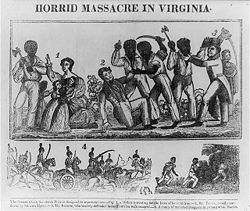
- August 21 – Nat Turners slave rebellion in the United States breaks out in Southampton County, Virginia.
- August 29 – Michael Faraday demonstrates electromagnetic induction at the Royal Society of London.[4] Joseph Henry recognises it at about the same time.
- September 8– Battle of Warsaw: The Army of Russia takes the Polish capital after a two-day battle to crush the Polish uprising.
- September 8 – Coronation of King William IV of the United Kingdom (he will reign until 1837).
- September 22 – The House of Commons of the United Kingdom passes the Great Reform Bill to expand the franchise, but this is later defeated in the House of Lords.
- September 28– The first national presidential nominating convention in the United States concludes after three days as the Anti-Masonic Party selects its nominee for President in Baltimore, Maryland.
October–December
[edit]- October 9 – Ioannis Kapodistrias, Greek head of state and founder of Greek independence, is assassinated in Nafplion.
- October 21 – The November Uprising ends in the defeat of Polish forces.
- October 28 – Michael Faraday constructs an early form of dynamo.[5]
- October 29 – The 1831 Bristol riots ("Queen Square riots") in Bristol (England) begin, in connection with the Great Reform Bill controversy. Quelled by the authorities and the military on October 31, 100 city centre properties are destroyed, at least 120 are estimated to have been killed, 31 of the rioters will be sentenced to death and a colonel facing court-martial for failure to control the riot commits suicide.
- October 30 – In Southampton County, Virginia, escaped slave Nat Turner is captured and arrested for leading the bloodiest slave rebellion in United States history.
- November 7 – Slave trading is forbidden in Brazil.
- November 8 – The Kings School (Parramatta) was approved to be established.
- November 17 – Ecuador and Venezuela are separated from Gran Colombia.
- November 22 – First Canut Revolt: After a bloody battle with the military causing 600 deaths, rebellious silk workers seize Lyon, France.
- December 26 – Global financial services business Assicurazioni Generali is founded in Trieste (at this time in the Austrian Empire) as Imperial Regia Privilegiata Compagnia di Assicurazioni Generali Austro-Italiche.[6]
- December 27
- The Baptist War (Christmas Rebellion) begins in Jamaica, with the setting afire of the Kensington House in St James Parish, inspiring thousands of black slaves to revolt against their British masters. At its peak, more than 20,000 people will be involved, and more than 500 killed.[7]
- Charles Darwin embarks from Plymouth on the second voyage of HMS Beagle which will be the foundation for his life of scientific study.
- December 31 – Gramercy Park is deeded to New York City.
Date unknown
[edit]- Egyptian–Ottoman War (1831–1833): Muhammad Ali of Egypt's French-trained forces occupy Ottoman Syria.
- Scholar Rifa'a at-Tahtawi returns from study in Paris to Egypt, where he will participate in the Nahda.
- Founding of educational establishments:
- Denison University in Granville, Ohio
- New York University in New York City
- Wesleyan University in Middletown, Connecticut
- Xavier University in Cincinnati (as "The Athenaeum")
- Wallinska skolan, the first secondary school for girls in the Swedish capital of Stockholm.
Births
[edit]January–June
[edit]

- January 3 – Savitribai Jyotirao Phule, Indian social reformer, poet (d. 1897)
- January 7 – Heinrich von Stephan, German postal union organizer (d. 1897)
- January 11 – Pope Cyril V of Alexandria (d. 1927)
- January 26 – Heinrich Anton de Bary, German botanist, mycologist (d. 1888)
- February 12 – Myra Bradwell, American lawyer, political activist (d. 1894)
- February 24 – Leo von Caprivi, Chancellor of Germany (d. 1899)
- March 3
- Gioacchino La Lomia, Italian Roman Catholic priest and venerable (d. 1905)
- George Pullman, American inventor and industrialist (d. 1897)
- March 6 – Philip Sheridan, American general (d. 1888)
- March 12 – Clement Studebaker, American automobile pioneer (d. 1901)
- March 15 – Mariano Álvarez, Filipino general (d. 1924)
- March 16 – Elise Hwasser, Swedish actress (d. 1894)
- April 3 – Adelaide of Löwenstein-Wertheim-Rosenberg, Queen consort of Portugal (d. 1909)[8]
- April 6 – Nire Kagenori, Japanese admiral (d. 1900)
- April 19 – Mary Louise Booth, American writer, editor and translator (d. 1889)
- May 7 – Richard Norman Shaw, British architect (d. 1912)
- June 1 – John Bell Hood, American Confederate general (d. 1879)
- June 2 – Jan Gerard Palm, Curaçao-born composer (d. 1906)
- June 7 – Amelia Edwards, English journalist and author (d. 1892)[9]
- June 13 – James Clerk Maxwell, Scottish physicist (d. 1879)
- June 28 – Joseph Joachim, Austrian violinist (d. 1907)
July–December
[edit]


- July 8 – John Pemberton, American inventor of Coca-Cola (d. 1888)
- July 9 – Wilhelm His Sr., Swiss anatomist (d. 1904)
- July 17 – Xianfeng Emperor of China (d. 1861)
- July 22 – Emperor Kōmei of Japan (d. 1867)
- August 12 – Helena Blavatsky, Russian-born author, theosophist (d. 1891)
- August 16 – Ebenezer Cobb Morley, English sportsman and the father of modern football (d. 1924)
- August 20 – Eduard Suess, Austrian geologist (d. 1914)
- August 28 – Lucy Webb Hayes, First Lady of the United States (d. 1889)
- September 3 – States Rights Gist, Confederate Brigadier General in the American Civil War (d. 1864)
- September 8 – Wilhelm Raabe, German novelist (d. 1910)
- September 18 – Siegfried Marcus, German-born automobile pioneer (d. 1898)
- September 20 – Kate Harrington, American teacher, writer and poet (d. 1917)
- September 29 – John Schofield, American general (d. 1906)
- October 6 – Richard Dedekind, German mathematician (d. 1916)
- October 14 – Samuel W. Johnson, English railway mechanical engineer (d. 1912)
- October 16 – Lucy Stanton, American abolitionist (d. 1910)
- October 18 – Frederick III, German Emperor (d. 1888)
- October 29 – Othniel Charles Marsh, American paleontologist (d. 1899)
- October 31
- Paolo Mantegazza, Italian neurologist, physiologist, anthropologist and fiction writer (d. 1910)
- Romualdo Pacheco, Governor of California (d. 1899)
- November 1 – Harry Atkinson, 10th Premier of New Zealand (d. 1892)
- November 5 – Anna Leonowens, Anglo-Indian educator (Anna of The King and I) (d. 1915)
- November 7 – Mélanie Calvat, French Roman Catholic nun, Marian Visionary, canonized (d. 1904)
- November 19 – James A. Garfield, 20th President of the United States (d. 1881)
- December 1 – Princess Maria Amélia of Brazil, daughter of Emperor Pedro I of Brazil (d. 1853)
- December 14 – Arsenio Martínez Campos, Spanish general, revolutionary and prime minister (d. 1900)
- December 19 – Bernice Pauahi Bishop, Hawaiian aliʻi (d. 1884)
Date unknown
[edit]- Richard Hawksworth Barnes, English coffee grower, naturalist and meteorologist (d. 1904)
- Jacob W. Davis, (b. Jacob Youphes), Latvian-born American tailor, inventor of jeans (d. 1908)
- Sotirios Sotiropoulos, Greek economist, politician (d. 1898)
- Eugenia Kisimova, Bulgarian feminist, philanthropist, women's rights activist (d. 1885)
Deaths
[edit]January–June
[edit]
- January 8 – Franz Krommer, Czech composer (b. 1759)
- January 21 – Ludwig Achim von Arnim, German poet (b. 1781)
- February 2 – Vincenzo Dimech, Maltese sculptor (b. 1768)
- February 14
- Vicente Guerrero, 2nd President of Mexico, Independence War hero (b. 1782)
- Marye of Yejju, Ethiopian Ras
- Sabagadis, Ethiopian warlord (b. c. 1770)
- February 17 – Friedrich Wilhelm, Duke of Schleswig-Holstein-Sonderburg-Glücksburg (b. 1785)
- March 9 – Friedrich Maximilian Klinger, German writer (b. 1752)
- April 5 – Dmitry Senyavin, Russian admiral (b. 1763)
- April 20 – John Abernethy, English surgeon (b. 1764)
- April 21 – Thursday October Christian I, Pitcairn Islander and son of Fletcher Christian (b. 1790)
- April 27 – Charles Felix of Sardinia, King of Sardinia (b. 1765)
- April 30 – Collet Barker, British military officer, explorer (b. 1784)
- May 17 – Nathaniel Rochester, American politician (b. 1752)
- June 5 – Tarenorerer, indigenous Australian Tasman freedom fighter (b. 1800)

- June 6 – Robert Fullerton, governor of Penang, first governor of British Straits Settlements (b. 1773)
- June 8 – Sarah Siddons, English actress (b. 1755)
- June 27 – Sophie Germain, French mathematician (b. 1776)
- June 30 – William Roscoe, English abolitionist and writer (b. 1753)
July–December
[edit]

- July 4 – James Monroe, 73, 5th President of the United States (b. 1758)
- July 16 – Louis Alexandre Andrault de Langeron, Russian general (b. 1763)
- July 20 – Jacques Defermon des Chapelières, French politician (b. 1752)
- August 5 – Sébastien Érard, German-born French instrument maker (b. 1752)
- August 24 – August von Gneisenau, Prussian field marshal (b. 1760)
- September 28 – Philippine Engelhard, German writer, scholar (b. 1756)
- November 6 – Hilchen Sommerschild, Norwegian educator (b. 1756)
- November 11 – Nat Turner, American slave rebel (b. 1800)
- November 14 – Georg Hegel, German philosopher (b. 1770)
- November 16 – Carl von Clausewitz, German military strategist (b. 1780)
- November 19 – Titumir, Bengali revolutionary (b. 1782)[10]
- November 21 – Marie Anne Simonis, Belgian textile industrialist (b. 1758)
- December 15 – Hannah Adams, American author (b. 1755)
- December 18 – Willem Bilderdijk, Dutch author (b. 1756)
- December 23 – Emilia Plater, Polish heroine (b. 1806)
- December 26
- Henry Louis Vivian Derozio, Indian poet (b. 1809)
- Stephen Girard, French-American banker (b. 1750)
Date unknown
[edit]- Marengo, Napoleon's mount in several battles (b. 1793)
- Charlotta Richardy, Swedish industrialist (b. 1751)
References
[edit]- ^ "Takashimaya Archives 1831-1908" (in Japanese). Takashimaya. Archived from the original on April 7, 2016. Retrieved 2021-01-11.
- ^ "Pope Gregory XVI - The 254th Pope - PopeHistory.com". popehistory.com. 2017-01-27. Retrieved 2025-07-17.
- ^ Miskimon, Scott A. (2010). "The Fires of 1831: Fayetteville and Raleigh in Flames". State Library of North Carolina.
- ^ "Icons, a portrait of England 1820–1840". Archived from the original on 2007-09-22. Retrieved 2007-09-12.
- ^ Penguin Pocket On This Day. Penguin Reference Library. 2006. ISBN 0-14-102715-0.
- ^ "1831". Generali Group.
- ^ Drainville, Andre C. (2013). A History of World Order and Resistance: The Making and Unmaking of Global Subjects. Routledge.
- ^ Denmark (1902). Kongelig dansk hof- og statskalender (in Danish). J.H. Schultz Universitetsbogtrykkeri. p. 13.
- ^ Benjamin F. Fisher IV (1985). "Amelia B. Edwards". In Bleiler, E. F. (ed.). Supernatural Fiction Writers. New York: Scribner's. p. 255. ISBN 0-684-17808-7.
- ^ Khan, Muazzam Hussain (2012). "Titu Mir". In Sirajul Islam; Miah, Sajahan; Khanam, Mahfuza; Ahmed, Sabbir (eds.). Banglapedia: the National Encyclopedia of Bangladesh (Online ed.). Dhaka, Bangladesh: Banglapedia Trust, Asiatic Society of Bangladesh. ISBN 984-32-0576-6. OCLC 52727562. OL 30677644M. Retrieved 9 February 2026.
| National | |
|---|---|
| Other | |

from Grokipedia
1831 was a year of profound political convulsions and foundational scientific progress, witnessing the formal establishment of independent Belgium following its revolution against Dutch rule, the violent slave uprising led by Nat Turner in Virginia that killed approximately 55 to 65 white people and intensified Southern fears of abolitionism, the crushing of Poland's November Uprising by Russian forces which ended hopes for autonomy under Tsar Nicholas I, and Michael Faraday's experimental demonstration of electromagnetic induction that enabled the generation of electric currents from changing magnetic fields. These events underscored causal tensions in imperial governance, where suppressed nationalities like the Belgians and Poles leveraged revolutionary fervor—sparked by economic grievances and cultural divides—to challenge established powers, though outcomes varied: Belgium secured recognition via European diplomacy including the 1830 London Conference, while Poland's defeat stemmed from military asymmetry against Russia's larger army. In America, Turner's religiously motivated revolt, involving around 60 enslaved African Americans, prompted immediate reprisals killing over 100 blacks and stricter slave codes, reflecting empirical realities of demographic imbalances that limited slave rebellions' success despite their disruptive potential. Faraday's induction work, achieved through systematic trials with coils and magnets, provided first-principles evidence for field interactions, bypassing prior failures by contemporaries like Ørsted and Ampère due to his focus on transient rather than static fields. Amid these, cultural milestones included the premiere of Hector Berlioz's Symphonie fantastique and the death of philosopher Georg Wilhelm Friedrich Hegel on November 14, encapsulating an era where enlightenment rationalism intersected with Romantic individualism and realist power struggles.[1][2][3][4][5][6][7][8]
In the wake of the Belgian Revolution of 1830, which sought independence from the United Kingdom of the Netherlands, the National Congress approved a liberal constitution on February 7 establishing Belgium as a parliamentary monarchy with popular sovereignty, separation of powers, and guarantees of individual liberties such as freedom of religion and the press.[29] This document, drafted amid revolutionary fervor, limited monarchical authority and empowered a bicameral legislature, reflecting Enlightenment influences while accommodating Catholic majorities in the southern provinces.[30] The constitution's adoption solidified the provisional government's legitimacy following armed conflict and diplomatic negotiations with European powers.[31] In March, approximately 1,600 members of the United Tailoresses Society in New York City conducted a strike demanding wage parity with male counterparts and better working conditions, representing one of the earliest organized labor actions by women in the United States amid the rise of factory-based textile production.[32] This action highlighted emerging class tensions in urban manufacturing, where female pieceworkers faced exploitative pay scales tied to outwork systems.[33] Victor Hugo's novel Notre-Dame de Paris (known in English as The Hunchback of Notre-Dame) appeared in March, critiquing architectural decay and social neglect in medieval Paris while romanticizing Gothic heritage as a counter to post-revolutionary rationalism.[34] The work, completed earlier that year, sold 4,000 copies on its first day and influenced preservation efforts for the Notre-Dame Cathedral, underscoring Romanticism's emphasis on historical continuity over utilitarian progress.[35]
(Image unrelated; no direct match, but placeholder for exploratory theme) Wait, no, image 5 is Maxwell, not Ross. Omit image. On June 1, during Sir John Ross's second Arctic expedition, James Clark Ross reached the North Magnetic Pole on the Boothia Peninsula in present-day Nunavut, Canada, where dip circle measurements indicated a magnetic inclination of nearly 90 degrees, confirming the site's status through empirical observation and advancing understanding of Earth's geomagnetic field.[37][38] In late June, Cyrus McCormick conducted an early demonstration of his mechanical reaper prototype in Rockbridge County, Virginia, featuring a vibrating sickle blade and horse-drawn mechanism to cut grain more efficiently than manual methods, laying groundwork for agricultural mechanization despite initial limitations in reliability.[39][40]
Historical Context
Geopolitical Tensions
The July Revolution in France of 1830, which overthrew Charles X and installed the Orléans monarchy under Louis Philippe, propagated liberal-nationalist ideas that destabilized the United Kingdom of the Netherlands. Belgian provinces, chafing under King William I's Dutch-centric governance—including favoritism toward Amsterdam commerce, suppression of French-language rights, and Protestant dominance over Catholic majorities—erupted in revolt by August 1830, culminating in a provisional government's independence declaration on October 4. William I's refusal to accept partition, backed by military incursions into Brabant, left the conflict unresolved by year's end, with Dutch forces occupying key southern territories and prompting the Great Powers' London Conference in November 1830 to negotiate boundaries and neutrality; entering 1831, persistent Dutch resistance threatened escalation absent enforced mediation.[9][10] In Eastern Europe, Tsar Nicholas I's policies intensified strains in the Congress Kingdom of Poland, nominally autonomous since the 1815 Congress of Vienna's grant of a constitution, Sejm legislature, and separate army. Ascending amid the 1825 Decembrist revolt, Nicholas imposed stricter oversight, viewing Polish constitutionalism as a subversive model; measures included expanded secret police surveillance, partial Russification of administration, and preparations to deploy Polish troops for imperial suppression duties, eroding the 1815 framework's liberal elements. Crowned King of Poland on May 24, 1829, without fully pledging to uphold the constitution, Nicholas's autocratic consolidation alienated Polish nobles and cadets, fostering underground patriotic societies and military discontent that simmered into 1831.[11][12] The Ottoman Empire's vulnerabilities, exposed by the Greek War of Independence (1821–1830) and the October 20, 1827, Battle of Navarino—where British, French, and Russian fleets obliterated the Ottoman-Egyptian armada—invited challenges from semi-autonomous Muhammad Ali Pasha of Egypt. Having dispatched his modernized forces and fleet to aid Sultan Mahmud II against Greek rebels, Ali claimed Syria (encompassing modern Syria, Lebanon, and Palestine) as recompense for Navarino's destruction of 60+ Egyptian ships and 4,000+ casualties, but Mahmud denied the demand to preserve central authority. By late 1830, Ali's buildup of Egyptian troops under Ibrahim Pasha signaled imminent invasion, exploiting Ottoman military disarray from Greek losses (over 100,000 troops dead or deserted) and internal Janissary purges, thus endangering imperial cohesion in the Near East entering 1831.[13][14] Britain, anchoring the post-1815 Vienna settlement, navigated these disruptions under Foreign Secretary Lord Palmerston (appointed July 1830), prioritizing balance-of-power diplomacy to curb French or Russian overreach while accommodating limited constitutional reforms. Active in the London Conference, Britain advocated Belgian independence as a neutral buffer against continental hegemony, deploying naval forces to enforce Dutch withdrawal from Antwerp by December 1830; domestically, parliamentary reform agitation and Irish Catholic tensions strained resources, yet geopolitically, London sustained colonial stability in India and Canada amid export slumps and Boer migrations at the Cape.[15][16]Social and Economic Conditions
In Britain, the ongoing Industrial Revolution by late 1830 had driven rapid urbanization, concentrating workers in factory centers amid inadequate housing and sanitation, fostering conditions of endemic poverty and disease. Approximately 8-10% of the population depended on poor relief, strained further by the displacement of traditional artisans, including a sharp decline in hand-loom weavers from around 250,000 in the 1820s due to mechanized competition. These disparities highlighted incentives for capital-intensive production over labor-intensive crafts, amplifying urban-rural divides and resource competition in an era of limited welfare mechanisms.[17][18][19] Across continental Europe, population growth—spurred by earlier introductions of New World crops—intensified Malthusian pressures, with expanding numbers outpacing agricultural output and contributing to rising food prices and rural indebtedness by 1830. Feudal dues persisted in many regions, compelling peasant migration to overcrowded urban areas, where competition from cheap imported goods undercut local artisans and heightened class antagonisms rooted in scarcity of arable land and employment. Early manifestations of labor discontent, such as strikes among textile workers including tailoresses in emerging industrial pockets, reflected these tensions over wage suppression and job insecurity, driven by human incentives to resist exploitative terms amid surplus labor supplies.[20][21][22] In contrast, the Americas maintained agrarian dependencies, particularly in the U.S. South, where slavery underpinned cotton cultivation as the dominant economic engine, producing roughly 750,000 bales by 1830 and comprising over half of national exports. This coerced-labor model capitalized on the crop's labor-intensive harvesting, yielding efficiencies that free-labor alternatives struggled to match in tropical climates, though Northern and British critics increasingly questioned its long-term sustainability against industrial free-labor paradigms. Post-1815 trade resumption after the Congress of Vienna exacerbated global imbalances, with Europe's textile industries reliant on American cotton imports, perpetuating dependencies on plantation commodities sustained by unfree labor amid uneven industrialization.[23][24][25]Events
January–March
On January 1, William Lloyd Garrison published the inaugural issue of The Liberator in Boston, Massachusetts, declaring his commitment to immediate and uncompensated emancipation of all slaves as a moral imperative without gradualism or colonization schemes.[26][27] The newspaper's masthead proclaimed "Our Country is the World—Our Countrymen are Man," signaling a universalist antislavery stance that eschewed compromise with slaveholders.[28]In the wake of the Belgian Revolution of 1830, which sought independence from the United Kingdom of the Netherlands, the National Congress approved a liberal constitution on February 7 establishing Belgium as a parliamentary monarchy with popular sovereignty, separation of powers, and guarantees of individual liberties such as freedom of religion and the press.[29] This document, drafted amid revolutionary fervor, limited monarchical authority and empowered a bicameral legislature, reflecting Enlightenment influences while accommodating Catholic majorities in the southern provinces.[30] The constitution's adoption solidified the provisional government's legitimacy following armed conflict and diplomatic negotiations with European powers.[31] In March, approximately 1,600 members of the United Tailoresses Society in New York City conducted a strike demanding wage parity with male counterparts and better working conditions, representing one of the earliest organized labor actions by women in the United States amid the rise of factory-based textile production.[32] This action highlighted emerging class tensions in urban manufacturing, where female pieceworkers faced exploitative pay scales tied to outwork systems.[33] Victor Hugo's novel Notre-Dame de Paris (known in English as The Hunchback of Notre-Dame) appeared in March, critiquing architectural decay and social neglect in medieval Paris while romanticizing Gothic heritage as a counter to post-revolutionary rationalism.[34] The work, completed earlier that year, sold 4,000 copies on its first day and influenced preservation efforts for the Notre-Dame Cathedral, underscoring Romanticism's emphasis on historical continuity over utilitarian progress.[35]
April–June
On April 7, Dom Pedro I, Emperor of Brazil, abdicated the throne in favor of his five-year-old son, Dom Pedro II, to lead liberal forces in the ongoing Portuguese civil war against his absolutist brother Miguel, marking a pivotal shift in Brazilian imperial governance and underscoring European monarchs' interventions in colonial successor states. In the United States, Francis Preston Blair's editorship of the Washington Globe solidified its role as the official organ of President Andrew Jackson's administration, advancing partisan journalism that rigorously defended Jacksonian policies against opposition critiques throughout the spring and early summer.[36](Image unrelated; no direct match, but placeholder for exploratory theme) Wait, no, image 5 is Maxwell, not Ross. Omit image. On June 1, during Sir John Ross's second Arctic expedition, James Clark Ross reached the North Magnetic Pole on the Boothia Peninsula in present-day Nunavut, Canada, where dip circle measurements indicated a magnetic inclination of nearly 90 degrees, confirming the site's status through empirical observation and advancing understanding of Earth's geomagnetic field.[37][38] In late June, Cyrus McCormick conducted an early demonstration of his mechanical reaper prototype in Rockbridge County, Virginia, featuring a vibrating sickle blade and horse-drawn mechanism to cut grain more efficiently than manual methods, laying groundwork for agricultural mechanization despite initial limitations in reliability.[39][40]