


Community hub
Recent from talks
Contribute something
Nothing was collected or created yet.
Eulachon
View on Wikipedia
| Eulachon | |
|---|---|

| |
Scientific classification 
| |
| Kingdom: | Animalia |
| Phylum: | Chordata |
| Class: | Actinopterygii |
| Order: | Osmeriformes |
| Family: | Osmeridae |
| Genus: | Thaleichthys Girard, 1858 |
| Species: | T. pacificus
|
| Binomial name | |
| Thaleichthys pacificus (J. Richardson, 1836)
| |
| Synonyms[3] | |
| |


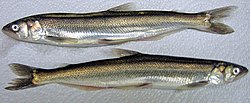
The eulachon (/ˈjuːləkɒn, -lɪkən/;[4] Thaleichthys pacificus), or the candlefish, is a small anadromous species of smelt that spawns in some of the major river systems along the Pacific coast of North America from northern California to Alaska.
Etymology
[edit]_here_first_ever_documentation_of_this_species_by_artist_and_explorer_William_Clark_-_Clark_Family_Collection-_Volume_2._Voorhis_Journal_No._2,_page_60,_February_25,_1806_(cropped).jpg)
The name "candlefish" derives from it being so fatty during spawning, with up to 15% of the total body weight in fat, that if caught, dried, and strung on a wick, it can be burned as a candle.[7][8][better source needed] This is the name most often used by early explorers. The name eulachon (occasionally seen as oolichan /ˈuːlɪkɑːn/, ooligan /ˈuːlɪɡən/, hooligan /ˈhuːlɪɡən/, oulachon, and uthlecan) is from the Chinookan language and the Chinook Jargon based on that language.[citation needed] One of several theories for the origin of the name of the state of Oregon is that it was a corruption from the term "Oolichan Trail", the native trade route for oolichan oil. In some parts it is also known as "halimotkw", which can be translated as "savior fish" or "salvation fish", due to its availability for fishing often coming at the end of winter, when food supplies typically run low.[9]
The unrelated sablefish Anoplopoma fimbria is also called "candlefish" in the United Kingdom.
Species description
[edit]Eulachon are distinguished by the large canine-like teeth on the vomer bone and 19 to 31 rays in the anal fin. Like salmon and trout they have an adipose fin (aft of the dorsal); it is sickle-shaped. The paired fins are longer in male fish than in females. All fins have well-developed breeding tubercles (raised tissue "bumps") in ripe males, but these are poorly developed or absent in females. Adult coloration is brown or blue on the back extending to the top of the head, lighter to silvery white or light blue on the sides, and white on the ventral surface; speckling is extra fine, sparse, and restricted to the back.[10] Adults can reach maximum lengths of 30 cm (12 in) but most adults are between 15 and 20 cm (6 and 8 in).[11] Adults have striae on their operculum that aid in distinguishing Thaleichthys pacificus from other smelt.[12] They feed on plankton but only while at sea.[10]
Ecology
[edit]Eulachon feed primarily on plankton as well as fish eggs, insect larvae, ocean debris and small crustaceans. It forms an important part of the diet of many ocean and shore predators, and serves as a prominent food source for people living near its spawning streams.
Eulachon, as anadromous fish, spend most of their adult lives in the ocean but return to their natal freshwater streams and rivers to spawn and die.[13] As such, one stream may see regular large runs of eulachon while a neighboring stream sees few or none at all. Regular annual runs are common but not entirely predictable, and occasionally a river which has large runs sees a year with no returns; the reasons for such variability are not known. The eulachon run is characteristic for the early portion being almost entirely male, with females following about midway through the run to its conclusion.[citation needed] Males are easily distinguished from females during spawning by fleshy ridges which form along the length of their bodies.[clarification needed]
Economics and trade
[edit] | This section includes a list of references, related reading, or external links, but its sources remain unclear because it lacks inline citations. (May 2023) |

Indigenous communities of the Pacific Coast from California to Alaska made eulachon an important part of their diet, as well as a valuable trade item with peoples whose territories did not include spawning rivers. The species was caught using traps, rakes, and nets. The harvest continues today, with other residents taking part in the exploitation of the large runs. Today harvested eulachon are typically stored frozen and thawed as needed. They may also be fried, dried, smoked, or canned. Eulachon were also processed for their rich oil. The usual process was to allow the fish to decompose (rot) for a week or more in a hole in the ground, then add boiling hot water and skim off the oil, which would rise to the surface, being less dense than water. Eulachon oil (also known as "Eulachon grease") was traded with inland communities; as a result, the trails over which the trade was conducted came to be known as grease trails. Other uses of eulachon by non-Natives include bait for sportfishing and food for cats and dogs.
Conservation status
[edit]In November 2008, the National Marine Fisheries Service (NMFS) received a petition from the Cowlitz Tribe to list a distinct population segment (DPS) of eulachon from Washington, Oregon, and California, (the so-called Southern DPS) as an endangered or threatened species under the Endangered Species Act.[14] (ESA). NMFS found that this petition presented enough information to warrant conducting a status review of the species. Based on the status review NMFS proposed listing this species as threatened on March 13, 2009.[15] On March 16, 2010, NOAA announced that the Southern DPS of eulachon will be listed as threatened under the ESA, effective on May 17, 2010 (See: the Federal Register notice published on May 18, 2010, at 74 FR 3178).[16] On September 6, 2017, the NMFS approved a recovery plan intended to serve as a blueprint for the protection and recovery of the southern Distinct Population Segment (DPS) of eulachon (Thaleichthys pacificus) using the best available science per the requirements of the Endangered Species Act.[17][18]
In Canada, the Central Pacific Coast and Fraser River populations were classified as endangered by the Committee on the Status of Endangered Wildlife in Canada (COSEWIC) in 2011.[12] At that time, the Nass / Skeena Rivers population was given threatened status, but this was downgraded to Special Concern status when the Nass / Skeena Rivers population was individually reassessed by COSEWIC in 2013.[19] As of May 2023, a decision is pending on the listing of these populations under Schedule 1 of the Species at Risk Act.[20]
Overall, the species faces multiple threats, including overharvest, pollution, loss of freshwater spawning habitat due to logging, diversion and dam construction and climate change.[1][2] Canadian spawning runs have been severely depleted compared to historic levels,[19] while abrupt declines were reported in the Columbia, Fraser and Klinaklini rivers in 1994.[1]
References
[edit]- ^ a b c NatureServe (2013). "Thaleichthys pacificus". IUCN Red List of Threatened Species. 2013 e.T202415A18236183. doi:10.2305/IUCN.UK.2013-1.RLTS.T202415A18236183.en. Retrieved 7 May 2023.
- ^ a b NatureServe (5 May 2023). "Thaleichthys pacificus". NatureServe Network Biodiversity Location Data accessed through NatureServe Explorer. Arlington, Virginia: NatureServe. Retrieved 7 May 2023.
- ^ "Thaleichthys pacificus (Richardson, 1836)". Global Biodiversity Information Facility. Retrieved 7 May 2023.
- ^ "eulachon". Merriam-Webster.com Dictionary. Merriam-Webster. Retrieved 2025-06-19.
- ^ Ehrlich, George (1990). "The Illustrations in the Lewis and Clark Journals: One Artist or Two?". Proceedings of the American Philosophical Society. 134 (2): 95–110. ISSN 0003-049X. JSTOR 986841.
- ^ Kris (2021-04-09). "Eulachon". Discover Lewis & Clark. Retrieved 2024-12-01.
- ^ "'Salvation Fish' That Sustained Native People Now Needs Saving". National Geographic Society. 7 July 2015.
- ^ "Watch a Fish Transform from Animal to Candle | National Geographic". YouTube. 15 July 2015.
- ^ "'Salvation Fish' That Sustained Native People Now Needs Saving". National Geographic Society. 7 July 2015.
- ^ a b "Pacific Eulachon/Smelt (Thaleichthys pacificus)". NOAA Fisheries Office of Protected Resources. National Marine Fisheries Service. 6 August 2013. Archived from the original on 3 February 2014.
- ^ McGinnis, Samuel M. (2006). Field guide to freshwater fishes of California (Revised ed.). Berkeley: University of California Press. pp. 202–203. ISBN 0-520-23727-7.
- ^ a b COSEWIC (2011). "COSEWIC assessment and status report on the Eulachon, Nass / Skeena Rivers population, Central Pacific Coast population and the Fraser River population Thaleichthys pacificus in Canada" (PDF). Ottawa: Committee on the Status of Endangered Wildlife in Canada. Retrieved 7 May 2023.
- ^ "Eulachon of the Pacific Northwest A Life History" (PDF). Living Landscapes Program, Royal BC Museum. January 11, 2006.
- ^ "Endangered Species Act". 28 April 2023.
- ^ "Proposed listing status for Pacific eulachon" (PDF). Archived from the original (PDF) on 2009-05-11.
- ^ "NOAA's Eulachon listing status history".
- ^ United States. National Marine Fisheries Service. West Coast Region (2017). Endangered Species Act Recovery Plan for the Southern Distinct Population Segment of Eulachon (Thaleichthys pacificus). Portland, OR: U.S. Department of Commerce, National Oceanic and Atmospheric Administration, National Marine Fisheries Service. Archived (PDF) from the original on 2023-12-03.
- ^ "Eulachon, Thaleichthys pacificus".
- ^ a b COSEWIC (2013). "COSEWIC assessment and status report on the Eulachon, Nass/Skeena Rivers population, Thaleichthys pacificus in Canada" (PDF). Ottawa: Committee on the Status of Endangered Wildlife in Canada. Retrieved 7 May 2023.
- ^ "Species search". Species at risk public registry. Government of Canada. 2 February 2021. Retrieved 7 May 2023.
External links
[edit]- FishBase entry for Thaleichthys pacificus
- Preserving the Tradition of T'lina Making - Virtual Museum Exhibit of Kwakwaka'wakw eulachon oil production
- Central Coast First Nation preserves eulachon grease tradition as the fish returns to Bella Coola River, Audrey McKinnon, CBC News, June 27, 2018, last opened Febr. 13, 2022
- Sinumwack: Bella Coola Oolichan Run (UBCIC, 1978)
- Watch a Fish Transform From Animal to Candle, National Geographic on YouTube, last opened Febr. 13, 2022
Eulachon
View on GrokipediaThe eulachon (Thaleichthys pacificus), commonly known as the candlefish or hooligan, is a small anadromous smelt belonging to the family Osmeridae, inhabiting coastal marine waters of the northeastern Pacific Ocean from northern California to Alaska.[1][2] This species typically reaches a length of up to 10 inches (25 cm), spending over 95% of its life in saltwater environments at depths ranging from nearshore to 300 meters or more, before returning to freshwater rivers for semelparous spawning in spring, where adults die after a single reproductive event.[3][4][5] Renowned for its high oil content, which historically enabled indigenous peoples of the Pacific Northwest to render eulachon grease for food preservation, medicine, and trade, as well as to burn dried fish as candles—earning its "candlefish" moniker—the species has served as a cultural keystone, often termed the "salvation fish" for sustaining communities through seasonal abundance after winter scarcity.[6][7][8] Ecologically, eulachon function as a key forage fish, supporting predators including seabirds, marine mammals, and larger fish, while their spawning runs in rivers like the Columbia, Fraser, and Nass provide critical nutrient pulses to riparian ecosystems via post-spawning carcasses.[6][9] Although eulachon populations exhibit natural fluctuations, with historical records documenting cyclic booms and busts, the southern distinct population segment—from the Klamath River south to California—has experienced persistent declines since the 1990s, leading to its listing as threatened under the U.S. Endangered Species Act in 2010, attributed to factors such as habitat alteration, bycatch, and possibly climate-driven changes in ocean conditions, though northern runs in Alaska and parts of British Columbia remain more robust.[10][11][12] Conservation efforts focus on monitoring spawning returns, reducing fishery impacts, and restoring river habitats, reflecting the species' resilience alongside ongoing vulnerabilities in specific regions.[13][14]
Taxonomy and Nomenclature
Scientific Classification
The eulachon (Thaleichthys pacificus Richardson, 1836) belongs to the family Osmeridae, comprising the true smelts, and represents the sole species within its monotypic genus Thaleichthys, a name derived from Greek roots denoting "rich" or "oily" fish in reference to its high fat content.[15][16] This classification places it among the osmeriforms, a group of small, primarily anadromous fishes characterized by certain osteological and morphological traits, as outlined in phylogenetic analyses of the Osmeroidei superfamily.[5]| Taxonomic Rank | Classification |
|---|---|
| Kingdom | Animalia |
| Phylum | Chordata |
| Class | Actinopterygii |
| Order | Osmeriformes |
| Family | Osmeridae |
| Genus | Thaleichthys |
| Species | T. pacificus |
Etymology and Common Names
The name eulachon derives from Chinook Jargon, a trade language of the Pacific Northwest Indigenous peoples, ultimately tracing to Chinookan languages spoken by groups such as the Clatsop, a Lower Chinook division along the Columbia River.[18][19] Variations include oolichan, ooligan, hooligan, and ulâ'qan, reflecting phonetic adaptations in Indigenous dialects and European transliterations during early contact.[20] Indigenous communities historically referred to the fish as a "salvation fish" due to its nutritional importance during spring runs, providing high-fat sustenance after winter.[1] The binomial scientific name Thaleichthys pacificus originates from Greek roots: thaleia or thaleichthys denoting "rich" or "luxurious fish," alluding to the species' high oil content and abundance, combined with ichthys for "fish" and pacificus indicating its Pacific Ocean distribution.[1] Among English common names, "candlefish" stems from the fish's extreme fat content during spawning—up to 15% of body weight—which historically allowed dried specimens, threaded with a wick, to be burned as candles by Indigenous peoples and early settlers.[21] Other regional names include "hooligan" in Alaska and "smelt" more broadly, though the latter applies to the Osmeridae family generally; "fathom fish" appears less commonly in historical accounts.[1][6]Description
Morphology and Anatomy
The eulachon (Thaleichthys pacificus) has an elongated body with a laterally compressed cross-section and body depth comprising 15-20% of total length.[22] [23] Adults typically reach 20 cm in total length, with a maximum of 34 cm.[23] Coloration exhibits countershading, with the back and head brown to blue, sides silvery white, and ventral surface white; fine, sparse speckling occurs on the back.[23] In saltwater, the body appears blue-silver, shifting to gray-brown and green in freshwater during spawning.[13] The flesh contains high levels of oil, contributing to its historical use as a candle when dried.[24] The head features a large mouth, with the maxilla extending to or past the rear margin of the eye, and prominent canine-like teeth on the vomer, which are absent by spawning time.[22] [23] [13] Gill covers bear obvious circular grooves, a distinguishing trait among smelts.[13] The species has 65-72 vertebrae.[23] Fin structure includes no dorsal or anal spines; the dorsal fin has 10-13 soft rays and originates well posterior to the pelvic fin insertion; the anal fin bears 18-23 soft rays; a sickle-shaped adipose fin is present aft of the dorsal.[23] [13] Fins are transparent, with pectoral and caudal often dusky; they lack markings.[23] Paired pectoral and pelvic fins are longer in males than females.[23] [13] Sexual dimorphism is pronounced during spawning: males develop a raised midlateral ridge, well-developed tubercles on the head, body scales along the lateral line, and fins, imparting a rough texture; females are smaller, smoother, shinier, with poorly developed or absent tubercles.[23] [13]