Hubbry Logo
search
logo

The Three Bells

logo
Community Hub0 Subscribers
Read side by side
from Wikipedia
"The Three Bells"
Single by The Browns
from the album Sweet Sounds by The Browns
B-side"Heaven Fell Last Night"
ReleasedJuly 3, 1959
RecordedJune 3, 1959
StudioRCA Studio B
Genre
Length2:47
LabelRCA Victor
SongwritersJean Villard & Bert Reisfeld
ProducerChet Atkins
The Browns singles chronology
"Would You Care"
(1958)
"The Three Bells"
(1959)
"Scarlet Ribbons (For Her Hair)"
(1959)

"The Three Bells", also known as "The Jimmy Brown Song", "Little Jimmy Brown", or simply "Jimmy Brown", is a song made popular by the Browns in 1959.[2] The song is an English adaptation of the French-language song "Les Trois Cloches" written by Jean Villard, with English lyrics by Bert Reisfeld. The single reached number one in the U.S. on Billboard's Hot Country and Western Sides chart[3] and the Billboard Hot 100 chart in 1959.[4][5]

Origin

[edit]

The song is an English adaptation of the French-language song "Les Trois Cloches" written by Jean Villard (also known as Gilles). This French song narrates the life of someone named Jean-François Nicot who lived in a small village at the bottom of a valley, starting with his birth, then his marriage, and ending with his death, events all accompanied by ringing of the bells.[6][7] The song was recorded a cappella by Edith Piaf with French vocal group Les Compagnons de la chanson using an arrangement by group member Marc Herrand in July 1946.[7][8]

Piaf and Les Compagnons introduced the song to an American audience in a tour in 1947. Two different English versions of "Les trois cloches" were written in 1948 – "While the Angelus Was Ringing" (with unrelated lyrics and recorded by Frank Sinatra among others),[9] and "The Three Bells". The English lyrics of "The Three Bells" were written by Bert Reisfeld, based broadly on the French original, and the named individual in the song was changed from Jean-François Nicot to Jimmy Brown. The Melody Maids recorded the English version in 1948.[10] In 1950, Piaf herself recorded the English version.[11] In 1951, The Andrews Sisters also recorded the song. Their version was the longest song the Andrews Sisters recorded for the label Decca Records, and although it was well-received by Billboard, the release failed to chart.[8] Les Compagnons de la chanson themselves also recorded an English version of "The Three Bells". This version reached number 14 in the United States in 1952,[12] and number 21 in the UK in 1959.[13]

The Browns' recording

[edit]

The most successful version of the song was recorded by the country group the Browns in 1959. The Browns at that time were considering quitting the music business, and for what they intended to be their last recording, they chose "The Three Bells".[14] Bonnie Brown had first heard the song being played on a local radio station—a deejay had heard "Les Trois Cloches" by Les Compagnons in Europe, and brought the record back to the US and played the song on his shows, which brought attention to the English version—and contacted the deejay to get a copy of the song.[15][16] As radio stations at that time rarely played songs longer than three minutes, the Browns shortened each of the three verses to keep their recording under three minutes.[8]

The Browns recorded the song at the RCA Studio B in Nashville on June 3, 1959. The song was produced by Chet Atkins with Anita Kerr helping with the arrangement of the song. Atkins was convinced the song would be "the biggest hit ever", and told the Browns: "I've just recorded you a million-seller. There's no way you'll be quitting the business".[16]

While editing the master to be sent to New York for pressing, the studio's sound engineer, Bill Porter, accidentally hit the wrong controls on the tape recorder and stretched the tape at the beginning of the song, distorting the pitch. Without telling anyone, he spliced a different take with a good introduction onto the beginning, and sent that version, instead. Four decades later, Porter recalled his quick fix: " This was a need-to-know situation, and I figured nobody needed to know. I had been in the business three months or something like that. You're not a good engineer until you destroy a master and hopefully live to talk about it."[citation needed]

Commercial performance

[edit]

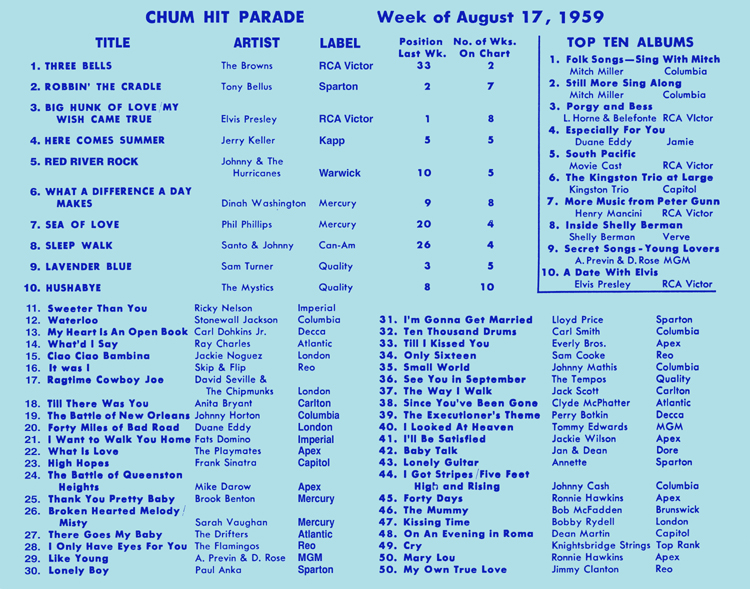
The song was released on July 3, 1959. It reached number one on Billboard Hot 100, staying there for four weeks. It also topped the Hot Country and Western Sides chart for 10 weeks, as well as reaching number 10 on Billboard's Hot Rhythm and Blues Sides chart.[17][18]

The song sold half a million copies within the first month of its debut on the chart,[14] eventually selling over a million copies.[19] The song received a Grammy nomination in 1959 for Best Record of the Year, but lost to "Mack the Knife".[20]

Other versions

[edit]

The song has also been covered by many other artists. Brian Poole & The Tremeloes's version reached number 17 on the UK chart in 1965.[21] Nana Mouskouri recorded a version in 1974 which reached number seven on the Dutch charts.[22] The Irish singer Daniel O'Donnell recorded a version which reached number 19 on the Irish chart in 1991.[23]

Chart position

[edit]

Les Compagnons de la chanson

[edit]
Chart (1952–1959) Peak
position
Netherlands (Single Top 100)[24] 4
UK Singles (OCC)[13] 21
US Billboard Best Selling Pop Singles[12] 14
US Cash Box Best Selling Singles[25] 16

The Browns

[edit]

Jim Ed Brown

[edit]
Chart (1969) Peak
position
U.S. Billboard Hot Country Singles[38] 29
Canadian RPM Country[39] 22

Daniel O'Donnell

[edit]
Chart (1991–1993) Peak
position
Ireland (IRMA)[23] 19
UK Singles Chart[40] 71

See also

[edit]

References

[edit]
[edit]
Revisions and contributorsEdit on WikipediaRead on Wikipedia
from Grokipedia
"The Three Bells" is a narrative ballad that chronicles the life stages of a villager named Jimmy Brown—his birth, marriage, and death—marked by the ringing of church bells in a secluded valley village, originally composed in French as "Les Trois Cloches" in 1939 by Jean Villard, and adapted into English lyrics by Bert Reisfeld in 1948.[1][2] The song gained international prominence through the 1959 recording by the American country and folk vocal trio The Browns—siblings Jim Ed, Maxine, and Bonnie Brown—whose harmonious rendition topped the Billboard Hot 100 for four weeks, the Hot Country Singles chart for ten weeks, and reached number ten on the Hot R&B Sides chart, marking their breakthrough hit and earning a Grammy nomination for Best Country & Western Performance.[3][1] Originally a 1946 French hit performed by Les Compagnons de la Chanson with guest vocalist Édith Piaf, "Les Trois Cloches" evoked post-World War II themes of community and resilience in rural France, selling millions and inspiring global adaptations.[1] The English version first appeared in the U.S. in 1948 by the Melody Maids on Mercury Records but achieved limited success until The Browns, who had signed with RCA Victor in 1956 and were on the verge of disbanding due to modest sales, discovered it via a radio broadcast and recorded it on June 1, 1959, at RCA Studio B in Nashville under producer Chet Atkins.[3][2] Released as a single on July 3, 1959, from their album The Three Bells, the track's gentle melody, close sibling harmonies, and poignant storytelling propelled it to crossover success, broadening country's appeal to pop audiences and facilitating the trio's Grand Ole Opry induction in 1963.[1][3] The song's enduring legacy includes numerous covers, such as those by Brian Poole and the Tremeloes (number one in the UK in 1965) and Jim Ed Brown solo in 1969 (peaking at number 29 on the country chart), and it held the record for the longest number-one run on the country charts by a group until 2015.[1] The Browns' version, often noted for the coincidental naming of protagonist Jimmy Brown after lead singer Jim Ed, influenced later family harmony acts like the Osborne Brothers and Lady A, underscoring its role in the Nashville Sound era's emphasis on polished, emotive productions that transcended genre boundaries.[3][2]

Origins and Composition

Creation and Writers

"Les Trois Cloches" originated as a French-language song composed in 1939 by the Swiss writer Jean Villard, who used the pseudonym Jean Villard Gilles, with both lyrics and music by Villard; it was initially created as a poem that he set to music and premiered on Radio Lausanne on November 18, 1939.[4] The work drew from traditional folk idioms, incorporating Catholic imagery and a narrative centered on life's passages in a rural village setting.[5] The initial musical arrangement was provided by Marc Herrand, who crafted a haunting melody that prominently featured the tolling of church bells to symbolize key life events such as birth, marriage, and death, evoking a sense of communal ritual.[5] This arrangement emphasized the song's choral potential, aligning with post-war French musical styles that favored collective harmony.[6] In 1948, British lyricist Bert Reisfeld adapted the song into English as "The Three Bells," translating the lyrics while preserving the central bell motif and the story's episodic structure tracing an individual's life within a village community.[7] Reisfeld's version maintained the original's introspective tone, making it accessible to English-speaking audiences without altering the core narrative framework.[7] The song's themes of community solidarity and the milestones of human life later resonated in post-World War II Europe, particularly through its 1946 recording.[5]

Lyrics and Theme

The lyrics of "The Three Bells" narrate the life cycle of a central character through three pivotal events marked by the tolling of church bells in a secluded village setting. In the English adaptation, the story centers on Jimmy Brown, beginning with his birth on a sunny morning, where the village community gathers for his baptism amid joyful pealing bells; progressing to his marriage nineteen years later to a bride described as "fair as a lily flower," celebrated with wedding bells; and concluding with his untimely death at age ninety from a sudden illness, accompanied by somber funeral bells as the villagers mourn and pray for his soul.[1][8] This narrative emphasizes the village's collective involvement, portraying the bells not merely as auditory signals but as communal anchors that unite the residents in shared rituals of joy, union, and loss.[1] The song employs a poetic structure consisting of three distinct verses, each dedicated to one life stage, culminating in a recurring chorus that mimics the bells' tolls with the onomatopoeic refrain "Ding-dong-ding-dong." This repetitive choral element evokes the rhythmic, echoing sound of the bells, reinforcing their symbolic role in punctuating human existence. The verses build a sense of progression and inevitability, with vivid imagery of the village—hidden among pine trees or in a starry valley—underscoring isolation yet interconnectedness.[9][10] At its core, the lyrics explore themes of life's cyclical nature, the relentless passage of time, and the enduring bonds of community, all framed by the reflective tone of the original French poem. The bells serve as powerful symbols of transition: baptismal chimes heralding new beginnings with celebration, wedding bells signifying love and communal blessing, and funeral tolls representing mourning and eternal rest, collectively illustrating how ordinary lives are woven into the fabric of collective memory and faith.[8][11] This philosophical undertone draws from the French version's contemplative style, evoking a sense of humility before life's transience and the comforting presence of tradition.[8] The English lyrics, adapted by Bert Reisfeld from Jean Villard's original French poem "Les Trois Cloches," introduce subtle differences to enhance accessibility for English-speaking audiences, most notably by personalizing the protagonist as "Jimmy Brown" instead of the more formal "Jean-François Nicot," fostering greater emotional relatability. While the French text adopts a more poetic, starry-night ambiance with explicit Catholic references to priests and divine echoes, the English version shifts to brighter, weather-varied scenes (sunny birth, rainy death) and incorporates congregational prayers, imparting a slightly less somber, more narrative-driven tone without altering the fundamental structure or symbolism.[1][8][12]

Early Recordings

French Original

The first major recording of "Les Trois Cloches" was made by the French vocal group Les Compagnons de la Chanson in 1946, released as a single in France by Columbia Records.[13] The group, consisting of nine male vocalists, delivered the track in a choral style, employing tight harmonies and vocal imitations to evoke the ringing of church bells, which formed a central motif in the song's narrative.[14] This a cappella arrangement, captured at Studio Albert in Paris on June 25, 1946, highlighted the ensemble's folk-inspired precision and emotional depth.[15] The recording quickly gained traction in post-war France, emerging as a national hit that symbolized resilience and hope during a period of national rebuilding after World War II. Its poignant depiction of life's milestones through the tolling of village bells provided a comforting reflection on community and continuity, resonating with audiences seeking solace amid lingering hardships.[16] In a pivotal collaboration, Les Compagnons de la Chanson joined forces with Édith Piaf for the session, blending the group's harmonious backing with Piaf's raw, emotive lead vocals to create one of her signature performances. Released under Columbia DFX 242, the single topped the French charts and sold over a million copies, cementing its status as a post-war cultural touchstone.[17]

Pre-1959 English Adaptations

The first English-language adaptation of "Les Trois Cloches" appeared in 1948, with lyrics by Bert Reisfeld transforming the French original into "The Three Bells." This version was recorded by The Melody Maids, a traveling vocal group, and released as a single in November of that year, marking the song's initial entry into American markets.[18] However, the recording received limited commercial traction and failed to generate significant attention or sales in the United States. A more notable early English effort came from Les Compagnons de la Chanson, the French vocal ensemble that had originally popularized the song with Édith Piaf in 1946. In 1952, they released their own English-language version as a single on Columbia Records, paired with "That Lucky Old Sun," aiming to appeal to international audiences.[19] This recording achieved modest success in the U.S., receiving airplay on radio stations but not reaching high positions on national charts, thus providing only incremental exposure for the song beyond French-speaking regions.[20] Translating the song's poignant narrative—centered on the motif of three bell tolls marking birth, marriage, and death—posed challenges for adapters like Reisfeld, as the shift from French to English risked diluting the lyrical rhythm and emotional resonance tied to the original's poetic structure and cultural nuances. Additional minor releases in the early 1950s by American artists helped foster gradual awareness of the song. For instance, the Andrews Sisters, backed by Gordon Jenkins and His Orchestra and Chorus, recorded an English rendition in October 1951 for Decca Records, emphasizing harmonious vocal styling but achieving only niche play without broader commercial breakthrough.[21]

The Browns' Version

Recording Process

The Browns were a family vocal trio consisting of siblings Jim Ed Brown (born 1934 in Sparkman, Arkansas), Maxine Brown (born 1938 in Campti, Louisiana), and Bonnie Brown (born 1938 in Sparkman, Arkansas), who grew up singing together on the family farm near Pine Bluff, Arkansas.[22] After performing on local radio programs such as the Barnyard Frolics in Little Rock and national shows like the Ozark Jubilee, they caught the attention of producer Chet Atkins, leading to their signing with RCA Victor Records in 1956.[22] Their early recordings showcased the trio's natural close harmonies, blending country and folk influences drawn from their rural upbringing.[3] By early 1959, financial difficulties from low-paying gigs had left the Browns disillusioned and preparing to disband the group, but they entered what they believed would be their final recording session at RCA's Studio B in Nashville. The Browns discovered the song via a radio broadcast of an earlier English adaptation and chose to record it during this session.[3] Produced by Chet Atkins, the session captured their version of "The Three Bells" on June 1, with Jim Ed Brown delivering the lead vocal to anchor the poignant narrative of life's stages—birth, marriage, and death—while Maxine and Bonnie provided layered backing harmonies.[23] Atkins, recognizing the song's potential, encouraged the group to record it despite their reservations, later predicting it would become their signature hit.[24] The recording emphasized the trio's sibling vocal blend through close harmony arrangements typical of the emerging Nashville Sound, incorporating soft orchestral elements such as strings to subtly evoke the tolling bells central to the song's theme.[23] This production choice highlighted the emotional authenticity of their country-gospel-inflected style, allowing the family's innate chemistry to shine without overpowering instrumentation.[3] Jim Ed's adaptation of the lead drew from their Arkansas roots, infusing the performance with a grounded, heartfelt quality that resonated with the song's universal storytelling.[22]

Release and Initial Reception

"The Three Bells" was released as a single by The Browns on RCA Victor (catalog number 47-7555) on July 3, 1959, building on the momentum from their earlier hit "Scarlet Ribbons (For Her Hair)," which had peaked at No. 13 on the Billboard Hot 100 earlier that year.[25] The B-side, "Heaven Fell Last Night," complemented the A-side's folk-country style, but it was the lead track that quickly captured attention following the group's debut album Sweet Sounds in 1957. The single received initial airplay primarily on country radio stations, where it was lauded for its poignant, heartfelt storytelling and the siblings' signature close harmonies that evoked emotional depth without excess ornamentation.[26] Produced by Chet Atkins, the recording's simple arrangement—featuring acoustic guitar and subtle backing vocals from the Anita Kerr Singers—resonated with listeners seeking sincere narratives amid the era's rock-influenced sounds. Critical reception in trade publications like Billboard emphasized the song's potential for crossover success, bridging country roots with pop accessibility through its evocative "tearjerker" tale of life's milestones marked by church bells.[27] By early August 1959, it had climbed to No. 32 on the Hot 100, signaling broad appeal beyond traditional country audiences.[27] Early live performances, including appearances on platforms like the Grand Ole Opry, amplified the single's visibility and helped introduce the trio's warm, familial dynamic to diverse listeners across the U.S.[28] These outings underscored the song's narrative power, fostering an immediate connection that propelled its radio and chart trajectory.

Commercial Performance

Chart Achievements

The Browns' recording of "The Three Bells" achieved significant chart success in 1959, topping the Billboard Hot 100 for four weeks from August 24 to September 14.[1] It also reached number one on the Billboard Hot Country Songs chart, holding the position for ten weeks between August and November.[29] Additionally, the single peaked at number 10 on the Billboard Hot R&B Sides chart, underscoring its broad appeal across genres.[26] This performance marked a notable cross-genre milestone, as the song simultaneously topped both the country and pop charts, highlighting the rising influence of the Nashville Sound in mainstream music.[3] On year-end charts, "The Three Bells" ranked seventh on the Billboard Hot 100 for 1959, reflecting its enduring popularity throughout the year.[30] Internationally, the track peaked at number six on the UK Singles Chart, spending 13 weeks in the Top 40.[31] Earlier versions also saw modest chart success. The 1952 English adaptation by Les Compagnons de la Chanson peaked at number 14 on the U.S. pop charts.[32] In 1975, Jim Ed Brown's solo re-recording reached number 29 on the Billboard Hot Country Songs chart.

Sales and Certifications

The Browns' single "The Three Bells" sold over one million copies in the United States by 1960, marking their first million-seller and qualifying it for gold status under RIAA standards at the time, as the inaugural such achievement for a country group.[33][34] The accompanying album, The Three Bells, peaked at number 5 on the Billboard country albums chart. The single saw strong international sales, with steady catalog sales persisting into the 21st century through reissues and compilations. "The Three Bells" earned a Grammy nomination for Best Country & Western Performance at the 2nd Annual Grammy Awards in 1960, though it did not secure the win. The song's commercial impact was later honored in connection with The Browns' 2015 induction into the Country Music Hall of Fame, where it was celebrated as a pivotal milestone in their career.[35][36]

Other Versions and Legacy

Notable Covers

Following the success of The Browns' 1959 recording, "The Three Bells" inspired numerous reinterpretations across genres, with artists adapting its narrative structure to suit their styles. In 1972, Roy Orbison included a version on his album Memphis, emphasizing dramatic swells and his signature operatic vocals to evoke a sense of cinematic grandeur.[37] Similarly, Ray Charles offered an R&B-infused take in 1971 on Volcanic Action of My Soul, transforming the folk ballad into a soulful gospel-tinged piece with rich backing vocals and rhythmic drive that highlighted themes of community and loss.[38] In the country realm, Jim Ed Brown, formerly of The Browns, revisited the song solo in 1969 on his album Jim Ed Sings the Browns, delivering a nostalgic rendition that recaptured the familial harmony while allowing his baritone lead to shine, appealing to longtime fans as a reflective nod to the group's legacy.[39] The 1990s saw further genre-spanning covers, including Alison Krauss's bluegrass arrangement in 1998 on the compilation Tribute to Tradition, where her crystalline voice and Union Station's intricate harmonies added a rootsy, Appalachian flavor to the lyrics' life-cycle storytelling.[40] That same decade, Daniel O'Donnell's 1991 single release maintained a traditional country arrangement, resonating strongly in Ireland and the UK country scenes and reaching No. 19 on the Irish Singles Chart.[41] Vocal harmony groups continued to embrace the song's choral potential, as seen in The Tokens' 1965 doo-wop-inflected single version, which infused pop-soul energy into the melody. Internationally, the song found new life in Spanish as "Las Tres Campanas," with enduring adaptations in Spanish, such as "Campanitas campanitas" by Los Impala in 1962, preserving the original's emotional arc through Latin bolero styling and acoustic guitar accompaniment. More recently, The Isaacs performed a live cover in 2024 as part of a tribute tour.[42] These covers underscore the song's versatility, bridging folk traditions with diverse musical idioms while honoring its poignant depiction of human milestones.

Cultural Impact

"The Three Bells" emerged as a poignant emblem of 1950s family values and nostalgia, its lyrical narrative tracing the life cycle of a small-town individual from birth to marriage to death, set against the ringing of church bells that underscored community and tradition. This storytelling approach, delivered through the Browns' signature sibling harmonies, resonated deeply with post-war audiences seeking wholesome, relatable tales amid rapid social changes, helping to bridge rural American experiences with mainstream pop sensibilities.[3] The song's crossover triumph—topping Billboard's Hot Country Singles chart for 10 weeks and the Hot 100 for 4 weeks in 1959—pioneered the lush, orchestrated "Nashville Sound" that softened country's edges for broader appeal, influencing subsequent narrative-driven tracks in the genre by emphasizing emotional depth and vocal blend over twangy instrumentation. Its harmonious style paved the way for later family-oriented country acts, such as Lady A and Little Big Town, who drew inspiration from the Browns' smooth, layered vocals in crafting accessible, heartfelt ballads.[3][43] Beyond music, "The Three Bells" has appeared in media to evoke themes of fate and community, notably featured on the soundtrack of the 2020 film The Devil All the Time, where it underscores the story's rural Midwestern setting and moral undertones. The track's enduring resonance is evident in its role in music education, where it serves as a model for teaching vocal harmony techniques and narrative songwriting in classrooms, highlighting the Browns' arrangement's clarity and emotional progression. The song's legacy endures through its universal portrayal of life's milestones, often performed at weddings and memorials to symbolize joy, union, and remembrance, reflecting its timeless appeal across generations. The Browns' version earned a Grammy nomination for Record of the Year in 1960, and the group's 2015 induction into the Country Music Hall of Fame cemented "The Three Bells" as a cornerstone of American musical heritage.[44][45]

References

User Avatar
No comments yet.