
Recent from talks
The Yellow Book
Knowledge base stats:
Talk channels stats:
Members stats:
The Yellow Book
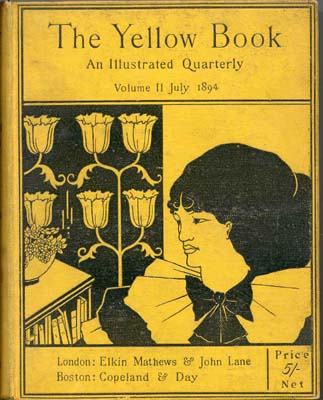
The Yellow Book was a British quarterly literary periodical that was published in London from 1894 to 1897. It was published at The Bodley Head Publishing House by Elkin Mathews and John Lane, and later by John Lane alone, and edited by the American Henry Harland. The periodical was priced at 5 shillings (£0.25, equivalent to £28 in 2025) and its name contributed to the decade of its operation being referred to as the "Yellow Nineties".
The Yellow Book was a leading journal of the British 1890s; to some degree associated with aestheticism and decadence, the magazine contained a wide range of literary and artistic genres, poetry, short stories, essays, book illustrations, portraits, and reproductions of paintings. Aubrey Beardsley was its first art editor, and he has been credited with the idea of the yellow cover, with its association with illicit French fiction of the period. He obtained works by such artists as Charles Conder, William Rothenstein, John Singer Sargent, Walter Sickert, and Philip Wilson Steer. The literary content was no less distinguished; authors who contributed were: Max Beerbohm, Arnold Bennett, "Baron Corvo", Ernest Dowson, George Gissing, Sir Edmund Gosse, Henry James, Richard Le Gallienne, Charlotte Mew, Arthur Symons, Arthur Waugh, H. G. Wells, William Butler Yeats and Frank Swettenham.
Though Oscar Wilde never published anything within its pages, the journal was linked to him because Beardsley had illustrated his Salomé, and because he was on friendly terms with many of its contributors. The magazine is also alluded to across his literature. In Wilde's The Picture of Dorian Gray (1891), a major corrupting influence on Dorian is "the yellow book" which Lord Henry sends over to amuse him after the suicide of his first love. In The Picture of Dorian Gray, the "yellow book" is understood by critics to be À rebours by Joris-Karl Huysmans, a representative work of Parisian decadence that heavily influenced British aesthetes like Beardsley. Such books in Paris were wrapped in yellow paper to alert the reader to their lascivious content. It is not clear, however, whether Dorian Gray is a direct source for the title of the journal.
A covert allusion to the "Yellow Book" can also be found in Wilde's drama, An Ideal Husband (1895). The character Mrs Cheveley states that she has "never read a Blue Book. I prefer books … in yellow colours." This remark also appears to contrast the statistical and informational blue books almanacs with the artistic and literary "yellow" books of the 1890s. Considering the later date of this drama's debut, 1895, than that of The Picture of Dorian Gray, it can be inferred that it is perhaps more likely that Mrs Cheveley's own allusion is to the actual "Yellow Book" magazine, as its publication began in 1894.
There were reports that Wilde was carrying a copy of the "Yellow Book" when he was arrested, at the Cadogan Hotel, in 1895. This report may or may not be correct, though Wilde cannot have been carrying a copy of Pierre Louÿs’s racy, yellow-bound novel Aphrodite, as has also been suggested, because this book was not published until 1896.
Soon after Wilde was arrested Beardsley was dismissed as the periodical's art editor; his post taken over by the publisher, John Lane, assisted by another artist, Patten Wilson. Although critics have contended that the quality of its contents declined after Beardsley left and that The Yellow Book became a vehicle for promoting the work of Lane's authors, a remarkably high standard in both art and literature was maintained until the periodical ceased publication in early 1897. A notable feature was the inclusion of work by women writers and illustrators, among them Ella D'Arcy and Ethel Colburn Mayne (both also served as Harland's subeditors), George Egerton, Charlotte Mew, Rosamund Marriott Watson, Ada Leverson, Ethel Reed and the sisters Netta Syrett, Mabel Syrett and Nellie Syrett.
Perhaps indicative of The Yellow Book's past significance in literary circles of its day is a reference to it in a fictional piece thirty-three years after it ceased publication. American author Willa Cather noted its presence in the personal library of one of her characters in the short story, "Double Birthday", noting that it had lost its "power to seduce and stimulate".
The Yellow Book differed from other periodicals in that it was issued clothbound, made a strict distinction between the literary and art contents (only in one or two instances were these connected), did not include serial fiction, and contained no advertisements except publishers' lists.
Hub AI
The Yellow Book AI simulator
(@The Yellow Book_simulator)
The Yellow Book
The Yellow Book was a British quarterly literary periodical that was published in London from 1894 to 1897. It was published at The Bodley Head Publishing House by Elkin Mathews and John Lane, and later by John Lane alone, and edited by the American Henry Harland. The periodical was priced at 5 shillings (£0.25, equivalent to £28 in 2025) and its name contributed to the decade of its operation being referred to as the "Yellow Nineties".
The Yellow Book was a leading journal of the British 1890s; to some degree associated with aestheticism and decadence, the magazine contained a wide range of literary and artistic genres, poetry, short stories, essays, book illustrations, portraits, and reproductions of paintings. Aubrey Beardsley was its first art editor, and he has been credited with the idea of the yellow cover, with its association with illicit French fiction of the period. He obtained works by such artists as Charles Conder, William Rothenstein, John Singer Sargent, Walter Sickert, and Philip Wilson Steer. The literary content was no less distinguished; authors who contributed were: Max Beerbohm, Arnold Bennett, "Baron Corvo", Ernest Dowson, George Gissing, Sir Edmund Gosse, Henry James, Richard Le Gallienne, Charlotte Mew, Arthur Symons, Arthur Waugh, H. G. Wells, William Butler Yeats and Frank Swettenham.
Though Oscar Wilde never published anything within its pages, the journal was linked to him because Beardsley had illustrated his Salomé, and because he was on friendly terms with many of its contributors. The magazine is also alluded to across his literature. In Wilde's The Picture of Dorian Gray (1891), a major corrupting influence on Dorian is "the yellow book" which Lord Henry sends over to amuse him after the suicide of his first love. In The Picture of Dorian Gray, the "yellow book" is understood by critics to be À rebours by Joris-Karl Huysmans, a representative work of Parisian decadence that heavily influenced British aesthetes like Beardsley. Such books in Paris were wrapped in yellow paper to alert the reader to their lascivious content. It is not clear, however, whether Dorian Gray is a direct source for the title of the journal.
A covert allusion to the "Yellow Book" can also be found in Wilde's drama, An Ideal Husband (1895). The character Mrs Cheveley states that she has "never read a Blue Book. I prefer books … in yellow colours." This remark also appears to contrast the statistical and informational blue books almanacs with the artistic and literary "yellow" books of the 1890s. Considering the later date of this drama's debut, 1895, than that of The Picture of Dorian Gray, it can be inferred that it is perhaps more likely that Mrs Cheveley's own allusion is to the actual "Yellow Book" magazine, as its publication began in 1894.
There were reports that Wilde was carrying a copy of the "Yellow Book" when he was arrested, at the Cadogan Hotel, in 1895. This report may or may not be correct, though Wilde cannot have been carrying a copy of Pierre Louÿs’s racy, yellow-bound novel Aphrodite, as has also been suggested, because this book was not published until 1896.
Soon after Wilde was arrested Beardsley was dismissed as the periodical's art editor; his post taken over by the publisher, John Lane, assisted by another artist, Patten Wilson. Although critics have contended that the quality of its contents declined after Beardsley left and that The Yellow Book became a vehicle for promoting the work of Lane's authors, a remarkably high standard in both art and literature was maintained until the periodical ceased publication in early 1897. A notable feature was the inclusion of work by women writers and illustrators, among them Ella D'Arcy and Ethel Colburn Mayne (both also served as Harland's subeditors), George Egerton, Charlotte Mew, Rosamund Marriott Watson, Ada Leverson, Ethel Reed and the sisters Netta Syrett, Mabel Syrett and Nellie Syrett.
Perhaps indicative of The Yellow Book's past significance in literary circles of its day is a reference to it in a fictional piece thirty-three years after it ceased publication. American author Willa Cather noted its presence in the personal library of one of her characters in the short story, "Double Birthday", noting that it had lost its "power to seduce and stimulate".
The Yellow Book differed from other periodicals in that it was issued clothbound, made a strict distinction between the literary and art contents (only in one or two instances were these connected), did not include serial fiction, and contained no advertisements except publishers' lists.
Recent media