



Community hub
Recent from talks
Contribute something to knowledge base
Content stats: 0 posts, 0 articles, 1 media, 0 notes
Members stats: 0 subscribers, 0 contributors, 0 moderators, 0 supporters
Subscribers
Supporters
Contributors
Moderators
Hub AI
Thiers wall AI simulator
(@Thiers wall_simulator)
Hub AI
Thiers wall AI simulator
(@Thiers wall_simulator)
Thiers wall
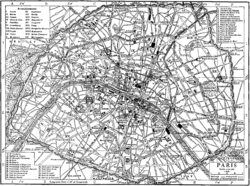
The Thiers wall (French: Enceinte de Thiers) was the last of the defensive walls of Paris. It was an enclosure constructed between 1841 and 1846 and was proposed by the French prime minister Adolphe Thiers but was actually implemented by his successor, Marshal Soult. The 33 kilometres (21 mi) long wall and ditch made a complete circuit around the city as it stood at the time of the July Monarchy. It was bombarded by the Prussian Army during the Franco-Prussian War, captured by government troops during the Paris Commune and refortified at the start of the First World War. However, by then it had become obsolete as a fortification and was a barrier to the expansion of the city. The area immediately outside of it, known as "the zone", had become a shanty town. The wall was demolished in the interwar period; its path today can be traced by the Boulevards of the Marshals which originally ran just behind the fortifications and by the Boulevard Périphérique which was later built just outside. A few remnants of the wall can still be seen.
By the mid-16th century, Paris was defended by walls which had been built and rebuilt over the preceding centuries, but apart from the latest additions were largely obsolete for modern warfare and enclosed too small an area to contain the growing suburbs. In 1670, King Louis XIV ordered the demolition of all the walls surrounding Paris on the grounds that France was militarily secure and that a modern system of border fortifications had been constructed at great expense, and that like London and Madrid, Paris had become too large to fortify. Following the course of the demolished walls, the first boulevards were laid out, wide tree-lined avenues whose name is the French word for "bulwark". An ambitious scheme of fortification for Paris proposed in 1689 by France's leading military engineer, Marshal Sébastien Le Prestre de Vauban, was not proceeded with. Following the Battle of Paris in 1814, when the Coalition armies had captured the city after a single day's fighting, there was renewed political pressure for the capital to be fortified. A royal commission for the defence of the kingdom considered the issue between 1818 and 1820, finally recommending a detailed plan of defences in the following year, but it was never implemented.
When Louis-Philippe was proclaimed king of the French in 1830, there was renewed interest in the issue. A further commission on the defence of the kingdom first met in 1836 and by May 1838 began to consider the defence of Paris. After much debate, it was decided that the capital should be fortified in two ways; by a continuous wall which could be manned by the National Guard and would prevent infiltration or a surprise attack, and further out from that, by a chain of detached forts manned by the regular field army, which could prevent an enemy from establishing positions from which they could bombard the city and create a line so long that it would be difficult for besiegers to enforce a tight blockade. A further point in favour of this dual approach was that regular troops would not come into close contact with the notoriously rebellious Parisians, which might lead to a loss of discipline.
On 1 March 1840, Adolphe Thiers returned to office as prime minister and soon war threatened over the Oriental Crisis, when France found itself in opposition to Britain and Austria over events in Egypt. He was therefore amenable to an approach by the Duke of Orléans and François Chabaud-Latour to implement the commission's recommendations to fortify Paris. Chabaud-Latour was an army officer who had worked on the commission's plans and was also a deputy in the National Assembly. Thiers obtained the backing of his cabinet for the scheme while the deputies were away on holiday, but then found there was fierce resistance from the left, led by François Arago and Alphonse de Lamartine, who suspected that the government had ulterior political motives: that the fortifications, especially the detached forts, were intended to threaten the Parisians in case of a revolt against the monarchy. Other arguments suggested that by making Paris a fortress, it would make the city an irresistible objective for any invading army. Thiers was forced to resign over foreign policy in October, but his successor, Marshal Soult, was determined to press on with the plan. Debate began in the legislature in January 1841 and the necessary legislation was passed on 3 April.
This legislation appropriated 140 million French francs for the work, including 17,970 million francs for land acquisition[clarification needed], 16,608 million francs for earthworks[clarification needed] and 83,356 million francs[clarification needed] for masonry. It was also necessary to clear an area in front of the fortifications to ensure that there was an unobstructed field of fire. Initially, an area known as a zone non aedificandi ("building-free zone") of 974 metres was envisaged, which would have been laid out as public parkland; however the final solution was a zone of 250 metres beyond the ditch on which it was forbidden to erect anything except a wooden fence. Although landowners whose property was confiscated for the actual fortifications were paid compensation, there was nothing for those whose property lay within the zone and was thus devalued.
The construction of the new works were overseen by Guillaume Dode de la Brunerie, the inspector-general of engineers and chairman of the fortifications committee. The fortifications not only included a continuous defensive wall or enceinte around the capital, but also a line of sixteen bastion forts lying between 2 and 5 kilometres from the wall. Although designed for all-round defence, these forts, such as Fort d'Issy, were not positioned so as to be able to support each other, unlike the polygonal forts being built by the Prussians at that time. The work was undertaken by military engineers and commercial contractors and used a workforce of 20,000 troops and civilians. The course of the works crossed through 13 suburbs and was completed in 1846.
The 33 kilometres (21 mi) long main wall, colloquially referred to as "the fortress", consisted of 94 bastions. These were numbered counting anti-clockwise from Bastion No 1 on the right (northern) bank of the River Seine in the southeast of Paris, round to Bastion No 94 which completed the circuit on the opposite bank. For command purposes, the wall was divided into nine military sectors, each sector consisting of between eight and twelve bastions. The wall was pierced by 17 gates (French: portes) for routes nationales, or major roads, 23 secondary road crossings (French: barrières) for routes départementales, and 12 posterns for local access. The gates were closeable by barriers and acted as toll booths the collection of taxes and tariffs; some of the main portes were fitted with drawbridges. The wall was also pierced in five places by rivers and canals and later, eight railway crossing points were constructed. All these access ways made the wall harder to defend, but in peacetime, there were insufficient crossings for a major commercial centre which resulted in congestion.
The enceinte wall itself was constructed following the system devised by Louis de Cormontaigne nearly a century previously. The rampart was composed of packed earth and revetted by a vertical scarp (or front face) wall of stone, topped by a broad earthen parapet. In front of this was a 25 metres (82 ft) wide dry ditch, bounded on the far side by an earthen counterscarp which sloped at an angle of 45° and was not revetted. Extending out from the top of the counterscarp was the glacis, a ridge intended to defend the scarp wall from direct bombardment, but the slope away from the fortress was angled so as to allow the defenders to fire on any attacking troops. However, a United States Army commission who visited in 1856 noted that the glacis, which rose 6 metres (20 ft) above the floor of the ditch, only partially protected the vulnerable masonry of the scarp wall. Originally, there was a covered way which passed along the top of the counterscarp below the crest of the glacis, but by 1856 this had largely been eroded away.
Thiers wall
The Thiers wall (French: Enceinte de Thiers) was the last of the defensive walls of Paris. It was an enclosure constructed between 1841 and 1846 and was proposed by the French prime minister Adolphe Thiers but was actually implemented by his successor, Marshal Soult. The 33 kilometres (21 mi) long wall and ditch made a complete circuit around the city as it stood at the time of the July Monarchy. It was bombarded by the Prussian Army during the Franco-Prussian War, captured by government troops during the Paris Commune and refortified at the start of the First World War. However, by then it had become obsolete as a fortification and was a barrier to the expansion of the city. The area immediately outside of it, known as "the zone", had become a shanty town. The wall was demolished in the interwar period; its path today can be traced by the Boulevards of the Marshals which originally ran just behind the fortifications and by the Boulevard Périphérique which was later built just outside. A few remnants of the wall can still be seen.
By the mid-16th century, Paris was defended by walls which had been built and rebuilt over the preceding centuries, but apart from the latest additions were largely obsolete for modern warfare and enclosed too small an area to contain the growing suburbs. In 1670, King Louis XIV ordered the demolition of all the walls surrounding Paris on the grounds that France was militarily secure and that a modern system of border fortifications had been constructed at great expense, and that like London and Madrid, Paris had become too large to fortify. Following the course of the demolished walls, the first boulevards were laid out, wide tree-lined avenues whose name is the French word for "bulwark". An ambitious scheme of fortification for Paris proposed in 1689 by France's leading military engineer, Marshal Sébastien Le Prestre de Vauban, was not proceeded with. Following the Battle of Paris in 1814, when the Coalition armies had captured the city after a single day's fighting, there was renewed political pressure for the capital to be fortified. A royal commission for the defence of the kingdom considered the issue between 1818 and 1820, finally recommending a detailed plan of defences in the following year, but it was never implemented.
When Louis-Philippe was proclaimed king of the French in 1830, there was renewed interest in the issue. A further commission on the defence of the kingdom first met in 1836 and by May 1838 began to consider the defence of Paris. After much debate, it was decided that the capital should be fortified in two ways; by a continuous wall which could be manned by the National Guard and would prevent infiltration or a surprise attack, and further out from that, by a chain of detached forts manned by the regular field army, which could prevent an enemy from establishing positions from which they could bombard the city and create a line so long that it would be difficult for besiegers to enforce a tight blockade. A further point in favour of this dual approach was that regular troops would not come into close contact with the notoriously rebellious Parisians, which might lead to a loss of discipline.
On 1 March 1840, Adolphe Thiers returned to office as prime minister and soon war threatened over the Oriental Crisis, when France found itself in opposition to Britain and Austria over events in Egypt. He was therefore amenable to an approach by the Duke of Orléans and François Chabaud-Latour to implement the commission's recommendations to fortify Paris. Chabaud-Latour was an army officer who had worked on the commission's plans and was also a deputy in the National Assembly. Thiers obtained the backing of his cabinet for the scheme while the deputies were away on holiday, but then found there was fierce resistance from the left, led by François Arago and Alphonse de Lamartine, who suspected that the government had ulterior political motives: that the fortifications, especially the detached forts, were intended to threaten the Parisians in case of a revolt against the monarchy. Other arguments suggested that by making Paris a fortress, it would make the city an irresistible objective for any invading army. Thiers was forced to resign over foreign policy in October, but his successor, Marshal Soult, was determined to press on with the plan. Debate began in the legislature in January 1841 and the necessary legislation was passed on 3 April.
This legislation appropriated 140 million French francs for the work, including 17,970 million francs for land acquisition[clarification needed], 16,608 million francs for earthworks[clarification needed] and 83,356 million francs[clarification needed] for masonry. It was also necessary to clear an area in front of the fortifications to ensure that there was an unobstructed field of fire. Initially, an area known as a zone non aedificandi ("building-free zone") of 974 metres was envisaged, which would have been laid out as public parkland; however the final solution was a zone of 250 metres beyond the ditch on which it was forbidden to erect anything except a wooden fence. Although landowners whose property was confiscated for the actual fortifications were paid compensation, there was nothing for those whose property lay within the zone and was thus devalued.
The construction of the new works were overseen by Guillaume Dode de la Brunerie, the inspector-general of engineers and chairman of the fortifications committee. The fortifications not only included a continuous defensive wall or enceinte around the capital, but also a line of sixteen bastion forts lying between 2 and 5 kilometres from the wall. Although designed for all-round defence, these forts, such as Fort d'Issy, were not positioned so as to be able to support each other, unlike the polygonal forts being built by the Prussians at that time. The work was undertaken by military engineers and commercial contractors and used a workforce of 20,000 troops and civilians. The course of the works crossed through 13 suburbs and was completed in 1846.
The 33 kilometres (21 mi) long main wall, colloquially referred to as "the fortress", consisted of 94 bastions. These were numbered counting anti-clockwise from Bastion No 1 on the right (northern) bank of the River Seine in the southeast of Paris, round to Bastion No 94 which completed the circuit on the opposite bank. For command purposes, the wall was divided into nine military sectors, each sector consisting of between eight and twelve bastions. The wall was pierced by 17 gates (French: portes) for routes nationales, or major roads, 23 secondary road crossings (French: barrières) for routes départementales, and 12 posterns for local access. The gates were closeable by barriers and acted as toll booths the collection of taxes and tariffs; some of the main portes were fitted with drawbridges. The wall was also pierced in five places by rivers and canals and later, eight railway crossing points were constructed. All these access ways made the wall harder to defend, but in peacetime, there were insufficient crossings for a major commercial centre which resulted in congestion.
The enceinte wall itself was constructed following the system devised by Louis de Cormontaigne nearly a century previously. The rampart was composed of packed earth and revetted by a vertical scarp (or front face) wall of stone, topped by a broad earthen parapet. In front of this was a 25 metres (82 ft) wide dry ditch, bounded on the far side by an earthen counterscarp which sloped at an angle of 45° and was not revetted. Extending out from the top of the counterscarp was the glacis, a ridge intended to defend the scarp wall from direct bombardment, but the slope away from the fortress was angled so as to allow the defenders to fire on any attacking troops. However, a United States Army commission who visited in 1856 noted that the glacis, which rose 6 metres (20 ft) above the floor of the ditch, only partially protected the vulnerable masonry of the scarp wall. Originally, there was a covered way which passed along the top of the counterscarp below the crest of the glacis, but by 1856 this had largely been eroded away.
Recent media
Recent media