Hubbry Logo
Toghrol TowerToghrol TowerMain
Open search
Toghrol Tower
Community hub
Toghrol Tower
logo
8 pages, 0 posts
0 subscribers
Be the first to start a discussion here.
Toghrol Tower
Toghrol Tower
from Wikipedia

Toghrol Tower (Persian: برج طغرل‌) also transliterated Toghrul, Tughrol, or Tughrul) is a 12th-century monument, located in the city of Rey, Tehran province, Iran. Tuğrul Tower is near Rashkan Castle.

Key Information

The 20-metre-tall (66 ft) brick tower is the tomb of Seljuk ruler Tughril I, who died in Rey in 1063. Originally, like other monuments of its time, it was capped by a conical dome (گنبد, gonbad), which collapsed during an earthquake.[when?]

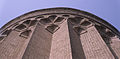
The thickness of the walls varies from 1.75 to 2.75 m (5.7 to 9.0 ft). The inner and outer diameters are 11 and 16 m (36 and 52 ft), respectively. The exterior shape is that of a polygon with 24 angles in its design, which is thought to contribute to the structure's stability against tremors. At the top of the tower, Kufic inscriptions were originally observable.

The tower is protected by Iran's Cultural Heritage Organization.

In some texts, this place is called Burj Khalifa Yazid. According to some experts' ideas, this tower is like a clock pointer and the time can be recognized by the sunshine on its congresses.

History

[edit]

It is said that one of the uses of this tower was to use it on foggy nights by lighting a fire on its high barrier to guide the travelers of the Silk Road coming from Khorasan to Rey, and to meet the chronological needs of the people during the day. According to Manouchehr Arian in the article "Another Look at the Towers", calling the term "tower" to this building and similar buildings refers to the annual moving passageways of sunlight in Zodiacal. In addition to this feature, Toghrol Tower has another unique feature called the sundial that is hidden in the heart of its congresses. Naser al-Din Shah Qajar ordered some restorations to be made to the top part of the tower, which was collapsing in 1884.

Burial dispute

[edit]
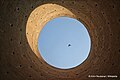
Interior view, originally domed with a conical cap

There are many challenges and discrepancies between experts and historians about the character buried in this building. Some consider it to be the tomb of Tughral Beyk of Seljuk, and it is stated in the “Mahmalottavarikh” book on page 465 that "Sultan Tughralibek died in the city of Rey and his tomb is there." Turkish historian, Faregh Sumer, also considers the burial place of Toghrol in the same location. Other writers consider this place to be the burial place of Khalil Sultan, the son of Timur Lang and his wife Shadalmolk in the 15th century. In the book of Reye Baastaan (the ancient Ray) authoring Hassan Karimiyan mentions that a group attributes this monument to Fakhr Deilami. Mohammad Mohit Tabatabai considered this building to belong to Ibrahim Khawas, and he himself was buried next to this tower in 1992.

Decline and restoration

[edit]

As mentioned above, Toghrol Tower was first renovated in 1922 and at the end of the 35th year of the reign of Naser al-Din Shah. This restoration was carried out by the order of the Shah and by the Chancellor Amin al-Sultan and by Abul Hassan Khan Memarbashi, and marble slabs were installed on the entrance of the building. This reconstruction saved the building from the danger of destruction, but destroyed the elegance of the old works and the tomb of the Kufic inscription. After the Revolution of 1978, this building was abandoned until it was rebuilt again in the early seventies, and was seriously begun in mid-1998 and ended in the winter of 2000. Reconstruction is currently underway by District 20 of Tehran Municipality in an area of 2 hectares in order to expand and build a cultural center, library, museum, and restaurant.

[edit]

See also

[edit]

References

[edit]
Revisions and contributorsEdit on WikipediaRead on Wikipedia
from Grokipedia
The Toghrol Tower, also known as Tughrul Tower or Borj-e Toghrol, is a 12th-century Seljuk mausoleum located in the ancient city of Rey, in southern Tehran Province, Iran, standing approximately 20 meters tall and constructed from brick with a water-resistant sarooj mortar. It serves as the reputed tomb of Tughril Beg (Tughril I), the founder and first sultan of the Great Seljuk Empire, who died in Rey in 1063, though the structure itself dates to around 1139. The tower exemplifies early Seljuk architecture, blending Persian, Armenian, and Byzantine influences in the Razi style, with a hollow cylindrical interior (11 meters in diameter), a fluted polygonal exterior featuring 24 vertical angles (16 meters in external diameter), thick walls (1.75–2.75 meters), and decorative elements such as a high muqarnas cornice and Kufic inscriptions. Historically, the tower not only functioned as a site but also as a along the , where fires were lit at its summit to guide travelers. Its design enables it to function as a sundial (solar clock), often described as the world's largest, where the 24 crenellations (vertical angles) light up sequentially with the sun's movement, indicating hours after sunrise, with no mechanical clock present. Rey itself became a key administrative center under Seljuk rule during Tughril's era, underscoring the tower's role in marking the empire's expansion and cultural prominence in the region until the Mongol invasions of the early . Its earthquake-resistant construction and acoustic features, including ventilation holes and a deep foundation, highlight advanced engineering for the period, contributing to its survival as one of Tehran's oldest monuments. The tower has undergone multiple restorations to preserve its integrity, including a major effort in 1884 under to repair its collapsing upper sections (which originally supported a conical dome, now lost), and a third phase completed in 2023 by Iran's to enhance structural strength and protect against environmental damage. Today, it stands as a protected site managed by Iran's , symbolizing the enduring legacy of Seljuk architectural innovation and serving as a focal point for historical and study of Islamic heritage in .

Location and Overview

Site in Rey

The Toghrol Tower is situated in the ancient city of Rey, also known as Rayy, located in southern , , at coordinates 35°36′2.37″N 51°26′44.32″E. Rey, now a suburb of modern , boasts a rich historical urban fabric with origins in pre-Islamic periods, including remnants from the Median Empire and earlier settlements that highlight its role as a longstanding cultural and political hub. Positioned near Rashkan Castle, the tower integrates seamlessly into Rey's historic landscape, serving as a key landmark amid other ancient structures that define the area's enduring architectural heritage. This proximity underscores its place within the layered urban development of Rey, which evolved from pre-Islamic fortified sites to a vital medieval center. Rey occupied a strategic junction on the , facilitating and cultural exchange across Asia, and the Toghrol Tower contributed to this network by acting as a visual guide for travelers approaching from the south, potentially lit as a during adverse weather to aid . The Seljuk dynasty's expansion into Rey further emphasized its importance as a trade nexus during the 11th and 12th centuries.

Physical Characteristics

The Toghrol Tower is a 12th-century Islamic affiliated with Seljuk heritage, characterized by its distinctive 24-sided polygonal cylindrical form that tapers upward. Constructed primarily of , the structure features an outer of 16 meters and an inner of 11 meters, with wall thickness varying from 1.75 to 2.75 meters. Its height measures 20 meters (66 feet), providing a robust yet elegant silhouette typical of medieval Persian tomb towers. The tower lacks its original conical dome, which collapsed due to an , leaving the interior open to the sky and the structure at its current height of 20 meters (66 feet). Following a restoration completed in 2023 by Iran's , the tower maintains its structural integrity. The exposed cylindrical inner chamber and polygonal exterior walls highlight its enduring structural integrity. As a protected site, it is maintained by Iran's to preserve its architectural features.

Architecture

Design and Construction

The Toghrol Tower was constructed around 1140 CE, as indicated by an inscription on an iron plaque over the entrance bearing the date 534 AH (March 1140 CE) and the craftsman's signature, during the Seljuk era in the 12th century, though traditionally reputed to mark the death year (1063 CE) of Sultan Tughril Beg. It was built using fired bricks as the primary material to ensure longevity in the region's arid climate. The mortar employed was sarooj, a lime-based, water-resistant mixture common in Persian architecture that provided superior adhesion and protection against moisture and erosion, allowing the structure to withstand environmental stresses over centuries. A key engineering innovation in the tower's design is its cylindrical shaft, divided into 22 protruding flanges that enhance structural stability, particularly against seismic activity prevalent in the area, by distributing forces more evenly across the facade. These flanges rise to a series of three superimposed tiers of muqarnas (stalactite-like vaulting elements), which transition to a shallow cornice, serving as a transitional feature that reinforces the upper portion while mitigating wind loads and contributing to overall earthquake resistance. This approach exemplifies Seljuk advancements in load-bearing masonry, prioritizing mass and geometric form over ornate decoration to achieve durability. The original design culminated in a conical dome, now collapsed due to later damage, which would have capped the tower and emphasized its verticality. The entrance portal features a crescent-shaped archway crafted from arranged bricks, creating an that resembles the open mouth of a when viewed from certain angles, a subtle choice that integrated form with symbolic protection. Kufic inscriptions were incorporated into the upper aesthetic, though their details are lost.

Decorative Features

The Toghrol Tower's exterior showcases Seljuk-era that prioritizes structural mass over profuse ornamentation, distinguishing it from more elaborately decorated contemporaries in medieval . The cylindrical shaft is articulated by twenty-two projecting flanges, forming a subtle geometric of indentations that enhance the tower's visual rhythm without overt complexity. Crowning the flanges are three tiers of large , which serve as transitional and decorative elements leading to a shallow , exemplifying early Seljuk use of muqarnas-like forms for aesthetic depth and symbolic elevation. Around the southwest entrance, additional bands—up to three rows high—framed the portal, complemented by brick corbels that added layered texture to the facade prior to 19th-century restorations. Kufic inscriptions, a hallmark of Islamic aniconic art, were originally prominent: an illegible band in angular encircled the area above the , as documented in 19th-century European drawings, while another likely appeared below the crowning near the entrance. These epigraphic elements, tied to 11th-century stylistic conventions, emphasized religious or commemorative phrases without figural imagery, underscoring the tower's role in conveying cultural and spiritual symbolism through script and geometry. An iron plaque bearing a dated inscription ( 534 AH / March 1140 CE) and the craftsman's signature was affixed over the door, highlighting individualized Seljuk artisanal pride.

Historical Development

Construction and Attribution

The Toghrol Tower, a prominent Seljuk-era structure in Rey, , is dated to 534 AH (March 1140 CE) based on an iron plaque. This inscription confirms its construction during the mid-12th century, a period of Seljuk consolidation in Persia following the dynasty's initial conquests. The tower's erection reflects the architectural patronage of the Seljuks, who used such monuments to assert dynastic authority in key regional centers like Rey, which the Seljuks captured around 1043 CE and briefly made their capital, serving as a strategic hub amid the expansion of Islamic rule across the . Traditionally, the tower has been attributed as the mausoleum of (r. 1037–1063 CE), the founder of the , who died in Rey after a victorious campaign against the . This attribution links the structure to early Seljuk royal burial practices, where tomb towers symbolized eternal legitimacy and power for the dynasty's leaders. However, no contemporary historical records directly support this connection, and the 77-year interval between Tughril's death and the documented construction date renders the identification apocryphal. A Kufic inscription in brick, now lost, formerly adorned the north face. Despite scholarly debates over its exact occupant, the tower stands as a dynastic monument emblematic of Seljuk architectural innovation in Rey, a city that became a focal point for the empire's cultural and political ambitions in Persia during the 11th and 12th centuries. Alternative attributions exist but remain secondary to the longstanding association with .

Original Functions and Uses

The Toghrol Tower, constructed in March 1140 during the Saljuq period, primarily functioned as a for an unknown individual, reflecting the era's tradition of commemorative architecture. Beyond this foundational purpose, its elevated position and substantial height of approximately 20 meters near of Rey positioned it as a key visual landmark for travelers along trade routes, including the , facilitating navigation toward the urban center in the region's expansive plains. The tower also functions as a sundial, often described as the world's largest. Its exterior features 24 crenellations that are illuminated sequentially by the sun's movement, indicating the hours after sunrise, with no mechanical clock present. Leveraging the Seljuks' sophisticated astronomical expertise, this enables timekeeping through solar shadows cast on its fluted exterior. These shadow patterns vary daily and seasonally, providing a mechanism aligned with Islamic prayer times and agricultural cycles in medieval Persia. Symbolically, the tower embodied the enduring presence of the in Persia, erected amid their consolidated rule following the conquests that began in the 1030s and culminated in Tughril Beg's establishment of authority by 1063, serving as a testament to their cultural and political dominance through monumental .

Preservation and Legacy

Decline and Restorations

Over the centuries, the Toghrol Tower experienced significant deterioration, beginning with the collapse of its original conical dome during an at an unknown post-medieval date, likely due to seismic activity in the region. By the , the structure had suffered further general decay from prolonged exposure to the elements and neglect, with the upper portions showing visible instability and erosion of . The tower's robust construction using high-quality and sarooj mortar contributed to its overall longevity despite these challenges. Efforts to preserve the tower commenced in the late , with ordering structural reinforcements in 1884 to address the collapsing top section, including the addition of marble slabs for stabilization. A major repair of the followed in 1922, focusing on restoring the exterior and preventing further degradation. These interventions were succeeded by a comprehensive restoration project from 1998 to 2000, undertaken by Iran's Cultural Heritage Organization, which involved detailed conservation of the masonry and inscriptions. Since the early 2000s, reconstruction has been ongoing under the supervision of Municipality's District 20, encompassing a 2-hectare site expansion to develop the tower into a cultural center with facilities such as a library and . As of 2023, phases of the tower's restoration entered final stages, emphasizing seismic to mitigate leaning caused by dampness and to enhance resistance, building on the tower's historically deep foundations.

Cultural and Architectural Significance

The Toghrol Tower exemplifies early Seljuk architectural innovation as a tomb tower, featuring a distinctive polygonal form with a 24-angled brick shaft that creates a star-like profile, emphasizing structural mass over ornate decoration. This design, topped by three tiers of muqarnas stalactites forming a shallow cornice, represents a transitional style in Persian architecture, bridging earlier cylindrical tombs with more complex stellar plans. Its construction in 1140 CE highlights the Seljuk era's engineering prowess, using durable bricks and sarooj mortar for seismic resistance, and it influenced subsequent tomb towers by introducing the muqarnas cornice as a decorative and structural motif. Culturally, the tower symbolizes the zenith of the and the in Rey, serving as a monumental testament to dynastic power and the perpetuation of rulers' legacies during the 11th-12th centuries. Traditionally associated with Tughrul Beg, founder of the Seljuk Sultanate who died in Rey in 1063 CE, it embodies the political and architectural achievements of the dynasty, reflecting influences from Buyid and Ziyarid predecessors while asserting Seljuk identity. The structure functions as a sundial (often described as the world's largest), its 24-angled facade featuring crenellations that light up sequentially with the sun's movement, enabling shadow-based timekeeping to indicate hours after sunrise, with no mechanical clock present. This role underscores medieval Iranian advancements in science, integrating practical functionality with symbolic grandeur to aid travelers and mark cosmic order. In contemporary , the Toghrol Tower functions as a key , drawing visitors to explore Rey's pre-modern heritage and the broader narrative of Persian-Islamic . Its protected status under Iran's Cultural Heritage Organization reinforces , safeguarding it as a vital link to the Seljuk legacy amid urban encroachment.

References

Add your contribution
Related Hubs
User Avatar
No comments yet.