Hubbry Logo
search
logo
1826299

Topkapi manuscript

logo
Community Hub0 Subscribers
Read side by side
from Wikipedia
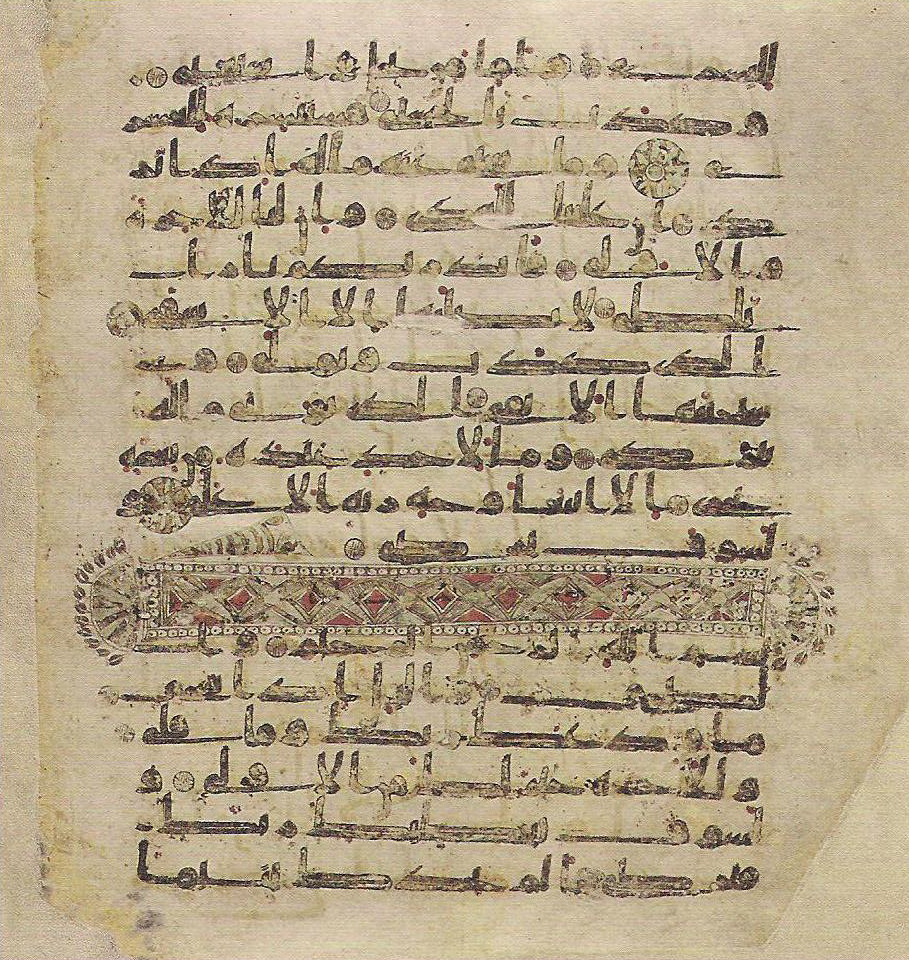
Page from the Topkapi manuscript with heading for the chapter Ad-Dhuha

The Topkapı manuscript or Topkapı Quran (Also known as Topkapı Qurʾān Manuscript H.S. 32 or Topkapı H.S. 32)[1]: 81–83  is an early manuscript of the Quran dated to the middle 2nd century AH (mid 8th century AD).[1]: 81–83 

This manuscript is kept in the Topkapi Palace Museum, Istanbul, Turkey. It is traditionally attributed to Uthman ibn Affan (d. 656).[1]: 81–83  However, a recent study by Professor Rami Hussein Halaseh indicates that attributing H.S. 32 to "ʿUthmān or claiming its production during the first/seventh century is historically inaccurate."[1]: 83 

Similar illuminations can be found in the Dome of the Rock in Jerusalem, the Umayyad Mosque in Damascus and other Umayyad monuments. The size of this manuscript is 41 cm × 46 cm (16 in × 18 in). According to Halaseh, H.S. 32 currently contains about 97.78% of the text of the Qur'ān.[1]: 31  With only two pages (23 verses) lacking, this manuscript is the closest to the complete text of the Quran. Mehmed Ali Pasha, Governor of Egypt, sent this manuscript to the Ottoman Sultan Mahmud II as a gift in the 19th century (CE).[1]: 35 [2][3]

The paleographic assessment indicates that the Topkapi manuscript comes closest to those writings that date back to the 8th century. (cf. the examples in Déroche: Abbasid, page 36).[4] Halaseh also shows that based on the paleography of the manuscript, folios 2r–6v and 11 seems to have been created by another hand and added to the manuscript at a much later stage.[1]: 43 

According to Tayyar Altıkulaç, the manuscript dates to somewhere in the second half of the first century AH to the first half of the second century AH based on vowelling and dottings.[5]

Also cf. E. İhsanoǧlu: "An examination of the Topkapı Muṣḥaf shows that it was written with a developed kufic script. The shape of the letters does not confirm to the writing style of the early Muṣḥafs attributed to Caliph ʿUthmān, which were written on vellum in his period and therefore known as the Muṣḥafs of Caliph ʿUthmān. (...) Apparently this Method of Abū al-Aswad al-Duʾalī [invented after the death of Caliph ʿUthmān] was carefully followed in placing the vowel marks of the Topkapi Palace copy. Single dots were placed in red ink above, beside or below the letters." (Altıkulaç, al-Muṣḥāf al-Sharif (Preface), page 9).[4]

"According to the evaluation of Munadjdjid, neither this Muṣḥaf nor the Muṣḥafs located in Tashkent, al-Mashhad al-Ḥusayn in Cairo and in the Museum of Turkish and Islamic Works in Istanbul were the Muṣḥafs attributed to Caliph ʿUthmān; however considering the differences in their script, the centuries when they were copied and their different dimensions, they must have been copied from the Muṣḥafs attributed to Caliph ʿUthmān. For this reason, each of them was called the (Muṣḥaf ʿUthmān)" (Altıkulaç, al-Muṣḥaf al-Sharif, page 80).[4]

References

[edit]
Revisions and contributorsEdit on WikipediaRead on Wikipedia
from Grokipedia
The Topkapi manuscript is an early manuscript of the Quran, dated to the Umayyad period in the late 7th or early 8th century CE (late 1st or early 2nd century AH), written in Hijazi Kufic script on vellum. Housed in the Topkapi Palace Museum in Istanbul, Turkey, under accession number H.S. 32, it measures approximately 41 cm by 46 cm and comprises 408 folios (precise details such as folio count may vary across sources), preserving approximately 97.78% of the Quranic text (though earlier estimates suggested over 99% and sources vary slightly) with only two pages (23 verses) missing. The script employs early diacritical marks as colored dots for vowels and dashes for consonants, with verse divisions marked by simple rosettes and rectangular indicators, but lacks ornate illumination typical of later Islamic manuscripts. Its provenance traces to the Islamic heartlands, likely Medina or Damascus, where it was probably copied from an exemplar associated with the standardization efforts under Caliph Uthman ibn Affan (r. 644–656 CE), though it is not the original. The manuscript reached the Ottoman Empire from Egypt as a gift from Egyptian Governor Mehmed Ali Pasha to Sultan Mahmud II in 1811 CE. Traditionally revered as one of the "Uthmanic" codices due to its early date and stylistic similarities to Medinan transmissions, it has been preserved in the palace's Holy Relics Department since its arrival, with public access beginning in 1962. Scholarly analysis, notably by Turkish researcher Tayyar Altıkulaç in his 2007 study and facsimile edition published by the Research Centre for Islamic History, Art and Culture (IRCICA), highlights its orthographic consistency with the consonantal skeleton (rasm) of early Quranic codices, including minor variants in spelling but no significant deviations in content from the standardized Hafs recitation; however, more recent studies, such as Rami Hussein Halaseh's 2024 examination, have identified numerous non-canonical textual variants. The manuscript's codicology—such as parchment quality, ink composition, and binding—distinguishes it among contemporaries, offering evidence of scribal practices in the formative Islamic era. Its study contributes to understanding the Quran's textual transmission, paleography, and the evolution of Arabic script, serving as a key artifact in Islamic manuscript traditions despite debates over precise dating via stylistic methods.

Description

Physical characteristics

The Topkapi manuscript is composed of 408 folios (with exact folio counts varying slightly across sources) made from parchment, with overall dimensions of approximately 41 cm in height by 46 cm in width. The text area measures 32 cm by 40 cm. The text is written primarily in black ink, enhanced by gold and red accents that denote diacritical marks, verse endings, and other structural elements. The pages follow a consistent layout of 18 lines per page, with surah headings rendered in a larger script to distinguish chapter divisions.[1][2] The manuscript's binding consists of red leather featuring stamped ornamentation, which was added during the Ottoman period as part of later conservation efforts. In terms of condition, several folios show evidence of repairs undertaken over time, alongside minor worm damage and some fading in the illuminations and accents. These physical attributes underscore the artifact's age and the challenges of its preservation as an early Islamic codex.

Script and content

The Topkapi manuscript is written in an early form of Kufic script, characterized by its angular letter forms and bold, elongated horizontal strokes that give it a distinctive, quasi-square appearance suited to the vertical layout of the pages.[3] This variant, often described as transitional from the earlier Hijazi style, lacks full vowel pointing (tashkil) but incorporates basic i'jam dots to distinguish between similar consonants, such as separating ب, ت, ث, and ن.[1] The script's rigidity and lack of cursive flow reflect the scribal conventions of the Umayyad period, prioritizing clarity and uniformity in rendering the consonantal skeleton (rasm) of the text.[3] The manuscript preserves approximately 97.78% of the Quranic text (with earlier estimates over 99% and minor source variations possible), encompassing all 114 surahs in the standard Uthmanic rasm, with minor lacunae due to the absence of two folios (23 verses).[1][2] Across its 408 extant folios, the text adheres closely to the canonical ordering, providing a near-complete representation of the revelation as standardized in the 7th century. Surahs are organized with clear separations marked by illuminated panels, typically wide horizontal bands that interrupt the flow of text and feature basic geometric or scroll motifs executed in gold ink.[1][3] These panels serve both functional and aesthetic purposes, signaling the transition between chapters while enhancing the manuscript's visual rhythm; for instance, longer surahs like al-Baqara may have multiple such dividers to accommodate subdivisions.[1] The absence of chapter numbers aligns with early scribal practices, but each surah begins with a boldly inscribed title (e.g., "بسم الله الرحمن الرحيم" for the basmala, followed by the surah name), ensuring navigational ease without modern numbering.[3] Unique to the manuscript's layout are the verse divisions, denoted by small gold rosettes—simple circular ornaments filled with ink dots or subtle patterns—that punctuate the end of each ayah, creating a subtle decorative cadence across the pages.[1] Groups of five or ten verses are highlighted with larger, more elaborate rosettes or rectangular markers, sometimes outlined in red, which aid in recitation and memorization without overwhelming the script.[3] This system of markers, combined with the consistent line rulings (18 lines per page), underscores the manuscript's role as a practical tool for liturgical use. Artistic elements further distinguish the script and content integration, with marginal decorations consisting of simple motifs that frame text blocks and occasionally extend into the borders, adding a layer of ornamental harmony without intruding on readability.[3] These motifs, drawn from early Islamic decorative traditions, appear sporadically along the edges of folios, particularly near surah openings, and complement the illuminated panels by echoing their themes in a more subdued manner.[1] Such embellishments not only elevate the manuscript's aesthetic value but also reinforce the sanctity of the text through symbolic abundance and symmetry.

History

Early origins

The Topkapi manuscript of the Quran, one of the earliest nearly complete copies of the Islamic holy text, is dated to the late 7th or early 8th century CE (late 1st or early 2nd century AH, circa 680–750 CE) through paleographic analysis of its script and orthographic features.[4] This dating aligns with the late Umayyad period, as the manuscript's Kufic script exhibits characteristics typical of transitional styles from that era, including angular letter forms and minimal diacritical markings. Scholarly examinations, such as those by Tayyar Altıkulaç, place it in the second half of the 1st century AH to the first half of the 2nd century AH, emphasizing its role as a product of early Islamic scribal traditions. The manuscript was likely produced in the Hijaz region of the Arabian Peninsula, possibly in Mecca or Medina, centers of early Islamic scholarship and religious authority during the Umayyad caliphate's final decades. This origin is inferred from the Hijazi-influenced elements in its script, such as elongated horizontal strokes and a somewhat rustic execution, which reflect local writing practices before the full development of standardized Kufic forms in urban centers like Kufa or Basra. As a copy of the Quran's canonical rasm (consonantal skeleton), it reflects the standardized text established following the Uthmanic recension in the mid-7th century, but it is not an autograph from that standardization process.[5][6] Traditional attributions linking the manuscript directly to Caliph Uthman ibn Affan (r. 644–656 CE) persist in some historical narratives, portraying it as one of the original codices dispatched to major Islamic cities. However, paleographic and codicological evidence firmly rejects a 7th-century origin, with experts like François Déroche and Efim Rezvan classifying it as an early 8th-century production rather than a contemporary of Uthman. Such myths likely arose from the manuscript's antiquity and completeness, enhancing its perceived sanctity, but modern scholarship prioritizes material analysis over legendary associations.[4][7] Initially, the manuscript would have served liturgical or scholarly purposes, aiding recitation and study in a mosque or madrasa setting within the early Islamic community. Its format—large folios on high-quality parchment with simple verse markers—suggests it was designed for communal reading during prayers, a common practice for monumental Quranic codices in the early 8th century. This functional role underscores its contribution to the dissemination and preservation of the Quranic text in the post-Umayyad era.[8]

Ottoman acquisition

The Topkapi manuscript entered the Ottoman palace collections in Istanbul in 1811 CE (1226 AH), when Mehmed Ali Pasha, the semi-autonomous Governor of Egypt, presented it as a diplomatic gift to Sultan Mahmud II.[1] While scholarly sources confirm this 1811 arrival, some traditional accounts associate the manuscript with the Ottoman conquest of Egypt by Sultan Selim I in 1517 CE.[9] This gesture occurred amid Mehmed Ali's efforts to consolidate power in Egypt and strengthen ties with the Ottoman court, reflecting the manuscript's perceived prestige as an ancient Quranic codex.[10] The gift was transported from Cairo to Istanbul through official channels, ensuring its secure delivery as a high-value religious artifact.[1] Upon arrival, the manuscript was initially housed in the Imperial Treasury (Hazine-i Hümayun) within Topkapi Palace, where prized items from across the empire were safeguarded.[1] It was soon integrated into the palace's Sacred Relics (Eşya-ı Hümayun) collection, a revered assemblage of Islamic artifacts that included other manuscripts traditionally attributed to Caliph Uthman ibn Affan, such as additional early Quranic codices purportedly from his standardization efforts.[1] This placement elevated the Topkapi manuscript's status among the empire's holy treasures, alongside relics like the Prophet Muhammad's mantle and footprints, all curated to embody Ottoman custodianship over Islamic heritage.[11] In the 19th century, the manuscript received formal documentation through Ottoman palace inventories, which meticulously recorded its accession details and condition as part of broader cataloging efforts for the Sacred Relics.[1] Sultans, including Mahmud II and his successors, commissioned minor restorations to address wear, such as reinforcing bindings and repairing folios, preserving its integrity without altering the original script.[9] These interventions highlighted the Ottoman commitment to maintaining such artifacts amid the empire's cultural patronage. Symbolically, the manuscript served as a key element in imperial ceremonies, where it was displayed during religious observances and state rituals to invoke divine sanction.[12] As a diplomatic and caliphal emblem, its presence in the palace collections reinforced the Ottoman sultans' legitimacy as leaders of the Sunni Muslim world, particularly after the formal assumption of the caliphate in 1774, by linking the dynasty to the foundational era of Islam.[11]

Modern preservation

Following the dissolution of the Ottoman Empire and the proclamation of the Republic of Turkey in 1923, Topkapı Palace was transformed into a museum in 1924, with its collections, including the manuscript, placed under state custody and cataloged with the inventory number H.S. 32.[1] The manuscript is preserved in the Topkapı Palace Museum's Chamber of the Sacred Relics (Mukaddes Emanetler Dairesi), a dedicated space originally established under Sultan Selim I (r. 1512–1520) to house Islamic holy artifacts.[1] It is displayed in a protective glass case under controlled environmental conditions, including limited light exposure, to mitigate degradation from humidity, temperature fluctuations, and ultraviolet radiation.[1] Handling is strictly restricted to authorized conservators and scholars, ensuring the vellum folios—measuring approximately 41 cm by 46 cm and comprising 408 leaves—remain intact despite minor losses like two missing folios.[1] To facilitate preservation and research without direct contact, a full-color facsimile edition was produced in 2007 by the Organisation of Islamic Cooperation's Research Centre for Islamic History, Art and Culture (IRCICA), reproducing the manuscript's Hijazi script and layout for global distribution.[1] Digital access has expanded scholarly engagement; while high-resolution images are not freely available on the museum's official portal due to conservation policies, detailed photographs and scans are accessible through academic repositories like the Corpus Coranicum project, which began digitizing early Qur'anic manuscripts in the early 2010s.[2][13] In the 2020s, non-invasive analytical techniques have supported ongoing conservation assessments, as evidenced in the 2024 monograph by Rami Hussein Halaseh, which examines the manuscript's material composition, ink properties, and subtle textual variants through close physical inspection and photographic documentation, revealing insights into its early 8th-century production without altering the artifact.[7] These efforts underscore the museum's commitment to sustaining the manuscript's condition, addressing challenges like natural fading while prioritizing its role as a cultural heritage object.

Significance

Textual and scholarly value

The Topkapi manuscript represents an early exemplar of the consonantal skeleton (rasm) associated with the Uthmanic textual tradition, containing approximately 97.78% of the complete Quranic text according to recent detailed analysis (though earlier estimates suggested over 99%), and aligning closely with the standardized Hafs recitation in its core structure.[10][1] Scholarly analysis identifies around 2,483 orthographic differences from the 1924 Cairo edition (based on Hafs), primarily involving plene spellings such as medial alif elongations, but these do not alter semantic meaning or doctrinal content. Updated in a 2024 study by Rami Hussein Halaseh et al., which confirms the variant counts and emphasizes its Medinan rasm origins.[10][14] For instance, in Surah 2 (al-Baqarah), variants include spellings like "bāriyikum" (Q.2:54) and "lakumū" instead of "lakum" (Q.2:132), reflecting minor extensions for pronunciation clarity without impacting interpretation.[10] These differences appear across approximately 15 surahs, encompassing subtle consonantal shifts (63 instances, or 20.39% of total variants), vocalizations (136, or 44.01%), and case endings (75, or 24.27%), alongside 15 hamza adjustments (4.85%).[10] Examples beyond Surah 2 include "arjihi" versus "arjih" in Q.3:83 and "sāriʿū" with waw in Q.3:133, all consistent with pre-canonical qira'at traditions like those of Nafi' or Ibn Kathir, confirming no substantive theological deviations.[10] The manuscript's rasm thus underscores the textual stability of the Uthmanic archetype, with variants largely attributable to orthographic evolution rather than corruption.[1] Paleographic evidence, including the Kufic script's angular forms and inconsistent diacritics, supports an 8th-century origin (mid-2nd century AH), likely from the Umayyad heartlands, such as the Hijaz or Syria.[1] Claims of a 7th-century (1st-century AH) dating, sometimes linked to Uthmanic attribution, have been refuted through detailed script analysis, as the features align with post-Umayyad developments rather than Hijazi prototypes; no radiocarbon dating has been performed on this manuscript, but comparative studies of similar codices (e.g., Sana'a palimpsest, dated 578–669 CE) highlight methodological limitations in extrapolating early dates without corroboration.[1][15] François Déroche's 2009 study of early Quranic corpora, including comparative paleography of Umayyad-era fragments, positions the Topkapi manuscript within a transitional phase of script standardization, emphasizing its role in tracing rasm fidelity across regional copies. Furthermore, the manuscript features prominently in the Corpus Coranicum project, where digital variant mapping reveals alignments with Medinan reading traditions and unattested forms, aiding reconstructions of pre-Ibn Mujahid (d. 936 CE) transmissions.[16] This integration highlights its utility in mapping orthographic diversity without challenging the Uthmanic baseline. Overall, the Topkapi manuscript exemplifies the interplay between oral and written Quranic preservation in early Islam, demonstrating remarkable textual consistency amid regional scribal practices and contributing to debates on the canonization process by illustrating how minor variants reinforced rather than undermined the tradition's integrity.[10] Its analysis supports the view that the Quran's transmission maintained stability through controlled oral memorization alongside skeletal written aids, as evidenced by the absence of doctrinal shifts across centuries of copying.[17]

Artistic and cultural impact

The Topkapi manuscript's illuminations, consisting of simple rosettes marking verse divisions, rectangular panels for major sections, and horizontal bands separating surahs with decorated corners, represent an early stage in the evolution of Quranic decoration, transitioning from the austere Hijazi script of the 7th century to the more elaborate styles of later Islamic periods.[1] These modest ornamental elements, executed in ink on vellum, laid foundational precedents for structural highlighting in sacred texts, influencing the development of non-figurative motifs in Islamic manuscript art. While the original lacks gold leaf or arabesque patterns, the broader adoption of Byzantine-inspired gold ink and dyed parchment in subsequent Quranic production—evident from the 8th century onward—reflects regional artistic exchanges that enhanced the manuscript's aesthetic legacy.[18] As a prime example of aniconic art in Islam, the Topkapi manuscript underscores the centrality of calligraphy as a sacred medium for conveying divine revelation, eschewing human or animal figures to emphasize spiritual purity and textual reverence.[19] This approach aligns with Islamic principles that prioritize geometric and abstract designs to evoke infinity and avoid idolatry, positioning the manuscript as a cultural emblem of devotion where the written word itself becomes an object of veneration.[20] During the Ottoman era, the manuscript held profound veneration in the Topkapi Palace's Holy Relics Chamber, inspiring daily recitations by hafizes that continue to this day, completing 365 full readings annually as a symbol of perpetual worship.[21] It also motivated the production of ornate illuminated Qurans by Ottoman court calligraphers, incorporating lavish decorations while maintaining textual reverence. The manuscript's prestige extended to 19th-century Ottoman artistic discourse, where it served as a reference for calligraphy standards and ornamental restraint in treatises on Islamic aesthetics. The Topkapi manuscript's early decorative framing techniques, including banded surah markers, contributed to the broader evolution of Islamic manuscript traditions, influencing Mamluk illuminators in Egypt who integrated similar structural elements with Persianate floral motifs by the 14th century.[8] This cross-regional exchange is evident in how Umayyad-era simplicity informed the refined borders and panels in Persian Qurans under Timurid patronage.[22] In modern times, the manuscript symbolizes Turkey's Islamic heritage, preserved as a national treasure in the Topkapi Palace Museum and featured in scholarly publications and facsimiles, such as the 2007 edition by the Organization of the Islamic Conference.[1] It gained renewed attention in 2015 amid debates on early Quranic dating, underscoring its role in global discussions of Islamic textual history, though not directly exhibited abroad like contemporaneous fragments.[23]

Key comparisons

The Topkapi manuscript differs from the Sana'a manuscript in its textual uniformity and script characteristics. While the Sana'a codex is a palimpsest with a lower layer in Hijazi script containing numerous variants from the standard Uthmanic rasm—such as omissions, additions, and word substitutions—the Topkapi presents a consistent Kufic rasm without palimpsest overlays or such deviations, reflecting a more standardized early transmission.[24][1] Compared to the Birmingham folios, the Topkapi shares an early dating within the 7th-8th centuries CE but surpasses it in scale and preservation. The Birmingham, radiocarbon-dated to 568–645 CE and inscribed in Hijazi script, comprises only two leaves preserving portions of surahs 18 (Al-Kahf) through 20 (Ta-Ha), whereas the Topkapi, dated to the late 1st or early 2nd century Hijra (late 7th or early 8th century CE) and in Kufic script, includes 408 folios preserving approximately 97.78% (with earlier estimates over 99%) of the Quranic text.[25][1][26] In relation to the Samarkand (Tashkent) codex, the Topkapi avoids the intense legendary association with Caliph Uthman ibn Affan and shows fewer later interventions. The Samarkand, also in Kufic script and dated to the 2nd century Hijra (8th century CE), carries a traditional claim of being one of Uthman's original codices—complete with stories of bloodstains from his martyrdom—but scholarly analysis dismisses this as apocryphal, noting its 378 fragmented folios, paper mends, and dispersed Abbasid-era additions; the Topkapi, while sometimes similarly attributed, lacks these mythic elements and has minimal such repairs, maintaining greater integrity.[27][1] These codices share core traits as products of the Uthmanic standardization process, adhering to the consonantal skeleton (rasm) established in the mid-7th century CE to unify regional recitations, though none are definitively from Uthman's era. The Topkapi stands out through its Ottoman provenance, acquired and preserved in the Topkapi Palace library from the 15th century onward, contrasting with the Yemeni mosque origins of Sana'a, the Mingana Collection housing of Birmingham, and the Central Asian relocation of Samarkand.[1][27][24] Scholarly comparative studies have emphasized the Topkapi's contributions to tracing script evolution, particularly the shift from angular Hijazi forms in manuscripts like Birmingham and Sana'a to the more rigid Kufic style seen in Topkapi and Samarkand, as explored in analyses of "Uthmanic" codices and their courtly contexts.

Influence on later copies

Early Kufic manuscripts like the Topkapi contributed to the evolution of codex formats during the Abbasid caliphate, with features such as horizontal layout, minimal diacritics, and verse dividers influencing standardization of recitation aids in later productions.[28] In the Ottoman context, the Topkapi manuscript directly inspired replicas produced in 16th-century palace workshops, where artisans transitioned from angular Kufic to the more fluid naskh script while preserving the original's sacral aura. These copies, often commissioned for imperial libraries, incorporated the manuscript's textual integrity into naskh-based editions, influencing the Ottoman court's standardization of Quranic calligraphy during the reign of Suleiman the Magnificent. The palace's collection of over 1,600 Korans, including facsimiles of early exemplars like the Topkapi, underscores this replicative tradition, which blended reverence for Uthmanic archetypes with innovative script adaptations. The manuscript's transmission extended to Egyptian and Syrian recension styles through Mamluk artisans in the 14th and 15th centuries, who emulated early script styles and integrated lapidary elements into their illuminations, contributing to a chain of influence that shaped post-Abbasid Quranic production in the Levant and Nile Valley.[28] This artisanal lineage preserved orthographic details, such as consonant skeletal forms, that aligned with Syrian and Egyptian recensions. Culturally, subtle decorative elements from early manuscripts like the Topkapi were adapted in Mughal Indian Qurans, appearing in 17th-century albums where floral designs echoed early aesthetics in subcontinental contexts.[29] These elements, adapted in Deccani and Agra ateliers, symbolized continuity in Islamic artistic heritage.[29] On a scholarly level, the Topkapi manuscript has informed modern textual criticism, with variants documented in studies like Tayyar Altıkulaç's 2007 edition contributing to understandings of the Hafs 'an 'Asim recension and early manuscript transmissions.[28] This underscores the manuscript's enduring role in Quranic scholarship.

References

User Avatar
No comments yet.