Hubbry Logo
Torcida SplitTorcida SplitMain
Open search
Torcida Split
Community hub
Torcida Split
logo
8 pages, 0 posts
0 subscribers
Be the first to start a discussion here.
Torcida Split
Torcida Split
from Wikipedia

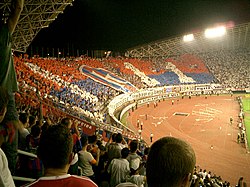
Torcida fans decorating the stands of Poljud stadium during the Eternal Derby.

Key Information

Torcida Split is a HNK Hajduk Split supporters' group in Croatia with the branches in other countries, mostly, (but not exclusively) among Croat communities. Founded on 28 October 1950, Torcida is the oldest supporters group in Europe. [1]

The group as a whole traditionally maintains good relations with the French Magic Fans of AS Saint-Étienne, the Czech Slavia Prague football club supporters, especially fan group Tribuna Sever, Polish Torcida Górnik fan group from Górnik Zabrze and has a long friendship with the Portuguese fan group No Name Boys from Benfica.[2]

History

[edit]

The Torcida was founded in 1950 by a group of sailors from Korčula who had witnessed the passion of the crowd at the World Cup Final in Brazil.[2] While their first official appearance at a game was on October 29, 1950 against Red Star Belgrade for the League of Yugoslavia title, the group started gathering and chanting more regularly in the center of the east stand in the early 1970s.[3]

Hajduk Split supporters, Torcida, were formed on 28 October 1950 by a group of students in Zagreb, namely Ante Dorić, Vlado Mikulić, Šime Perković, Ante Ivanišević and Vjenceslav Žuvela.[4] According to Ante Dorić, the person who gave them most incentive to form a group was the Club legend Bernard Vukas. They took their name from the Brazilian fan group they idolized,[5] which comes from the Portuguese 'torcer' which means 'to cheer on'. "Hajduk lives forever" is their slogan.[6]

During the late 1980s, Torcida's anthem was the song "Glasno, glasnije" ("Loud, Louder") by the Split hard rock band Osmi Putnik.[7]

References

[edit]
[edit]
Revisions and contributorsEdit on WikipediaRead on Wikipedia
from Grokipedia
Torcida Split is the organized supporters' group of the Croatian football club , recognized as Europe's oldest organization, founded on 28 October 1950 by 113 university students and young men primarily of Dalmatian origin to provide coordinated backing during a crucial league match against . Inspired by the passionate Brazilian fans, known as torcida, observed at the final, the group adopted similar fervent styles including chants, flags, and banners, marking a pioneering shift in European football fandom from passive spectatorship to active, collective expression. Throughout the post-World War II era under Yugoslav communism, Torcida embodied regional Dalmatian pride and resistance, facing political repression such as bans on their name and imprisonment of leaders, yet sustaining Hajduk's identity as a symbol of anti-authoritarian sentiment. In the 1970s and 1980s, the group expanded with innovative supporter culture, including south stand coordination and alliances with other firms, but also engaged in violent clashes during away games and incidents like the 1984 slaughter of a rooster at a UEFA match against Tottenham Hotspur, leading to international stadium bans. During the 1990s Croatian War of Independence, many members enlisted in defense forces, contributing to national efforts while Hajduk achieved European successes, such as reaching the UEFA Cup quarter-finals; post-war, Torcida has maintained intense rivalries, notably with Dinamo Zagreb's Bad Blue Boys, amid ongoing efforts to curb hooliganism following repeated disciplinary actions. Their enduring legacy includes trailblazing fan choreography and unwavering loyalty, defining Hajduk's home atmosphere at Poljud Stadium, though tempered by a history of extremism-linked violence that has drawn scrutiny from authorities and governing bodies.

Origins and Formation

Founding in 1950

Torcida Split was established on October 28, 1950, as the organized for , Europe's oldest such firm. The founding group consisted of 113 students and young men, predominantly of Dalmatian origin studying in , along with other enthusiasts from across , who sought to emulate the fervent crowd dynamics observed among Brazilian fans during the . The name "Torcida" directly derives from the term used for Brazilian supporter collectives, reflecting the influence of their rhythmic drumming, unified chanting, and visual displays at the final. This formation occurred on the eve of Hajduk Split's match against , prompting the group to charter trains from to Split, with the last arriving in the early morning of October 29, 1950. The supporters positioned themselves in the east stand of the newly built , introducing coordinated cheering, flags, and scarves to amplify the home atmosphere, which contrasted with the more subdued fan behaviors prevalent in post-World War II Yugoslav football. This debut marked a deliberate shift toward organized, passionate , drawing from international models to foster club loyalty amid the centralized sports policies of the communist regime. Initial activities focused on travel support for away games and enhancing matchday spectacles, quickly gaining traction despite official scrutiny from Yugoslav authorities wary of autonomous group formations. By late 1950, Torcida had solidified as Hajduk's dedicated core, with membership expanding through word-of-mouth among Dalmatian expatriates and local youth, laying the groundwork for its enduring role in Croatian football culture.

Influences from Brazilian Torcidas

The formation of Torcida Split drew direct inspiration from the passionate, organized fan culture observed in Brazilian football stadia, particularly the vibrant atmosphere at the Maracanã during the hosted in . A group of Hajduk Split supporters, primarily students from studying in , were influenced by accounts of the "southern" style of support characterized by rhythmic drumming, large banners, and collective chanting, which contrasted with the more subdued European fan behaviors of the era. This exposure prompted them to establish Europe's first formalized ultras-style group on October 28, 1950, explicitly modeling it after Brazilian torcidas organizadas—structured supporter associations that emphasized coordinated displays and unwavering loyalty. The name "Torcida" itself derives from the Brazilian term rooted in torcer, meaning "to cheer" or "to root for," reflecting homage to these South American precedents where fan groups like Gaviões da Fiel (formed in 1969, though earlier informal torcidas existed) pioneered hierarchical organizations for match-day spectacles. Hajduk player , who frequently discussed the electric energy of Brazilian matches with teammates and fans, further amplified this influence, encouraging the adoption of elements such as percussion instruments and unified visual displays to replicate the Maracanã's intensity. Unlike contemporaneous European supporters who focused primarily on individual attendance, Torcida Split imported the practice of pooled resources for flags, flares, and choreographed routines, marking a causal shift toward professionalized that prioritized atmosphere as a competitive edge. This Brazilian model proved instrumental in Torcida's early innovations, including the use of to lead chants and the creation of expansive tifos—large fabric mosaics—mirroring how Brazilian torcidas funded elaborate decorations from collective dues starting in the . By emulating these tactics, Torcida not only enhanced Hajduk's at Poljud Stadium but also disseminated the concept across , influencing subsequent groups like Italy's in the ; however, Brazilian torcidas' occasional ties to territorial rivalries were not fully replicated, as Torcida emphasized anti-authoritarian over factional violence in its formative years. Empirical accounts from participants confirm that without the 1950 World Cup's global broadcast of Brazilian fervor, such organized import would likely not have occurred amid Yugoslavia's football constraints.

Historical Development

Resistance Under Yugoslav Communism (1950s–1980s)

Torcida Split, established on October 28, 1950, rapidly emerged as a focal point for Croatian and Dalmatian identity assertion amid Yugoslavia's emphasis on supranational unity. Inspired by Brazilian fan groups, its early displays of regional pride—such as banners emphasizing Split's Dalmatian heritage—prompted direct intervention from , who personally ordered the group's ban shortly after its founding, viewing it as a threat to Yugoslav cohesion. Founder Vjenceslav Žuvela faced expulsion from the and imprisonment, while the name "Torcida" was prohibited in official discourse. Despite formal dissolution, supporters operated informally, using matches to subtly promote Croatian symbols and chants suppressed under the regime's anti-nationalist policies. Throughout the 1950s and 1960s, Torcida's activities drew repeated clashes with authorities, who perceived the group as fostering . In 1961, fans assaulted a following a disallowed goal against Hajduk Split, highlighting escalating defiance against perceived biases favoring Belgrade-based clubs like . Yugoslav secret services monitored Croatian supporter organizations, including Torcida, as potential incubators of , subjecting members to and arrests to curb organized expressions of ethnic identity. These efforts reflected the regime's broader strategy to suppress regional loyalties, yet Torcida's underground persistence allowed it to serve as a conduit for cultural resistance, evading total eradication through decentralized, match-centered gatherings. The 1970s intensified confrontations, exemplified by the 1974 match against at Poljud Stadium, where Torcida supporters numbering in the thousands clashed with several hundred Yugoslav army personnel deployed to maintain order—many of whom supported the visiting team—forcing the soldiers' retreat from the grounds. This incident underscored Torcida's capacity to challenge state military presence, symbolizing broader Croatian resentment toward centralized control from . By the , amid Yugoslavia's economic strains and Tito's death in 1980, authorities imposed further restrictions, including a mid-decade temporary disbandment amid violent clashes during away games in . Hajduk's management and fan leaders faced penalties, such as stadium bans, yet Torcida's role in sustaining anti-regime sentiment laid groundwork for its resurgence during the push for Croatian independence.

Role During Croatian Independence and Wars (1990s)

During the push for Croatian independence in the late 1980s and early 1990s, Torcida Split members expressed strong nationalist sentiments through displays at matches, including anti-Yugoslav chants and symbols that aligned with the growing secessionist movement in . Following Croatia's on June 25, 1991, and the onset of the (known domestically as the Homeland War), numerous Torcida members volunteered for military service in Croatian defense forces, contributing to frontline efforts against (JNA) advances and Serb paramilitaries. Split, as a key coastal city and Hajduk's home, faced direct threats, including naval bombardments during the on November 14–15, 1991, where JNA forces targeted port facilities; Torcida volunteers bolstered local defenses amid these engagements. Their participation reflected broader patterns among Croatian football ultras, who transitioned from activism to armed resistance, providing manpower amid the nascent Croatian National Guard's formation. At least 27 Torcida members lost their lives in the conflict, honored by a commemorative plaque outside Poljud in Split. Torcida's wartime role extended beyond combat to sustaining morale, with surviving members resuming organized support for matches post-1995, after recaptured remaining Serb-held territories. This involvement cemented their status as symbols of Dalmatian resilience, though documentation remains largely from club-affiliated accounts, which emphasize heroism without detailing operational specifics.

Post-Independence Evolution (2000s–Present)

In the early 2000s, Torcida Split experienced renewed tensions amid Hajduk Split's prolonged title drought, which lasted until 2004 after a five-year gap since their last Croatian championship in 1995. Frustration boiled over into clashes, including a major brawl with police during a 2000 match in that halted play, and significant confrontations with authorities at a Dinamo Zagreb game the same year. The 2000–2001 Croatian Cup final escalated into street riots in Split, underscoring persistent issues as Hajduk pursued domestic dominance and European qualification. Despite these disruptions, Torcida's influence deterred away fans from venturing into Split on match days, reinforcing their territorial presence. The 2010s marked a shift toward organized protests against perceived in Croatian football governance, with Torcida joining forces temporarily with rivals (BBB) of Dinamo . This uneasy alliance, peaking around 2010–2013, targeted figures like , Dinamo's influential executive accused of financial improprieties, through boycotts and demonstrations that pressured Hajduk's own leadership for greater transparency. Such cooperation dissolved amid renewed derby violence, but it highlighted Torcida's role in advocating fan ownership, contributing to Hajduk's 2011 member-driven buyout that expanded club membership from thousands to over 43,000 by 2016. However, fan misconduct drew penalties, including a 2017 partial stadium closure and €50,000 fine for racist chants and object-throwing during Europa League qualifiers, alongside fines for crowd trouble at away games like Everton's . Into the 2020s, Torcida sustained its core traditions with large-scale displays, such as the 2020 70th anniversary celebrations featuring midnight gatherings and pyrotechnics across Split and , while Hajduk's membership surged past 100,000 by 2023 under the fan-owned model Torcida helped foster. Occasional cross-rivalry emerged, as in 2023 when Torcida and BBB collaborated to combat wildfires threatening coastal areas. Yet, ethnic-nationalist expressions persisted, including a 2025 incident where members burned a banner with Serbian symbols and chanted "," a slogan linked to World War II-era Croatian forces, amid ongoing Eternal Derby clashes like pre-match brawls in Split. These events, alongside recurrent , have prompted crackdowns and further scrutiny, balancing Torcida's atmospheric contributions against criticisms of fostering division and extremism.

Organizational Aspects

Structure, Membership, and Leadership

Torcida Split operates as a registered non-governmental, non-partisan, and non-profit association, known as Klub navijača Hajduka Torcida Split. It maintains a hierarchical featuring a central leadership body and numerous subgroups based in Split's neighborhoods, including Špinut, Brda, Mertojak, and Radunica, which coordinate local activities and attendance at matches. Membership in Torcida Split centers on a core group estimated at 300 to 500 active individuals, primarily responsible for organizing choreographies, chants, and away support, though the group can mobilize thousands of affiliated supporters for major events like derbies or protests. These core members are typically long-term Hajduk Split enthusiasts from working-class backgrounds in Split and surrounding areas, with informal recruitment through neighborhood subgroups and shared rituals. Leadership is vested in elected officials, including a president and , who handle internal governance, public statements, and relations with the club and authorities. As of the latest available records, Ante Stipetić serves as president and Ivan Rinčić as . The leadership rotates periodically through internal elections among core members, emphasizing continuity in traditions while adapting to contemporary challenges like stadium regulations and fan-club collaborations.

Symbols, Rituals, and Traditions

Torcida Split's primary symbol is a incorporating the initials "T & H", denoting Torcida and , which emerged in the group's early years and has been interpreted by some members as also alluding to "Hrvatska". The group's , "Hajduk živi vječno" ("Hajduk lives forever"), was coined by longtime member Boris Jelović and first publicly displayed on a in the . Supporters prominently feature banners emblazoned with "Torcida" at matches and have used bearing the group's name to assert presence throughout Split since the . Key rituals revolve around organized gatherings at the Riva promenade and the Dubrovnik café, serving as unofficial headquarters for planning support activities. Prior to and following significant matches, members conduct parades through the city streets to rally enthusiasm and demonstrate solidarity. In the stadium, particularly from the north stand at Stadion Poljud, fans coordinate chants using a "southern" style influenced by European ultras groups, incorporating signal rockets, flares, and pyrotechnics introduced in the 1960s. Traditions include mass excursions to away games, a practice solidified in the with thousands traveling to support , often involving collective singing of the club's "Pjevajmo Hajduku" alongside self-composed . During the late , "Glasno, glasnije" ("Loud, Louder") by the Split band Pipschips&vidy served as an informal , amplifying the vocal intensity of displays. These elements foster a continuous of fervent, unified auditory and visual support, drawing from the group's 1950 founding inspiration in Brazilian torcidas.

Cultural and Atmospheric Contributions

Choreographies, Chants, and Stadium Atmosphere

Torcida Split supporters are renowned for their elaborate choreographies, or tifos, which involve coordinated displays across the stands of Poljud Stadium using banners, flags, flares, and colored materials to form large-scale images, messages, or symbols honoring Hajduk Split. These productions often require extensive preparation, with subgroups handling logistics like fabric sourcing and synchronization, as seen in behind-the-scenes preparations for matchday unveilings. Notable examples include a massive tifo during the 2022 Croatian Cup Final against Rijeka, depicting club motifs, and an intricate display in the 2023 UEFA Conference League qualifier against PAOK Thessaloniki, covering the entire curva sud (south stand). Such choreographies not only boost team morale but also intimidate opponents through visual dominance. The group's chants form a core element of their support, featuring rhythmic, continuous singing that sustains energy for 90 minutes or longer. Central to this is the recurring motto "Hajduk živi vječno" ("Hajduk lives forever"), chanted en masse to affirm enduring loyalty to the club founded in 1911. Rivalry-fueled songs, such as "Mrzim Dinamo" ("I hate Dinamo"), target Eternal Derby foes , amplifying sectarian tensions in Croatian football. These vocal traditions draw from Dalmatian folk influences and adapt popular melodies, fostering a where thousands synchronize without amplification, even in packed venues like Poljud's 35,000-capacity setup. The resulting stadium atmosphere at Poljud is characterized by unrelenting intensity, blending choreographed visuals, layered chants, and frequent into an auditory and visual assault that rivals Europe's most fervent scenes. Supporters' use of flares and smoke—despite regulatory bans—creates a hazy, roaring , as evidenced in matches where pyro barrages light up the night. This fervor extends beyond games; for Torcida's 70th anniversary in 2020, fans orchestrated city-wide pyro displays simulating "rain" over Split, drawing thousands and underscoring their capacity to generate sans official events. Observers note the atmosphere's psychological edge, pressuring visiting teams while binding locals in communal ritual, though it occasionally leads to disciplinary actions from or domestic authorities for prohibited elements.

Influence on European Fan Culture

Torcida Split, founded on October 28, 1950, holds the distinction of being Europe's oldest organized football , predating the formal movement that emerged later in during the 1960s. Inspired by the passionate, samba-infused torcidas observed during Brazil's 1950 campaign, Torcida introduced structured elements like coordinated chants, banners, and collective rituals to European stadia, setting a template for fan mobilization that emphasized unwavering loyalty and visual spectacle over passive spectatorship. This pioneering approach rippled outward, influencing ultras formations in Western and by promoting the concept of fan associations as semi-autonomous entities capable of generating intense atmospheres independent of club management. For instance, Torcida's emphasis on choreographed displays and away-game fervor inspired direct offshoots, such as Torcida Holland in the , and fostered alliances with groups like Benfica's No Name Boys, who adopted similar tactics for amplifying matchday intensity. In the , their model accelerated the rise of organized supporter cultures in clubs across , , and Bosnia, embedding practices like tifos and pyrotechnic shows that later permeated broader European fan scenes. While Torcida's innovations elevated fan engagement—evident in Hajduk Split's Poljud Stadium becoming a benchmark for hostile environments—their occasional entanglement with also normalized a harder-edged , where territorial rivalries and physical confrontations became intertwined with supporter identity, influencing the evolution of European firms toward more militant expressions of allegiance. This dual legacy underscores Torcida's role in shifting European fan from individualized cheering to institutionalized, tribal collectives, though it drew scrutiny for blurring lines between passion and in post-Yugoslav contexts.

Rivalries and Inter-Group Dynamics

The Eternal Derby with

The Eternal Derby, contested between Hajduk Split and Dinamo Zagreb since 1923, represents one of Europe's most intense football rivalries, fueled by regional divides between and northern , historical grievances from the Yugoslav era, and post-independence political tensions. Torcida Split, Hajduk's ultras group established in 1950, and (BBB), Dinamo's supporters formed in 1986, embody this antagonism, often manifesting in organized clashes, pyrotechnics, and disruptions that overshadow the matches. Their confrontations extend beyond stadiums, with pre- and post-match street fights drawing police interventions and arrests. Violence between Torcida and BBB has escalated periodically, including a , 1990, clash during Yugoslavia's dissolution that highlighted emerging ethnic frictions in football fandom. In April 2024, following a Croatian semi-final at Poljud in Split, Torcida members invaded the pitch to assault Dinamo fans and players, hurling bottles at police and injuring 17 officers, resulting in over 50 arrests and a stadium closure for investigation. A more recent street brawl on May 3, 2025, in Split ahead of a league derby saw approximately 200 Torcida members face 80 BBB supporters, leading to several injuries and over 100 detentions, with 85 from and 25 from Split. Despite entrenched hatred, brief alliances have occurred, such as in 2013 when Torcida and BBB united against perceived in Dinamo's management, demonstrating how shared sentiments can temporarily override . However, cooperation dissolved rapidly, reverting to hostility, as evidenced by BBB's 2015 Zagreb match pyrotechnics and chair-throwing at during a . These episodes underscore the groups' roles in perpetuating the derby's volatility, with authorities frequently deploying heavy security measures, including bans on away fans, to mitigate risks. The rivalry's persistence reflects deeper cultural identities, where Torcida's Dalmatian pride clashes with BBB's -centric loyalty, often amplifying match atmospheres with relentless chants and flares but at the cost of frequent charges.

Interactions with Other Fan Groups and Occasional Alliances

Torcida Split has maintained complex relations with other Croatian groups, marked by occasional s amid broader rivalries. In the mid-1980s, during the Yugoslav era, Torcida coordinated with , the supporters of Dinamo , forming a temporary against common adversaries from clubs such as Partizan and ; this involved mutual support at key matches, with Torcida detachments attending Dinamo games and vice versa. Such cooperation reflected emerging national alignments among fan groups within , prioritizing ethnic Croatian solidarity over club loyalties. Post-independence, interactions with groups like Armada (HNK Rijeka supporters) have been tense, often involving clashes during inter-city derbies, though sporadic joint efforts emerged against perceived systemic issues in Croatian football. For instance, in June 2016, Torcida participated in a large meeting with and other Croatian to address fan incidents and governance problems following Croatia's 2016 match against the . More recently, in April 2023, Torcida and issued joint calls for members to combat wildfires ravaging , demonstrating pragmatic unity in national crises despite their Eternal Derby antagonism. A brief period of cooperation between Torcida and occurred during the 2010–2011 Poljud Stadium blockade protests against Hajduk's management, lasting about six months within the three-year action, before reverting to rivalry. Internationally, Torcida has forged enduring friendships with select groups, influencing and drawing from European fan cultures. Strong bonds exist with Torcida Górnik Zabrze, the Polish supporters of , sharing nomenclature and casual styles rooted in mutual admiration for organized support. Similarly, alliances with No Name Boys of Benfica () have been evident, including joint presence at Hajduk-Dinamo derbies, stemming from historical goodwill since a 1994 UEFA Cup encounter. These ties, often solidified through away support and shared anti-commercial stances, contrast with Torcida's inspirational role for groups like Dutch Torcida formations, though formal alliances remain selective.

Controversies and Criticisms

Hooliganism and Violent Incidents

Torcida Split supporters have been implicated in multiple violent clashes, primarily during matches against rival Dinamo Zagreb fans from the and with Croatian police forces. These incidents often escalate around the Eternal Derby, involving street brawls, pitch invasions, and confrontations with authorities enforcing crowd control. While the group emphasizes passionate support, a subset engages in organized , leading to arrests, injuries, and occasional use of lethal force by police. On April 3, 2024, following Hajduk Split's Croatian Cup semi-final loss to Dinamo Zagreb at Poljud Stadium, Torcida members stormed the pitch in an attempt to provoke a fight with supporters, sparking chaos that spilled into clashes with police. Dozens of fans threw flares, bottles, and stones at officers, resulting in around 50 arrests and several injuries among fans and law enforcement. In May 2022, violent confrontations occurred during the escort of approximately 1,600 Torcida fans returning from an away match, with police firing live ammunition for the first time against Croatian citizens in such a context. The clashes left 35 people injured, including 20 officers and 15 supporters, four of whom sustained bullet wounds, and led to multiple arrests. A large-scale brawl erupted on May 3, 2025, before and after the , involving and groups. Croatian police detained 198 fans—90 home and 108 away—mostly for violations of anti-disorder laws at sports events, with two individuals seriously injured in the pre- and post-match incidents. These events highlight recurring patterns of premeditated violence, often tied to inter-group rivalries and frustrations with match outcomes or federation decisions, contributing to Croatia's reputation for football-related unrest despite efforts by authorities to curb hooliganism through bans and heightened security.

Accusations of Nationalism and Extremism

Torcida Split has faced repeated accusations of promoting nationalism and extremism, largely centered on the use of chants, banners, and symbols evoking the Ustaše movement, which governed the fascist Independent State of Croatia (NDH) as a Nazi puppet regime during World War II. These claims, often voiced by international observers, rival Serbian fan groups, and Balkan analysts, portray the ultras as harboring far-right ideologies that glorify collaborationist history and express anti-Serb animus, contrasting with Hajduk Split's own partisan resistance legacy against Axis forces. A prominent example involves the chant "Za dom spremni" ("For the homeland, ready"), the Ustaše salute and motto, which Croatian law restricts as due to its NDH associations. During a 2013 Croatian league match between Hajduk Split and , hundreds of Torcida members publicly chanted it in call-and-response form, protesting a fine against player Joe Šimunić for similar utterances after a national team game against on November 19, 2013; Hajduk's president, Marin Brbić, denounced the display as "shameful." Similar chants have recurred at Poljud Stadium, including during home games in 2025, where they accompanied banners referencing —a 1945 site of Croatian retreats and subsequent communist reprisals invoked by nationalists to commemorate perceived victimhood. Additional incidents include displays of NDH-derived iconography, such as stylized "U" symbols or numeric codes like "88" (code for "Heil Hitler"). In summer 2023, at a first-division match between Split and NK Rudes, a Nazi-era German imperial flag emblazoned with "" was unfurled among Hajduk supporters, drawing scrutiny from anti-extremism monitors. Critics argue these acts extend beyond mere regional pride—rooted in Torcida's 1950 founding as a of Dalmatian defiance against Yugoslav centralism—to endorsements of revisionist narratives minimizing atrocities, including the of Serbs, , and Roma. Such behaviors have prompted disciplinary actions against Hajduk Split, including a €50,000 fine and partial closure in 2017 for racist and discriminatory fan conduct during a Europa League qualifier, encompassing chants deemed offensive. While Torcida officially distances itself from national team support to avoid broader politicization, the group's tolerance for these elements has sustained perceptions of extremism, amplified by Balkan media rivalries where Serbian outlets equate with , though empirical incidents substantiate isolated but recurrent violations.

Internal Conflicts and Club Relations

Torcida Split's relationship with Hajduk Split's management has been characterized by strong loyalty tempered by periodic conflicts over , financial transparency, and external influences on the club. Founded in 1950 as the club's dedicated , Torcida has historically advocated for fan-centric control, viewing the club as a symbol of Dalmatian and Croatian identity rather than a commercial entity. Tensions escalated in the early 2010s amid attempts to privatize Hajduk through the sale of majority shares to private investors, which Torcida opposed as a threat to the club's communal ethos. In response, Torcida spearheaded the "Naš Hajduk" (Our Hajduk) initiative in 2011, mobilizing over 43,000 supporters to collectively purchase shares and block the privatization deal, thereby securing a minority stake and establishing a role for fans. This movement formalized Torcida's push for democratic reforms, including demands for audits and measures, and laid the groundwork for ongoing against perceived mismanagement. A critical flashpoint occurred in October 2012, when faced imminent due to debts exceeding €10 million. Torcida organized widespread protests targeting the Split City Council's initial refusal to guarantee a €3 million loan, framing the crisis as a result of poor stewardship by club officials and local authorities. Within days, the council relented under pressure from fan demonstrations and petitions, averting liquidation; over 20,000 supporters then filled Poljud Stadium for a match against Istra 1961, displaying banners like "Vi Ste " to reaffirm . These events highlighted Torcida's leverage through mobilization, though they strained relations with management, who accused fans of politicizing football operations. In November 2014, conflicts intensified when Torcida boycotted the Eternal Derby against Dinamo Zagreb at Maksimir Stadium after hundreds of supporters were denied tickets via a federation-enforced "black list," seen as retaliation for prior protests. Approximately 2,000 fans returned tickets en masse, leading to forfeit the match 3-0 and incur fines; upon returning to Split, 8,000 Torcida members celebrated the stand with flares and chants at Poljud, demanding resignations from federation executives including , accused of undue influence over both clubs and the (HNS). The incident underscored intertwined grievances against HNS policies favoring certain clubs, but also exposed rifts with 's board, who faced fan ultimatums for alignment against federation overreach. Internal divisions within Torcida have been relatively subdued compared to its external activism, with the group maintaining organizational unity rooted in shared principles. The Naš Hajduk project, while Torcida-led, occasionally created friction by institutionalizing fan oversight, drawing criticism from some traditionalists wary of formal structures diluting ultras autonomy; however, no major schisms or violent intra-group clashes have been documented, as Torcida's decentralized branches prioritize over factionalism. This cohesion has enabled sustained pressure on club relations, fostering reforms like enhanced transparency but perpetuating cycles of when management deviates from fan ideals.

Impact on Hajduk Split and Croatian Football

Loyal Support and Achievements Enabled

Torcida Split's unwavering attendance and organized displays have sustained Hajduk Split's competitive edge, particularly through fostering a high-pressure environment at that amplifies team motivation and disrupts opponents. Founded on October 28, 1950, the group originated as 113 young supporters inspired by Brazilian fan fervor at the , debuting with coordinated chants during a pivotal Yugoslav league match against . This early structure evolved into consistent south-stand coordination by the , where a reinvigorated generation of fans adopted flags, banners, and relentless vocal support, coinciding with Hajduk's capture of four titles between 1971 and 1979. In the post-independence era, Torcida's loyalty proved instrumental amid Croatia's 1991–1995 war, as members balanced frontline defense duties with sustained matchday presence, enabling to dominate early domestic competitions. The club secured the majority of Prva HNL trophies in the , including titles in 1992, 1994, and 1995, alongside a historic quarterfinal appearance in the —the deepest European run for any Croatian side since independence. This period's successes, unmatched by peers, stemmed partly from the fans' morale-boosting parades, anthem renditions, and full-capacity home crowds, which maintained institutional resilience against external pressures. Beyond titles, Torcida's model of perpetual cheering—often spanning entire 90 minutes without pause—has cultivated 's reputation for unyielding home dominance, with routines like large-scale choreographies reinforcing player focus during critical campaigns. Their expansion into international branches further amplified away support, contributing to sustained European qualifications and a tally of nine Yugoslav-era cups alongside league honors. Such dedication has not only preserved 's status as Croatia's second-most titled club but also embedded fan-club synergy as a causal factor in overcoming resource disparities relative to rivals.

Protests Against Corruption and Governance

Torcida Split has been instrumental in organizing protests against corruption within the (HNS) and broader governance issues in Croatian football, often framing their actions as a defense of Hajduk Split's integrity against and . These efforts intensified in the amid scandals involving , a former Dinamo executive indicted for multi-million-euro from player transfers, whom fans accused of exerting over the HNS through political ties. A pivotal event occurred on , 2014, when approximately 10,000 supporters, led by Torcida, gathered in Split's Poljud Stadium area to demand the resignation of HNS president and the entire executive board, citing referee corruption, match-fixing allegations, and financial mismanagement as evidence of systemic rot. The demonstration included chants and banners decrying the federation's protection of figures like Mamić, marking a rare instance of sustained fan mobilization that pressured authorities, though it yielded limited immediate reforms. In June 2016, amid Croatia's Euro 2016 campaign, Torcida escalated by issuing an official statement boycotting national team support, attributing the federation's failures to Mamić's lingering control and post-war that enabled his rise. This stance led to fan disruptions, including racist chants during matches, as supporters viewed the team's participation under HNS auspices as tacit endorsement of ; Torcida argued democratic avenues had failed, necessitating . Unusually, Torcida forged temporary alliances with rival (Dinamo Zagreb ) in protests, such as joint demonstrations in December 2013 and 2016, uniting against shared grievances over HNS governance despite historic enmity in the Eternal Derby. These coalitions amplified calls for transparency in player sales and federation elections but highlighted football's entrenched issues, as corruption persisted despite exposures, with Mamić fleeing to Bosnia in 2018 before his 2022 conviction.

References

Add your contribution
Related Hubs
User Avatar
No comments yet.