


Community hub
Recent from talks
Contribute something
Nothing was collected or created yet.
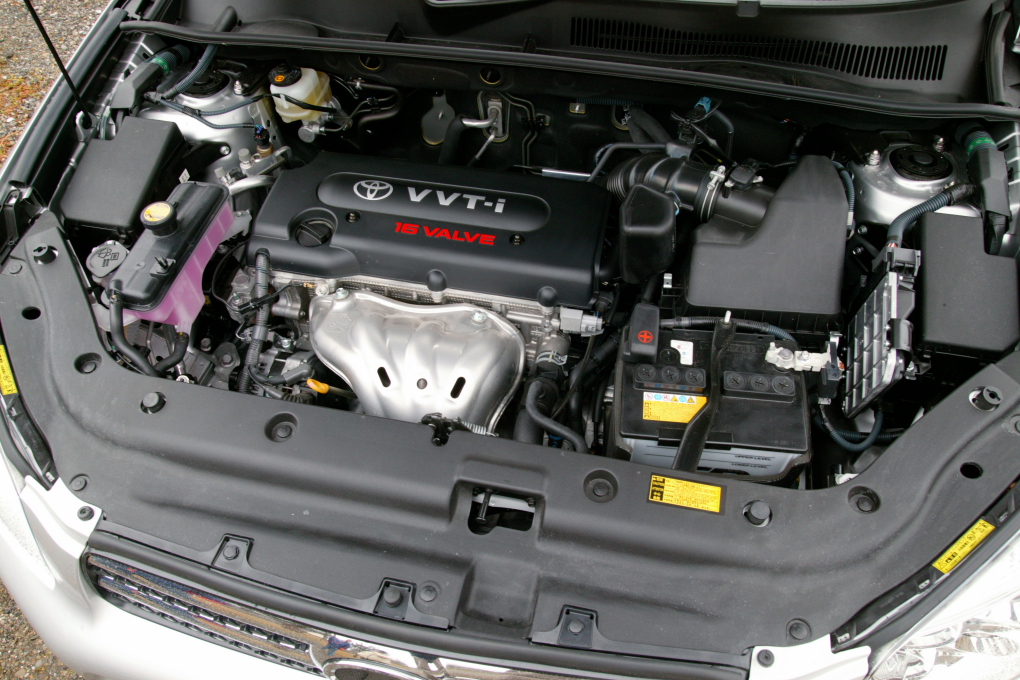
Toyota AZ engine
View on Wikipedia | This article needs additional citations for verification. (January 2019) |
| Toyota AZ engine | |
|---|---|
 2AZ-FE engine | |
| Overview | |
| Manufacturer | Toyota Motor Corporation |
| Production | 2000–2019 |
| Layout | |
| Configuration | Straight-4 |
| Displacement | 2.0 L (1,998 cc) 2.4 L (2,362 cc) |
| Cylinder bore | 86 mm (3.39 in) 88.5 mm (3.48 in) |
| Piston stroke | 86 mm (3.39 in) 96 mm (3.78 in) |
| Cylinder block material | Aluminium |
| Cylinder head material | Aluminium |
| Valvetrain | DOHC 4 valves x cyl. with VVT-i |
| Compression ratio | 9.6:1, 9.8:1, 11.0:1, 12.5:1 |
| RPM range | |
| Max. engine speed | 6500 |
| Combustion | |
| Supercharger | TRD (on 1st gen Scion tC and 2nd gen xB only) |
| Fuel system | Sequential MPFI D-4 direct injection |
| Fuel type | Gasoline |
| Cooling system | Water-cooled |
| Output | |
| Power output | 145–240 hp (108–179 kW) |
| Torque output | 190–325 N⋅m (140–240 lb⋅ft) |
| Dimensions | |
| Length | 626 mm (24.6 in) |
| Width | 608 mm (23.9 in) |
| Height | 681 mm (26.8 in) |
| Chronology | |
| Predecessor | Toyota S engine |
| Successor | Toyota AR engine |
The Toyota AZ engine family is a straight-4 piston engine series. The AZ series uses an aluminium engine block with cast iron cylinder liners and aluminium DOHC cylinder head. The engine series features many advanced technologies including slant-squish combustion chambers, offset cylinder and crank centers, and the VVT-i continuously variable intake valve timing system. The aluminium engine measures 626 mm (24.6 in) long, 608 mm (23.9 in) wide, and 681 mm (26.8 in) tall.
The cylinder block is an open-deck, midi-skirt die-cast aluminium type with cast-in iron liners and a die-cast aluminium lower crankcase and a stamped oil pan. The forged steel crankshaft is fully balanced with eight counterweights and supported by five main bearings. A helical gear pressed in No. 3 counterweight drives twin contra-rotating balance shafts in the shaft housing within the lower crankcase.
The dual overhead camshafts are driven by a single-stage roller chain of 8 mm (0.31 in) pitch, enabling a narrow included valve angle of 27.5°. The camshafts act on four valves per cylinder via bucket tappets. As in the recent Toyota engine practice, no clearance adjusting shim is employed. Valve diameters are 34 mm (1.3 in) for intake and 29.5 mm (1.16 in) for exhaust, with 8 mm (0.31 in) lift for both intake and exhaust. The four-vane VVT-i device is fitted on the intake camshaft, altering timing by 50°. The valve cover is made of magnesium to save weight.
Fuel is injected sequentially via an ultra-fine-atomization injector with twelve small injection holes, each 0.18 mm (0.0071 in) in diameter. As in the smaller NZ engine, the new AZ adopts a plastic, built-up, and vibration-welded intake manifold integrating a large volume plenum chamber (3.5 L (210 cu in) volume including a 1.3 L (79 cu in) resonator). Exhaust manifolds are of tubular construction with integrated catalytic converters.
The AZ is the replacement for the S engine. Its successor is the AR engine.
Excessive oil consumption
[edit]The 2AZ-FE engine in the 2007-2009 Camry and 2006-2009 Rav4 may burn excessive oil and is involved in a lawsuit. Other engines are also affected.[1]
Toyota service will perform a free oil consumption test to determine if the engine is affected. To qualify, all of the following must apply:
- Burning more than 1 US quart (946 ml) of oil in 1,200 miles (1,931 km)
- Has less than 150,000 miles (241,402 km)
- Is less than 10 years old
- Is located in the U.S.
There are approximately 1,715,200 vehicles covered by this Warranty Enhancement Program. A similar campaign are also done in Japan by Toyota in 2014.[2]
1AZ
[edit]The 1AZ line of engines have 2.0 L (1,998 cc) of displacement.
1AZ-FE
[edit]The 1AZ-FE is a 2.0 L (1,998 cc) version. Output is 108 kW (145 hp) at 6000 rpm with 190 N⋅m (140 lb⋅ft) of torque at 4000 rpm for the Camry Aurion version. Rav4 and Ipsum engines were rated at 148–150 hp (110–112 kW) at 6000 rpm and 142 lb⋅ft (193 N⋅m) of torque at 4000 rpm.
The 1AZ has a total displacement of 2.0 L (1,998 cc) with 86 mm × 86 mm (3.39 in × 3.39 in) bore and stroke, and a compression ratio of 9.6:1.
- 2002-2006 Toyota Camry (Southeast Asian/Taiwanese version)
- 2006–2009 Toyota Camry (Aurion version)
- 2000–2003 Toyota RAV4
- 2003-2006 Toyota RAV4 Euro
- 2001–2009 Toyota Ipsum
- 2004–2008 Toyota Wish (Southeast Asian/Taiwanese version)
1AZ-FSE
[edit]The 1AZ-FSE is a 2.0 L (1,998 cc) version. Bore and stroke is 86 mm × 86 mm (3.39 in × 3.39 in), and a compression ratio of 11.0:1. Output is 149 PS (110 kW; 147 hp) at 5700 rpm with 196 N⋅m (145 lb⋅ft) of torque at 4000 rpm. The 1AZ-FSE features Toyota's D-4 direct injection system.
2AZ
[edit]The 2AZ line of engines have 2.4 L (2,362 cc) of displacement.
2AZ-FE
[edit]The 2AZ-FE is a 2.4 L (2,362 cc) version built in Japan (Kamigo Plant and by Toyota Industries Corporation), at TMMK in the USA and also built in China for select Scion xB models, and also in Australia, obtains a total displacement of 2.4 L (2,362 cc) with 88.5 mm × 96 mm (3.48 in × 3.78 in) bore and stroke, with a compression ratio of 9.6:1. Output is 160 hp (119 kW) at 5600 rpm; 220 N⋅m (162 lb⋅ft) of torque at 4000 rpm.
Later versions of the 2AZ-FE engine were upgraded with 9.8:1 compression ratio, a slightly more aggressive intake cam profile, 6500 rpm redline, and piston oil squirters. These later versions are rated at 161 hp (120 kW) in the Scion tC, 177 hp (132 kW) in the RAV4, and 158 hp (118 kW) in the Camry, Corolla XRS, Scion xB, and 177 hp (132 kW) for the Previa/Estima/Alphard.

Some Japan-made Toyota vehicles with the 2AZ-FE engine were equipped with the K112 transmission also referred to as 7-speed Super CVT-i automatic (Seven-speed Sequential Shiftmatic) from October 2005.[3]
However, these later 2AZ-FE models were the first to be rated under the new SAE J1349 standard.[citation needed] The new standard usually produces more conservative numbers, though no definitive comparison is available since the two versions were never tested by the same standard. The RAV4 uses a different timing chain cover from the Camry, they can however be interchanged.[citation needed]
A TRD supercharger was available for the Scion tC and 2nd generation xB until Spring 2009.
There have been complaints of this engine "burning oil" in North America from the 2006 model year onwards,[4] with the issue starting after 45,000 miles (72,000 km), though mostly after 60,000–75,000 miles (97,000–121,000 km). Piston ring design has been identified as a potential problem. Toyota has issued a TSB (Technical service bulletin) TSB #0094-11 in August 2011 but has not issued a recall. Alternative theories point to a head gasket problem: the 2AZ-FE aluminum block threads may wear out on the back three middle bolts (closest to firewall).[citation needed] Check TSB SB-0015-11.
There are several class-action lawsuits underway regarding this issue. In January 2015, Toyota North America issued extended warranty notification (ZE7) for this issue for Toyota North America vehicles only.
- 2002–2011 Toyota Camry in Australia. ACV40R
- 2009–2011 Toyota Matrix S (USA)/XR (Canada)/XRS
- 2009–2010 Pontiac Vibe
- 2009–2010 Toyota Corolla XRS (2011-2013 only in Mexico and in Canada)
- 2002–2008 Toyota Camry Solara
- 2004–2012 Toyota RAV4
- 2000–2007 Toyota Highlander/Kluger
- 2000−2013 Toyota Harrier
- 2000-2019 Toyota Estima / Toyota Previa / Toyota Tarago
- 2001-2010 Toyota Ipsum
- 2002−2015 Toyota Alphard
- 2008−2015 Toyota Vellfire
- 2006−2012 Toyota Blade
- 2003-2009 Toyota Avensis
- 2005–2010 Scion tC
- 2008–2015 Scion xB
- 2007-2013 Toyota Mark X ZiO
2AZ-FSE
[edit]The 2AZ-FSE is a 2.4 L (2,362 cc) version. Bore and stroke is 88.5 mm × 96 mm (3.48 in × 3.78 in), and a compression ratio of 11.0:1. Output is 163 PS (120 kW; 161 hp) at 5800 rpm with 231 N⋅m (170 lb⋅ft) of torque at 3800 rpm. The 2AZ-FSE features Toyota's D-4 direct injection system.
2AZ-FXE
[edit]The 2AZ-FXE is an Atkinson cycle variant of the 2AZ-FE. It has the same bore and stroke, but the intake cam and pistons are unique. It has a physical compression ratio of 12.5:1.
The longer than normal open intake valve duration leads to a reduction in cylinder charge and reduced torque and power output, but efficiency is increased. This combination makes the 2AZ-FXE suitable for use only in hybrid vehicles, where peak torque and power demands can be met by the electric motor and battery.
Maximum output when used in the Camry hybrid is 187 hp (139 kW; 190 PS) at 6000 rpm with 257 N⋅m (190 lb⋅ft) of torque at 4400 rpm.
- 2003–2014 Toyota Alphard Hybrid
- Toyota Estima Hybrid
- 2007–2011 Toyota Camry Hybrid AHV40
- 2010–2014 Lexus HS 250h
- 2009–2017 Toyota Sai
3AZ
[edit]The 3AZ line of engines have 2.4 L (2,362 cc) of displacement.
3AZ-FXE
[edit]The 3AZ-FXE is an Atkinson cycle engine which is always paired to an electric motor in a hybrid system. This engine is an analogue of the 2AZ-FXE which is for the Chinese market only.[5]
See also
[edit]
References
[edit]- ^ "Warranty Enhancement Program – ZE7" (PDF). media.fixed-ops.com. Toyota Motor Sales, U.S.A., Inc. Retrieved 2024-08-03.
- ^ "エスティマなど 2AZエンジンの修理". Toyota.jp (in Japanese). November 2014. Archived from the original on 30 April 2019. Retrieved 15 December 2023.
{{cite web}}: CS1 maint: bot: original URL status unknown (link) - ^ "Toyota Launches New RAV4 in Japan | Toyota Motor Corporation Official Global Website".
- ^ "2AZ-FE Engine Oil Comsumption" (PDF). NHTSA.
- ^ "Toyota AZ series engine". toyota-club.net. Retrieved 2025-01-22.
Toyota AZ engine
View on GrokipediaOverview
Description and Role
The Toyota AZ engine family comprises a series of inline-four (straight-4) dual overhead camshaft (DOHC) gasoline engines with displacements ranging from 2.0 liters to 2.4 liters.[1] These engines utilize an aluminum block with cast iron cylinder liners and aluminum DOHC cylinder heads, contributing to reduced overall weight compared to predecessors.[2] Introduced in 2000, the AZ series was developed as mid-size powerplants to replace the older S-series engines, becoming a core component in Toyota's lineup for over a decade.[8] They powered a variety of vehicles, including compact and mid-size sedans, SUVs, minivans, and later hybrid models, such as the 2AZ-FXE in the 2003 Alphard Hybrid.[2][9] Notable initial applications included the 1AZ-FE variant in the Toyota Avensis sedan and RAV4 SUV. Key family characteristics emphasize efficiency and versatility, featuring Variable Valve Timing with intelligence (VVT-i) for optimized performance and fuel economy, alongside aluminum construction that aids in weight savings.[7] The design also supports adaptability to both conventional drivetrains and hybrid systems, as seen in variants like the 2AZ-FXE used in models such as the Camry Hybrid.[5]Production History
The Toyota AZ engine family was introduced in February 2000 at the Kamigo Plant in Japan, marking Toyota's transition from the heavier cast-iron S-series engines to lighter, more fuel-efficient aluminum-block designs aimed at improving vehicle performance and meeting evolving environmental standards.[10] This shift supported broader corporate goals for reduced weight and enhanced efficiency in mid-size applications. Key milestones included the debut of the 1AZ-FE variant in 2000, followed by expansion into hybrid applications with the 2AZ-FXE engine in the Alphard Hybrid in 2003.[11] Production of hybrid variants continued to grow, powering models like the Camry Hybrid from 2007 onward. Most AZ variants ceased production around 2014, though select 2AZ-FE applications persisted until 2018 in certain markets.[12] Manufacturing occurred primarily at Toyota's Kamigo and Shimoyama plants in Japan, with additional assembly in Thailand for regional Camry production starting in the early 2000s and in China at the Guangqi Toyota Engine facility from 2005.[13][14] These sites enabled global supply chains for vehicles such as the RAV4 and Highlander. The AZ series was gradually phased out starting around 2008–2010, replaced by the AR series for port-injected FE variants and the ZR series for direct-injection FSE models, driven by increasingly stringent global emissions regulations and Corporate Average Fuel Economy (CAFE) requirements.[8] Cumulative production exceeded 10 million units by May 2004, reflecting its widespread adoption across Toyota's lineup.[15]Design Features
Core Architecture
The Toyota AZ engine family utilizes a die-cast aluminum engine block of open-deck design, incorporating thin cast-iron cylinder liners fused into the aluminum structure to enhance durability, reduce weight, and improve heat dissipation.[8] These liners provide robust cylinder wall integrity while maintaining the lightweight benefits of aluminum construction essential for transverse mounting in compact vehicles.[8] Bore diameters across the series vary from 86 mm to 88.5 mm, paired with stroke lengths of 86 mm to 96 mm, yielding displacements ranging from 2.0 L (1,998 cc) in the 1AZ variants to 2.4 L (2,362 cc) in the 2AZ and 3AZ configurations.[16] This modular approach allows scalability within the family while preserving core structural consistency. Pistons are made from lightweight aluminum alloy with a shortened skirt design and friction-reducing polymer coating, complemented by low-tension rings that lower internal drag for better fuel efficiency.[8] The crankshaft consists of forged steel, fully balanced with eight counterweights and supported by five main bearings to minimize vibrations and ensure reliable high-rpm performance.[8][16] Lubrication is handled via a wet-sump system with a chain-driven trochoidal oil pump that provides pressurized oil flow through an external filter, while certain applications include an integrated oil cooler to manage temperatures during extended operation.[17] Compression ratios are generally set at 9.8:1 to 10.0:1 for standard variants to balance power and efficiency, around 12.5:1 in hybrid models utilizing the Atkinson cycle for enhanced efficiency.Valvetrain and Timing
The Toyota AZ engine employs a double overhead camshaft (DOHC) configuration with 16 valves arranged in a 4-valve-per-cylinder layout, utilizing direct-acting mechanical bucket tappets for valve actuation. This valvetrain design minimizes friction and valvetrain noise while providing precise valve control.[6][18] The timing system features a single-row roller chain drive for the camshafts, paired with an automatic hydraulic tensioner to maintain proper tension and reduce wear. Engineered for durability, the timing chain is designed to achieve a service life exceeding 200,000 km under normal operating conditions with regular oil changes and maintenance.[1][18][19] All AZ engines incorporate Toyota's Variable Valve Timing with intelligence (VVT-i) system on the intake camshaft, which hydraulically adjusts intake valve phasing relative to the crankshaft by a range of 40–60 degrees to enhance low-end torque, mid-range power, and fuel efficiency across the RPM spectrum. This technology contributes to improved performance in applications such as the Camry, where it supports better overall economy without compromising drivability.[20] The valvetrain is generally of an interference design, though the robust chain and tensioner setup minimizes risks; however, chain stretch may occur after approximately 150,000 km, potentially requiring inspection or replacement to prevent timing issues.[21][22]Fuel and Emission Systems
The Toyota AZ engine family primarily employs a multi-point electronic fuel injection (MPI) system with sequential injection, delivering fuel to each cylinder individually for optimized combustion efficiency and reduced emissions. This base system is paired with coil-on-plug ignition, where individual ignition coils mounted directly on each spark plug provide precise spark timing and energy delivery, minimizing misfires and supporting variable valve timing integration.[1][23][24] In FSE variants, Toyota's D-4 direct injection technology replaces or supplements MPI, utilizing a high-pressure fuel pump capable of up to 13 MPa to force fuel through slit-nozzle injectors directly into the combustion chamber, enabling stratified charge operation for improved fuel economy and power output under lean mixtures (air-fuel ratios greater than 20:1), where atomized fuel forms a targeted cloud around the spark plug to enhance ignition reliability.[8][2][25] Emissions control in the AZ series incorporates an exhaust gas recirculation (EGR) valve with a water-cooled aluminum manifold to uniformly distribute cooled exhaust gases back into the intake, reducing NOx formation by lowering combustion temperatures. A three-way catalytic converter is integrated into the tubular exhaust manifold for rapid light-off and efficient conversion of hydrocarbons, carbon monoxide, and NOx; early models also feature secondary air injection to supply fresh air to the exhaust during cold starts, promoting complete oxidation of unburnt fuels. These technologies enable compliance with Euro 4 standards in Europe and ULEV requirements in the United States.[8] The engines use an electronic throttle control system with intelligence (ETCS-i), a drive-by-wire setup that adjusts the throttle body electronically for precise airflow management, improved idle stability, and integration with traction control.[24][26] The AZ engines are designed for unleaded gasoline with an octane rating of 87-91 (RON 91-96), balancing performance and knock resistance.[27][28] In hybrid applications such as the 2AZ-FXE, the Atkinson cycle further enhances efficiency while leveraging these fuel and emissions systems.[2]1AZ Series
1AZ-FE
The 1AZ-FE is a 2.0-liter inline-four engine from Toyota's AZ series, featuring conventional multi-point fuel injection and serving as the base variant for various mid-size vehicles in both domestic and export markets.[3] It displaces 1998 cc with a square bore and stroke of 86 mm × 86 mm, achieving a compression ratio of 9.8:1.[29] Output varies by application and market tuning, typically delivering 145-152 PS (107-112 kW) at 6000 rpm and 190-193 Nm of torque at 4000 rpm.[3] This power band supports responsive performance in compact SUVs and sedans, with the engine's aluminum block and head contributing to a lightweight design of approximately 140 kg.[29] Introduced in 2000, the 1AZ-FE remained in production until 2014, gradually replacing the older S-series engines, while the direct-injection 1AZ-FSE was used primarily in Japan and some European models for enhanced efficiency.[3] It was manufactured at Toyota's Kamigo and Shimoyama plants in Japan.[23] Key features include the early adoption of Variable Valve Timing with intelligence (VVT-i) on the intake camshaft for optimized low-end torque and fuel efficiency, paired with the Electronic Throttle Control System with intelligence (ETCS-i) for precise throttle response and integration with traction control systems.[30] The DOHC 16-valve valvetrain uses a timing chain for durability, and the engine incorporates balance shafts to reduce noise, vibration, and harshness (NVH), with a 2006 revision enhancing these aspects for even smoother operation.[8] Compared to its S-series predecessor, the 1AZ-FE provides notably smoother operation due to these refinements.[3] The 1AZ-FE powered several Toyota models, including the Avensis from 2000 to 2008, RAV4 from 2000 to 2005, Camry (Europe and Asia) from 2001 to 2006, Caldina from 2002 to 2007, and Ipsum from 2001 to 2009.[3] These applications highlighted its versatility in front-wheel-drive configurations, often paired with four- or five-speed automatic transmissions.[8] Tuning potential for the 1AZ-FE is limited by its conservative design, but mild modifications such as upgraded camshafts and intake systems can yield gains of around 10 hp while maintaining reliability.[31] More aggressive upgrades like forced induction require significant supporting changes to the fuel and cooling systems.[31]| Specification | Details |
|---|---|
| Displacement | 1998 cc |
| Bore × Stroke | 86 mm × 86 mm |
| Compression Ratio | 9.8:1 |
| Power Output | 145-152 PS at 6000 rpm |
| Torque | 190-193 Nm at 4000 rpm |
| Valvetrain | DOHC, 16-valve with VVT-i |
| Fuel System | Multi-point injection with ETCS-i |