Hubbry Logo
search
logo
TrES-4b
TrES-4b
current hub
1468178

TrES-4b

logo
Community Hub0 Subscribers
Read side by side
from Wikipedia
TrES-4b
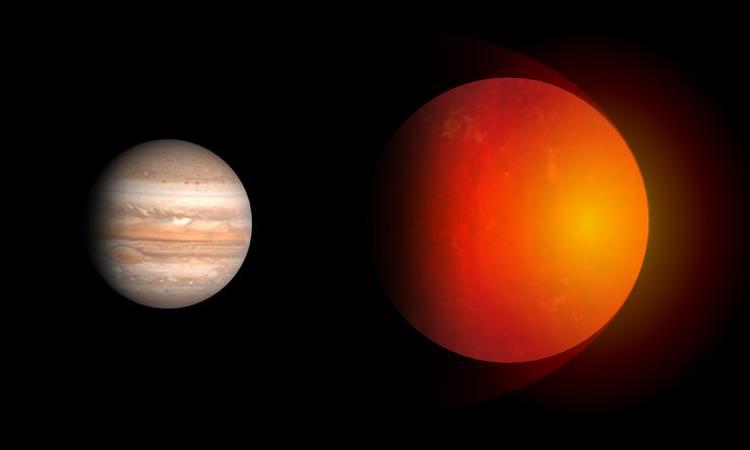
Size comparison of TrES-4 with Jupiter
Discovery
Discovered byMandushev et al[1]
Discovery date2006–2007
Transit
Orbital characteristics
0.05091 ± 0.00071 AU (7.616 ± 0.106 million km)[2]
Eccentricity0
3.553945 ± 0.000075 d
Inclination82.86 ± 0.33[2]
Semi-amplitude86.1
StarGSC 02620-00648 A[2]
Physical characteristics
1.838+0.240
−0.238
 RJ
[3]
Mass0.78±0.19 MJ[3]
Mean density
0.156+0.072
−0.071
 g/cm3
[3]
7.04 ± 1.12 m/s2 (23.1 ± 3.7 ft/s2)
0.718 ± 0.114 g
Temperature1,782±29 K (1,509 °C; 2,748 °F, equilibrium)[2]

TrES-4b is an exoplanet. It was discovered in 2006, and announced in 2007, by the Trans-Atlantic Exoplanet Survey, using the transit method. At the time of its discovery TrES-4 was the largest confirmed exoplanet ever found, now more than 10 larger planets have been discovered. It is approximately 1,400 light-years (430 pc) away orbiting the star GSC 02620-00648, in the constellation Hercules.[1]

Orbit

[edit]

TrES-4 orbits its primary star every 3.543 days and eclipses it when viewed from Earth.

A 2008 study concluded that the GSC 02620-00648 system (among others) is a binary star system allowing even more accurate determination of stellar and planetary parameters.[2]

The study in 2012, utilizing a Rossiter–McLaughlin effect, have determined the planetary orbit is probably aligned with the equatorial plane of the star, misalignment equal to 6.3±4.7°.[4]

Physical characteristics

[edit]

The planet is slightly less massive than Jupiter (0.919 ± 0.073 MJ) but its diameter is 84% larger. This give TrES-4 an average density of only about a third of a gram per cubic centimetre, approximately the same as Saturn's moon Methone. At the time of its discovery in 2007, TrES-4 was described as both the largest known planet and the planet with the lowest known density.[2][1]

TrES-4b's orbital radius is 0.05091 AU, giving it a predicted surface temperature of about 1,782 K (1,509 °C; 2,748 °F). This by itself is not enough to explain the planet's low density, however. It is not currently known why TrES-4b is so large. The probable causes are the proximity to a parent star that is three to four times more luminous than the Sun as well as the internal heat within the planet.[2][1]

See also

[edit]

References

[edit]
[edit]
Revisions and contributorsEdit on WikipediaRead on Wikipedia
from Grokipedia
TrES-4b is a hot Jupiter exoplanet orbiting the F-type star TrES-4 (also known as GSC 02620-00648), located approximately 1,684 light-years away in the constellation Hercules.[1] Discovered in 2007 through the transit method by the Trans-Atlantic Exoplanet Survey (TrES), it was the largest and least dense known exoplanet at the time of its announcement, with a radius of about 1.7 times that of Jupiter but a mass of only 0.8 Jupiter masses, yielding an average density of roughly 0.2 g/cm³—comparable to balsa wood or the icy moon Methone.[2][1][3] Revised measurements as of 2025 give a radius of 1.89 Jupiter radii, a mass of 0.78 Jupiter masses, and a density of 0.10 g/cm³.[1] This extreme puffiness classifies TrES-4b as one of the most inflated hot Jupiters, orbiting its host star—a slightly larger and hotter F8 V dwarf than the Sun—every 3.55 days at a close semi-major axis of 0.051 AU, which subjects it to intense stellar radiation and an equilibrium temperature exceeding 1,700 K.[1][2] The planet's low density is attributed to atmospheric heating and expansion from the star's high-energy irradiation, potentially leading to partial atmospheric escape, though the exact mechanisms remain under study; recent spectroscopic observations as of 2025 continue to probe its extended atmosphere.[4][5][6] Subsequent observations have revealed that the TrES-4 system includes stellar companions, adding complexity to its dynamics, and TrES-4b continues to serve as a key target for understanding the physics of highly irradiated gas giants.[7][1]

Discovery and designation

Discovery

TrES-4b was discovered in 2007 by the Trans-Atlantic Exoplanet Survey (TrES) team, led by Georgi Mandushev at Lowell Observatory.[3] The detection relied on the transit method, which identifies exoplanets by observing periodic dips in a star's brightness caused by a planet passing in front of it.[3] Photometric observations were obtained using the 4-inch KeplerCam imager mounted on the 48-inch (1.2 m) telescope at the Fred Lawrence Whipple Observatory (FLWO) in Arizona, as well as the 10-inch TrES-North telescope at Palomar Observatory in California.[8] These wide-field instruments monitored thousands of stars for transit signatures, with TrES-4b's host star, GSC 02620-00648, identified as a candidate after repeated photometric dips were detected.[3] To confirm the planetary nature of the transiting object and rule out false positives such as eclipsing binaries, the team conducted radial velocity measurements using the Tillinghast Reflector Echelle Spectrograph (TRES) on the 60-inch (1.5 m) Tillinghast Reflector at FLWO.[9] These spectroscopic observations revealed the reflex motion of the host star due to an orbiting companion, consistent with a Jupiter-mass planet.[3] The discovery was announced on August 6, 2007, in a press release accompanying the publication in The Astrophysical Journal Letters.[10] The key paper, Mandushev et al. (2007), detailed the light curve analysis that determined the orbital period of approximately 3.55 days from the photometric data.[3]

Designation

TrES-4b is the primary designation for the exoplanet, assigned by the Trans-Atlantic Exoplanet Survey (TrES), in which "TrES-4" identifies the fourth target star (cataloged as GSC 02620-00648 A) and "b" signifies the first confirmed planet around it.[3][1] Given the binary configuration of its host system, the planet is alternatively designated TrES-4 Ab in some catalogs to specify its association with the primary star.[11] TrES-4b is included in major exoplanet archives, such as the NASA Exoplanet Archive, where it was confirmed in 2007 based on transit observations.[1] Upon its announcement, TrES-4b held the record for the largest radius among known exoplanets, a status it maintained until the discovery of WASP-17b in 2009.[3][12]

Host star system

Primary star

TrES-4A is the primary star of the TrES-4 system, classified as an F8 V dwarf located in the constellation Hercules.[2] It has an apparent visual magnitude of V = 11.59 ± 0.004 and lies at a distance of 516 ± 7 parsecs (about 1,683 light-years) from Earth, as determined by Gaia DR3 parallax measurements.[13][1] The star has a mass of 1.18 ± 0.21 M_⊙ and a radius of 2.01 ± 0.11 R_⊙, based on Gaia DR2 analysis and stellar evolution models (updated with DR3-consistent values).[13][1] Its effective temperature is 6184 ± 138 K, with a surface gravity of log g ≈ 3.9 (derived), and metallicity [Fe/H] = +0.14 ± 0.09, indicating a slightly metal-rich composition relative to the Sun.[14][13] The luminosity is approximately 5.3 L_⊙, which contributes to the intense insolation received by the orbiting planet TrES-4b, affecting its atmospheric and thermal properties.[13][1] The age of TrES-4A is estimated at 2.2 ± 0.4 Gyr, consistent with its position on the main sequence for an F-type star.[15] Observations of the Rossiter-McLaughlin effect during planetary transits reveal a close spin-orbit alignment, with the sky-projected obliquity λ = 6.3° ± 4.7°, suggesting that the planet's orbital plane is nearly aligned with the star's equatorial plane.[16] TrES-4A is the brighter component of a wide binary system, with a fainter companion at a projected separation of approximately 0.8 arcseconds.

Companion star

TrES-4 is a binary star system comprising the primary F-type star TrES-4A and a fainter companion designated TrES-4B, classified as an M-type dwarf. The companion contributes negligibly to the combined system's light during transit observations of the planet, allowing accurate determination of planetary parameters from photometry centered on the primary.[17] The binary nature was discovered in 2009 through high-resolution Lucky Imaging observations using the AstraLux instrument on the 2.2 m telescope at Calar Alto Observatory, which resolved the companion within the primary's point-spread function wings.[17] Follow-up astrometric monitoring confirmed common proper motion with the primary, establishing physical association rather than a chance alignment.[18] The projected angular separation measures 0.786 ± 0.001 arcseconds, corresponding to a physical projected distance of approximately 406 AU given the system's distance of 516 ± 7 pc, with a position angle of 359.8 ± 0.3 degrees.[17][1] Spectral analysis indicates TrES-4B has a type of M0.5 V, with an effective temperature around 3800 K and an estimated mass of 0.6 M, consistent with main-sequence evolution models for low-mass stars.[17] Later photometric constraints from i- and z-band colors refine the spectral type to the range K4.5 V to M1.5 V, implying a mass range of roughly 0.5–0.7 M.[18] The companion's faintness (Δi ≈ 4.56 mag) underscores its lower luminosity compared to the primary.[17] Given the wide separation exceeding several hundred AU, TrES-4B exerts minimal gravitational influence on the inner planetary orbit, with no significant perturbations to TrES-4b's close-in path.[17] Dynamical simulations of the hierarchical system confirm long-term orbital stability for the planet around TrES-4A, as the binary's outer orbit lies well beyond the stability radius predicted by three-body models (typically ~50 AU for equal-mass binaries, scaled appropriately here).[17] This architecture supports the planet's observed transit properties without requiring revisions beyond small flux dilution corrections (~0.5% effect on semi-major axis estimates).[17]

Orbital characteristics

Orbital parameters

TrES-4b completes one orbit around its host star every 3.553927 ± 0.000003 days, corresponding to a highly circular trajectory with eccentricity $ e \approx 0 $.[19] Radial velocity observations confirm no significant eccentricity, as the measured semi-amplitude $ K = 97.4 \pm 7.2 $ m/s aligns with a circular model without deviations indicative of an eccentric orbit.[19] The semi-major axis of this orbit measures 0.05084 ± 0.00050 AU, placing TrES-4b in a close-in configuration typical of hot Jupiters.[19] This distance, combined with the short orbital period, results in an orbital inclination of 82.81° ± 0.37°, sufficiently near edge-on to facilitate transit detections.[19] More recent analysis as of 2025 refines the inclination to 82.582° ± 0.025° (Meech et al. 2025).[20] For a circular orbit, the mean orbital speed $ v $ is given by the formula
v=2πaP, v = \frac{2\pi a}{P},
where $ a $ is the semi-major axis and $ P $ is the orbital period; using the measured values yields $ v \approx 156 $ km/s.[19] The proximity of TrES-4b to its host star, driven by the brief orbital period, implies a strong potential for tidal locking, where the planet's rotation synchronizes with its orbital motion, a common outcome for hot Jupiters in such configurations.[21] Subsequent radial velocity studies, including Sozzetti et al. (2015) and Bonomo et al. (2017), report a revised K ≈ 51 m/s, consistent with a lower planetary mass of ≈0.5 M_Jup while maintaining e ≈ 0.[22][23]

Transit properties

TrES-4b's transits are characterized by a duration of approximately 3.63 hours, during which the planet passes in front of its host star, causing a detectable dip in the stellar flux.[24] The transit depth is about 0.937%, reflecting the planet's large radius relative to the star, with the ratio of planetary to stellar radius derived from the square root of the depth as $ R_p / R_\star = \sqrt{\delta} $.[24] Analysis of the transit light curves reveals nearly box-shaped profiles, indicative of minimal limb darkening effects due to the host star's F-type spectral class and the transit geometry. The impact parameter, defined as $ b = (a / R_\star) \cos i $, is approximately 0.755, confirming a nearly edge-on orbit that facilitates clear transit observations.[24][19] No significant transit timing variations (TTVs) have been detected in multiple photometric datasets, placing constraints on the presence of additional perturbing bodies in the system.[22] Follow-up observations, including several transits monitored with the Spitzer Space Telescope in the 2010s, have focused on infrared secondary eclipses to measure the planet's day-night temperature contrast and thermal emission.[25] These measurements reveal a brightness temperature consistent with efficient heat redistribution across the planet's dayside.[25]

Physical characteristics

Mass and radius

The mass of TrES-4b is derived from radial velocity observations of its host star, which measure the star's wobble due to the planet's gravitational influence. The radial velocity semi-amplitude $ K = 51 \pm 3 $ m/s is used in the standard formula for the minimum planetary mass:
Mpsini=(P2πG)1/3KM2/3(1e2)1/2, M_p \sin i = \left( \frac{P}{2\pi G} \right)^{1/3} K M_\star^{2/3} \left(1 - e^2 \right)^{-1/2},
where $ P $ is the orbital period, $ G $ is the gravitational constant, $ M_\star $ is the stellar mass, $ e $ is the eccentricity (assumed to be 0 for a circular orbit), and $ i $ is the orbital inclination. With updated stellar parameters, including $ M_\star = 1.18 \pm 0.21 $ M_\odot from Gaia-based analysis and $ i \approx 90^\circ $, this yields a planetary mass of $ 0.78 \pm 0.19 $ MJ_J.[26][13] The radius of TrES-4b is obtained primarily from transit photometry, where the depth of the light curve provides the ratio of planetary to stellar radius, combined with the stellar radius to derive the absolute value. High-precision observations, refined with empirical methods using Gaia parallaxes, yield $ R_p = 1.61 \pm 0.18 $ RJ_J. Uncertainties in both mass and radius stem from errors in stellar parameters (such as $ M_\star $ and $ R_\star $) and instrumental noise in radial velocity and photometric data. These parameters were initially refined in a 2015 study using HARPS-N data but further updated in 2017 to account for improved stellar characterization, resolving earlier discrepancies.[26][22] Relative to Jupiter, TrES-4b has approximately 78% the mass but a radius about 1.6 times larger, resulting in a volume roughly 4.2 times greater and underscoring its low density.[26]

Density and internal structure

TrES-4b exhibits a low mean density of approximately 0.25 g/cm³, calculated from its measured mass and radius using the formula ρ=3M4πR3\rho = \frac{3M}{4\pi R^3}, where MM is the planetary mass and RR is the radius, with $ M_p = 0.78 \pm 0.19 $ MJup_\mathrm{Jup} and $ R_p = 1.61 \pm 0.18 $ RJup_\mathrm{Jup}.[26] This value is approximately 19% of Jupiter's mean density of 1.33 g/cm³, indicating significant inflation relative to solar system gas giants, though less extreme than earlier estimates.[26] The density implies an internal structure dominated by an extended hydrogen-helium envelope, consistent with models of inflated hot Jupiters that feature a modest central core of heavy elements. Interior models for similar low-density exoplanets suggest a rocky or icy core mass below 10 Earth masses, surrounded by an envelope where heavy elements constitute 20–30% of the total mass by enhancing opacity and altering heat transport. Updated parameters from 2017 align better with standard evolutionary models, though additional heating mechanisms may still be required to fully explain the observed radius.[22] The causes of this inflation extend beyond stellar irradiation, which alone cannot fully account for the expansion according to equilibrium tide calculations yielding insufficient energy input (maximum ~4.5 × 10^{18} W). Potential additional contributors include internal heat retained from the planet's formation or obliquity-driven tides generating kinetic heating or Ohmic dissipation in the envelope.[22] Evolutionary models indicate that TrES-4b will gradually contract over gigayear timescales, with simulations predicting a tidal circularization timescale of ~40 Myr, obliquity evolution over ~24 Gyr, and orbital decay in ~6 Gyr, though current radius predictions may still require enhanced heating for full consistency.[22] Earlier analyses classified TrES-4b among Class II hot Jupiters with high equilibrium temperatures, supporting long-term contraction but highlighting the role of its wide binary host separation in limiting external perturbations.[27]

Atmosphere

Temperature profile

The equilibrium temperature of TrES-4b's dayside is 1778 ± 22 K, determined from observations and the standard blackbody approximation for irradiated planets.[1] This value is calculated using the formula
Teq=TstarRstar2a(1A)1/4f, T_\text{eq} = T_\text{star} \sqrt{\frac{R_\text{star}}{2a}} (1 - A)^{1/4} f,
where Tstar=6200±75T_\text{star} = 6200 \pm 75 K is the effective temperature of the host star, Rstar=1.66±0.19RR_\text{star} = 1.66 \pm 0.19\, R_\odot its radius, a=0.05084±0.00050a = 0.05084 \pm 0.00050 AU the semi-major axis of the planet's orbit, A0.3A \approx 0.3 the Bond albedo, and f1f \approx 1 the redistribution factor assuming no heat transfer to the nightside.[1][3] The Bond albedo of TrES-4b is low, in the range ~0.1–0.3, consistent with secondary eclipse measurements that show bright dayside thermal emission without significant reflected light.[28] These observations imply efficient absorption of incident stellar radiation, contributing to the planet's high thermal emission in the infrared.[28] Stellar irradiation dominates the energy budget of TrES-4b, delivering an incident flux of F=Lstar/(4πa2)1.9×109F = L_\text{star} / (4\pi a^2) \approx 1.9 \times 10^9 erg cm2^{-2} s1^{-1}, where LstarL_\text{star} is the stellar luminosity derived from its effective temperature and radius (as of November 2025).[1] Internal heat generation, estimated at ~10810^8 erg cm2^{-2} s1^{-1}, plays a minor role compared to this external input.[3] Infrared observations with the Spitzer Space Telescope reveal a substantial day-night temperature contrast of ~500–1000 K, indicating inefficient global heat redistribution and localized heating on the dayside.[25] This contrast is evidenced by the planet's broadband emission spectrum, which shows elevated brightness temperatures on the dayside (e.g., 1960 ± 70 K at 3.6 μm) relative to models assuming uniform circulation.[25]

Atmospheric models

The atmosphere of TrES-4b is primarily composed of hydrogen and helium, with trace amounts of metals and detected molecules such as water vapor (H₂O), carbon monoxide (CO), and carbon dioxide (CO₂).[29] Recent JWST NIRSpec transmission spectroscopy in the 2.8–5.2 μm range reveals a sub-stellar metallicity of 0.4–0.7 times solar and a carbon-to-oxygen (C/O) ratio of 0.30–0.42, indicating carbon depletion relative to solar abundances and suggesting formation scenarios involving oxygen-rich gas accretion or carbon-poor solids.[29] Theoretical models of TrES-4b's atmosphere incorporate hydrodynamic escape driven by extreme ultraviolet (XUV) irradiation from its host star, predicting a mass loss rate on the order of 10¹⁰ g/s, consistent with energy-limited escape for low-density hot Jupiters.[30] Transmission spectroscopy analyses suggest a hazy upper atmosphere, as earlier Hubble Space Telescope (HST) observations in the near-infrared showed featureless spectra best fit by models including Rayleigh scattering from haze particles or H₂-H₂ collision-induced absorption, with no clear molecular features detected at the time.[31] More recent JWST data resolve individual molecular absorptions, confirming the presence of H₂O at 8.4σ significance (log X_{H₂O} = -2.98^{+0.68}{-0.73}), CO at 3.1σ (log X{CO} = -3.76^{+0.89}{-1.01}), and CO₂ at 4.0σ (log X{CO₂} = -6.86^{+0.62}_{-0.65}), while the overall spectrum aligns with chemical equilibrium models lacking strong evidence for additional hazes.[29] Infrared emission observations from Spitzer indicate potential thermal inversions in the dayside atmosphere, attributable to absorbers like titanium oxide (TiO) and vanadium oxide (VO), which could stratify the temperature profile and contribute to the planet's inflated radius.[32] Atmospheric inflation models for TrES-4b invoke mechanisms such as double-diffusive convection in the radiative zone, where compositional gradients inhibit cooling and sustain an extended envelope, or magnetic drag inducing ohmic dissipation that deposits heat deep in the interior (up to ~10^{20} W below 100 bar pressures).[33] These processes explain its large radius of ~1.6 R_{Jup} without requiring extreme internal heat sources.[1] As of November 2025, while HST provided broad constraints, JWST has delivered the first resolved molecular spectra, but deeper observations are anticipated to detect additional features like methane (CH₄) or ammonia (NH₃), potentially refining models of vertical mixing and metallicity gradients.[29]

Scientific significance

Puffy planet archetype

TrES-4b stands as one of the earliest identified examples of a "puffy" hot Jupiter, featuring an exceptionally low density of approximately 0.22 g/cm³, the lowest among known transiting exoplanets at the time of its discovery.[34] This characteristic inspired the definition of a subclass of inflated gas giants, often termed puffy planets, which exhibit radii significantly larger than expected for their masses due to intense stellar heating.[35] Its identification in 2007 marked a pivotal moment in recognizing the diversity of hot Jupiter structures beyond standard models.[34] A defining trait of TrES-4b is its radius anomaly, with a measured size of 1.674 ± 0.094 R_J despite a mass of 0.84 ± 0.10 M_J, posing a direct challenge to conventional evolutionary theories that predict smaller radii for such planets under typical irradiation levels.[34] Updated measurements have refined this to a mass of 0.78 ± 0.19 M_J and radius of 1.61 ± 0.18 R_J, maintaining its status as highly inflated with a density around 0.21 g/cm³.[1] The discovery of TrES-4b spurred investigations into the mechanisms driving inflation, particularly the balance between stellar irradiation absorbed in the upper atmosphere and potential internal energy sources like tidal heating or residual formation heat.[36] It has served as a comparative benchmark for subsequent puffy planets, such as Kepler-7b (density ~0.17 g/cm³) and HAT-P-67b (density ~0.06 g/cm³), highlighting variations in inflation efficiency across different systems.[37] Notably, TrES-4b demonstrates extreme inflation without an ultra-short orbital period—its 3.55-day orbit contrasts with more tightly bound puffier planets—implying non-standard formation or atmospheric retention processes that sustain its expanded envelope.[34]

Research impacts

The discovery of TrES-4b exemplified the success of ground-based wide-field transit surveys, validating the TrES network's approach and contributing to its identification of five transiting hot Jupiters, which informed the design of subsequent space-based missions like NASA's Transiting Exoplanet Survey Satellite (TESS) by emphasizing efficient photometric monitoring of bright stars.[34] As one of the earliest examples of an extremely low-density hot Jupiter, TrES-4b spurred theoretical models explaining planetary inflation through mechanisms such as ohmic dissipation from induced currents in the planet's interior and tidal heating, with its parameters frequently referenced in studies testing these processes against observational data.[38] Observations of spin-orbit alignment in the TrES-4 system, revealing a near-zero obliquity of approximately 6.3° ± 4.7°, provided key tests for tidal migration theories in hot Jupiter formation, supporting models where disk interactions align planetary orbits with stellar spin.[39] TrES-4b served as an early target for infrared characterization of hot Jupiter atmospheres, with Spitzer Space Telescope secondary eclipse photometry detecting a temperature inversion in its dayside emission spectrum, marking it as a benchmark for understanding stratospheric heating from absorbers like titanium oxide. More recently, JWST NIRSpec transmission spectroscopy in 2024 revealed sub-solar metallicity (0.4–0.7 times solar) and carbon depletion in its atmosphere, confirming its status as a reference for aligned hot Jupiters while highlighting compositional anomalies possibly linked to formation history.[29] Although no major parameter revisions have occurred since refined radial-velocity analyses around 2015, TrES-4b remains a standard for validating atmospheric retrieval techniques due to its well-constrained transit depth and brightness.[22] Ongoing research gaps include limited constraints on atmospheric circulation, where future JWST phase-curve observations could map day-night heat redistribution and probe equatorial winds exceeding 1 km/s, building on its aligned orbit for dynamical studies.[40] Additionally, the host star's binary companionship underscores the need for incorporating multiplicity effects in planet formation models, as gravitational interactions may influence migration and stability in such systems.

References

User Avatar
No comments yet.