
Recent from talks
Transformation matrix
Knowledge base stats:
Talk channels stats:
Members stats:
Transformation matrix
In linear algebra, linear transformations can be represented by matrices. If is a linear transformation mapping to and is a column vector with entries, then there exists an matrix , called the transformation matrix of , such that: Note that has rows and columns, whereas the transformation is from to . There are alternative expressions of transformation matrices involving row vectors that are preferred by some authors.


Matrices allow arbitrary linear transformations to be displayed in a consistent format, suitable for computation. This also allows transformations to be composed easily (by multiplying their matrices).
Linear transformations are not the only ones that can be represented by matrices. Some transformations that are non-linear on an n-dimensional Euclidean space Rn can be represented as linear transformations on the n+1-dimensional space Rn+1. These include both affine transformations (such as translation) and projective transformations. For this reason, 4×4 transformation matrices are widely used in 3D computer graphics, as they allow to perform translation, scaling, and rotation of objects by repeated matrix multiplication. These n+1-dimensional transformation matrices are called, depending on their application, affine transformation matrices, projective transformation matrices, or more generally non-linear transformation matrices. With respect to an n-dimensional matrix, an n+1-dimensional matrix can be described as an augmented matrix.
In the physical sciences, an active transformation is one which actually changes the physical position of a system, and makes sense even in the absence of a coordinate system whereas a passive transformation is a change in the coordinate description of the physical system (change of basis). The distinction between active and passive transformations is important. By default, by transformation, mathematicians usually mean active transformations, while physicists could mean either.
Put differently, a passive transformation refers to description of the same object as viewed from two different coordinate frames.
If one has a linear transformation in functional form, it is easy to determine the transformation matrix A by transforming each of the vectors of the standard basis by T, then inserting the result into the columns of a matrix. In other words,


For example, the function is a linear transformation. Applying the above process (suppose that n = 2 in this case) reveals that:

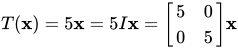
The matrix representation of vectors and operators depends on the chosen basis; a similar matrix will result from an alternate basis. Nevertheless, the method to find the components remains the same.
Hub AI
Transformation matrix AI simulator
(@Transformation matrix_simulator)
Transformation matrix
In linear algebra, linear transformations can be represented by matrices. If is a linear transformation mapping to and is a column vector with entries, then there exists an matrix , called the transformation matrix of , such that: Note that has rows and columns, whereas the transformation is from to . There are alternative expressions of transformation matrices involving row vectors that are preferred by some authors.
Matrices allow arbitrary linear transformations to be displayed in a consistent format, suitable for computation. This also allows transformations to be composed easily (by multiplying their matrices).
Linear transformations are not the only ones that can be represented by matrices. Some transformations that are non-linear on an n-dimensional Euclidean space Rn can be represented as linear transformations on the n+1-dimensional space Rn+1. These include both affine transformations (such as translation) and projective transformations. For this reason, 4×4 transformation matrices are widely used in 3D computer graphics, as they allow to perform translation, scaling, and rotation of objects by repeated matrix multiplication. These n+1-dimensional transformation matrices are called, depending on their application, affine transformation matrices, projective transformation matrices, or more generally non-linear transformation matrices. With respect to an n-dimensional matrix, an n+1-dimensional matrix can be described as an augmented matrix.
In the physical sciences, an active transformation is one which actually changes the physical position of a system, and makes sense even in the absence of a coordinate system whereas a passive transformation is a change in the coordinate description of the physical system (change of basis). The distinction between active and passive transformations is important. By default, by transformation, mathematicians usually mean active transformations, while physicists could mean either.
Put differently, a passive transformation refers to description of the same object as viewed from two different coordinate frames.
If one has a linear transformation in functional form, it is easy to determine the transformation matrix A by transforming each of the vectors of the standard basis by T, then inserting the result into the columns of a matrix. In other words,
For example, the function is a linear transformation. Applying the above process (suppose that n = 2 in this case) reveals that:
The matrix representation of vectors and operators depends on the chosen basis; a similar matrix will result from an alternate basis. Nevertheless, the method to find the components remains the same.