Hubbry Logo
Trump VillageTrump VillageMain
Open search
Trump Village
Community hub
Trump Village
logo
8 pages, 0 posts
0 subscribers
Be the first to start a discussion here.
Trump Village
Trump Village
from Wikipedia

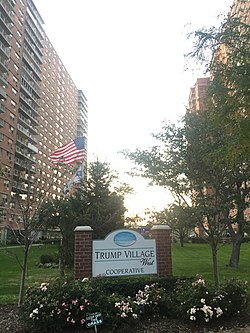
Trump Village is a seven-building cooperative apartment complex in the Coney Island neighborhood of Brooklyn in New York City, New York.[1][2]

Key Information

History

[edit]

The apartment complex was built in 1963–1964 and developed by Fred Trump, the father of Donald Trump.[1][3] The complex, built on the site of the former Culver Depot,[4] was designed by architect Morris Lapidus.[2]

The construction cost US$70 million.[5] It was supported by the New York State Housing Finance Agency through public bonds issued by the state of New York, coupled with tax exemption.[6] Five out of the seven buildings were part of the Mitchell-Lama Housing Program until 2007.[3]

It is the only Trump-branded building complex named by Fred Trump rather than his son Donald.[7]

References

[edit]
[edit]
Revisions and contributorsEdit on WikipediaRead on Wikipedia
from Grokipedia
Trump Village is a apartment complex consisting of seven 23-story residential towers containing approximately 3,800 units, located in the neighborhood of , . Developed by real estate magnate Fred C. Trump and completed in 1964, it stands as the largest and final major project in his portfolio of middle-class housing developments, spanning roughly 30 acres and constructed at a cost of around $70 million. The complex, which includes amenities such as on-site parking, laundry facilities, and proximity to Coney Island's beach and , was designed to provide for working-class families in a post-World War II urban expansion effort. , who began his career building single-family homes in and in the , leveraged federal financing and ownership models to scale up to high-rise constructions like Trump Village, marking a shift toward larger-scale urban housing solutions. Though the development displaced some existing low-income residents from the site, it ultimately housed over 1,000 families upon opening in late 1963, contributing significantly to Brooklyn's residential stock amid a housing shortage. Trump Village gained further notability as the only pre-1980s project bearing the Trump family name, predating Donald Trump's ventures, and has endured as a stable with maintained original features in many units, despite occasional legal challenges related to tenant accommodations. Its location near elevated train lines and amusement areas underscores its role in integrating middle-income housing with recreational access, though residents note persistent noise from transit infrastructure.

Overview

Location and Physical Description

Trump Village is located in the neighborhood of , , along Neptune Avenue between Ocean Parkway and West 5th Street. The complex occupies a site proximate to the Atlantic Ocean, Coney Island Beach, and the historic amusement district, providing many units with ocean and boardwalk views. The development comprises seven 23-story residential towers constructed in a modernist style, characterized by large L-shaped building footprints, extensive arrangements, and the absence of upper-floor setbacks. These mid-rise structures approximately 3,700 and rental apartments across the complex, set within a park-like environment featuring green spaces amid the urban coastal setting. Individual , such as those at 458 Avenue, contain around 572 units each, emphasizing spacious layouts with central and proximity to transportation and recreational amenities.

Purpose and Design Features

Trump Village was developed to provide affordable middle-income housing amid initiatives in , replacing a neighborhood of declining three- and four-story brick and wooden structures with modern high-rise apartments targeted at working-class and middle-class families. The project, constructed under New York State's Mitchell-Lama program, aimed to address post- housing shortages by offering subsidized rentals that could convert to cooperative ownership, with initial purchase prices as low as $3,000 per unit in later sections. The design emphasized sturdy, functional suited to mass , featuring seven 23-story towers arranged in a park-like setting on approximately 40 acres, containing around 3,800 one- to three-bedroom apartments without initial but with carpeted hallways. Architect , known for Miami Modern style, oversaw the utilitarian brown- facades accented by splashes of blue or yellow tile, uniform balconies, and an institutional aesthetic prioritizing durability over ornamentation. Key features included proximity to Coney Island Beach and boardwalk for recreational access, on-site shopping facilities in the Trump Village , and a layout fostering community living through shared green spaces, though the towers' height and repetitive design reflected the era's focus on vertical density to maximize in a coastal zone.

Development History

Pre-Development Site and Urban Renewal Context

The pre-development site of Trump Village occupied approximately 40 acres in the West End of , , characterized by dilapidated low-rise residential structures, including densely packed bungalows and small homes housing low-income families. This area, sometimes referred to locally as "the Gut," suffered from post-World War II deterioration, with substandard housing conditions typical of neighborhoods targeted for . Prior to clearance, the site supported around 900 households, comprising Black, Italian, and Irish residents. New York City's urban renewal efforts in Coney Island formed part of a broader mid-20th-century initiative under the federal Housing Act of 1949's Title I, which provided funding for slum clearance and to replace blighted areas with modern housing and infrastructure. In 1949, urban planner designated the residential West End, including the future Trump Village footprint, as an urban renewal zone to address overcrowding and decay. Throughout the and , authorities demolished entire blocks west of West 19th Street, displacing thousands of residents citywide as part of these programs, which prioritized high-density replacement projects over preserving existing communities. For the Trump Village site specifically, clearance involved and relocation overseen by developer , who shifted displaced families—predominantly poor households—to adjacent like the 1940s-era Coney Island Houses (later renamed Dayton Houses) managed by the . This process cleared the land for a Mitchell-Lama project, a state program established in 1955 to incentivize private development of middle-income cooperatives through low-interest loans and tax abatements, often utilizing urban renewal-acquired sites. While enabling construction of 3,700 new units by 1964, the renewal displaced established low-income residents without equivalent replacement nearby, contributing to criticisms of net loss despite the infusion of subsidized modern apartments.

Planning and Financing

The planning of Trump Village originated with , who envisioned a large-scale middle-income complex on a 35-acre site in , , as part of New York City's broader efforts to replace dilapidated structures with modern residential towers. The design featured seven 23-story buildings intended to house approximately 3,700 apartments, emphasizing ownership models to promote long-term affordability for working-class and middle-class residents, including teachers and civil servants. This approach aligned with post-World War II policies prioritizing high-, elevator-served apartments with on-site amenities to maximize while containing costs. Financing for the project, totaling $70 million, relied heavily on the Mitchell-Lama Housing Program, a 1959 New York State initiative that offered developers low-interest mortgages, tax abatements, and regulatory flexibility in return for rent restrictions and affordability covenants. The program facilitated public bond issuances through entities like the New York State Housing Finance Agency, which committed over $50 million specifically for Trump Village, enabling rapid scaling without full private equity reliance. These government-backed mechanisms, including subsidies from the Federal Housing Administration for similar postwar projects, allowed Fred Trump to leverage public resources for private development while adhering to income-targeted occupancy requirements.

Construction Phase

Construction of Trump Village began with groundbreaking ceremonies in May 1962, following site clearance as part of efforts in . The project, developed by Fred C. Trump, involved erecting seven 23-story residential towers containing approximately 3,800 apartments on a 40-acre site bounded by Ocean Parkway, West 5th Street, Neptune Avenue, and Stillwell Avenue. The architectural design was handled by Morris Lapidus in collaboration with Kornbluth, Harle & Liebman, adhering to 1961 zoning requirements that mandated small building footprints and extensive landscaping to preserve open space. General contracting was awarded to HRH Construction, with Trump Organization entities receiving a builder's fee of $4.8 million, of which $3.8 million was collected by fall 1963. Financing came primarily from $50 million in bonds issued by the New York State Housing Finance Agency, supporting the Mitchell-Lama program's aim to provide middle-income housing. Delays in the construction timeline arose from legal and political disputes with Abraham , a prominent cooperative housing advocate and competitor, which postponed final agency approvals. To mitigate issues, Trump accepted down payments from prospective co-op buyers prior to securing full financing, a practice that accelerated progress despite the hurdles. The towers' height and placement made them visible up to 20 miles offshore, emphasizing their scale in the waterfront landscape. The complex reached substantial completion by fall 1964, with an estimated total development cost of $60 million, marking one of the largest middle-income housing projects in at the time.

Post-Construction Evolution

Opening and Initial Occupancy

Trump Village's initial buildings opened in late , with Trump Village West—consisting of two 23-story towers containing 1,144 apartments—welcoming residents on December 16, . This marked the start of occupancy for the complex, developed by under New York's Mitchell-Lama program to provide subsidized middle-income housing through low-interest state loans and tax incentives. Subsequent phases followed rapidly, with additional sections including three buildings in Section 3 (1,672 apartments) and further units in Section 4 completing occupancy in 1964, bringing the total to seven high-rise towers across approximately 40 acres. The development's 3,700 units filled quickly with working- and middle-class families, primarily renters at inception, drawn by affordable rents and amenities such as on-site parking, playgrounds, and proximity to Coney Island's beachfront. Initial tenancy reflected the era's urban renewal priorities, replacing dilapidated pre-war structures with modern co-op-eligible rentals that emphasized family-oriented living in a then-underdeveloped area of . High demand led to near-full occupancy within the first year, establishing Trump Village as a stable residential hub amid Coney Island's transition from amusement-centric to mixed-use neighborhood.

Conversion to Cooperative Ownership

In 2007, shareholders of Trump Village Section 3 voted to terminate the complex's participation in New York's Mitchell-Lama program, marking its conversion from a limited-equity, government-supervised cooperative to a private, market-rate cooperative housing corporation. This transition occurred after the complex had fulfilled the program's minimum 20-year residency requirement and paid off its underlying mortgage, securing approval from the New York State Division of Housing and Community Renewal (DHCR). The Mitchell-Lama framework, established in 1955 to promote affordable middle-income housing through low-interest loans and regulatory oversight, had governed the property since its 1964 opening, restricting share sales to capped resale prices and imposing income eligibility for buyers. The process amended the 's , eliminating DHCR supervision and enabling unrestricted market-based share transactions. Trump Village Section 3, comprising three 23-story buildings with 1,674 apartments, became one of the earliest Mitchell-Lama co-ops in the to exit the program, following a similar move by its adjacent Section 4. Post-conversion, the board gained to set maintenance fees without regulatory caps, impose flip taxes on resales (typically 20% of profits), and exercise rights of first refusal on sales, which facilitated revenue generation through unit acquisitions and flips. This shift rapidly escalated property values, with two-bedroom apartments appreciating from approximately $30,000 in the early (under limited-equity constraints) to around $400,000 by the mid-2010s, reflecting Coney Island's improving market dynamics but eroding the site's original affordability mandate. Legal challenges ensued, including disputes over city transfer taxes on the , which the ultimately ruled inapplicable, affirming no taxable "transfer" occurred in the internal restructuring. The change enabled capital improvements, such as renovated lobbies, elevators, playgrounds, and on-site amenities like a daycare and medical center, funded by higher fees and sales proceeds. However, it also contributed to subsequent financial strains in related sections, as rising costs outpaced revenues without program subsidies.

Management and Operations

Trump Family Role

, as the developer and principal of Trump Management Corporation, directed the initial leasing and operational management of Trump Village following its completion in , including oversight of tenant selection processes that drew federal scrutiny for alleged . The complex's early operations involved renting units under government-subsidized programs like Mitchell-Lama, with Trump Management handling applications and maintenance across its outer-borough portfolio, of which Trump Village formed a cornerstone with approximately 3,700 units. Donald Trump joined the family business in 1968 and assumed a growing role in operations by the early , including supervision of rental properties like those in Trump Village, amid a 1973 U.S. Department of Justice lawsuit against Trump Management for in tenant screening—practices the Trumps denied and settled without admitting wrongdoing in 1975. His involvement emphasized efficiency in managing but marked a transitional phase, as he later pivoted the organization toward luxury developments, reducing focus on middle-class complexes like Trump Village. Sections 3 and 4 of Trump Village converted to ownership in the mid-1960s, shifting primary governance to resident-elected boards responsible for ongoing maintenance, rules enforcement, and financial decisions, thereby diminishing direct Trump family control over daily operations. The complex fully exited the Mitchell-Lama program in 2007, further solidifying independent co-op management without documented continued involvement.

Ongoing Governance and Maintenance

Trump Village's cooperative sections operate under independent governance structures, with each section incorporated as a separate managed by a resident-elected responsible for strategic decisions, financial oversight, and enforcement of bylaws. These boards approve share sales, set policies on subletting and , and allocate resources for upkeep, drawing from monthly carrying charges collected from shareholders. In Trump Village Section 3, governance shifted to private cooperative status in 2007 following from the Mitchell-Lama program, with AKAM Living Services contracted for administrative and operational management, including coordination of repairs and resident services across its 1,672 units in 23-story towers. Section 4, known as Trump Village West, maintains an on-site management office that oversees daily operations for its 1,144 units, supported by a 24-hour maintenance department tasked with responsive repairs and preventive upkeep of structural elements, common areas, and amenities like indoor and outdoor playgrounds. Maintenance efforts encompass boiler plant operations, building code compliance, and infrastructure preservation, as evidenced by state-issued permits requiring ongoing repairs to heating systems and facades in accordance with prudent standards. Funding derives from shareholder fees covering operational costs, though boards have faced scrutiny in related cooperatives for fee adjustments amid service challenges, such as delayed parking lot resurfacing and code violations for smoke detectors and stairway lighting documented in Section 3 as recently as April 2025. Legal settlements, including a 2015 Fair Housing Act agreement for Section 4 mandating accommodations for service animals, underscore boards' roles in resolving claims while upholding rules, with ongoing against unauthorized short-term rentals via subpoenaed records to prevent erosion of community standards.

Controversies and Criticisms

Resident Displacement and Urban Renewal Effects

The development of occurred within the framework of New York City's urban renewal programs in , which designated the site—previously known as "the Gut," an area of substandard housing—for clearance and redevelopment starting in the late 1950s. This process required the demolition of existing structures and the relocation of low-income residents, primarily poor families living in dilapidated conditions, to make way for the 3,800-unit complex. , as the primary developer, managed these relocations, directing many families to nearby sites such as the Surfside Gardens complex, which was subsequently criticized for its poor maintenance and substandard living conditions. Urban renewal efforts in , authorized under federal Housing Act provisions and local plans from the 1960s, mirrored broader patterns in where displaced tens of thousands of residents, often from minority communities, to facilitate new housing and infrastructure. For Trump Village specifically, the displacement disrupted tight-knit neighborhoods characterized by informal economies tied to Coney Island's amusement industry, leading to social fragmentation as families were scattered to outer areas with limited amenities. Relocation support was minimal by modern standards, with reports indicating inadequate compensation and challenges in rehousing equivalent to pre-clearance affordability, contributing to cycles of among the affected. While the project ultimately provided modern, subsidized cooperative targeted at moderate-income families—contrasting with the site's prior informal tenements—critics, including local historians, contend that it prioritized profit-driven development over equitable preservation, effectively shifting the area's demographic from low-income renters to more affluent co-op owners and reinforcing residential segregation patterns prevalent in FHA-backed projects of the . Long-term effects included a net increase in stock but at the cost of erasing and cultural landmarks, such as proximity to the iconic , which was visually overshadowed by the new high-rises upon completion in 1964. These outcomes exemplify the trade-offs of mid-century , where federal subsidies enabled private developers like Trump to acquire land via but often amplified inequities in access to renewed spaces.

Discrimination Lawsuits and Practices

In October 1973, the U.S. Department of Justice filed a civil lawsuit in the U.S. District Court for the Eastern District of New York against Fred C. Trump, Donald J. Trump, and Trump Management Corporation, alleging a pattern of racial discrimination in violation of the Fair Housing Act of 1968 across 39 apartment complexes comprising approximately 14,000 units in Brooklyn and Queens, including properties in the Coney Island area such as Trump Village sections. The complaint cited evidence from investigations, including tester applications and internal records, showing practices such as marking rental applications from African American prospective tenants with a "C" for "colored," falsely informing them of no vacancies despite available units, requiring larger security deposits from black applicants, and steering them toward properties in predominantly black neighborhoods while reserving units for white applicants. These methods were documented in federal probes starting in 1972, which uncovered directives from Trump Management supervisors to rental agents to avoid renting to black individuals unless compelled by low occupancy rates. Trump Management denied the allegations, countersuing the Justice Department for $100 million and claiming the suit was politically motivated reverse against whites. The case concluded in June 1975 with a that mandated nondiscriminatory advertising, centralized record-keeping of applicant data including race, and training for staff, but included no admission of liability by the defendants; the countersuit was subsequently withdrawn. Post-settlement compliance reports submitted to the court through 1978 indicated adjustments in hiring and procedures, though federal monitoring ended without further enforcement actions specific to these properties. In a separate matter, on December 23, 2015, the Justice Department sued Trump Village Section IV Inc., housing corporation for one of the complex's buildings, alleging familial status discrimination under the Fair Housing Act by restricting access to the and recreational facilities for residents with children under 16 from May 2012 to March 2015, including rules barring minors unless accompanied by adults and limiting pool hours for families. The suit sought damages for affected residents and injunctive relief to end the practices. It settled via a 2016 agreement requiring public notice of equal access policies, staff training, and reporting of complaints to the Justice Department for two years, with no admission of wrongdoing.

Tax and Financial Scrutiny

In the 1990s, as part of to transfer assets to his children, commissioned appraisals that significantly undervalued holdings, including two buildings comprising 886 rental apartments at Trump Village. A 1995 appraisal by Robert Von Ancken valued these apartments at a negative $5.9 million, citing a temporary financial shortfall following the complex's exit from an program in 1992 that permitted higher rents; this contrasted with the City of New York's contemporaneous of $38.1 million for the properties. participated in devising the overall strategy, which utilized a (GRAT) established in 1997 to minimize gift taxes on transfers valued collectively at $41.4 million across the Trump portfolio, though subsequent sales demonstrated substantially higher market values. A 2018 New York Times investigation, drawing on over 100,000 pages of confidential returns, financial records, and internal documents, characterized these low valuations—including those for Trump Village—as part of broader "dubious schemes" that enabled the Trump family to avoid hundreds of millions in gift and estate taxes. For context, a 2004 bank appraisal valued the same Trump Village apartments at $106.6 million, and sold its interests in Trump Village in 2003 for approximately $600 million as part of privatizing the Mitchell-Lama properties. The Trump family contested the Times' portrayal, with denouncing it as a "hit piece" reliant on inaccurate or illegally obtained information, and later pursued legal action against the newspaper and sources involved, though no formal charges resulted from the reported discrepancies. Trump Village itself, developed under New York's Mitchell-Lama program, received government-backed low-interest loans and exemptions to promote affordable cooperative housing, benefits that leveraged during construction in the early 1960s. Post-conversion to co-op ownership, the complex faced routine disputes, including challenges to assessments and transfer taxes (RPTT) on internal share transactions, which courts upheld as applicable despite arguments that such taxes targeted conveyances rather than co-op shares. Additionally, Trump Village Section 3 litigated federal tax treatment of interest income under Section 277 in the 1990s, with the U.S. Tax Court ruling in favor of the cooperative's position that it qualified for deductions as a Mitchell-Lama entity. These operational matters, while contentious, did not involve allegations of systemic evasion akin to the family-level scrutiny.

Legacy and Current Status

Architectural and Community Impact

Trump Village consists of seven 23-story brick-faced residential towers constructed between 1963 and 1964, featuring modernist design elements including large L-shaped footprints and expansive lobbies. The architecture, overseen by developer , prioritized functional high-rise living with doorman services and proximity to amenities, though it diverged from designer Morris Lapidus's signature Miami Modern flair seen in his projects. The complex's development under the Mitchell-Lama program introduced cooperative ownership to middle-class residents, including teachers and public workers, fostering a stable community in an area previously characterized by dilapidated housing. This shift provided approximately 3,700 units of , contributing to by replacing slums with modern infrastructure, though it involved the relocation of around 900 primarily low-income families, many to substandard conditions in nearby areas like the decrepit Surfside Gardens. Over time, Trump Village influenced Coney Island's demographic by attracting working-class families and supporting local commerce through its integrated , which later spurred further . However, the 2007 exit from Mitchell-Lama led to market-rate resales, eroding initial affordability and highlighting tensions in preserving community stability amid rising property values. The towers' durable construction has endured, with ongoing maintenance addressing aging infrastructure, while the site's evolution reflects broader challenges in balancing preservation with pressures in coastal neighborhoods. In 2023, the ordered Trump Village Section 4 to bargain collectively with Teamsters Local 237, representing maintenance and cleaning workers whose contract had expired in fall 2021, following findings that the co-op unlawfully withdrew recognition of the union. The decision stemmed from charges filed by the union alleging unfair labor practices, though Trump Village's representatives denied the allegations and sought dismissal. A 2022 Department of Buildings violation against Trump Village Section 4 addressed safety concerns, where the co-op installed blocking devices in 2021 to restrict resident access during repairs but failed to fully comply with code requirements for heights and railings, leading to an dismissed in April 2022. This incident highlighted ongoing structural maintenance challenges in the aging complex, originally constructed in the 1960s. In a 2022 personal injury lawsuit, Kaley v. Trump Village Section 4, Inc., alleged harm from an unsafe condition in a 23rd-floor on August 24, 2019, with the co-op moving for based on indemnification clauses in elevator and contracts; the court examined notice of the defect but did not resolve liability in the reported decision. Trump Village Section 4, Inc. v. Young, decided in June 2023, involved a dispute over lease rights to a unit, where the co-op accepted payments from the for over a decade before seeking to declare the shares and evict occupants, raising questions of and historical record-keeping under former manager Igor Oberman, who assumed the role in 2015. The appellate division partially affirmed lower court rulings, noting the co-op's prior treatment of the occupant as a . Housing Preservation and Development records indicate Trump Village sections maintain relatively low violation rates per unit compared to city averages, with Section 3 averaging 0.03 violations per unit as of recent data. However, resident complaints documented via 311 and other channels have periodically cited issues like malfunctions and intermittent hot water shortages, though these remain anecdotal without systemic enforcement actions in the reviewed period.

References

Add your contribution
Related Hubs
User Avatar
No comments yet.