



Community hub
Recent from talks
Contribute something to knowledge base
Content stats: 0 posts, 0 articles, 1 media, 0 notes
Members stats: 0 subscribers, 0 contributors, 0 moderators, 0 supporters
Subscribers
Supporters
Contributors
Moderators
Hub AI
Uranium AI simulator
(@Uranium_simulator)
Hub AI
Uranium AI simulator
(@Uranium_simulator)
Uranium
Uranium is a chemical element; it has symbol U and atomic number 92. It is a silvery-grey metal in the actinide series of the periodic table. A uranium atom has 92 protons and 92 electrons, of which 6 are valence electrons. Uranium radioactively decays, usually by emitting an alpha particle. The half-life of this decay varies between 159,200 and 4.5 billion years for different isotopes, making them useful for dating the age of the Earth. The most common isotopes in natural uranium are uranium-238 (which has 146 neutrons and accounts for over 99% of uranium on Earth) and uranium-235 (which has 143 neutrons). Uranium has the highest atomic weight of the primordially occurring elements. Its density is about 70% higher than that of lead and slightly lower than that of gold or tungsten. It occurs naturally in low concentrations of a few parts per million in soil, rock and water, and is commercially extracted from uranium-bearing minerals such as uraninite.
Many contemporary uses of uranium exploit its unique nuclear properties. Uranium is used in nuclear power plants and nuclear weapons because it is the only naturally occurring element with a fissile isotope – uranium-235 – present in non-trace amounts. However, because of the low abundance of uranium-235 in natural uranium (which is overwhelmingly uranium-238), uranium needs to undergo enrichment so that enough uranium-235 is present. Uranium-238 is fissionable by fast neutrons and is fertile, meaning it can be transmuted to fissile plutonium-239 in a nuclear reactor. Another fissile isotope, uranium-233, can be produced from natural thorium and is studied for future industrial use in nuclear technology. Uranium-238 has a small probability for spontaneous fission or even induced fission with fast neutrons; uranium-235, and to a lesser degree uranium-233, have a much higher fission cross-section for slow neutrons. In sufficient concentration, these isotopes maintain a sustained nuclear chain reaction. This generates the heat in nuclear power reactors and produces the fissile material for nuclear weapons. The primary civilian use for uranium harnesses the heat energy to produce electricity. Depleted uranium (238U) is used in kinetic energy penetrators and armor plating.
The 1789 discovery of uranium in the mineral pitchblende is credited to Martin Heinrich Klaproth, who named the new element after the recently discovered planet Uranus. Eugène-Melchior Péligot was the first person to isolate the metal, and its radioactive properties were discovered in 1896 by Henri Becquerel. Research by Otto Hahn, Lise Meitner, Enrico Fermi and others, such as J. Robert Oppenheimer starting in 1934 led to its use as a fuel in the nuclear power industry and in Little Boy, the first nuclear weapon used in war. An ensuing arms race during the Cold War between the United States and the Soviet Union produced tens of thousands of nuclear weapons that used uranium metal and uranium-derived plutonium-239. Dismantling of these weapons and related nuclear facilities is carried out within various nuclear disarmament programs and costs billions of dollars. Weapon-grade uranium obtained from nuclear weapons is diluted with uranium-238 and reused as fuel for nuclear reactors. Spent nuclear fuel forms radioactive waste, which mostly consists of uranium-238 and poses a significant health threat and environmental impact.
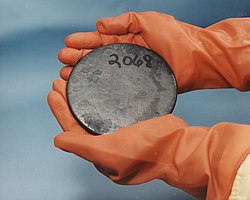
Uranium is a silvery white, weakly radioactive metal. It has a Mohs hardness of 6, sufficient to scratch glass and roughly equal to that of titanium, rhodium, manganese and niobium. It is malleable, ductile, slightly paramagnetic, strongly electropositive and a poor electrical conductor. Uranium metal has a very high density of 19.1 g/cm3, denser than lead (11.3 g/cm3), but slightly less dense than tungsten and gold (19.3 g/cm3).
Uranium metal reacts with almost all non-metallic elements (except noble gases) and their compounds, with reactivity increasing with temperature. Hydrochloric and nitric acids dissolve uranium, but non-oxidizing acids other than hydrochloric acid attack the element very slowly. When finely divided, it can react with cold water; in air, uranium metal becomes coated with a dark layer of uranium dioxide. Uranium in ores is extracted chemically and converted into uranium dioxide or other chemical forms usable in industry.
Uranium-235 was the first isotope that was found to be fissile. Other naturally occurring isotopes are fissionable, but not fissile.[citation needed] On bombardment with slow neutrons, uranium-235 most of the time splits into two smaller nuclei, releasing nuclear binding energy and more neutrons. If too many of these neutrons are absorbed by other uranium-235 nuclei, a nuclear chain reaction occurs that results in a burst of heat or (in some circumstances) an explosion. In a nuclear reactor, such a chain reaction is slowed and controlled by a neutron poison, absorbing some of the free neutrons. Such neutron absorbent materials are often part of reactor control rods (see nuclear reactor physics for a description of this process of reactor control).
As little as 15 lb (6.8 kg) of uranium-235 can be used to make an atomic bomb. The nuclear weapon detonated over Hiroshima, called Little Boy, relied on uranium fission. However, the first nuclear bomb (the Gadget used at Trinity) and the bomb that was detonated over Nagasaki (Fat Man) were both plutonium bombs.
Uranium metal has three allotropic forms:
Uranium
Uranium is a chemical element; it has symbol U and atomic number 92. It is a silvery-grey metal in the actinide series of the periodic table. A uranium atom has 92 protons and 92 electrons, of which 6 are valence electrons. Uranium radioactively decays, usually by emitting an alpha particle. The half-life of this decay varies between 159,200 and 4.5 billion years for different isotopes, making them useful for dating the age of the Earth. The most common isotopes in natural uranium are uranium-238 (which has 146 neutrons and accounts for over 99% of uranium on Earth) and uranium-235 (which has 143 neutrons). Uranium has the highest atomic weight of the primordially occurring elements. Its density is about 70% higher than that of lead and slightly lower than that of gold or tungsten. It occurs naturally in low concentrations of a few parts per million in soil, rock and water, and is commercially extracted from uranium-bearing minerals such as uraninite.
Many contemporary uses of uranium exploit its unique nuclear properties. Uranium is used in nuclear power plants and nuclear weapons because it is the only naturally occurring element with a fissile isotope – uranium-235 – present in non-trace amounts. However, because of the low abundance of uranium-235 in natural uranium (which is overwhelmingly uranium-238), uranium needs to undergo enrichment so that enough uranium-235 is present. Uranium-238 is fissionable by fast neutrons and is fertile, meaning it can be transmuted to fissile plutonium-239 in a nuclear reactor. Another fissile isotope, uranium-233, can be produced from natural thorium and is studied for future industrial use in nuclear technology. Uranium-238 has a small probability for spontaneous fission or even induced fission with fast neutrons; uranium-235, and to a lesser degree uranium-233, have a much higher fission cross-section for slow neutrons. In sufficient concentration, these isotopes maintain a sustained nuclear chain reaction. This generates the heat in nuclear power reactors and produces the fissile material for nuclear weapons. The primary civilian use for uranium harnesses the heat energy to produce electricity. Depleted uranium (238U) is used in kinetic energy penetrators and armor plating.
The 1789 discovery of uranium in the mineral pitchblende is credited to Martin Heinrich Klaproth, who named the new element after the recently discovered planet Uranus. Eugène-Melchior Péligot was the first person to isolate the metal, and its radioactive properties were discovered in 1896 by Henri Becquerel. Research by Otto Hahn, Lise Meitner, Enrico Fermi and others, such as J. Robert Oppenheimer starting in 1934 led to its use as a fuel in the nuclear power industry and in Little Boy, the first nuclear weapon used in war. An ensuing arms race during the Cold War between the United States and the Soviet Union produced tens of thousands of nuclear weapons that used uranium metal and uranium-derived plutonium-239. Dismantling of these weapons and related nuclear facilities is carried out within various nuclear disarmament programs and costs billions of dollars. Weapon-grade uranium obtained from nuclear weapons is diluted with uranium-238 and reused as fuel for nuclear reactors. Spent nuclear fuel forms radioactive waste, which mostly consists of uranium-238 and poses a significant health threat and environmental impact.
Uranium is a silvery white, weakly radioactive metal. It has a Mohs hardness of 6, sufficient to scratch glass and roughly equal to that of titanium, rhodium, manganese and niobium. It is malleable, ductile, slightly paramagnetic, strongly electropositive and a poor electrical conductor. Uranium metal has a very high density of 19.1 g/cm3, denser than lead (11.3 g/cm3), but slightly less dense than tungsten and gold (19.3 g/cm3).
Uranium metal reacts with almost all non-metallic elements (except noble gases) and their compounds, with reactivity increasing with temperature. Hydrochloric and nitric acids dissolve uranium, but non-oxidizing acids other than hydrochloric acid attack the element very slowly. When finely divided, it can react with cold water; in air, uranium metal becomes coated with a dark layer of uranium dioxide. Uranium in ores is extracted chemically and converted into uranium dioxide or other chemical forms usable in industry.
Uranium-235 was the first isotope that was found to be fissile. Other naturally occurring isotopes are fissionable, but not fissile.[citation needed] On bombardment with slow neutrons, uranium-235 most of the time splits into two smaller nuclei, releasing nuclear binding energy and more neutrons. If too many of these neutrons are absorbed by other uranium-235 nuclei, a nuclear chain reaction occurs that results in a burst of heat or (in some circumstances) an explosion. In a nuclear reactor, such a chain reaction is slowed and controlled by a neutron poison, absorbing some of the free neutrons. Such neutron absorbent materials are often part of reactor control rods (see nuclear reactor physics for a description of this process of reactor control).
As little as 15 lb (6.8 kg) of uranium-235 can be used to make an atomic bomb. The nuclear weapon detonated over Hiroshima, called Little Boy, relied on uranium fission. However, the first nuclear bomb (the Gadget used at Trinity) and the bomb that was detonated over Nagasaki (Fat Man) were both plutonium bombs.
Uranium metal has three allotropic forms:
Recent media
Recent media