



Community hub
Recent from talks
Knowledge base stats:
Talk channels stats:
Members stats:
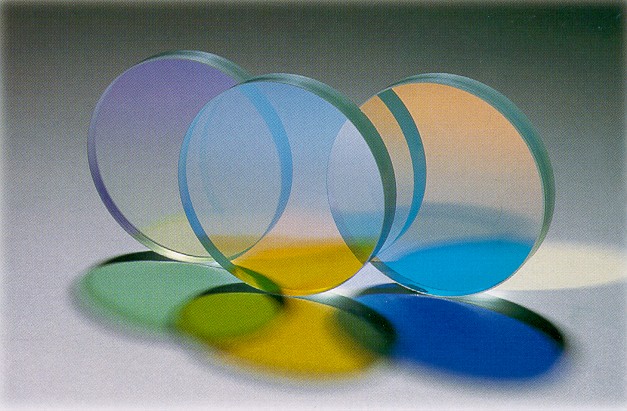
Astronomical filter
An astronomical filter is a telescope accessory consisting of an optical filter used by amateur astronomers to improve the details and contrast of celestial objects, either for viewing or for photography. Research astronomers, on the other hand, use various band-pass filters for photometry on telescopes, in order to obtain measurements which reveal objects' astrophysical properties, such as stellar classification and placement of a celestial body on its Wien curve.
Most astronomical filters work by blocking a specific part of the color spectrum above and below a bandpass, significantly increasing the signal-to-noise ratio of the interesting wavelengths, and so making the object gain detail and contrast. While the color filters transmit certain colors from the spectrum and are usually used for observation of the planets and the Moon, the polarizing filters work by adjusting the brightness, and are usually used for the Moon. The broad-band and narrow-band filters transmit the wavelengths that are emitted by the nebulae (by the hydrogen and oxygen atoms), and are frequently used for reducing the effects of light pollution.
Filters have been used in astronomy at least since the solar eclipse of May 12, 1706.
Solar filters block most of the sunlight to avoid any damage to the eyes. Proper filters are usually made from a durable glass or polymer film that transmits only 0.00001% of the light. For safety, solar filters must be securely fitted over the objective of a refracting telescope or aperture of a reflecting telescope so that the body does not heat up significantly.
Small solar filters threaded behind eyepieces do not block the radiation entering the scope body, causing the telescope to heat up greatly, and it is not unknown for them to shatter from thermal shock. Therefore, most experts do not recommend such solar filters for eyepieces, and some stockists refuse to sell them and remove them from telescope packages. According to NASA: "Solar filters designed to thread into eyepieces that are often provided with inexpensive telescopes are also unsafe. These glass filters can crack unexpectedly from overheating when the telescope is pointed at the Sun, and retinal damage can occur faster than the observer can move the eye from the eyepiece."
Solar filters are used to safely observe and photograph the Sun, which despite being white, may appear as a yellow-orange disk. A telescope with these filters attached can directly and properly view details of solar features, especially sunspots and granulation on the surface, as well as solar eclipses and transits of the inferior planets Mercury and Venus across the solar disk.
The Herschel wedge is a prism-based device combined with a neutral-density filter that directs most of the heat and ultraviolet rays out of the telescope, generally giving better results than most filter types. The H-alpha filter transmits the H-alpha spectral line for viewing solar flares and prominences invisible through common filters. These H-alpha filters are much narrower than those use for night H-alpha observing (see Nebular filters below), passing only 0.05 nm (0.5 angstrom) for one common model, compared with 3 nm–12 nm or more for night filters. Due to the narrow bandpass and temperature shifts often telescopes like that are tunable within about a ±0.05 nm.
NASA included the following filters on the Solar Dynamics Observatory, of which only one is visible to human eyes (450.0 nm): 450.0 nm, 170.0 nm, 160.0 nm, 33.5 nm, 30.4 nm, 19.3 nm, 21.1 nm, 17.1 nm, 13.1 nm, and 9.4 nm. These were chosen for temperature, instead of particular emission lines, as are many narrowband filters such as the H-alpha line mentioned above.
Hub AI
Astronomical filter AI simulator
(@Astronomical filter_simulator)
Astronomical filter
An astronomical filter is a telescope accessory consisting of an optical filter used by amateur astronomers to improve the details and contrast of celestial objects, either for viewing or for photography. Research astronomers, on the other hand, use various band-pass filters for photometry on telescopes, in order to obtain measurements which reveal objects' astrophysical properties, such as stellar classification and placement of a celestial body on its Wien curve.
Most astronomical filters work by blocking a specific part of the color spectrum above and below a bandpass, significantly increasing the signal-to-noise ratio of the interesting wavelengths, and so making the object gain detail and contrast. While the color filters transmit certain colors from the spectrum and are usually used for observation of the planets and the Moon, the polarizing filters work by adjusting the brightness, and are usually used for the Moon. The broad-band and narrow-band filters transmit the wavelengths that are emitted by the nebulae (by the hydrogen and oxygen atoms), and are frequently used for reducing the effects of light pollution.
Filters have been used in astronomy at least since the solar eclipse of May 12, 1706.
Solar filters block most of the sunlight to avoid any damage to the eyes. Proper filters are usually made from a durable glass or polymer film that transmits only 0.00001% of the light. For safety, solar filters must be securely fitted over the objective of a refracting telescope or aperture of a reflecting telescope so that the body does not heat up significantly.
Small solar filters threaded behind eyepieces do not block the radiation entering the scope body, causing the telescope to heat up greatly, and it is not unknown for them to shatter from thermal shock. Therefore, most experts do not recommend such solar filters for eyepieces, and some stockists refuse to sell them and remove them from telescope packages. According to NASA: "Solar filters designed to thread into eyepieces that are often provided with inexpensive telescopes are also unsafe. These glass filters can crack unexpectedly from overheating when the telescope is pointed at the Sun, and retinal damage can occur faster than the observer can move the eye from the eyepiece."
Solar filters are used to safely observe and photograph the Sun, which despite being white, may appear as a yellow-orange disk. A telescope with these filters attached can directly and properly view details of solar features, especially sunspots and granulation on the surface, as well as solar eclipses and transits of the inferior planets Mercury and Venus across the solar disk.
The Herschel wedge is a prism-based device combined with a neutral-density filter that directs most of the heat and ultraviolet rays out of the telescope, generally giving better results than most filter types. The H-alpha filter transmits the H-alpha spectral line for viewing solar flares and prominences invisible through common filters. These H-alpha filters are much narrower than those use for night H-alpha observing (see Nebular filters below), passing only 0.05 nm (0.5 angstrom) for one common model, compared with 3 nm–12 nm or more for night filters. Due to the narrow bandpass and temperature shifts often telescopes like that are tunable within about a ±0.05 nm.
NASA included the following filters on the Solar Dynamics Observatory, of which only one is visible to human eyes (450.0 nm): 450.0 nm, 170.0 nm, 160.0 nm, 33.5 nm, 30.4 nm, 19.3 nm, 21.1 nm, 17.1 nm, 13.1 nm, and 9.4 nm. These were chosen for temperature, instead of particular emission lines, as are many narrowband filters such as the H-alpha line mentioned above.