



Community hub
Recent from talks
Contribute something to knowledge base
Content stats: 0 posts, 0 articles, 1 media, 0 notes
Members stats: 0 subscribers, 0 contributors, 0 moderators, 0 supporters
Subscribers
Supporters
Contributors
Moderators
Hub AI
Ulysses (spacecraft) AI simulator
(@Ulysses (spacecraft)_simulator)
Hub AI
Ulysses (spacecraft) AI simulator
(@Ulysses (spacecraft)_simulator)
Ulysses (spacecraft)
Ulysses (/juːˈlɪsiːz/ yoo-LISS-eez, UK also /ˈjuːlɪsiːz/ YOO-liss-eez) was a robotic space probe whose primary mission was to orbit the Sun and study it at all latitudes. It was launched in 1990 and made three "fast latitude scans" of the Sun in 1994/1995, 2000/2001, and 2007/2008. In addition, the probe studied several comets. Ulysses was a joint venture of the European Space Agency (ESA) and the United States' National Aeronautics and Space Administration (NASA), under leadership of ESA with participation from Canada's National Research Council. The last day for mission operations on Ulysses was 30 June 2009.
To study the Sun at all latitudes, the probe needed to change its orbital inclination and leave the plane of the Solar System. To change the orbital inclination of a spacecraft to about 80° requires a large change in heliocentric velocity, the energy to achieve which far exceeded the capabilities of any launch vehicle. To reach the desired orbit around the Sun, the mission's planners chose a gravity assist maneuver around Jupiter, but this Jupiter encounter meant that Ulysses could not be powered by solar cells. The probe was powered instead by a General-Purpose Heat Source Radioisotope Thermoelectric Generator (GPHS-RTG).
The spacecraft was originally named Odysseus, because of its lengthy and indirect trajectory to study the solar poles. It was renamed Ulysses, the Latin translation of "Odysseus", at ESA's request in honor not only of Homer's mythological hero but also of Dante's character in the Inferno. Ulysses was originally scheduled for launch in May 1986 aboard the Space Shuttle Challenger on STS-61-F. Due to the 28 January 1986 loss of Challenger, the launch of Ulysses was delayed until 6 October 1990 aboard Discovery (mission STS-41).
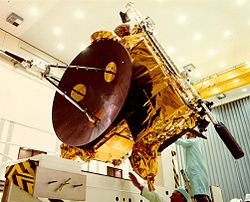
The spacecraft was designed by ESA and built by Dornier Systems, a German aircraft manufacturer. The body was roughly a box, approximately 3.2 m × 3.3 m × 2.1 m (10.5 ft × 10.8 ft × 6.9 ft) in size. The box mounted the 1.65 m (5 ft 5 in) dish antenna and the GPHS-RTG radioisotope thermoelectric generator (RTG) power source. The box was divided into noisy and quiet sections. The noisy section abutted the RTG; the quiet section housed the instrument electronics. Particularly "loud" components, such as the preamps for the radio dipole, were mounted outside the structure entirely, and the box acted as a Faraday cage.
Ulysses was spin-stabilised about its z-axis which roughly coincides with the axis of the dish antenna. The RTG, whip antennas, and instrument boom were placed to stabilize this axis, with the spin rate nominally at 5 rpm. Inside the body was a hydrazine fuel tank. Hydrazine monopropellant was used for course corrections inbound to Jupiter, and later used exclusively to repoint the spin axis (and thus, the antenna) at Earth. The spacecraft was controlled by eight thrusters in two blocks. Thrusters were pulsed in the time domain to perform rotation or translation. Four Sun sensors detected orientation. For fine attitude control, the S-band antenna feed was mounted slightly off-axis. This offset feed combined with the spacecraft spin introduced an apparent oscillation to a radio signal transmitted from Earth when received on board the spacecraft. The amplitude and phase of this oscillation were proportional to the orientation of the spin axis relative to the Earth direction. This method of determining the relative orientation is called conical scanning and was used by early radars for automated tracking of targets and was also very common in early infrared guided missiles.
The spacecraft used S-band for uplinked commands and downlinked telemetry, through dual redundant 5-watt transceivers. The spacecraft used X-band for science return (downlink only), using dual 20 watts TWTAs until the failure of the last remaining TWTA in January 2008. Both bands used the dish antenna with prime-focus feeds, unlike the Cassegrain feeds of most other spacecraft dishes.
Dual tape recorders, each of approximately 45-megabit capacity, stored science data between the nominal eight-hour communications sessions during the prime and extended mission phases.
The spacecraft was designed to withstand both the heat of the inner Solar System and the cold at Jupiter's distance. Extensive blanketing and electric heaters protected the probe against the cold temperatures of the outer Solar System.
Ulysses (spacecraft)
Ulysses (/juːˈlɪsiːz/ yoo-LISS-eez, UK also /ˈjuːlɪsiːz/ YOO-liss-eez) was a robotic space probe whose primary mission was to orbit the Sun and study it at all latitudes. It was launched in 1990 and made three "fast latitude scans" of the Sun in 1994/1995, 2000/2001, and 2007/2008. In addition, the probe studied several comets. Ulysses was a joint venture of the European Space Agency (ESA) and the United States' National Aeronautics and Space Administration (NASA), under leadership of ESA with participation from Canada's National Research Council. The last day for mission operations on Ulysses was 30 June 2009.
To study the Sun at all latitudes, the probe needed to change its orbital inclination and leave the plane of the Solar System. To change the orbital inclination of a spacecraft to about 80° requires a large change in heliocentric velocity, the energy to achieve which far exceeded the capabilities of any launch vehicle. To reach the desired orbit around the Sun, the mission's planners chose a gravity assist maneuver around Jupiter, but this Jupiter encounter meant that Ulysses could not be powered by solar cells. The probe was powered instead by a General-Purpose Heat Source Radioisotope Thermoelectric Generator (GPHS-RTG).
The spacecraft was originally named Odysseus, because of its lengthy and indirect trajectory to study the solar poles. It was renamed Ulysses, the Latin translation of "Odysseus", at ESA's request in honor not only of Homer's mythological hero but also of Dante's character in the Inferno. Ulysses was originally scheduled for launch in May 1986 aboard the Space Shuttle Challenger on STS-61-F. Due to the 28 January 1986 loss of Challenger, the launch of Ulysses was delayed until 6 October 1990 aboard Discovery (mission STS-41).
The spacecraft was designed by ESA and built by Dornier Systems, a German aircraft manufacturer. The body was roughly a box, approximately 3.2 m × 3.3 m × 2.1 m (10.5 ft × 10.8 ft × 6.9 ft) in size. The box mounted the 1.65 m (5 ft 5 in) dish antenna and the GPHS-RTG radioisotope thermoelectric generator (RTG) power source. The box was divided into noisy and quiet sections. The noisy section abutted the RTG; the quiet section housed the instrument electronics. Particularly "loud" components, such as the preamps for the radio dipole, were mounted outside the structure entirely, and the box acted as a Faraday cage.
Ulysses was spin-stabilised about its z-axis which roughly coincides with the axis of the dish antenna. The RTG, whip antennas, and instrument boom were placed to stabilize this axis, with the spin rate nominally at 5 rpm. Inside the body was a hydrazine fuel tank. Hydrazine monopropellant was used for course corrections inbound to Jupiter, and later used exclusively to repoint the spin axis (and thus, the antenna) at Earth. The spacecraft was controlled by eight thrusters in two blocks. Thrusters were pulsed in the time domain to perform rotation or translation. Four Sun sensors detected orientation. For fine attitude control, the S-band antenna feed was mounted slightly off-axis. This offset feed combined with the spacecraft spin introduced an apparent oscillation to a radio signal transmitted from Earth when received on board the spacecraft. The amplitude and phase of this oscillation were proportional to the orientation of the spin axis relative to the Earth direction. This method of determining the relative orientation is called conical scanning and was used by early radars for automated tracking of targets and was also very common in early infrared guided missiles.
The spacecraft used S-band for uplinked commands and downlinked telemetry, through dual redundant 5-watt transceivers. The spacecraft used X-band for science return (downlink only), using dual 20 watts TWTAs until the failure of the last remaining TWTA in January 2008. Both bands used the dish antenna with prime-focus feeds, unlike the Cassegrain feeds of most other spacecraft dishes.
Dual tape recorders, each of approximately 45-megabit capacity, stored science data between the nominal eight-hour communications sessions during the prime and extended mission phases.
The spacecraft was designed to withstand both the heat of the inner Solar System and the cold at Jupiter's distance. Extensive blanketing and electric heaters protected the probe against the cold temperatures of the outer Solar System.
Recent media
Recent media