Hubbry Logo
UnderhookUnderhookMain
Open search
Underhook
Community hub
Underhook
logo
8 pages, 0 posts
0 subscribers
Be the first to start a discussion here.
Underhook
Underhook
from Wikipedia

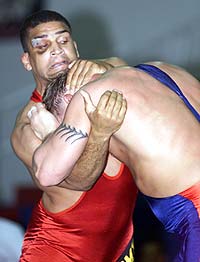
An underhook is a clinch hold that is used in grappling to control the opponent.[1] It is performed from any direction by putting an arm under the opponent's arm, and holding the opponent's midsection or upper body.[2] Having an underhook with one arm is called a single underhook, while having underhooks with both arms is known as double underhooks. The typical response to an underhook is to try to break it, or to establish an overhook.

Key Information

Single underhook

[edit]

A single underhook can be used as a takedown maneuver.[3] The protagonist underhooks one arm of the opponent and extends his underhooking arm partly or mostly across the opponent's back, while using his other hand to pull the opponent's other elbow across the opponent's body, and drives forward into the underhooked side of the opponent.

Double underhooks

[edit]

The double underhooks are considered one of the most dominant positions in the clinch, primarily because they allow for great control of the opponent, and can be used for doing a takedown or throwing the opponent. The double underhooks can be used to advance into a bear hug by locking the hands behind the back, and holding the opponent close to the chest. The opponent typically responds to double underhooks with double overhooks, to prevent the opponent from advancing into the bear hug.

See also

[edit]

References

[edit]
Revisions and contributorsEdit on WikipediaRead on Wikipedia
from Grokipedia
An underhook is a fundamental clinch hold in disciplines including wrestling, (BJJ), and (MMA), achieved by passing one arm underneath an opponent's armpit to encircle and control their torso or upper body from various angles. This technique provides significant positional leverage, enabling the holder to disrupt the opponent's balance, drive forward with pressure, and initiate takedowns, throws, or transitions while simultaneously defending against similar grips or strikes. In stand-up scenarios, securing an underhook—often through pummeling exchanges or from a —allows for offensive setups like single-leg takedowns or body locks, making it a of in combat sports. On the ground, underhooks maintain top control by framing the opponent's hips or arms, facilitating passes to dominant positions such as mount or , and aiding escapes from inferior spots like guard or bottom turtle. Double underhooks, where both arms secure this grip, amplify control and are prized for their role in sweeping or reversing an opponent in BJJ and submission . The underhook's versatility extends across amateur and professional levels, influencing strategies in , no-gi grappling tournaments, and MMA cage fights, where it integrates with striking to create hybrid attacks. Its mastery requires precise timing, , and head positioning to counter overhooks, underscoring its status as an essential skill for grapplers seeking dominance in close-range exchanges.

Fundamentals

Definition

An underhook is a clinch hold in where one passes their arm underneath the opponent's armpit, securing control over the upper body and restricting the opponent's arm mobility. This technique allows the user to grip the opponent's or back, often with the hand clasping behind the or for leverage. The primary purposes of the underhook include establishing dominant posture to maintain forward pressure, preventing the opponent from initiating takedowns, and creating opportunities for offensive transitions such as throws or sweeps. By denying the opponent effective use of their arms, it disrupts their defensive framing and balance, facilitating control in close-range exchanges. Anatomically, the underhook emphasizes control of the shoulders and to compromise the opponent's base and mobility. This focus on upper-body leverage helps in off-balancing the opponent without relying solely on lower-body engagement. Clinch holds known as "hooks" trace their origins to styles that emerged in 19th-century , particularly in , , where traveling wrestlers developed foundational clinch and submission techniques for competitive matches. These evolved into modern freestyle and folkstyle wrestling, adapting such holds for broader applications. As the counterpart to the overhook, where the arm passes over the opponent's armpit, it forms a core element of bilateral control strategies in combat sports.

Grip Mechanics

To secure an underhook, the practitioner inserts their deeply under the opponent's armpit, ensuring the points downward toward the ground to maximize depth and prevent slippage. The hand then grips the opponent's back, opposite latissimus dorsi, or for stability, often using a thumb-up orientation to enhance leverage without straining the wrist. This placement keeps the inserting tight to the practitioner's own body, avoiding exposure to counters like a whizzer, an overhook used to defend against the underhook. Effective body alignment during the underhook involves chest-to-chest contact to neutralize the opponent's posture and maintain forward pressure, while squaring the hips ensures balanced leverage against rotational forces. Weight distribution shifts toward the lead leg on the underhook side, creating a stable base that allows the practitioner to drive without losing balance. The head position, ideally inside and tight to the opponent's shoulder, further reinforces this alignment by preventing the opponent from creating separation. Common errors in establishing the underhook include shallow insertion, which allows the opponent to easily strip the grip or counter with an overhook, and overcommitment of the away from the body, exposing the practitioner's back to attacks or disrupting their balance. Failing to keep the tight to the can also lead to loss of control, as it permits the opponent to posture up and break the hold. Biomechanically, the underhook provides advantages by leveraging the practitioner's deltoid and latissimus dorsi muscles to generate pulling force and rotational control with minimal excessive strain, as the deep arm insertion transfers load efficiently through the . This positioning allows sustained pressure without relying solely on arm strength, distributing effort across the core and hips for prolonged dominance.

Variations

Single Underhook

The single underhook is a fundamental clinch hold in wrestling and arts, executed by placing one arm under the opponent's armpit to control their midsection or upper body, with the hand typically securing the back or for leverage, while the other arm remains free for supplementary actions such as posting, striking, or additional grips. This unilateral application emphasizes asymmetric control, allowing the practitioner to maintain the pointed downward for optimal positioning without overextending. One key advantage of the single underhook lies in its facilitation of quicker entries and enhanced mobility during stand-up exchanges, enabling rapid transitions to offensive maneuvers like takedowns while preserving balance and footwork. It also serves as a robust defensive tool against incoming takedown attempts, such as double-leg shots, by disrupting the opponent's posture and creating space for counters. In contrast to the double underhook, which provides fuller bilateral dominance, the single variant offers greater versatility for dynamic scenarios where one free arm can exploit openings. Common setups for the single underhook often originate from collar ties, where the practitioner drives an uppercut-like motion to slip the arm inside, or through pummeling exchanges in the clinch to gain inside positioning and secure the hold. Despite its strengths, the single underhook carries limitations, particularly its vulnerability on the uncontrolled side, where opponents can execute counters like arm drags or establish an overhook to neutralize the position.

Double Underhook

The double underhook, also known as the bilateral underhook, involves securing both arms underneath the opponent's armpits to encircle their upper body, providing comprehensive control over their and posture. This position often evolves into a "" variant when the practitioner's hands clasp together behind the opponent's back, enhancing leverage for lifts or throws. It typically emerges from a single underhook during prolonged clinch exchanges. The primary advantages of the double underhook lie in its ability to maximize upper body dominance, restricting the opponent's arm movement and enabling powerful drives or lifts to disrupt their balance. This setup is commonly achieved through mutual pummeling in the clinch, where the practitioner swims their arms inside to break an opponent's overhook, or by off-balancing them to create entry opportunities. In contexts, it establishes a strong offensive platform for advancing position while minimizing defensive vulnerabilities from partial grips. However, the double underhook carries risks, particularly exposure of the practitioner's head and neck if head position is not actively controlled, such as by maintaining an inside tie or forehead pressure against the opponent. Without this integration, the position can leave the user open to upper body counters that target the elevated arms. Proper execution demands precise timing to mitigate these hazards while capitalizing on the hold's inherent power.

Applications

In Wrestling

In , the underhook is a core offensive tool that enables chain wrestling sequences by allowing wrestlers to maintain upper-body control and flow seamlessly between attempts, such as high crotches or ankle picks. This position dictates the match's pace, limiting the opponent's ability to initiate attacks while setting up counters. It excels at preventing opponent shots by disrupting their posture, keeping them elevated, and neutralizing level changes to force defensive reactions. In folkstyle wrestling, the underhook adapts to top-position dominance, integrating into rides like the club underhook pinch headlock for superior mat control. From this hold, the wrestler secures the opponent's and with locked hands behind the spine, elbows pinched high, and steps in to drive them down, breaking posture and preventing escapes while positioning for pins. This approach emphasizes tight spacing and hip pressure to maintain control and transition to pinning combinations. Key techniques leveraging the underhook include the transition to a single-leg takedown, where inside head position and far-wrist control create imbalance, allowing the free hand to scoop the leg for a finish, as demonstrated by wrestlers like . Snap-down setups from the underhook pull the opponent forward by releasing head control and driving the arm down, exposing the back for go-behinds or front headlocks to continue offensive chains.

In Grappling Arts

In (BJJ), the underhook serves as a critical tool for guard passing, enabling the top practitioner to establish dominant pressure and control while navigating complex leg entanglements. By securing the underhook on the side of the trapped leg in , the top player can drive chest-to-chest contact to pin the opponent's shoulders and facilitate passes such as the knee slice, a method popularized by elite competitors like Marcelo Garcia. This grip negates size disadvantages, allowing efficient transitions to or mount while maintaining base against recovery attempts. From the bottom , the underhook empowers sweeps and positional advancements, particularly back takes, by facilitating elevation and circling motion. A common sequence involves using the underhook to knee-up while keeping the opponent off-balance, then slipping behind for hooks and seatbelt control, as detailed in techniques taught by world champion Lucas Leite. This approach transforms defensive positions into offensive opportunities, emphasizing leverage over strength for securing the back and subsequent submissions. On the ground, the underhook facilitates seamless transitions to submissions, such as the armbar from , where isolating the far arm via the underhook prevents defensive framing. illustrates this by using the underhook to pull the opponent onto their side, knee-cut into the armpit, and swing the leg over for the armbar finish, ensuring tight knee pressure to hyperextend the . Similarly, the underhook sets up kimura attacks by controlling the arm for a figure-four grip and rotational , common in BJJ's emphasis on locks from dominant positions. In , the underhook integrates into kuzushi principles for off-balancing during throws like , where arm and torso control disrupts posture for the inner reap. This , often seen in no-gi contexts, aligns with BJJ's hybrid applications.

Techniques

Establishing Control

Establishing an underhook begins with entry that emphasize dynamic movement from a neutral clinch position. Pummeling, a fundamental , involves circling the arms in a continuous motion to battle for control under the opponent's armpit, using hand frames and elbow positioning to create space and prevent defensive overhooks. This technique allows practitioners to transition fluidly into securing the underhook while maintaining forward . Once secured, maintaining posture is crucial to prevent the underhook from slipping. Practitioners keep their elbows tight to the body to lock the grip securely and drive their hips forward, ensuring an upright stance that off-balances the opponent and limits counter-maneuvers. This posture not only stabilizes the hold but also positions the body for subsequent control. Effective pressure application further solidifies the underhook by leveraging body weight to pin the opponent's arm against their torso, restricting their mobility and upper body rotation. By driving through the opponent with controlled force while keeping the underhooking arm tight, the practitioner can dominate the clinch and set up advantageous positions. Training progressions for establishing control start with shadow drilling to build foundational technique and without resistance, progressing to partner pummeling drills for timing and adaptability, and culminating in live to apply the underhook under dynamic conditions. These steps enhance both muscular endurance and reflexive responses essential for real-time execution.

Defensive Counters

Defensive counters to the underhook emphasize proactive disruption and reversal, serving as the inverse of techniques used to establish control. Prevention strategies focus on blocking the opponent's arm insertion before the underhook fully secures. A primary method involves securing an overhook, also known as a whizzer, by wrapping the arm over the opponent's underhooking arm and applying downward pressure with the elbow while using hip and knee blocks to disrupt their balance and base. This grip neutralizes the underhook's leverage early in the tie-up, preventing deeper control. Once an underhook is established, escapes prioritize creating space and regaining positional parity. Framing the opponent's elbow with the creates a barrier against forward pressure, allowing the defender to pummel their own arm to the outside for an over-under configuration or full overhook. Alternatively, dropping the level by bending at the knees and circling away defends against attempts, often transitioning to a sprawl or snap-down to off-balance the attacker. Counterattacks exploit the underhook's vulnerability by redirecting the opponent's momentum into submissions. From a whizzer defense, the defender can pull the head into a front headlock setup for a , tightening the guard around the neck while squeezing with the arms. These reversals require precise timing to avoid exposing the back. Common mistakes in underhook defense include overrelying on raw strength rather than proper footwork and leverage, which can lead to off-balancing and exposure to sweeps or takedowns. Defenders must prioritize circular movement and base maintenance to mitigate these risks.

References

Add your contribution
Related Hubs
User Avatar
No comments yet.