


Community hub
Recent from talks
Contribute something to knowledge base
Content stats: 0 posts, 0 articles, 1 media, 0 notes
Members stats: 0 subscribers, 0 contributors, 0 moderators, 0 supporters
Subscribers
Supporters
Contributors
Moderators
Hub AI
Hapkido AI simulator
(@Hapkido_simulator)
Hub AI
Hapkido AI simulator
(@Hapkido_simulator)
Hapkido
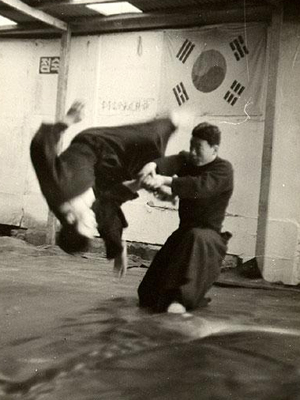
Hapkido (UK: /ˌhæpkiːˈdoʊ/ HAP-kee-DOH, US: /hɑːpˈkiːdoʊ/ hahp-KEE-doh, Korean: 합기도; RR: hapgido; pronounced [hap̚.ki.do]), also spelled hap ki do or hapki-do is a Korean martial art. It is a hybrid form of self-defense that employs joint locks, grappling, chokeholds, throwing techniques, kicks, punches, and other striking attacks. It also teaches the use of traditional weapons, including knife, sword, rope, nunchaku (ssang juhl bong), cane (ji pang ee), short stick (dan bong), and middle-length staff (joong bong), gun (analogous to the Japanese jō), and bō (Japanese), which vary in emphasis depending on the particular tradition examined.
Hapkido employs both long-range and close-range fighting techniques, utilizing jumping kicks and percussive hand strikes at longer ranges, and pressure point strikes, joint locks, and throws at closer fighting distances. Hapkido emphasizes circular motion, redirection of force, and control of the opponent. Practitioners seek to gain advantage over their opponents through footwork and body positioning to incorporate the use of leverage, avoiding the use of brute strength against brute strength.
The art was adapted from Daitō-ryū Aiki-jūjutsu as it was taught by Choi Yong-sool (최용술) when he returned to Korea after World War II after having lived in Japan for 30 years. This system was later combined by Choi's disciples with kicking and striking techniques of indigenous and contemporary arts such as Taekkyon and Tang Soo Do; as well as various throwing techniques and ground fighting from Japanese Judo.
Hapkido or 합기도 in the native Korean writing system hangul is rendered as 協氣道 in hanja. This is similar to how the Japanese Aikido was written using Kyūjitai in the pre-1946 period. Currently, though, the second character is preferably written in Japanese using shinjitai, which replaces the original 氣 with the modern, simplified 気, thus reducing the number of strokes by four.
In hanja, the character 張 hap means "coordinated"; 氣 ki literally means air, gas or breath but is used to mean spirit or so-called 'internal energy'; and 道 do means "way" or "art", yielding a literal translation of "joining-energy-way". It is most often translated as "the way of coordinating energy", "the way of coordinated power", or "the way of harmony".
Although Japanese Aikido and Korean hapkido share common technical origins, in time they have become separate and distinct from one another. They differ significantly in philosophy, range of responses, and manner of executing techniques. The fact that they share the same Japanese technical ancestry represented by their respective founders' practice of Daitō-ryū Aiki-jūjutsu, and that they share the same Chinese characters, despite 協 being pronounced "ai" in Japanese and "hap" in Korean, has proved problematic in promoting hapkido internationally as a discipline with its own set of unique characteristics differing from those common to Japanese martial arts.[citation needed]
The birth of modern hapkido can be traced to the efforts of a group of Korean nationals in the post-Japanese colonial period of Korea: Choi Yong-sool (최용술) (1904–1986) and his most prominent students; Chinil Chang, his personally chosen successor, Seo Bok-Seob, the first student of the art; Ji Han-jae (born 1936), one of the earliest promoters of the art; Jung Hwan Park, a long time student of Choi; Kim Moo-hong, a major innovator; Myung Jae-nam, a connector between the art of hapkido and aikido; and Myung Kwang-sik the historian and ambassador, all of whom were direct students of Choi or of his immediate students.
Choi Yong-sool (최용술)'s training in martial arts is a subject of contention. It is known that Choi was sent to Japan as a young boy and returned to Korea with techniques characteristic of Daitō-ryū Aiki-jūjutsu, a forerunner of aikido.
Hapkido
Hapkido (UK: /ˌhæpkiːˈdoʊ/ HAP-kee-DOH, US: /hɑːpˈkiːdoʊ/ hahp-KEE-doh, Korean: 합기도; RR: hapgido; pronounced [hap̚.ki.do]), also spelled hap ki do or hapki-do is a Korean martial art. It is a hybrid form of self-defense that employs joint locks, grappling, chokeholds, throwing techniques, kicks, punches, and other striking attacks. It also teaches the use of traditional weapons, including knife, sword, rope, nunchaku (ssang juhl bong), cane (ji pang ee), short stick (dan bong), and middle-length staff (joong bong), gun (analogous to the Japanese jō), and bō (Japanese), which vary in emphasis depending on the particular tradition examined.
Hapkido employs both long-range and close-range fighting techniques, utilizing jumping kicks and percussive hand strikes at longer ranges, and pressure point strikes, joint locks, and throws at closer fighting distances. Hapkido emphasizes circular motion, redirection of force, and control of the opponent. Practitioners seek to gain advantage over their opponents through footwork and body positioning to incorporate the use of leverage, avoiding the use of brute strength against brute strength.
The art was adapted from Daitō-ryū Aiki-jūjutsu as it was taught by Choi Yong-sool (최용술) when he returned to Korea after World War II after having lived in Japan for 30 years. This system was later combined by Choi's disciples with kicking and striking techniques of indigenous and contemporary arts such as Taekkyon and Tang Soo Do; as well as various throwing techniques and ground fighting from Japanese Judo.
Hapkido or 합기도 in the native Korean writing system hangul is rendered as 協氣道 in hanja. This is similar to how the Japanese Aikido was written using Kyūjitai in the pre-1946 period. Currently, though, the second character is preferably written in Japanese using shinjitai, which replaces the original 氣 with the modern, simplified 気, thus reducing the number of strokes by four.
In hanja, the character 張 hap means "coordinated"; 氣 ki literally means air, gas or breath but is used to mean spirit or so-called 'internal energy'; and 道 do means "way" or "art", yielding a literal translation of "joining-energy-way". It is most often translated as "the way of coordinating energy", "the way of coordinated power", or "the way of harmony".
Although Japanese Aikido and Korean hapkido share common technical origins, in time they have become separate and distinct from one another. They differ significantly in philosophy, range of responses, and manner of executing techniques. The fact that they share the same Japanese technical ancestry represented by their respective founders' practice of Daitō-ryū Aiki-jūjutsu, and that they share the same Chinese characters, despite 協 being pronounced "ai" in Japanese and "hap" in Korean, has proved problematic in promoting hapkido internationally as a discipline with its own set of unique characteristics differing from those common to Japanese martial arts.[citation needed]
The birth of modern hapkido can be traced to the efforts of a group of Korean nationals in the post-Japanese colonial period of Korea: Choi Yong-sool (최용술) (1904–1986) and his most prominent students; Chinil Chang, his personally chosen successor, Seo Bok-Seob, the first student of the art; Ji Han-jae (born 1936), one of the earliest promoters of the art; Jung Hwan Park, a long time student of Choi; Kim Moo-hong, a major innovator; Myung Jae-nam, a connector between the art of hapkido and aikido; and Myung Kwang-sik the historian and ambassador, all of whom were direct students of Choi or of his immediate students.
Choi Yong-sool (최용술)'s training in martial arts is a subject of contention. It is known that Choi was sent to Japan as a young boy and returned to Korea with techniques characteristic of Daitō-ryū Aiki-jūjutsu, a forerunner of aikido.
Recent media
Recent media