Hubbry Logo
V-driveV-driveMain
Open search
V-drive
Community hub
V-drive
logo
8 pages, 0 posts
0 subscribers
Be the first to start a discussion here.
V-drive
V-drive
from Wikipedia

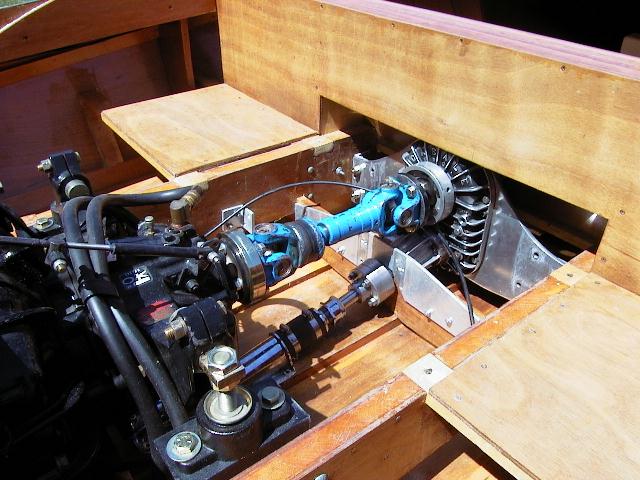
A V-drive is a power transmission system for boats that consists (usually) of two gearboxes, two drive shafts, and a propeller.

Whereas the conventional arrangement sites the engine with its gearbox aft, driving the propeller shaft directly, in a "V-drive" layout, the engine is reversed, to have the gearbox in front. This primary gearbox typically drives a short shaft forward to a transfer gearbox which reverses the transmission to the main tailshaft which is directed rearwards the propeller, at a "V" angle to the short shaft.

A V-drive system variation is for the tailshaft to drive a saildrive propeller, mounted on a skeg below the hull. This is common on Lagoon catamarans.

A Volvo saildrive

A variation of the two-shaft V-Drive layout is the "close-coupled V-drive" whereby the engine is still mounted "back-to-front", but the main gearbox incorporates an output flange that has already been reversed. This system obviates the need for any short primary shaft.[1]

Counter-intuitively, a V-drive system will not necessarily mean that the engine is sited further rearward; the whole engine/transmission may be sited forward than in a conventional arrangement.

V-drive rationales

[edit]

V-drives are typically fitted to (i) sport motorboats or (ii) cruising yachts and catamarans. The pros and cons tend to be different for each type.

For sportboats, a V-drive may be an alternative to an inboard/outboard (I/O) drive. Here the V-drive will allow the engine to be moved further forwards and the propeller (& rudder) will be under the boat. This can give a flatter ride (getting the boat planing earlier), greater choice of propellers, and a safer stern access for swimmers.

For cruising yachts, the rationale of the V-drive installation may include:[2]

  • the propeller can be mounted further forward in deeper "quieter water".
  • the engine can be mounted in a more space-efficient position.
  • the position of the hull's centre of gravity may be optimised,

In all cases, maintenance may be more difficult with a V-drive, since the main propshaft beneath the engine may be somewhat inaccessible. Also, when installing a V-drive, it can be a difficult process to ensure accurate alignment.

Boats with V-drives

[edit]

Fred Cooper's 1935 design for Malcolm Campbell's Blue Bird used a v-drive designed by Reid Railton for its 2,000 bhp engine.[3]

See also

[edit]

References

[edit]
Revisions and contributorsEdit on WikipediaRead on Wikipedia
from Grokipedia
A V-drive is an inboard system designed for boats, featuring an mounted near the with its output shaft facing forward, connected via a specialized transmission that reverses the drive direction by 180 degrees using angled gears to power a shaft exiting through the hull bottom at a 7- to 12-degree angle. This configuration, often consisting of precision helical gears, a gearbox, drive shafts, and sometimes a for alignment, positions the forward under the hull for enhanced safety and maneuverability. V-drives differ from direct-drive inboards by relocating the engine aft, which frees up mid-boat space for seating, storage, or cabins while shifting weight rearward to produce larger, cleaner wakes ideal for watersports like wakeboarding and surfing. Commonly used in towboats from brands such as Malibu, Nautique, and , as well as flat-bottomed cruisers on lakes and rivers, V-drives offer reliable performance when properly installed but require precise alignment to avoid vibrations or damage. Their compact design lowers the center of for better stability and handling, though they involve more power loss through the transmission compared to simpler direct drives. Introduced with careful engineering to ensure durability, V-drives have been manufactured for over 70 years by companies like Walter Machine, emphasizing low maintenance—such as oil changes every other year—and quiet operation through features like flexible joints that reduce noise and vibration. Despite their advantages in recreational and commercial applications, V-drives can be costlier to service due to specialized parts and fewer repair facilities, particularly for high-horsepower models exceeding 1,000 hp.

Overview

Definition

A V-drive is a system used in inboard boats for , consisting of a specialized transmission (V-drive unit), a , and a . The is mounted near the and faces aft, with its output directed forward to the V-drive transmission, which reverses the direction by 180 degrees using internal angled to send power forward along a single beneath the hull to the , exiting through the boat's bottom forward of the . This arrangement positions the forward under the hull, forming a distinctive "V" shape through the angled gears within the transmission unit. Unlike standard direct-drive inboard , where power flows straight from the to the at the , the V-drive distinguishes itself by redirecting power forward through the transmission for optimized placement while maintaining efficient power delivery in marine environments.

Basic Configuration

In a V-drive system, the is positioned near the transom and oriented facing aft, with its directed toward the bow to facilitate the integration of the transmission components. This placement shifts the engine rearward compared to traditional direct-drive inboards, typically 3 to 8 feet aft depending on the configuration, allowing for a more compact layout and improved weight distribution at the . The V-drive transmission is directly coupled to the engine's output shaft at the forward-facing end, reversing the power direction through a series of —typically precision helical for quiet operation—to produce an output shaft that extends forward beneath the hull. This forward runs longitudinally under the , often spanning much of the boat's length to connect directly with the , which is located beneath the hull forward of the . The transmission may include a or flexible coupling for alignment. This configuration results in a shallower shaft angle, typically 7 to 12 degrees, which minimizes drag and enhances by aligning the more closely with the hull's water flow. Overall, the V-drive's spatial layout promotes a flatter hull in and tow boats, optimizing interior space while maintaining structural integrity for marine applications.

History and Development

Origins

The V-drive propulsion system emerged in the mid-20th century as an innovative solution to enhance interior space in growing recreational vessels. Earlier prototypes, such as the V-drive designed by Reid Railton for Fred Cooper's 1935 boat used in Malcolm Campbell's Blue Bird, demonstrated the concept before commercial adoption. Invented to overcome the spatial constraints imposed by traditional straight inboard drives, which positioned amidships and limited cabin accommodations, the V-drive allowed for aft engine placement through a compact transmission setup involving angled gearboxes and drive shafts. This configuration addressed key limitations in planing hull designs, where forward engine weight could hinder optimal trim and performance, by shifting mass rearward to improve planing efficiency and balance. The system's initial commercial development for recreational boats occurred in 1954, when the Walter Machine Company of , introduced the first widely available V-drive. Established in 1927, Walter engineered this transmission to redirect power from a rear-facing via a V-shaped gear arrangement, enabling larger living quarters in cruisers while maintaining reliable propulsion. Marine engineers focused on this design to meet the demands of post-World War II boaters seeking versatile hulls for leisure, as straight inboards often cluttered cockpits and reduced usable space in planing vessels optimized for speed and stability. First commercial implementations appeared amid the post-WWII recreational boom of the , a period marked by surging demand for affordable leisure craft as middle-class prosperity grew and construction enabled . V-drives found early adoption in ski boats, where the aft-weighted setup provided unobstructed cockpits for watersports and tucked propellers safely beneath the hull, and in cruisers, prioritizing expanded cabin areas for family outings. This timing aligned with the era's emphasis on planing hulls for dynamic performance, propelling V-drives into initial popularity in Southern California's vibrant scene.

Evolution and Adoption

In the 1970s and 1980s, V-drive systems underwent key improvements focused on compactness and reliability, enabling broader integration into diverse marine applications. Manufacturers like Twin Disc expanded their marine gear lines during this period for boats, pleasure craft, and work boats. Similarly, transmissions from brands like Velvet Drive were commonly integrated into V-drive setups, minimizing space requirements while maintaining smooth operation and allowing engines to be positioned more flexibly within hulls for enhanced cargo and cabin accommodations. These innovations addressed earlier limitations in size and efficiency, contributing to greater adoption in and recreational vessels despite industry recessions in the 1980s. The marked a surge in V-drive adoption for high-performance boats, driven by the growing popularity of watersports like , where the aft engine placement improved for superior wake formation and planing efficiency. This era saw manufacturers such as Malibu incorporating V-drives into tow boat designs as early as the early , aligning with the sport's boom and enabling boats to handle higher horsepower with reduced power loss compared to sterndrives. By the late , V-drives had become a preferred choice in performance segments, offering up to 8% less horsepower loss in propulsion delivery compared to sterndrives. From the 2000s to 2025, evolving regulations and material advancements have shaped modern V-drive designs, prioritizing durability in corrosive marine environments. U.S. updates to standards in 2024 eliminated prescriptive requirements for additional allowances when using resistant materials, encouraging the integration of alloys like in transmission components. Twin Disc, for instance, incorporated such materials in vertical offset and integral V-drive models to enhance resistance against saltwater exposure, aligning with broader industry trends toward sustainable, low-maintenance systems. These changes have sustained V-drive popularity in commercial and recreational sectors, with ongoing innovations focusing on efficiency without compromising environmental compliance.

Design and Components

Core Elements

The core elements of a V-drive marine propulsion system include the upper gearbox, drive shafts, lower gearbox, and the with its associated strut, each designed for reliability in harsh aquatic conditions. The upper gearbox connects directly to the flywheel via a mechanism, serving as the primary interface for initial power input from the . It utilizes precision-ground helical gears crafted from high-strength to achieve reduction ratios commonly between 1:1 and 3:1, enabling efficient matching of output to requirements while minimizing noise and vibration. These units feature compact designs with minimal vertical offset to facilitate lower mounting positions in the hull. Drive shafts form the intermediary links in the system, with one forward shaft extending from the upper gearbox to the lower unit and a shorter rear shaft connecting to the . Constructed from corrosion-resistant marine-grade , such as 316L alloy, these shafts endure exposure to saltwater and mechanical stress without degrading. Lengths vary by vessel dimensions and placement, with the forward shaft typically spanning 4 to 8 feet in mid-sized boats to accommodate the V-shaped layout. The lower gearbox houses bevel gears that execute a precise 90-degree redirection of rotational power to align with the shaft's horizontal orientation. Enclosed in a sealed housing and lubricated with high-performance , such as SAE 30 or synthetic equivalents, it ensures sustained operation under loads while preventing water ingress. The bevel gears themselves are components for balanced load distribution and efficiency. The is a conventional inboard design, typically three- or four-bladed and made from durable materials like or to optimize in various water conditions. It mounts to the end of the rear and is supported by a , which encases a portion of the shaft to dampen vibrations and shield it from hull impacts or . are generally cast from manganese for its superior strength-to-weight ratio and resistance to marine , featuring integrated bearings for smooth shaft rotation.

Transmission System

The V-drive transmission system integrates the engine's power output into a V-shaped pathway that redirects propulsion aft to the propeller while positioning the engine near the stern. Power flows from the engine, which faces aft, into the upper gear unit attached to the transmission, where it undergoes a 90-degree redirection forward along the hull's centerline. This forward-directed shaft connects via universal joints to the lower gear unit, which then redirects the power another 90 degrees aft to drive the propeller shaft. The universal joints accommodate minor misalignments and hull flex, ensuring smooth torque transfer over distances typically ranging from 3 to 8 feet between units. The system employs specific gear types optimized for efficiency and durability. The upper unit primarily uses helical gears for their angled teeth, which provide smoother engagement, reduced noise, and better load distribution compared to spur gears, facilitating reliable power input from the . In the lower unit, bevel gears handle the critical direction change, with their conical shape enabling the 90-degree turn while maintaining integrity; these are often spiral bevel variants for enhanced contact and minimal backlash. Gear ratios in V-drive systems vary by model and application, commonly ranging from 1:1 to 2.5:1 overall, allowing customization for engine speed and propeller pitch to optimize performance across hull designs. Efficiency in V-drive transmissions typically achieves 90-95% power transfer from to , with the 8% average loss primarily due to frictional heat in the gears and bearings. Losses are minimized through precise alignment of the upper and lower units, typically within 0.003 inches at the couplings, to prevent and premature ; misalignment can increase losses and cause component failure. Modern units from manufacturers like Twin Disc and ZF incorporate high-precision and sealed to sustain these ratings under continuous operation. Variants of the V-drive transmission differ in lower gearbox positioning to suit diverse hull configurations. Fixed-position designs, such as closed-coupled systems, integrate the upper and lower units closely (3-4 feet apart) for compact installations in smaller vessels, offering simplicity and reduced maintenance. Adjustable variants, like remote V-drives with mounts, allow the lower gearbox to shift 4-8 feet forward or aft via slotted mounts and variable-length shafts, accommodating longer hulls or custom layouts while preserving alignment flexibility.

Operation and Mechanics

Power Transmission Process

The power transmission process in a V-drive marine propulsion system initiates with the engine's being delivered to the upper gearbox through a , where the rotational speed is reduced and the power is redirected forward along a horizontal input shaft. This upper gearbox, often integrated with the marine transmission, employs spur gears to achieve the necessary reduction ratio while maintaining efficient . The forward shaft then conveys this reduced and directed rotation to the lower gearbox, positioned aft of the upper unit. Within the lower gearbox, a pair of bevel gears engage to redirect the power flow 180 degrees toward the stern, reversing the direction to align with the propeller shaft. This bevel gear arrangement ensures smooth angular transmission without significant efficiency loss, supported by precision bearings to handle the thrust loads. From the lower gearbox, the power proceeds along the aft shaft to the , where it generates forward by rotating the blades. The overall system incorporates engagement within the transmission component to enable forward or reverse operation, allowing the propeller to produce directional as needed. V-drive systems are designed to handle capacities equivalent to 500–2000 horsepower depending on the model and configuration, with vibration damping achieved through the initial flexible couplings and precise shaft alignments to minimize operational noise and wear.

Performance Dynamics

The V-drive system enhances boat performance by positioning the engine aft, which shifts to improve trim and stability, particularly under load. This configuration typically employs a shaft of 7 to 12 degrees, similar to many direct-drive setups, which helps reduce the likelihood of during acceleration and enabling efficient planing at typical speeds of 20 to 40 knots in recreational boats. In terms of handling, the aft engine placement in V-drive systems provides better trim balance, making it ideal for activities such as waterskiing, where rearward weight helps maintain hull levelness and generates a consistent wake without excessive bow rise. This results in superior control and responsiveness at low to mid-speeds, benefiting sports like by creating cleaner water flow behind the transom. While V-drive systems experience slightly higher power losses due to the additional transmission components compared to direct-drive systems, the losses are generally lower than in sterndrives. Manufacturers note that this setup loses only about 8 percent of the horsepower through the transmission, delivering approximately 92 percent to the , outperforming sterndrives which lose about 13 percent, though overall economy varies with hull design and load. Regarding noise and vibration, the isolated mounting of the in V-drive configurations reduces transmission of mechanical to the hull, lowering cabin noise levels through smoother gear operation in modern units like those from ZF or Twin Disc. This isolation typically results in a quieter ride, with advancements in transmission design contributing to noticeable reductions in operational sound for passenger comfort.

Advantages and Disadvantages

Key Benefits

One of the primary advantages of V-drive systems is the enhanced interior space they provide in boats. By positioning the engine aft, typically under a sundeck or in the , V-drives free up the midship area for additional cabin space, storage, or amenities such as mid-cabin berths and fish wells, particularly beneficial in watersports and vessels. This layout contrasts with forward-mounted engines in direct-drive systems, allowing designers to optimize usable interior volume without compromising . V-drives also contribute to draft reduction, enabling operation in shallower waters compared to or fully extended inboard configurations. The shorter propeller shaft and tucked-under-hull placement minimize the extension below the hull line, providing a shallower overall draft that enhances to shallow bays, rivers, and coastal areas while reducing the risk of grounding. This design feature is especially advantageous for recreational in varied water depths. In terms of , the aft engine placement in V-drives improves overall balance by lowering the center of gravity and shifting mass toward the . This configuration reduces bow rise during acceleration, enhances stability in rough water, and promotes better tracking, making it ideal for towing sports like where consistent wake shape is crucial. The result is smoother handling and reduced trim adjustments needed for planing. Finally, V-drives offer superior reliability due to their simpler mechanical design, featuring fewer through-hull penetrations and components exposed to external elements compared to sterndrives. With only a single shaft penetration for the —similar to drives but without the complexity of outdrive legs, U-joints, or —leak risks from hull breaches are minimized, and maintenance demands are lower. Proven transmissions from manufacturers like Walter have demonstrated durability over decades, with efficiency losses as low as 8% in power delivery to the .

Limitations and Drawbacks

V-drive systems typically entail higher installation costs than direct drive alternatives, primarily due to the added complexity and components involved in the V-drive transmission, which reverses the direction by 180 degrees using a series of angled gears. This increased demand during or retrofitting contributes to elevated labor and material expenses. One notable drawback is the challenge of accessing the for , as the aft-mounted configuration in V-drive installations often positions the powerplant in confined compartments, limiting workspace for technicians. Components such as drive belts, the water pump, , and transmission are oriented toward the transom, further complicating routine inspections and repairs in tight spaces. V-drives can be challenging to service due to the scarcity of specialized repair facilities, particularly outside regions with high concentrations of watersports . The inclusion of the V-drive transmission imposes a weight penalty on the vessel, with the unit alone adding approximately 190 pounds to the stern area, which can shift the overall center of gravity rearward and potentially reduce top-end speed by altering hydrodynamic balance. In larger boats, this aft weight distribution may also hinder initial planing efficiency. Heat management presents additional considerations for V-drive systems, given the engine's proximity to the transom, where ambient temperatures and restricted airflow in hot climates can exacerbate cooling demands and risk overheating without supplemental measures like enhanced heat exchangers or ventilation.

Applications

Suitable Boat Types

V-drives are particularly well-suited to planing hull boats, where the aft placement of the and transmission allows for efficient power delivery while maximizing interior space forward of the propulsion system. These systems excel in vessels designed for high-speed planing, such as sport boats and cruisers in the 20- to 60-foot range, enabling smooth transitions onto plane and stable handling in inland waters like lakes and rivers. In tow boats for watersports, including , waterskiing, and , V-drives provide an ideal platform due to the rearward positioning, which enhances wake production by adding weight aft and creates a spacious, stable area without intrusive components in the . Examples include modified or flat-bottom designs in the 20- to 25-foot category, where the system's ability to position the deeper in the water contributes to cleaner wakes and better control during maneuvers. This configuration supports power outputs typically ranging from 200 to 600 horsepower, balancing performance with the need for quick planing under load. For larger applications, such as 30- to 60-foot cruisers and sportfishing boats, V-drives accommodate higher power ranges up to 1,000 horsepower or more, offering reliable propulsion in planing hulls that prioritize cabin space and storage over minimal draft. However, they are less suitable for displacement hulls, which rely on slower, efficient cruising without planing benefits, or for very small boats under 20 feet, where the added complexity and space requirements of the V-drive transmission outweigh any advantages.

Notable Examples

Malibu Boats has prominently featured V-drives in its Wakesetter series, particularly for and applications where rear weight distribution enhances performance and maximizes usable deck space. The 25 LSV model, part of the Luxury Sport V-Drive line, exemplifies this with its 25-foot length and capacity for up to 18 passengers, allowing for customizable wake shapes through integrated systems. MasterCraft similarly employs V-drives in its ski and wake boats, such as the XT23 and X24 models, which prioritize propulsion efficiency and safety by positioning the under the hull. These configurations support high-performance at speeds up to 34 mph while providing ample interior for family use. In the cruiser segment, Sea Ray's 310 Sundancer model frequently incorporates V-drive systems, such as twin MerCruiser 350 Magnum MPI inboard engines, enabling smooth handling and a spacious cabin layout for overnight cruising. This setup delivers reliable power for vessels around 31 feet, with engine options up to horsepower per side. Custom yacht builders often integrate Velvet Drive transmissions in V-drive setups for vessels up to 50 feet, as seen in the 50 Custom Resolute, which uses Borg Warner Velvet Drive units paired with diesel engines for enhanced cabin room and reduced noise. These transmissions, known for their compact design and durability, support torque loads suitable for luxury trawlers and explorer yachts. As of 2025, V-drive systems are increasingly adapted for electric-hybrid prototypes, aligning with broader marine electrification trends to combine traditional transmission benefits with zero-emission in mid-sized boats.

Comparisons with Other Systems

Versus Direct Drive

The V-drive system differs from the direct drive inboard in its layout, where the is positioned closer to the with the facing forward, and a specialized transmission redirects the power through a V-shaped gear arrangement to drive the shaft aft under the hull in a straight path exiting near the transom. In contrast, the direct drive features the mounted amidships with the facing aft, allowing a straightforward propshaft that extends longitudinally from the directly through the hull to the at the without redirection. This redirection in the V-drive enables a more compact placement at the rear, while the direct drive's linear configuration requires greater longitudinal space for the . Regarding space utilization, the V-drive enhances interior cabin room by relocating the aft, freeing the midship area for seating or amenities without the intrusion of a centrally mounted engine found in direct drives. However, this aft placement increases the mechanical complexity of the transmission and shaft routing, potentially complicating access for maintenance compared to the simpler, more straightforward direct drive setup. Direct drives, while less intrusive at the transom, occupy valuable central space that could otherwise be used for passenger areas. In terms of and performance, Direct drives, with their straight shaft and midship , provide superior for high-speed, straight-line cruising, achieving higher top speeds with minimal power loss in the . V-drives may experience slight reductions from the geared redirection. Cost considerations favor direct drives for their simpler design and lower upfront pricing, as they avoid the premium components of the V-drive transmission. V-drives command a higher initial investment due to the specialized gearbox and increased installation complexity, though they can offer long-term value in space-constrained vessels.

Versus Inboard/Outboard (I/O)

V-drives represent a fully inboard system where the is positioned aft near the transom, connected via a V-shaped driveshaft to a located forward of the transom, keeping all components enclosed within the hull. In contrast, inboard/outboard (I/O) systems, also known as sterndrives, feature an mounted inside the boat ahead of the transom but with an external drive unit—or outdrive leg—extending through the transom to position the aft of the hull. This placement difference results in V-drives offering a more protected setup with no protruding elements, while I/O systems expose the drive leg to potential impacts and environmental exposure. Regarding maneuverability, I/O systems provide greater versatility through their tilt and trim capabilities, allowing the outdrive to be raised for beaching, navigating shallow waters, or reducing drag during trailering. V-drives, with their fixed and configuration, lack this adjustability but deliver a smoother, more stable ride due to the fully inboard design, which minimizes vibrations and external disruptions. While I/O drives enable vectored for predictable handling in reverse and tight spaces, V-drives can achieve higher arcs for forward agility, though reverse control may be less effective. Maintenance for V-drives benefits from the enclosed nature of the system, reducing exposure to saltwater corrosion and , which leads to fewer service needs compared to I/O systems where the external drive is susceptible to damage from obstacles and requires regular inspections of components like and anodes. The fixed hardware in V-drives simplifies routine care but may complicate access for repairs due to the aft engine placement. V-drives are particularly suited for larger enclosed boats over 30 feet, such as cruisers and watersports vessels, where the inboard maximizes interior and provides stability for extended use. Conversely, I/O systems excel in trailerable smaller craft under 30 feet, offering efficiency, speed, and ease of transport for recreational boating.

Maintenance and Considerations

Routine Procedures

Routine procedures for V-drive systems emphasize preventive upkeep to ensure reliable performance and longevity, typically scheduled based on hours or calendar intervals. Maintenance intervals and procedures vary by specific V-drive model and manufacturer; consult the for precise guidelines. These tasks focus on key components such as the gearbox, shafts, cooling pathways, and , with inspections and services performed by qualified marine technicians where necessary. Oil changes for the V-drive gearbox are recommended every 1,000 hours of operation or annually, whichever occurs first, to maintain and prevent wear. The procedure involves draining the old oil and refilling with ATF or premium grade SAE 30 weight engine oil (if engine RPM does not exceed 3,000). Alignment checks of the shafts should be conducted yearly to detect and correct any misalignment that could lead to excessive , seal damage, or inefficient . This typically includes measuring flanges and adjusting as needed while the boat is in the water. The cooling system requires an annual flush to remove salt buildup, , or , particularly in saltwater use, thereby preventing overheating and potential component failure. Flushing involves running freshwater through the system to clear residues, followed by a refill with appropriate . inspections for damage, such as dings, bends, or , must be performed after every 50 hours of use to ensure balanced and avoid strain on the V-drive assembly. Visual checks and minor repairs can often be done dockside, but significant issues require professional servicing.

Common Challenges

One prevalent challenge with V-drive systems is , typically stemming from misalignment between the , transmission, and propeller shaft. This misalignment can arise from worn mounts, hull flexing, or improper installation, leading to uneven load distribution and accelerated on couplings and bearings. To diagnose, operators should inspect for bent shafts, fouled , and loose components, then verify alignment using feeler gauges on the coupler faces or advanced alignment tools for precise measurement and adjustment. Correcting the alignment often involves shimming mounts or repositioning the while the is in the to account for hull loading. Gearbox leaks represent another frequent issue, primarily due to degradation of seals and within the transmission housing, such as the output shaft seal in Borg Warner or Velvet Drive units. Over time, these components wear from constant exposure to oil pressure, heat, and minor contaminants, allowing fluid to seep out and potentially contaminating the . Basic diagnosis includes visual inspection for oil residue around the seals and checking fluid levels; repair necessitates draining the gearbox, removing the affected assembly, and replacing the worn seals with new gaskets to restore integrity. Preventive measures, like regular fluid changes outlined in routine procedures, can extend seal life but do not eliminate the need for eventual replacement. Overheating of the V-drive transmission often results from clogged oil coolers or heat exchangers, where debris, salt buildup, or impeller fragments restrict coolant flow and cause fluid temperatures to rise. This is particularly common in raw-water-cooled systems used in marine environments. Diagnosis relies on monitoring dedicated temperature gauges on the transmission, which should remain below 180°F under load; elevated readings prompt inspection of the cooler lines and sump filter for blockages. Resolution involves flushing the cooler with a descaling solution or replacing restricted components to restore proper heat dissipation. Prop shaft wear, especially in saltwater operations, poses a significant to V-drive setups by eroding the shaft surface and compromising structural integrity. Saltwater accelerates this through electrolytic action on exposed metals, potentially leading to pitting or if unchecked. Mitigation employs sacrificial zinc anodes clamped to the shaft, which corrode preferentially; these should be inspected visually and replaced biannually or when 50% consumed to ensure ongoing protection.

References

Add your contribution
Related Hubs
User Avatar
No comments yet.