


Community hub
Recent from talks
Contribute something
Nothing was collected or created yet.
V763 Centauri
View on Wikipedia| Observation data Epoch J2000.0 Equinox J2000.0 | |
|---|---|
| Constellation | Centaurus |
| Right ascension | 11h 35m 13.28134s[2] |
| Declination | −47° 22′ 21.2888″[2] |
| Apparent magnitude (V) | +5.64[3] |
| Characteristics | |
| Evolutionary stage | AGB[4] |
| Spectral type | M3/4III[5] |
| B−V color index | +1.682±0.019[3] |
| Variable type | Lb[6] |
| Astrometry | |
| Radial velocity (Rv) | +21.07±0.29[2] km/s |
| Proper motion (μ) | RA: -87.503[2] mas/yr Dec.: -6.988[2] mas/yr |
| Parallax (π) | 5.4236±0.1476 mas[2] |
| Distance | 600 ± 20 ly (184 ± 5 pc) |
| Absolute magnitude (MV) | −1.05[3] |
| Details | |
| Radius | 64.7+5.9 −4.3[2] R☉ |
| Luminosity | 754±24[2] L☉ |
| Temperature | 3,761+130 −161[2] K |
| Other designations | |
| C1 Cen, V763 Centauri, CD−46°7199, GC 15886, HD 100733, HIP 56518, HR 4463, SAO 222887, CCDM J11352-4722[7] | |
| Database references | |
| SIMBAD | data |

C1 Centauri is a single[8] star in the southern constellation of Centaurus. It has the variable star designation V763 Centauri, while C1 Centauri is the Bayer designation. The star has a red hue and is dimly visibly to the naked eye with an apparent visual magnitude that fluctuates around +5.64.[3] It is located at a distance of approximately 600 light years based on parallax, and has an absolute magnitude of −1.05.[3] It is drifting further away with a radial velocity of +21 km/s.[2] At one time it was a candidate member of the Zeta Herculis Moving Group but has since been excluded.[9]
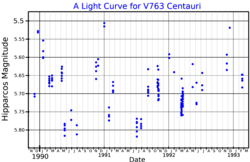
This object is an aging red giant star on the asymptotic giant branch[4] with a stellar classification of M3/4III.[5] Samus et al. (2017) classify this as a slow irregular variable of sub-type Lb and its brightness varies from magnitude +5.52 down to +5.82.[6] It was previously classified as a semiregular variable of sub-type SRb.[10] With the supply of hydrogen and helium at its core exhausted, the star has expanded until now it has 65 times the radius of the Sun. It is radiating 754 times the luminosity of the Sun from its photosphere at an effective temperature of 3,761 K.[2]
References
[edit]- ^ "Hipparcos Tools Interactive Data Access". Hipparcos. ESA. Retrieved 8 December 2021.
- ^ a b c d e f g h i j k Brown, A. G. A.; et al. (Gaia collaboration) (August 2018). "Gaia Data Release 2: Summary of the contents and survey properties". Astronomy & Astrophysics. 616. A1. arXiv:1804.09365. Bibcode:2018A&A...616A...1G. doi:10.1051/0004-6361/201833051. Gaia DR2 record for this source at VizieR.
- ^ a b c d e Anderson, E.; Francis, Ch. (2012), "XHIP: An extended hipparcos compilation", Astronomy Letters, 38 (5): 331, arXiv:1108.4971, Bibcode:2012AstL...38..331A, doi:10.1134/S1063773712050015, S2CID 119257644.
- ^ a b Eggen, Olin J. (July 1992), "Asymptotic giant branch stars near the sun", Astronomical Journal, 104 (1): 275–313, Bibcode:1992AJ....104..275E, doi:10.1086/116239.
- ^ a b Houk, Nancy (1978), Michigan catalogue of two-dimensional spectral types for the HD stars, vol. 2, Ann Arbor: Dept. of Astronomy, University of Michigan, Bibcode:1978mcts.book.....H.
- ^ a b Samus, N. N.; et al. (2017), "General Catalogue of Variable Stars", Astronomy Reports, 5.1, 61 (1): 80–88, Bibcode:2017ARep...61...80S, doi:10.1134/S1063772917010085, S2CID 125853869.
- ^ "HD 100733". SIMBAD. Centre de données astronomiques de Strasbourg. Retrieved 2020-03-02.
- ^ Eggleton, P. P.; Tokovinin, A. A. (September 2008), "A catalogue of multiplicity among bright stellar systems", Monthly Notices of the Royal Astronomical Society, 389 (2): 869–879, arXiv:0806.2878, Bibcode:2008MNRAS.389..869E, doi:10.1111/j.1365-2966.2008.13596.x, S2CID 14878976.
- ^ Eggen, O. J. (June 1971), "The ζ Herculis, σ Puppis, ∈ Indi, and η Cephei Groups of Old Disk Population Stars", Publications of the Astronomical Society of the Pacific, 83 (493): 251, Bibcode:1971PASP...83..251E, doi:10.1086/129119.
- ^ Kerschbaum, F.; Hron, J. (September 1994), "Semiregular variables of types SRa and SRb. New JHKL'M-photometry for 200 stars", Astronomy and Astrophysics Supplement, 106: 397–411, Bibcode:1994A&AS..106..397K.
