Hubbry Logo
VF-142VF-142Main
Open search
VF-142
Community hub
VF-142
logo
8 pages, 0 posts
0 subscribers
Be the first to start a discussion here.
VF-142
VF-142
from Wikipedia

Fighter Squadron 142
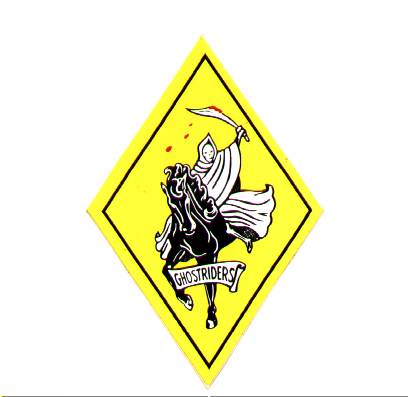
VF-142 insignia
Active24 August 1948 – 30 April 1995
CountryUnited States
BranchUSN
TypeFighter
NicknameGhostriders
Aircraft flown
FighterF4U-4 Corsair
F2H-3 Banshee
F3H-2/-2N Demon
F-4B/J Phantom II
F-14A Tomcat

VF-142 Ghostriders was a US Navy fighter squadron established on 24 August 1948 as VF-193, it was redesignated VF-142 on 15 October 1963, and disestablished on 30 April 1995.

History

[edit]

Late 1940s to the 1970s

[edit]
VF-193 F2H-3s on USS Oriskany in 1955.
A VF-193 F3H-2 on the catapult of USS Bon Homme Richard, 1961.

Fighter Squadron 193 (VF-193) was established on 24 August 1948 and assigned to Carrier Air Group Nineteen. The squadron was equipped with the Vought F4U-4 Corsair. It made two deployments to Korea during the Korean War between 1950 and 1952 aboard the aircraft carrier USS Princeton. In 1953 the squadron transitioned to the McDonnell F2H-3 Banshee. CVG-19 then made two deployments to the Western Pacific aboard USS Oriskany, with Donald Eleazer Carr Jr as the commanding officer in 1953–1954 campaign.

In 1958 the squadron then transitioned to the subsonic McDonnell F3H-2 Demon fighter. VF-193 then made four tours with CVG-19 aboard USS Bon Homme Richard, also to the Western Pacific.

VF-142 and VF-143 F-4Js on USS Constellation, 1969/70.

In 1963, VF-193 transitioned to the McDonnell F-4B Phantom II. On 15 October 1963, the squadron was re-designated VF-142. From 1953 to 1962 there had been another fighter squadron VF-142. This squadron had been established as United States Naval Reserve squadron VF-791 Fighting Falcons and was re-designated VF-142 after becoming a regular squadron on 4 February 1953. It was again re-designated VF-96 on 1 June 1962.

Between May 1964 and May 1968, the Ghostriders made four deployments to the Pacific on board USS Ranger and the three other deployments with USS Constellation. During these cruises deployed to the Vietnam War, VF-142 downed two MiG-21s, one MiG-17 and one AN-2 Colt This was a result of finding a problem correcting pilots, RIOs and line service personnel making adjustments to the radar display that were incorrect which resulted in incorrect closing velocity information being sent to the missiles, this was discovered by an IMA (intermediate maintenance activity) technician and later verified by a Raytheon tech representative. Prior to that, success with Sparrow III missiles had not been good. VF-142 was also awarded a Battle Efficiency (E) at that time. In 1969 they transitioned from the F-4B to the F-4J and headed out for a new cruise with Constellation on 11 August 1969. VF-142 was awarded the Naval Aviation Safety Award for 1969–1970. In June 1971, VF-142 deployed with USS Enterprise for their sixth combat deployment to Vietnam.

In September 1972 VF-142 deployed for their seventh and last combat deployment to Asia. Missions were flown in support for the first B-52 strikes into the heart of North Vietnam prior to the cease fire. VF-142 downed their fifth enemy aircraft, a MiG-21, making VF-142 the Navy’s first ace squadron of the war. In 1974, the Ghostriders deployed to the Mediterranean with USS America and after their return to NAS Miramar they transitioned to the F-14 Tomcat. On 1 April 1975, the squadron changed their home base from Miramar to NAS Oceana, leaving Carrier Air Wing 14 for Carrier Air Wing 6. In April 1976 VF-142 deployed to the Mediterranean Sea and conducted the first F-14 intercept of a Soviet Tu-95 Bear bomber on 23 April 1976. The Ghostriders were awarded the Battle E for their outstanding performance prior to and during the cruise.

In 1978, the Ghostriders changed both ship and air wing as Carrier Air Wing 7 and USS Dwight D. Eisenhower became their new home. In January 1979 they deployed for Eisenhower’s first Mediterranean deployment. They returned to NAS Oceana on 16 July 1979.

1980s

[edit]
VF-142 F-14 tail markings

In 1980 they began workups before heading to the Indian Ocean on 16 April 1980. As part of the 7th Fleet, Eisenhower and CVW-7 participated in contingency operations in support of US policy during the Iran Hostage Crisis. From 16 April – 22 December 1980, the Ghostriders were at sea continuously with the exception of one five-day port visit to Singapore. For this deployment the squadron was awarded the Navy Expeditionary Medal and a Navy Unit Commendation.

Between 5 January – 15 July 1982 yet another Mediterranean cruise was underway. After this cruise the squadron conducted a 4 month training cycle which included detachments to Nellis AFB and NAS Fallon, Nevada. On 27 April 1983, VF-142 departed Norfolk, Virginia for operations in the Middle East. From mid July until the end of the deployment in December 1983, VF-142 spent all but five days at sea in support of US Marines and multinational peace-keeping forces in Beirut, Lebanon. VF-142's 32 officers and 205 enlisted men and 12 F-14s accumulated over 3,200 flight hours and 1,500 carrier landings. During this cruise, VF-142 would intercept two Libyan MiG-23s that were heading towards the carrier group, no weapons were fired.[1]

In 1984, VF-142 had detachments to Nellis AFB, Roosevelt Roads Naval Station and NAS Fallon. In march the squadron set a new standard of excellence by achieving a 6.2:1 kill ratio during the Fleet Fighter Air Combat Maneuvering Readiness Program (FFARP) and captured the CVW-7 ACM shootdown Trophy for the second year in a row.

On 7 May 1984, the Ghostriders departed Norfolk for training which followed by a visit to Normandy for the D-Day 40th Anniversary celebration. From 10 July to 19 July and again from 8 August – 7 September 1984, VF-142 cruised the Caribbean Islands for a very successful Operation Readiness Exercise. In October the squadron deployed to the Mediterranean for one of its most successful deployments ever. VF-142 flew over 4000 accident and FOD free hours and dominated the competition for the coveted Battle E award. They returned to NAS Oceana on 7 May 1985, the Ghostriders had a little time home with the loved ones before leaving again on 18 July for the Central American operating area. During this time, they also participated in Ocean Safari, a 3 carrier battle group exercise in the North Atlantic. The squadron finally returned home on 4 September 1985 for an extended turnaround while Ike went into the shipyard for its first overhaul. After a change of command in April 1987, the squadron left NAS Oceana on 2 May for a CVW-7 weapons training detachment to NAS Fallon. There, the Ghostriders spearheaded what was described as "the best fighter performance ever seen " by the Commander of the Naval Strike and Air Warfare Center.

An F-14A Tomcat from VF-142, 1985.

From 15 June – 23 July 1987 the Ghostriders were embarked Dwight D. Eisenhower for her shakedown cruise. Thus began several short sea periods in preparation for their upcoming Mediterranean cruise. The squadron spent five weeks in the Caribbean where they participated in joint service operations with the Venezuelan Air Force. In September and late October, during operations in the Caribbean, the Ghostriders successfully fired two AIM-54, three AIM-7 and four AIM-9 air-to-air missiles. January 1988 saw the Ghostriders once again deployed with Dwight D. Eisenhower. The squadron started the year off on the right foot contributing directly to the success of the first fleet exercise of 1988. The exercise, which also involved USS Forrestal in dual carrier operations, was staged against adversary forces consisting of US Navy and Air Forces assets. The Ghostriders flew around the clock for five days testing their abilities in all aspects of anti-air warfare. Following the exercise, they successfully fired and guided three air-to-air missiles.

On 29 February 1988, the squadron departed NAS Oceana for a 6 month Mediterranean deployment with Dwight D. Eisenhower. The cruise was highlighted by the Ghostriders participation in several joint NATO, Air Force and Navy exercises. VF-142 flew overland and over-water missions in several highly successful NATO exercises with Spain, France and Tunisia. The squadron flew over 1,200 sorties totaling 2,500 hours during a six-month deployment. Following a brief stand down period, VF-142 commenced preparation for the Fleet Fighter Air Combat Maneuvering Readiness Program. After a highly successful FFARP in October and November, the Ghostriders participated in a missile exercise at Roosevelt Roads from 7 December – 18 December 1988. VF-142 fired two AIM-54, three AIM-7 and one AIM-9 missiles to culminate an extremely successful year of operations.

1989 began with an air-to-air gunnery detachment to NAS Key West. April was spent preparing for and then deploying with Dwight D. Eisenhower for a week of independent steaming exercises. Following a brief port visit to Norfolk, the aircraft carrier and her airwing departed to take part in the highly successful exercise Solid Shield 89, along with thousands of personnel from the Marines, Navy, Air Force and Army.

After returning from Solid Shield, the squadron began transitioning to the F-14B, receiving its first new aircraft on 24 March 1989. The F-14B, with much more powerful engines and several avionics upgrades, represented a long awaited update to the Tomcat. The Ghostriders and their sister squadron, the VF-143 Pukin' Dogs, were the Navy's first squadrons to fly the FFARP, conduct airwing strike exercises at NAS Fallon and became the first to deploy with the new F-14B.

1990s

[edit]
F-14 Tomcats from VF-142 overfly USS Dwight D. Eisenhower

The squadron deployed on 8 March 1990, to the Mediterranean for a six-month deployment once again with Dwight D. Eisenhower. Ghostriders aircrew engaged many NATO aircraft in exercise Dragon Hammer 90, and the new F-14Bs proved to be superior performers. The aircraft carrier transited the Suez Canal on 8 August in response to Iraq's invasion of Kuwait. Dwight D. Eisenhower and Airwing 7 were the first to arrive and took up station in the Red Sea in support of Operation Desert Shield. The first ever Red Sea battle group was well protected under the F-14Bs flying combat air patrol. The squadron exceeded 2,300 flight hours and logged over 1,200 arrested landings in their new Tomcats. The Ghostriders maintenance did an outstanding job in maintaining the new systems, and the squadron completed 1227 of 1229 assigned sorties. With a conflict in the Persian Gulf brewing, the Ghostriders took a short break after returning, but quickly got back on an accelerated turnaround schedule in case the need arose for more carriers in the Middle East.[citation needed]

In October 1990, the squadron got in a quick at sea period for some carrier refresher. From the end of November to the end of December saw the squadron completing the most successful FFARP ever with an 11.5:1 kill ratio. This earned the squadron the FFARP trophy for 1990. The Ghostriders quickly resumed full training as the crisis in the Middle East loomed. The squadron combined regular turnaround training with constant carrier qualification readiness to provide a ready asset. After the crisis passed the next deployment was finally set for September 1991. Dwight D. Eisenhower departed Norfolk on 26 September 1991 for a 6 month deployment to the Persian Gulf. While acting as a deterrent to regional aggression, the Ghostriders participated in many joint and multi-national exercises throughout the six months in the region. On the way home, Dwight D. Eisenhower was tasked to be the focal point of Teamwork 92, a large multi-national exercise in the North Atlantic.[citation needed]

After a brief break that followed their six-month deployment, the Ghostriders returned to full speed preparing for their transition to USS George Washington. The newest carrier in the fleet at the time welcomed CVW-7 in the early fall of 1992 and quickly got underway with a six-week shakedown cruise.[citation needed]

Early 1993 saw the Ghostriders excel once again in FFARP against adversaries of VF-43. With the new emphasis on using Tomcat in an air-to-ground role, the Ghostriders developed an entirely new syllabus for FFARP which incorporated the F-14B as self-escorted strike-fighters. The squadron then spent several weeks in the Spring flying as adversaries for the US Air Force Weapons School in Nevada. While in this detachment at Nellis AFB, the aircrew continued to train as strikers by dropping live Mk-80 series bombs and the first Rockeye delivery of a fleet F-14. The Ghostriders pushed into mid 1993 with a brief at sea period for carrier training and integration with the other squadrons of CVW-7. Immediately following, the squadron completed the newly developed air-to-ground intensive AARP training. The new syllabus emphasized the latest in F-14B strike tactics. The Ghostriders deployed in May 1994, on board George Washington for a six-month cruise. Their work included peace keeping operations over Bosnia-Herzegovina and Iraq. For their exceptional work they were awarded the Battle "E" and Golden Wrench. Due to budget cuts and air wing reorganization, VF-142 was disestablished in April 1995.[citation needed]

See also

[edit]

Notes

[edit]

Sources

[edit]
[edit]
Revisions and contributorsEdit on WikipediaRead on Wikipedia
from Grokipedia
Fighter Squadron 142 (VF-142), known as the Ghostriders, was a United States Navy fighter squadron established on 24 August 1948 as VF-193 at Naval Air Station Alameda, California, and redesignated VF-142 on 15 October 1963. The squadron operated until its disestablishment on 30 April 1995, transitioning through multiple aircraft types including the F4U-4 Corsair, F2H-3 Banshee, F3H-2 Demon, F-4 Phantom II, and F-14 Tomcat variants. VF-142 participated in significant combat operations, including two deployments during the aboard USS Princeton and seven deployments to the Tonkin Gulf during the Vietnam War from carriers such as , Constellation, and Enterprise, where it supported the 1964 and conducted strikes into . During Vietnam, the squadron achieved five confirmed air-to-air victories— one MiG-17 and four MiG-21s—while losing five aircraft and four to enemy action. It received the Battle Efficiency Award for 1968–1969 and the Safety Award for 1969–1970. In later years, VF-142 transitioned to the F-14A Tomcat in 1974, becoming the first F-14 squadron to earn the Battle "E" award in the late 1970s, and conducted deployments to the Mediterranean, (including during the 1980 ), and operations such as Desert Shield, Deny Flight, and Southern Watch in the . The squadron's final deployment was aboard USS in 1994 before disestablishment amid post-Cold War budget reductions and naval reorganization.

Formation and Early Operations

Establishment as VF-193

Fighter Squadron 193 (VF-193) was activated on 24 August 1948 at , California, amid the U.S. Navy's postwar buildup of carrier air wings to maintain readiness against emerging global threats. This establishment aligned with broader efforts to reconstitute forces demobilized after , drawing on experienced pilots and ground crews to form new squadrons capable of rapid deployment aboard Essex-class carriers. The squadron received F8F-2 Bearcat fighters as its initial , a lightweight, high-performance piston-engine design optimized for carrier landings with exceptional climb rates exceeding 4,000 feet per minute and armament including four 20 mm cannons. Early activities centered on pilot proficiency in carrier qualifications, , and intercept tactics, preparing for integration into air groups without immediate combat commitments. VF-193 maintained a typical strength of 12 to 24 , supported by roughly 20 to 30 aviators and maintenance personnel, reflecting standard organization for efficient training and sustainment.

Initial Aircraft and Training (1948–1962)

Following its establishment on 24 August 1948 as part of Carrier Air Group 19 (CVG-19), VF-193 initially operated the Vought F4U-4 Corsair piston-engine fighter from bases in California, including Naval Air Station North Island. The squadron conducted routine training flights and carrier qualification exercises to build proficiency in carrier operations, emphasizing day and night landings and tactical formations essential for fleet integration. In early 1950, VF-193 transitioned to the Grumman F8F-2 Bearcat, embarking aboard USS Boxer (CV-21) for initial carrier qualifications en route to , marking a step toward enhanced in high-speed intercepts and ground attack maneuvers during peacetime readiness drills. This upgrade supported participation in fleet exercises focused on air wing coordination, though the squadron retained Corsairs for some operations amid the rapid post-World War II drawdown and preparations. By 1952, VF-193 relocated to Naval Air Station Moffett Field, California, where it underwent administrative realignments within CVG-19 to streamline training pipelines. The squadron's shift to jet aircraft began in 1953 with the adoption of the McDonnell F2H-3 , enabling advanced all-weather interception training and supersonic capability development through simulated combat scenarios and instrument flight qualifications. By 1955, VF-193 integrated the F9F-5 Panther for further evolution in jet carrier operations, conducting extensive deck trials and formation tactics to refine low-altitude handling and radar-directed intercepts. These transitions were accompanied by the adoption of the "Ghostriders" moniker and associated insignia, symbolizing the squadron's emphasis on elusive, high-mobility tactics in non-combat exercises. Into the early , VF-193 upgraded to the McDonnell in 1960, basing at NAS Miramar, , for intensified readiness training, including carrier qualifications aboard USS Bon Homme Richard (CVA-31) in 1961–1962. This period featured rigorous simulations and cross-wing maneuvers to enhance , prioritizing empirical evaluation of jet transition effectiveness without engagement in hostilities. Squadron relocations and aircraft changes underscored a commitment to causal advancements in carrier-based fighter , informed by Navy-wide post-Korea analyses of and .

Redesignation and Vietnam War Involvement

Transition to VF-142 Designation

On 15 October 1963, Fighter Squadron 193 (VF-193), established in 1948, was officially redesignated as VF-142 at Naval Air Station Miramar, , as part of a U.S. administrative realignment to reuse squadron numbers vacated by the prior VF-142's disestablishment in 1962, thereby maintaining historical lineage while streamlining organization. This change aligned with broader efforts to rationalize numbering amid expanding fleet requirements, avoiding duplication and facilitating efficient record-keeping without disrupting operational continuity. The redesignation included the adoption of the "Ghostriders" moniker—previously associated with VF-193's insignia—and a refreshed squadron emblem featuring a spectral rider motif, intended to bolster unit identity, morale, and cohesion as the Navy prepared for heightened Pacific tensions. These symbolic updates emphasized esprit de corps during a transitional phase, reflecting command priorities on personnel retention and psychological readiness independent of immediate tactical shifts. Concurrently, VF-142 initiated integration of the McDonnell F-4B Phantom II, replacing earlier subsonic types like the , with revised training syllabi focused on supersonic , , and carrier qualification procedures tailored to the aircraft's twin-engine performance and all-weather capabilities. This organizational pivot equipped the squadron for advanced fighter roles, incorporating ground school on upgrades and simulated mission profiles to ensure proficiency prior to full operational status.

Combat Deployments and Engagements (1963–1975)

VF-142 undertook its initial combat deployment aboard USS Ranger (CV-61) in May 1964, participating in operations in the Gulf of Tonkin following the Tonkin Gulf incident, including retaliatory strikes against North Vietnamese torpedo boat bases using F-4B Phantoms for top cover. The squadron completed seven Pacific deployments between May 1964 and May 1968 in support of Vietnam War efforts, with the first four cruises on Ranger and the subsequent three on USS Constellation (CVA-64), conducting air-to-air patrols, MiGCAP missions, and air-to-ground strikes. During these early deployments, VF-142 achieved its first confirmed aerial victory on June 14, 1966, downing an An-2 Colt biplane with an AIM-7D Sparrow missile flown by Lt. T. Rodger and Lt. D. Vermilyea from Constellation. Further engagements included a MiG-21 downed on January 19, 1968, establishing the squadron as MiG killers. On October 30, 1967, during a MiGCAP near , an F-4B (BuNo 150629) suffered a premature Sparrow missile detonation, leading to engine failure and undercarriage malfunction; pilots LCDR Eugene P. Lund and LTJG James R. Borst ejected safely and were rescued, with the aircraft lost. Subsequent deployments included USS Constellation from August 11, 1969, to early 1970, where on March 28, 1970, an F-4J (BuNo 155875) scored a MiG-21 kill using an AIM-9 Sidewinder, the first by a TOPGUN graduate. VF-142's sixth combat cruise began in June 1971 aboard USS Enterprise (CVN-65), followed by a seventh in September 1972 supporting B-52 Arc Light strikes, during which the squadron downed a fifth enemy aircraft—a MiG-21—becoming the U.S. Navy's first ace squadron with two MiG-21s, one MiG-17, and one AN-2 confirmed prior. Operational realities included frequent damage from antiaircraft artillery, such as a 1964–1965 F-4B radome destruction by AAA on Ranger, allowing an emergency landing despite engine ingestion of debris. Overall, the squadron's record balanced confirmed victories against losses from enemy fire, accidents, and mission hazards in high-threat environments.

Post-Vietnam Modernization and Cold War Deployments

F-4 Phantom Era and Carrier Operations (1970s)

Following the squadron's final combat deployment in September 1972, which supported B-52 strikes over North Vietnam and resulted in the downing of a MiG-21, VF-142 shifted to peacetime carrier-based training and operational readiness with the F-4J Phantom II. This period emphasized recovery from wartime attrition, with focus on air-to-air interception tactics, fleet defense exercises, and sustained flight hours to counter Soviet naval expansions amid U.S. Navy budget reductions post-1973 Paris Peace Accords. The F-4Js, equipped with improved AN/APG-59 radars and AIM-7 Sparrow missile integrations from ongoing Navy upgrades, enabled realistic simulations of high-threat environments without live combat risks. In 1974, VF-142 conducted its last F-4J deployment aboard USS America (CV-66) to the Mediterranean Sea, participating in joint exercises that honed deterrence postures against Warsaw Pact forces, including mock intercepts of long-range reconnaissance aircraft. These operations maintained squadron readiness rates above fleet averages, building on prior safety accolades such as the Naval Aviation Safety Award for 1969–1970, while avoiding major incidents during the transition phase. The deployment underscored the Phantom's versatility in multi-role carrier strikes and air superiority missions, logging thousands of catapult-assisted takeoffs and arrested landings to prepare aircrews for evolving threats. This era highlighted internal advancements in tactics, such as refined doctrines adapted from lessons, though constrained by fiscal limits that deferred comprehensive airframe overhauls beyond basic tweaks. VF-142's emphasis on disciplined and pilot training ensured high sortie generation rates, positioning the squadron for its subsequent shift to more advanced platforms by late 1974.

Transition to F-14 Tomcat and Tactical Developments (1980s)

VF-142 continued intensive F-14A Tomcat operations throughout the early 1980s, conducting multiple deployments aboard (CVN-69) to counter Soviet naval activities during heightened tensions. From 16 April to 22 December 1980, the squadron supported operations in the amid the Iranian Hostage Crisis, logging significant flight hours in fleet air defense postures. Subsequent Mediterranean deployments from 5 January to 15 July 1982 and April to December 1983 involved patrols near the , including support for operations off , emphasizing the Tomcat's and AWG-9 for long-range surveillance and interception. In July-August 1985, VF-142 participated in Ocean Safari, a major North Atlantic exercise involving three U.S. carrier battle groups, honing coordinated tactics against simulated threats through multi-aircraft intercepts and radar tracking drills. These evolutions underscored the squadron's role in interoperability, with over-water and overland missions alongside Spanish, French, and Tunisian forces during a 1988 Mediterranean deployment from February to August. Tactical proficiency was demonstrated through live-fire qualifications, including missile launches in September-October 1987 (two successful firings) and tests in January and December 1988, validating the F-14's beyond-visual-range engagement capabilities. By April-May 1989, VF-142 upgraded to the F-14B variant, incorporating engines for enhanced thrust and reliability, along with improved avionics for expanded mission flexibility. This transition enabled initial adaptations toward multi-role employment, including early syllabus development for forward-firing (FFARP) operations to suppress enemy air defenses, aligning the Tomcat with evolving requirements for strike-fighter missions against heavily defended targets. VF-142 and sister squadron VF-143 pioneered FFARP integration in the F-14 fleet, achieving high simulated kill ratios in training scenarios that prepared for potential contingencies.

Final Deployments and Readiness Exercises (1990s)

In March 1990, VF-142 embarked on its first deployment with the F-14B Tomcat variant, joining Carrier Air Wing 7 (CVW-7) aboard (CVN-69) for a six-month cruise to the and in support of Operation Desert Shield. The squadron conducted air patrols from the , contributing to the enforcement of maritime interdiction and regional stability efforts prior to the . This deployment marked the initial operational sea use of the F-14B with VF-142, emphasizing enhanced engine performance and mission capabilities. Following return to Norfolk on September 12, 1990, VF-142 participated in advanced airwing training exercises in Nevada as part of pre-deployment workups for subsequent operations. The squadron then deployed again aboard USS Dwight D. Eisenhower from September 26, 1991, to August 2, 1992, focusing on Mediterranean operations and readiness maintenance amid shifting post-Cold War priorities. These exercises honed tactical proficiency in fleet defense and strike missions, sustaining high sortie generation rates despite fiscal constraints on naval aviation. VF-142's final deployment commenced in May 1994 aboard USS George Washington (CVN-73) for a six-month Mediterranean cruise, supporting peacekeeping missions over Bosnia and Iraq enforcement of no-fly zones. During this period, the Ghostriders executed combat air patrols and simulated threat engagements, demonstrating sustained operational effectiveness with F-14B aircraft. Readiness exercises prior to and during the deployment included joint maneuvers emphasizing interoperability with allied forces, reflecting the squadron's role in transitioning naval commitments from Cold War deterrence to regional contingency responses.

Disestablishment and Squadron Legacy

Factors Leading to Disestablishment

![Grumman F-14A Tomcat of VF-142][float-right] VF-142 was disestablished on 30 April 1995 at , , concluding nearly five decades of service. This action formed part of the U.S. Navy's post-Cold War force structure realignments, which reduced the number of active fighter squadrons from 26 in 1990 to 13 by 1998 to align with diminished global threats and fiscal constraints. The primary drivers included budgetary pressures from the "peace dividend" following the Soviet Union's dissolution in , prompting Congress and the Department of Defense to cut defense spending by approximately 30% in real terms between 1989 and 1998. Navy-specific directives, such as those in the Bottom-Up Review, mandated the inactivation of excess F-14 Tomcat squadrons amid delays in successor programs like the F/A-18E/F Super Hornet and uncertainties over the Advanced Tactical Aircraft. VF-142's reliance on the F-14A and F-14B, which faced escalating maintenance costs exceeding $1 million per annually by the mid-1990s, exacerbated its vulnerability to these cuts. Air wing reorganizations under Carrier Air Wing 1 further accelerated the process, with VF-142's last deployment aboard USS George Washington concluding in mid-1994, after which resources were consolidated to sustain higher-priority units. The squadron's 12-14 F-14 aircraft were transferred to remaining Tomcat operators, such as VF-143 and VF-32, while approximately 200 personnel underwent reassignment to other commands or early separation under reduction-in-force policies. These measures reflected a strategic shift toward multi-role platforms and reduced forward presence, prioritizing efficiency over squadron proliferation.

Achievements, Losses, and Post-Service Recognition

VF-142 accumulated five confirmed aerial victories during the , including one MiG-17 and four MiG-21s, contributing to U.S. air superiority efforts in contested . The squadron also received the Battle "E" Award for combat efficiency in 1968–1969 and the Naval Aviation Safety Award for 1969–1970, recognizing operational excellence and mishap-free performance amid high-tempo carrier operations. These accomplishments underscored VF-142's role in refining carrier-based fighter tactics, including escort missions and strike support that informed subsequent procedures for integrated air wings. The squadron sustained notable losses in , with five and four members lost to enemy action during deployments, reflecting the hazards of operations over . These figures, drawn from official records, highlight the asymmetric risks faced by naval aviators in surface-to-air missile and antiaircraft environments, without corresponding gains in squadron-level doctrinal shifts beyond standard after-action analyses. Following disestablishment on 30 April 1995 at Miramar, VF-142's legacy persisted through preserved artifacts and veteran networks, including squadron memorabilia maintained by alumni associations. A replica of a VF-142 was displayed in the , symbolizing contributions to carrier aviation culture and methodologies. No specific squadron aircraft, such as F-14 Tomcats, were directly allocated to public museums post-disestablishment, though individual airframes from similar operations remain in exhibits.

Aircraft and Armament

Primary Aircraft Types Operated

The served as VF-142's (originally designated VF-193) initial aircraft upon its establishment on August 24, 1948, at , . This single-engine, piston-powered carrier-based fighter, specifically the F8F-2 variant, featured a producing up to 2,250 horsepower with water-methanol injection, enabling a top speed of approximately 421 mph and a climb rate of 4,570 feet per minute. The Bearcat's lightweight design and high power-to-weight ratio made it suitable for advanced training and proficiency exercises during the U.S. Navy's shift from propeller-driven to in the late and early , with the squadron operating it until approximately the mid-1950s before full transition to jets. The became VF-142's primary jet fighter following its redesignation on October 15, 1963, with the squadron initially receiving the F-4B variant by early 1964. This tandem two-seat, supersonic multi-role aircraft, powered by two J79-GE-8 turbojet engines each delivering 17,000 pounds of thrust with afterburner, achieved a top speed of Mach 2.23 and a service ceiling of 60,000 feet, equipped for air-to-air and air-to-ground missions with variants including four or missiles, a 20 mm cannon (in later models), and up to 16,000 pounds of ordnance. VF-142 transitioned to the upgraded F-4J variant around 1974, which incorporated improved avionics such as the AWG-10 radar and enhanced reliability, maintaining operations with 12–14 aircraft per deployment until the late 1980s. The Grumman F-14 Tomcat marked VF-142's final primary type, with transition from the F-4J commencing in the late 1980s and full operational capability achieved by 1990. This twin-engine, two-crew variable-sweep wing interceptor, powered by two Pratt & Whitney TF30-P-414A turbofans (later upgraded to F-14B's GE F110 engines in 1989 for 25,000 pounds thrust each), featured a top speed of Mach 2.34, combat radius over 500 nautical miles, and the AN/AWG-9 radar capable of tracking 24 targets while engaging six simultaneously with AIM-54 Phoenix missiles for long-range fleet defense. The squadron operated 12–14 F-14A and F-14B aircraft until its disestablishment on April 30, 1995, emphasizing all-weather interception and reconnaissance roles with the LANTIRN pod for precision strikes in later years.

Weapons Systems and Tactical Adaptations

![F-14A Tomcat of VF-142][float-right] VF-142's armament evolved from internal 20mm cannons and unguided rockets on early jet fighters like the F3H-2 Demon to semi-active radar-homing AIM-7 Sparrow and infrared-homing AIM-9 Sidewinder missiles during the F-4 Phantom II period beginning in 1963. These missiles enabled initial beyond-visual-range (BVR) and close-range air-to-air capabilities, with the squadron achieving MiG kills using Sparrows despite early reliability issues reported in Vietnam operations. Ground attack options included Mk 80-series bombs and Zuni rocket pods, reflecting the multi-role demands of carrier-based fighter squadrons. Transitioning to the F-14 Tomcat in 1974, VF-142 integrated the for extended-range BVR intercepts, typically carrying up to six on the fuselage pallet alongside AIM-7 Sparrows on underwing stations and AIM-9 Sidewinders on wingtips. Exercise data from 1987–1988 documented live firings, including two AIM-54s, three AIM-7s, and four AIM-9s in September–October 1987, followed by additional AIM-54s, AIM-7s, and one AIM-9 in December 1988 at NAS Roosevelt Roads. This configuration prioritized fleet air defense against bomber threats, with the AWG-9 radar guiding multiple simultaneous Phoenix launches. In the F-14B era starting March 1989, the squadron adapted for enhanced strike roles, developing a customized Fleet Fighter Air Readiness Program (FFARP) syllabus by that trained pilots in self-escorted precision attacks using the F-14's variable-geometry wings and improved engines for low-level penetration. This included first-time Rockeye cluster bomb deliveries at Nellis AFB in spring , alongside Mk 80-series free-fall bombs, shifting emphasis from pure interception to integrated air-to-ground tactics while maintaining BVR proficiency evidenced by 11.5:1 kill ratios in December 1990 FFARP exercises. Training regimens drew from declassified tactics prioritizing and kinematics for Phoenix/Sparrow envelopes, minimizing within-visual-range risks.

References

Add your contribution
Related Hubs
User Avatar
No comments yet.