


Community hub
Recent from talks
Contribute something
Nothing was collected or created yet.
Vahdat Hall
View on WikipediaThe Vahdat Hall (Persian: تالار وحدت, romanized: Tālār-e Vahdat),[2] previously known as Roudaki Hall (also spelled Roodaki or Rudaki; Persian: تالار رودکی, romanized: Tālār e Rudaki) is a performing arts complex in Tehran, Iran.
Key Information


History
[edit]
Around the 1950s and 1970s, the Iranian national stage had become the most famous performing scene for known international artists and troupes in West Asia,[3] with the Vahdat Hall constructed in the capital of the country to function as the national stage for opera and ballet performances.
Construction
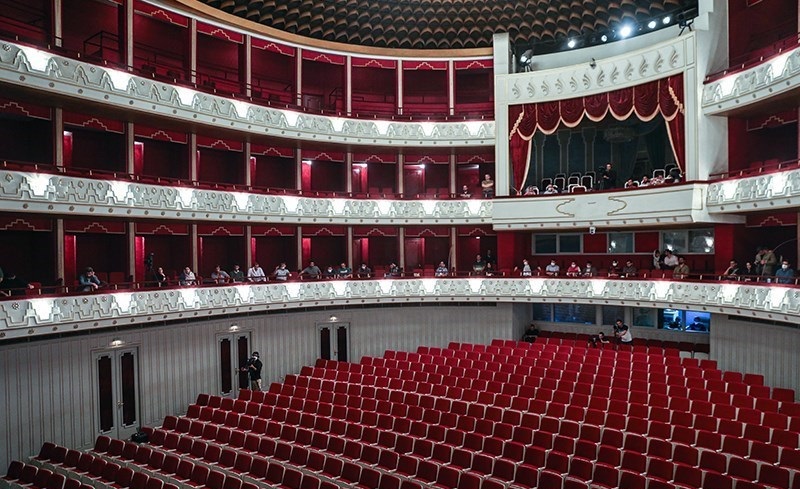
[edit]The complex was designed by architect Eugene Aftandilian, influenced by the Vienna State Opera, and was constructed during a period of ten years starting in 1957.[1] It was equipped with the latest lighting and sound system technologies of the time, with revolving and moving stages. The main stage consists of three different levels (podiums). The auditorium seats 1200 and has two tiers of boxes and balconies. The venue was fully supplied by Siemens Electrics. The main curtain in proscenium has a motif of a phoenix rising from the ashes, with the style of Persian miniature.
Just before the completion of Tehran's new opera house, Nejad Ahmadzadeh, artistic director of the Iranian National Ballet Company, was sent by the Ministry of Culture and Arts to the United States to visit their opera houses and study administrative, organizational, and technical constructions of American opera establishments that were deemed to be the most modern in the West. At his return, he was appointed as manager of the upcoming opera house, and established the technical, administrative, and artistic sections of the Vahdat Hall. The constructions of the hall were eventually completed in 1967.
Inauguration
[edit]
A part of the White Revolution, the Vahdat Hall of Tehran was inaugurated by Mohammad Reza Shah and Shahbanu Farah Pahlavi on 26 October 1967 with the performance of the Rustic Festival, the first Persian opera, composed by Ahmad Pejman. Two weeks of full house performances by international ensembles marked the coronation festivities. Numerous orchestras, opera singers, and dance companies were invited to perform for the occasion.
The hall is home to the Tehran Symphony Orchestra, Tehran Opera Orchestra, and the Iranian National Ballet Company. Other troupes, ensembles, and artists, such as the Iranian folk dancers, also used the stage of the Vahdat Hall for their performances.
Productions and guest presentations
[edit]


Before the 1979 Revolution
[edit]
Ballet
[edit]- Bijan and Manijeh (1975)
- La Bayadère (Season 1972–73)
- Myth of the Creation (1971)
- Nutcracker (1971)
- Bolero
- The Firebird (1967)
- Carmina Burana
- The Witch Boy
- The Fountain of Bakhchisaray (Season 73–74)
- Swan Lake (Season 1971–72)
- Petroushka
- Les Sylphides
- Giselle (Season 1970–71)
- La Fille Mal Gardée
- Romeo and Juliet (1968)
- Scheherazade
- Coppélia (Season 1972–72)
- Miss Julie
- Cinderella (1969)
- Serenade
- The Sleeping Beauty (1978)
Opera
[edit]- The Rustic Festival 1967
- Hero of Sahand (Delavareh Sahand)1968
- Pardis and Parisa
- La traviata
- Orfeo ed Euridice
- Madama Butterfly
- Turandot (1971)
- La bohème
- Carmen
- Nabucco (1976)
- Falstaff (1977)
- Werther (1977)
- Die Zauberflöte (1978)
Various national and international festivals were organized at the Roudaki Hall, including:
- International Film Festival
- Ballet and Dance Festival
- Folk Dance Festival
- Annual Festival of Culture and Arts
Since the inauguration of the Roudaki Hall in 1967 until the last stagings in the fall season of 1978, world famous music, opera, and dance artists visited Iran to stage their works. Presentations of the guest artists and ensembles included:
Guest ballet companies
[edit]- Kirov Ballet (Mariinsky Ballet)
- The Igor Moiseyev Ballet
- Le Grand Ballet Classique de France
- Antonio Gades Flamenco Ensemble
- Stuttgart Ballet
- Berliner Ballett
- Le Ballet de XXe Siécle (Ballet of the 20th Century)
- Nederlands Dans Theater (1977)
Guest ballet artists (dancers / choreographers)
[edit]- Rudolf Nureyev
- Margot Fonteyn
- Robert de Warren
- Liane Daydé
- William Dollar
- John Cranko
- Marcia Haydée
- Richard Cragun
- Robert Urazgildiev
- Maurice Béjart
- Alvin Ailey
- Jiri Kylian
Guest opera singers
[edit]Ingrid Rezai Anayatolla Rezai Monier Vaquilli
Guest music ensembles
[edit]- Moscow Symphony Orchestra
- Los Angeles Philharmonic Orchestra
- Berliner Philharmoniker
- Stuttgarter Kammerorchester
Guest musicians / conductors
[edit]Other presentations
[edit]- Marcel Marceau, the pantomime artist (1978)
After the 1979 Revolution
[edit]Roudaki Hall has remained the most important venue of Tehran. Concerts of traditional Iranian music, pop, and classical symphonic and orchestral music are staged regularly. After 1979 Revolution, Poetry Council at Office of Poetry and Music of Ministry of culture was formed in Roudaki Hall to preserve music in Iran. Some famous poets worked there, like: Mehrdad Avesta, Ahmad NikTalab (after him, Babak Niktalab), Mohammad Ali Bahmani,[4] Moshfegh Kashani.[5]
Among the presentations after the 1979 Revolution are:
Concerts
[edit]Artists
[edit]Events
[edit]- Tehran Art Expo.[6]


Guest presentation
[edit]- Dundee Repertory Theater
Specifications
[edit]
Total capacity of the hall is about 750 seats; with 500 seats in the main hall, and 250 seats in the balconies.
Operational and artistic directors
[edit]General directors
[edit]- Hamed Rowhani (1967–?)
- Sadi Hassani (in between the other two)
- Abedin Zanganeh (?–1979)
- ? (1979–?) (after the 1979 Revolution and before the re-organization of the hall in 2003)
Following a legislation from the Parliament of Iran in 2003, the operation management of the hall was reorganized. A new non-governmental public foundation was established in order to be in charge of the Roudaki Hall. The CEOs of Roudaki Foundation, responsible for the operation of Roudaki Hall have been:
- Mehdi Massoudshahi (2003–2008)
- Ali Asghar Amirnia (2008–2010)
- Hossein Parsaee (2010–2011)
- Alireza Hosseini (2011–2013)
- Hossein Seyfi (2013–2014)
- Bahram Jamali (2014–2016)
- Ali Akbar Safipour (2016–2019)
- Mehdi Afzali (2019–2022)
- Majid Zeinolabedin (2022–2023)
- Mehdi Salem (2023)
- Mohammad Allahyari Foumani (2023–present)
Ballet directors
[edit]- Nejad Ahmadzadeh (1967–1976)
- The Iranian National Ballet Company was founded in 1958 and moved to the Roudaki Hall in 1967.
- Ali Pourfarrokh (1976–1979) held the position until disbanding of the Iranian National Ballet.
Opera directors
[edit]- Enayat Rezai (1967–1979)[7]
Music directors
[edit]- Farhad Meshkat
- Alexander Rahbari[8] (2015–2016)
- Shahrdad Rouhani[9] (2016–2020)
- Nassir Heidarian-Rasty[10] (2022–2023)
- Manouchehr Sahbai[11] (2023–2025)
- Nassir Heidarian-Rasty (2025–present)
Gallery
[edit]-
 Auditorium of the Hall.
 -
 The ceiling of the Hall.
 -
 Eastern balconies and the special position.
 -
 Second floor of the complex.
 -
 Exterior of the complex.


References
[edit]- Citations
- ^ a b CAOI: Tehran Vahdat Hall
- ^ Don Rubin, ed. (1998), The World Encyclopedia of Contemporary Theatre, London: Routledge, ISBN 0415059283, OCLC 32008932
- ^ Kiann, Nima (2015). The History of Ballet in Iran. Wiesbaden: Reichert Publishingi
- ^ "محمدعلی بهمنی", ویکیپدیا، دانشنامهٔ آزاد (in Persian), 2020-11-10, retrieved 2020-12-19
- ^ "مشفق کاشانی", ویکیپدیا، دانشنامهٔ آزاد (in Persian), 2020-06-24, retrieved 2020-12-19
- ^ "Tehran Art Expo to open on June 17". Tehran Times. June 16, 2012. Archived from the original on November 6, 2013.
- ^ [1] Notes on Roudaki Hall in Tehran, Iran – A Celebration of Opera by Liliana Osses Adams
- ^ "'Bitterest day of my life': Maestro quits Tehran - Slippedisc".
- ^ "Conductor of Tehran Symphony Orchestra Shahrdad Rohani quits". Tehran Times. May 25, 2020.
- ^ "Nasir Heidarian takes baton in Tehran Symphony Orchestra". Honaronline. September 14, 2024.
- ^ "Iranian Musician Appointed As Tehran Symphony Orchestra Permanent Conductor - Iran Front Page". ifpnews.com. September 30, 2023.
- Bibliography
- Fajr Theater Festival
- Kiann, Nima. (2000). Persian Dance and Its Forgotten History
- Kiann, Nima (2015). The History of Ballet in Iran. Wiesbaden: Reichert Publishing
External links
[edit]
- Official Website of Roudaki Foundation
- Les Ballets Persans, the recreation of the Iranian National Ballet Company
- The chronology of the Iranian National Ballet Company and Les Ballets Persans
35°41′59.12″N 51°24′40″E / 35.6997556°N 51.41111°E
| Authority control databases: Geographic |
|---|

Operanostalgia Enayat Rezai