


Community hub
Variance-stabilizing transformation
View on WikipediaIn applied statistics, a variance-stabilizing transformation is a data transformation that is specifically chosen either to simplify considerations in graphical exploratory data analysis or to allow the application of simple regression-based or analysis of variance techniques.[1]
Overview
[edit]The aim behind the choice of a variance-stabilizing transformation is to find a simple function ƒ to apply to values x in a data set to create new values y = ƒ(x) such that the variability of the values y is not related to their mean value. For example, suppose that the values x are realizations from different Poisson distributions: i.e. the distributions each have different mean values μ. Then, because for the Poisson distribution the variance is identical to the mean, the variance varies with the mean. However, if the simple variance-stabilizing transformation

is applied, the sampling variance associated with observation will be nearly constant: see Anscombe transform for details and some alternative transformations.
While variance-stabilizing transformations are well known for certain parametric families of distributions, such as the Poisson and the binomial distribution, some types of data analysis proceed more empirically: for example by searching among power transformations to find a suitable fixed transformation. Alternatively, if data analysis suggests a functional form for the relation between variance and mean, this can be used to deduce a variance-stabilizing transformation.[2] Thus if, for a mean μ,

a suitable basis for a variance stabilizing transformation would be
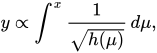
where the arbitrary constant of integration and an arbitrary scaling factor can be chosen for convenience.
Example: relative variance
[edit]If X is a positive random variable and for some constant, s, the variance is given as h(μ) = s2μ2 then the standard deviation is proportional to the mean, which is called fixed relative error. In this case, the variance-stabilizing transformation is

That is, the variance-stabilizing transformation is the logarithmic transformation.
Example: absolute plus relative variance
[edit]If the variance is given as h(μ) = σ2 + s2μ2 then the variance is dominated by a fixed variance σ2 when |μ| is small enough and is dominated by the relative variance s2μ2 when |μ| is large enough. In this case, the variance-stabilizing transformation is

That is, the variance-stabilizing transformation is the inverse hyperbolic sine of the scaled value x / λ for λ = σ / s.
Example: pearson correlation
[edit]The Fisher transformation is a variance stabilizing transformation for the pearson correlation coefficient.
Relationship to the delta method
[edit]Here, the delta method is presented in a rough way, but it is enough to see the relation with the variance-stabilizing transformations. To see a more formal approach see delta method.
Let be a random variable, with and . Define , where is a regular function. A first order Taylor approximation for is:

![{\displaystyle E[X]=\mu }](https://wikimedia.org/api/rest_v1/media/math/render/svg/51ed977b56d8e513d9eb92193de5454ac545231e)



From the equation above, we obtain:
- and
![{\displaystyle E[Y]\approx g(\mu )}](https://wikimedia.org/api/rest_v1/media/math/render/svg/9350eb857fea07cb25e9dd073a6305e754a15fd4)
![{\displaystyle \operatorname {Var} [Y]\approx \sigma ^{2}g'(\mu )^{2}}](https://wikimedia.org/api/rest_v1/media/math/render/svg/dc73d0925a27f157089c24ac4f0c8279500d4271)
This approximation method is called delta method.
Consider now a random variable such that and . Notice the relation between the variance and the mean, which implies, for example, heteroscedasticity in a linear model. Therefore, the goal is to find a function such that has a variance independent (at least approximately) of its expectation.
![{\displaystyle \operatorname {Var} [X]=h(\mu )}](https://wikimedia.org/api/rest_v1/media/math/render/svg/4cfa6701fb77d1ad1e2283d3a5a9b2d03d677f6f)
Imposing the condition , this equality implies the differential equation:
![{\displaystyle \operatorname {Var} [Y]\approx h(\mu )g'(\mu )^{2}={\text{constant}}}](https://wikimedia.org/api/rest_v1/media/math/render/svg/d4c3a51e267c4bd4aa63bc071a60cf7a66675dcc)
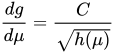
This ordinary differential equation has, by separation of variables, the following solution:
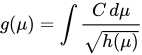
This last expression appeared for the first time in a M. S. Bartlett paper.[3]
References
[edit]- ^ Everitt, B. S. (2002). The Cambridge Dictionary of Statistics (2nd ed.). CUP. ISBN 0-521-81099-X.
- ^ Dodge, Y. (2003). The Oxford Dictionary of Statistical Terms. OUP. ISBN 0-19-920613-9.
- ^ Bartlett, M. S. (1947). "The Use of Transformations". Biometrics. 3: 39–52. doi:10.2307/3001536.
Variance-stabilizing transformation
View on GrokipediaIntroduction
Definition
A variance-stabilizing transformation (VST) is a functional transformation applied to a random variable whose variance depends on its mean, designed to render the variance of the transformed variable approximately constant across different values of the mean.[7] This approach is particularly useful in scenarios where the original data exhibit heteroscedasticity, meaning the variability increases or decreases systematically with the magnitude of the mean, complicating standard statistical procedures that assume homoscedasticity.[8] The core objective of a VST is to identify a function such that if and , then , where remains independent of .[7] Mathematically, this is often pursued through asymptotic approximations, ensuring that the transformed variable behaves as if drawn from a distribution with stable variance, thereby enhancing the applicability of methods like analysis of variance or regression that rely on constant spread.[8] The concept of VST was introduced by M. S. Bartlett in 1936, who proposed the square root transformation to stabilize variance in the analysis of variance, particularly for Poisson-distributed count data where the variance equals the mean.[9] This approach was developed to improve the reliability of inferences in experimental data with non-constant variance, such as biological counts.Purpose and benefits
Variance-stabilizing transformations (VSTs) address a fundamental challenge in statistical analysis: heteroscedasticity, where the variance of data increases with the mean, as commonly observed in count data (e.g., Poisson-distributed observations) and proportions (e.g., binomial data). This variance instability leads to inefficient estimators and invalidates assumptions of constant variance in models such as analysis of variance (ANOVA) and linear regression, potentially resulting in biased inference and reduced power of statistical tests.[10][11] The primary benefits of VSTs include stabilizing the variance to a roughly constant level, which promotes approximate normality in the transformed observations and enhances the efficiency of maximum likelihood estimators by minimizing variance fluctuations across the data range. This stabilization simplifies graphical exploratory analysis, making patterns more discernible, and bolsters the validity of parametric statistical tests that rely on homoscedasticity. Additionally, VSTs reduce bias in small samples, where untransformed data often exhibit excessive skewness, enabling the reliable application of methods designed for constant variance.[3][10][11] Without VSTs, inefficiencies arise prominently in regression contexts, where standard errors inflate for higher-mean observations, leading to overly conservative or imprecise estimates and unreliable prediction intervals. For example, in ordinary least squares applied to heteroscedastic data, this can distort the assessment of variable relationships and diminish overall model sensitivity. The foundational work by Bartlett (1947) emphasized these advantages for biological data, while Anscombe (1948) further demonstrated their utility in stabilizing variance for Poisson and binomial cases.[12][11][13]Mathematical Foundations
General derivation
A variance-stabilizing transformation (VST) is derived for a random variable with mean and variance , where is a known function of the mean. The goal is to find a function such that the transformed variable has approximately constant variance, independent of . This is achieved by solving the differential equation , which ensures that the local scaling of counteracts the variability in .[14][15] Integrating the differential equation yields the transformation , where is a suitable lower limit (often chosen for convenience or to ensure positivity) and is a constant. This integral form provides an exact solution when permits closed-form integration, though in practice, it is often scaled by a constant to achieve a target stabilized variance, such as 1. For instance, the approximation arises from a first-order Taylor expansion around : , implying . This holds asymptotically under the central limit theorem for large samples, where is sufficiently close to .[1][14][15] The derivation assumes that is positive, continuously differentiable, and depends solely on , which is typical for distributions in exponential families or those satisfying the central limit theorem. It applies particularly well to large-sample settings or specific parametric families where the variance-mean relationship is smooth. However, exact VSTs that stabilize variance for all are rare and often limited to simple cases; in general, the transformation provides only an approximation, with performance degrading for small samples or when higher-order terms in the expansion become significant.[15][14]Asymptotic approximation
In the asymptotic framework for variance-stabilizing transformations (VSTs), the variance of the transformed variable is approximated using a Taylor expansion around the mean for large sample sizes or large , where has variance . The first-order expansion yields , with higher-order terms contributing to deviations from constancy.[16] To achieve approximate stabilization to a constant (often set to 1), the derivative is chosen as , leading to the integral form as a first-order solution.[7] Second-order corrections refine this approximation by incorporating the second derivative to reduce bias in the mean of . The bias term arises as , and adjusting constants in (e.g., adding a shift) minimizes this bias, improving accuracy for finite samples. For variance, the second-order expansion includes additional terms like , but these are often set to yield a stabilized variance of .[7][17] Computation of relies on evaluating the integral, which admits closed forms when is polynomial—for instance, (Poisson case) gives , with the second-order bias-corrected version .[7] For non-polynomial , iterative numerical integration methods, such as quadrature or series approximations, are employed to obtain practical estimates.[7] The approximation is inherently inexact due to neglected higher-order terms in the Taylor series, which explain residual dependence on ; as or , converges to a constant plus , with error rates typically after second-order adjustments. This asymptotic behavior underpins the utility of VSTs in large-sample inference, though small-sample performance may require further refinements.[17][7]Specific Transformations
Poisson variance stabilization
For data distributed according to a Poisson distribution, where the random variable has variance equal to its mean, the variance-stabilizing transformation is obtained by integrating the reciprocal square root of the variance function, yielding . Applying this to the observed data gives the key transformation , which approximately stabilizes the variance of the transformed variable to 1. The asymptotic properties of this transformation ensure that for sufficiently large , with the approximation becoming exact as ; this independence from facilitates more reliable statistical inference, such as in normality-based tests or regression analyses on count data.[3] For practical simplicity, a scaled version is sometimes employed instead, which stabilizes the variance to approximately .[3] To improve accuracy for small , where the basic approximation may deviate, the Anscombe transform refines the expression as ; this correction minimizes bias in the variance stabilization and yields even for moderate . The additive term is chosen such that the first-order correction in the Taylor expansion of the variance aligns closely with the target constant, making it particularly useful for Poisson data with low counts, as encountered in fields like imaging or ecology.[3]Binomial variance stabilization
For a random variable following a binomial distribution , the mean is and the variance is , which is approximated as for large to reflect the quadratic dependence on the mean, particularly pronounced for proportions near 0 or 1.[18] This heteroscedasticity makes direct analysis of binomial proportions challenging, as variance increases with up to and decreases symmetrically.[3] The standard variance-stabilizing transformation for binomial data is the arcsine square-root transformation, defined for the proportion as .[7] Under this transformation, the variance of approximates , which is constant and independent of , assuming is fixed across observations.[18] This stabilization arises from the asymptotic approximation where the transformed variable behaves like a normal distribution with constant variance, facilitating parametric methods such as ANOVA or regression on proportion data.[7] A notable property of the arcsine transformation is its effectiveness in stabilizing variance for proportions near the boundaries (0 or 1), where the original variance approaches zero but empirical fluctuations can be misleading.[3] It also improves normality of the distribution, though it may not fully normalize for small . A variant, the Freeman-Tukey double arcsine transformation, defined as , effectively doubles the angle and yields a variance approximation of , offering better performance for small samples or boundary values by reducing bias in variance estimates.[19] This transformation is commonly applied in biology for analyzing percentage or proportion data, such as germination rates or infection incidences, where represents a fixed number of trials (e.g., seeds or organisms) and variance independence from simplifies comparisons across treatments.[20] In such contexts, it is often scaled by or 2 to align the standard deviation with unity for easier interpretation in statistical tests.[3]Other common cases
For the log-normal distribution, where a random variable follows , the mean-variance relationship is approximately with . The logarithmic transformation stabilizes the variance to the constant on the transformed scale, facilitating analyses assuming homoscedasticity. In the gamma distribution with fixed shape parameter , the variance function is , indicating a similar quadratic dependence on the mean. The primary variance-stabilizing transformation is the logarithm , which approximates constant variance ; power adjustments, such as the square root , offer asymptotic optimality as under criteria like Kullback-Leibler divergence to a normal target.[21] The chi-square distribution with degrees of freedom is a gamma special case (, scale 2), yielding mean and variance . The square-root transformation stabilizes variance to approximately 1, with effectiveness increasing for large where the distribution nears normality.[21] A general pattern emerges across these cases: when , the approximate variance-stabilizing transformation is for , or the logarithm for . This yields the identity transformation for constant variance (), square root for linear variance (, as in chi-square), and logarithm for quadratic variance (, as in log-normal and gamma). For overdispersed data exceeding standard Poisson variance (e.g., extra-Poisson variation), modified square-root transformations like with small (such as 0.5 or 3/8) enhance stabilization by accounting for the inflated variance while preserving approximate constancy.[3]Applications
In regression models
Variance-stabilizing transformations (VSTs) can be applied to the response variable to achieve approximately constant variance, enabling the use of ordinary least squares (OLS) regression to handle heteroscedasticity in data that might otherwise be modeled using generalized linear models (GLMs) for distributions like the Poisson. In such cases, the variance of the response is a function of the mean , denoted as , and a VST is chosen such that the variance of the transformed response is approximately constant, approximating a Gaussian error structure. This approach is particularly useful when the original data violate the homoscedasticity assumption of linear models, providing an approximation to GLM inference via OLS on the transformed scale.[22] The procedure for implementing a VST in regression involves first specifying or estimating the variance function based on the assumed distribution or from preliminary residuals, then deriving the transformation such that the variance of is approximately constant. The transformed response is subsequently used in an OLS regression, which is equivalent to fitting a GLM with a Gaussian family and identity link for certain choices of . For count data modeled under a Poisson distribution, where , the square root transformation (or more precisely, for small counts) is a standard choice to stabilize variance. This method enables straightforward parameter estimation and hypothesis testing while preserving the interpretability of the model.[22][13] In the context of analysis of variance (ANOVA), VSTs are beneficial for balanced experimental designs, as they stabilize variances across treatment groups, justifying the use of F-tests for comparing means. A classic application appears in agricultural yield experiments, where crop counts or yields often exhibit Poisson-like variability; applying the square root transformation allows valid assessment of treatment effects without bias from unequal variances. Post-fitting diagnostics on the transformed model, such as plotting residuals against fitted values, are essential to verify the constancy of residual variance and confirm the transformation's adequacy.[11][11] Software implementations facilitate this process; in R, for instance, the transformed response can be modeled using theglm function with family = gaussian(), enabling seamless integration with GLM diagnostics and inference tools.