Hubbry Logo
VelVelMain
Open search
Vel
Community hub
Vel
logo
8 pages, 0 posts
0 subscribers
Be the first to start a discussion here.
Vel
Vel
from Wikipedia
Not found
Revisions and contributorsEdit on WikipediaRead on Wikipedia
from Grokipedia
The Vel (Tamil: வேல்), meaning "victory" or "spear," is a sacred lance revered in Hinduism as the primary weapon and emblem of Murugan, the god of war also known as Kartikeya or Skanda. Gifted to Murugan by his mother, the goddess Parvati, the Vel empowered him to vanquish the demon Soorapadman, embodying triumph over evil forces and the dispelling of ignorance. In Tamil tradition, where Murugan holds paramount importance as a protector deity, the Vel symbolizes jnana shakti—the power of divine wisdom—and serves as a tool for spiritual liberation by negating illusions and elemental attachments. Murugan's iconography consistently depicts him as a youthful mounted on a peacock, brandishing the Vel in one hand while often holding a rooster in the other, underscoring his martial prowess and vigilance. The spear's significance extends beyond mythology into devotional practices, particularly in South Indian and Sri Lankan , where it is venerated independently as "Vel Murugan" in temples like those at and , representing redemption from inner turmoil and worldly suffering. Festivals such as commemorate the Vel's bestowal, with devotees undertaking rigorous penances, including body piercings with symbolic lances, to invoke its protective energies. As a multifaceted symbol, the Vel encapsulates themes of , purity, and cosmic balance, reflecting Murugan's role as the son of and in maintaining against chaos. Its worship underscores the integration of Dravidian tribal elements with broader Vedic traditions, evolving from a local Tamil war god's attribute to a pan-Hindu of intellectual and martial victory. Devotees regard the Vel not merely as a but as a conduit for higher intelligence, capable of conferring moksha (liberation) upon the faithful.

Etymology and Description

Linguistic Origins

The term "Vel" derives from the Tamil word வேல் (vél), primarily denoting a or , with secondary connotations of or rooted in its verbal base வெல்- (vel-), meaning "to conquer" or "to pierce." It also serves as an epithet for the Murugan, as in "Vel Murugan." This traces back to the Proto-Dravidian root *vel-, which reconstructs a concept of sharpness, penetration, or a pointed weapon, as evidenced in cognates across where it refers to piercing tools or implements. In ancient Tamil usage, the word emphasized not only the physical instrument but also its symbolic role in overcoming adversaries, distinguishing it as a of martial prowess. While the Vel shares conceptual parallels with Sanskrit terms such as śakti, denoting divine power or energy, and astra, referring to a supernatural weapon, its core identity remains distinctly Tamil, evolving independently as a sacred attribute without direct borrowing from Indo-Aryan lexicon. Historical linguistic evidence points to shifts in the term's application during the Sangam period (circa 300 BCE–300 CE), where "Vel" first emerges in classical Tamil poetry as the weapon of war deities, often invoked in contexts of heroism and divine intervention, as seen in texts like Akanāṉūṟu and Puṟanāṉūṟu. These adaptations highlight the Vel's enduring Tamil core, adapted regionally without altering its fundamental association with piercing victory.

Physical and Symbolic Description

The Vel is the divine or emblematic of deity Murugan, typically portrayed as an elongated with a sharp, pointed tip affixed to a sturdy shaft and a broadened base. In temple idols and processional artifacts, it is commonly fashioned from precious metals like or silver for ornate versions, or wood for simpler objects, emphasizing its sacred utility in . For example, a processional Vel at one temple measures 6 feet in length to facilitate carrying during festivals, allowing devotees to invoke its protective energies. Symbolically, the pointed tip of the Vel represents the piercing force that destroys ego, , and (maya), embodying sharp discernment and the awakening of akin to the expansion of in the mind. The shaft signifies , or righteousness, paralleling the spinal column through which spiritual energy ( ) ascends, fostering willpower and disciplined pursuit of truth. The base symbolizes and stability as the foundation of spiritual victory, grounding the weapon's transformative power. Beyond its physical attributes, the Vel encapsulates jñāna śakti, the profound power of wisdom, distinct from other divine armaments such as Shiva's trident (trishula), which denotes the triad of creation, preservation, and destruction. This symbolism underscores the Vel's role in the eternal triumph of good over evil, fusing the absolute wisdom of Shiva with the dynamic energy of Parvati to propel devotees toward moksha, or liberation. Regional variations in design, such as single-bladed forms in most Tamil temples versus occasionally multi-pronged tips in certain processional icons, reflect localized interpretations while preserving its core essence as a conduit for divine intellect.

Mythological Role

Origins in Hindu Texts

The Vel, a divine central to , first appears in detailed form within the , a text composed between the 7th and 10th centuries CE. In this Purana, the Vel is depicted as a powerful weapon created through the divine power of and presented to , the god of war, to enable him to vanquish the demon Soorapadman, who had been terrorizing the gods. This narrative underscores the Vel's role as an instrument of cosmic order, symbolizing the triumph of divine forces over chaos. Earlier epic references to the Vel as Kartikeya's primary weapon are found in the , where it is portrayed as a or used in grand battles against demonic forces, emphasizing its in maintaining during celestial conflicts. Similarly, the alludes to Kartikeya wielding a spear-like astra in his martial exploits, highlighting its unerring precision and destructive power in epic confrontations. The Vel's conceptual evolution traces back indirectly to Vedic traditions, where warrior deities like employed the , a weapon representing irresistible force and victory over adversaries. While the vajra embodies raw elemental power in the Rig Veda, the Vel emerges in post-Vedic texts as a distinct astra uniquely tailored for Kartikeya, often described as bestowed by to infuse it with , or divine feminine energy, distinguishing it from its Vedic precursors. The Vel is regarded not merely as a physical armament but as a manifestation of godly will, embodying divine wisdom and power, wielded by Kartikeya in his role as divine general. This is elaborated in Tamil adaptations like the Kanda Puranam, which recounts the detailed myth of its bestowal.

Association with Murugan

In Tamil lore, Murugan is known as Velan, the lord or owner of the Vel, portraying the divine spear as an integral extension of his six-faced form, Shanmukha (Arumugan), which embodies multifaceted divine consciousness and power. The Vel, bestowed upon him by his mother Parvati, fuses Shiva's jnana-shakti (wisdom power) with her para-shakti (supreme energy), manifesting as yoga-shakti to aid in spiritual liberation and cosmic balance. This association underscores the spear not merely as a weapon but as a vital aspect of Murugan's identity, symbolizing the integration of divine sparks into his unified, radiant form. A central highlighting the Vel's role recounts Murugan's epic battle against the demon Surapadman, an who had attained near-immortality through Shiva's boon and terrorized the devas. Wielding the Vel, Murugan pierces through Surapadman's illusions and defenses, ultimately cleaving the demon in half during the confrontation at ; the two fragments transform into a peacock, which becomes Murugan's (mount), and a rooster, adopted as his battle or flag. This triumph, celebrated during Skanda Shashti, illustrates the Vel's potency in subduing ego-driven chaos and restoring . As Murugan's constant companion, the Vel is invariably depicted in his right hand, signifying active divine intervention and contrasting with emblems like the discus (symbolizing ) or rooster (denoting vigilance) in his left hand. It represents discriminative , the piercing of maya (), and the eradication of inner impurities, often personified through figures like Veerabahu, Murugan's loyal general who mirrors the spear's role in warfare against asuric forces. While in North Indian traditions the Vel functions as Kartikeya's śakti, embodying general divine energy and less emphasized in worship, its significance intensifies in , particularly among , where it symbolizes youthful vigor, martial prowess, and cultural pride as a hallmark of regional identity and resistance to external influences.

Worship and Iconography

Depictions in Art and Sculpture

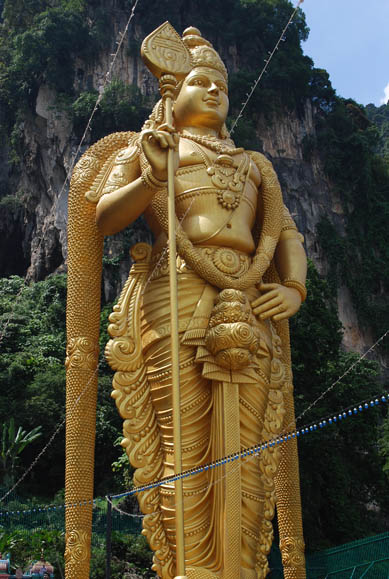
In South Indian temple art, the Vel is typically depicted as a prominent attribute held aloft by Murugan in idols from the Chola period (9th–13th century CE). These representations adhere to iconographic standards outlined in traditional texts, where the Vel is portrayed as a straight, lance-like with a sharp tip, embodying (wisdom) and (energy), and is grasped in Murugan's upper right hand in multi-armed forms. Notable examples include the massive golden Vel at the Murugan Temple, serving as a central processional during festivals, crafted in gleaming metal to evoke and . The artistic evolution of Vel depictions traces to more elaborate South Indian bronzes during the medieval period and contemporary paintings that emphasize dynamic motion and embellished details. Stylistic elements in sculptures follow proportions prescribed in iconographic texts for visual balance and symbolic harmony in compositions.

Rituals and Festivals

The rituals and festivals associated with the Vel center on its role as the divine spear granted to Murugan, emphasizing devotion, , and the triumph of good over evil in Tamil Hindu traditions. These practices are performed primarily in South Indian temples and diaspora communities, involving communal processions, fasting, and offerings to invoke the Vel's protective power. , a major festival dedicated to Murugan, commemorates the goddess bestowing the Vel upon him to battle demons, and it features prominent processions of Vel idols. Devotees emulate Murugan's spear-bearing by carrying kavadis—ornate wooden or metal structures adorned with peacock feathers and bells—during barefoot pilgrimages to temples, often spanning several kilometers. In these processions, participants undergo symbolic body piercings with Vel-like skewers through the cheeks, tongue, or back hooks, representing surrender and purification without drawing blood, as an act of intense devotion. Chants of "Vel, Vel Muruga" accompany the rituals, reinforcing the spear's role as a symbol of spiritual strength. Skanda Shashti, another key festival, celebrates the Vel's victory over the demon Soorapadman and his forces, observed with elaborate pujas in Tamil Nadu's Murugan temples such as Thiruchendur. The event spans six days, beginning on the first day of the Aippasi , during which devotees undertake strict —abstaining from grains and salt—from sunrise to the next dawn, culminating in the Soorasamharam ritual where the Vel is invoked to depict the demon's defeat through dramatic enactments and idol processions. Vel puja forms the core, with special prayers and offerings to honor the spear's divine intervention. Worship of the Vel involves daily and festival-specific methods, including abhishekam, where the spear icon is anointed with milk, curd, honey, sandalwood paste, and flower garlands to invoke Murugan's blessings for protection and wisdom. These anointing rituals, performed by priests in temples, symbolize the cleansing of negativity and are often followed by aarti with lamps and incense. Symbolic piercing practices, akin to those in Thaipusam, extend to personal devotion, where devotees use small Vel replicas for self-piercing during vows, signifying unwavering faith and emulation of Murugan's valor. Regionally, practices vary, with Malaysia's hosting one of the world's largest annual celebrations, drawing over a million participants for Vel-centered parades starting from Sri Mahamariaman Temple in . The procession features a massive silver bearing Murugan's image and the Vel, accompanied by kavadi bearers pierced with spears, highlighting the festival's scale in the . In contrast, North Indian worship of emphasizes his role as a general of the gods with less focus on the Vel, differing from the spear's central devotional prominence in Tamil traditions.

Cultural and Religious Significance

Symbolism in Tamil Hinduism

In Tamil Hinduism, the Vel serves as a profound symbol of the destruction of internal enemies, such as ego and , which obstruct spiritual progress. Aligned with Murugan's as a in Advaita Vedanta-inspired Tamil , the Vel embodies the divine power () that vanquishes these vices, enabling the devotee to attain and harmony. This interpretation underscores Murugan's function as a guide who empowers individuals to overcome ego-driven illusions, fostering inner victory essential to Shaivite philosophy. Philosophically, the Vel represents the piercing of , the cosmic illusion that veils ultimate truth, allowing the revelation of divine reality. In the hymns of the and Thiruppugazh by 15th-century saint , the Vel is depicted as jnana (power of ), a radiant that dispels ignorance and illuminates the soul with eternal knowledge. For instance, Arunagirinathar likens the Vel to a swift arrow of discernment that shatters the bonds of worldly attachment, guiding devotees toward liberation (). This symbolism draws from Tamil Shaivite traditions, where the Vel's light eradicates mental impurities and affirms the non-dual unity of the self with . Socially, the Vel embodies valor and protection within Tamil identity. During periods of colonial oppression, Tamil communities drew upon Murugan's Vel in rituals such as Thai Pusam to assert cultural defiance and unity against British rule, transforming the symbol into a beacon of resistance and ethnic pride. Distinct from pan-Hindu divine weapons like Vishnu's discus or Shiva's , the Vel uniquely symbolizes velvi (sacrificial offering) in Tamil traditions, linking it to ancient rites involving animal sacrifices in folk worship of Murugan as Velan, the oracular priest-god. Central to non-Brahminical practices, it integrates tribal elements such as blood offerings and ecstatic possession (veriyattu), emphasizing accessible devotion over Vedic orthodoxy and reinforcing Murugan's role as a of the Tamil masses.

Influence in Literature and Modern Culture

The Vel, as the divine spear of Murugan, holds a central place in , often symbolizing heroism, wisdom, and triumph over adversity. In ancient Sangam texts such as Thirumurugāṟṟuppaḍai, one of the Pathuppāṭṭu poems, the Vel is vividly portrayed as Murugan's indispensable weapon, embodying the god's role as a protector of the Tamil people. This depiction underscores the Vel's role in fostering themes of divine patronage and cultural identity, influencing subsequent devotional poetry that elevated Murugan as the quintessential Tamil deity. Later medieval works continued this tradition, integrating the Vel into narratives of moral and spiritual conquest, thereby embedding it deeply in the Tamil literary canon. In Tamil , the Vel permeates oral traditions, folk songs, and communal rituals, reinforcing its status as a of inevitability and divine . Folk performances, including processions during Murugan festivals, feature the Vel as a focal prop, where participants carry ornate replicas while chanting hymns that narrate its mythological origins, blending storytelling with cultural preservation. The Vel's influence extends into modern and politics, adapting its heroic symbolism to contemporary narratives. The 2007 film Vel, directed by and starring , draws directly from the spear's iconography to title the story of twin brothers embodying valor and familial bonds, grossing approximately ₹50 crore worldwide. In the political sphere, have embraced the Vel as an anti-caste emblem of empowerment and victory, notably when DMK leader brandished a silver Vel during a 2021 campaign to invoke Murugan's protective ethos against social hierarchies. Globally, among the , Vel motifs thrive in cultural festivals, particularly in Malaysia's annual celebrations, where thousands carry Vel replicas in ecstatic processions to the , commemorating Parvati's gift to Murugan and drawing over a million participants as a testament to enduring devotion. This practice not only sustains Tamil heritage abroad but also inspires contemporary adaptations in and community events, linking the ancient symbol to themes of resilience in multicultural contexts.

References

Add your contribution
Related Hubs
User Avatar
No comments yet.