


Community hub
Recent from talks
Contribute something
Nothing was collected or created yet.
Venasque
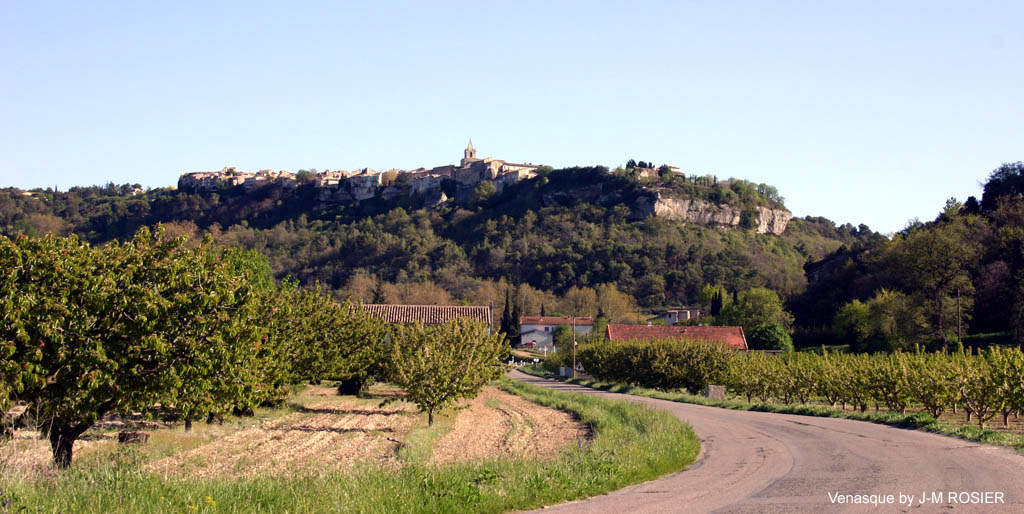
View on WikipediaVenasque (French pronunciation: [vənask]; Occitan: Venasca; Latin: Vendasca) is a commune in the Vaucluse department in the Provence-Alpes-Côte d'Azur region in southeastern France. It is a member of Les Plus Beaux Villages de France (The Most Beautiful Villages of France) Association.
Key Information


.svg)


The area has many tourist attractions, such as the nearby Mount Vaucluse, a park with several tennis courts, and many open areas. The town of Venasque stands on a hill, surrounded on all sides by ramparts in various states of disrepair. It is home to many notable foreigners, such as Darius Brubeck. It has a beautiful forest surrounding it, with picturesque trails and several shepherds' dwellings made out of rocks piled together to create domed huts.

History
[edit]In the high middle ages Venasque was the capital of the Comtat Venaissin, which became a possession of the Holy See in 1271. In 1320 Venasque was replaced as capital of the Comtat by Carpentras. Papal control of the Comtat continued until the 1790s, when it was annexed by France and placed within a new département of the Vaucluse, although the papacy did not recognise the annexation until 1814.
See also
[edit]- Comtat Venaissin
- Communes of the Vaucluse department
- Port de Venasque, a mountain pass in the Pyrenees
References
[edit]- ^ "Répertoire national des élus: les maires" (in French). data.gouv.fr, Plateforme ouverte des données publiques françaises. 13 September 2022.
- ^ "Populations de référence 2022" (in French). National Institute of Statistics and Economic Studies. 19 December 2024.
External links
[edit]

| International | |
|---|---|
| National | |
| Geographic | |
| Other | |

 | This Vaucluse geographical article is a stub. You can help Wikipedia by expanding it. |
Venasque
View on GrokipediaGeography
Location and setting
Venasque is a commune located in the Vaucluse department of the Provence-Alpes-Côte d'Azur region in southeastern France.[8] It lies approximately 11 kilometers southeast of Carpentras and about 32 kilometers (20 miles) east of Avignon.[1][9] The village's geographic coordinates are 43.9969°N 5.1472°E.[10] Perched atop a steep rocky outcrop, Venasque exemplifies the classic hilltop villages of Provence, with an average elevation of 310 meters and a topographic range spanning 137 to 639 meters across its 35.01 km² area.[10] The commune's terrain features rugged limestone formations within the Monts de Vaucluse, surrounded by dense forests, winding trails, and expansive vistas that include the towering Mont Ventoux to the northeast, the jagged Dentelles de Montmirail to the south, and the rolling Monts de Vaucluse.[11][1][2] This elevated position historically overlooks and dominates an ancient Roman road traversing the valley below.[12] The surrounding landscape is enriched by natural features such as the dramatic Gorges of the Nesque river, which carve through the nearby terrain just to the east, offering steep canyons and biodiversity hotspots.[13] As part of the broader Mont Ventoux area, Venasque integrates into a network of hiking paths, including the long-distance GR91 trail that passes along its eastern edge, facilitating access to forested plateaus and panoramic viewpoints.[9][14]Climate
Venasque experiences a Mediterranean climate classified as Csa under the Köppen-Geiger system, characterized by short, warm, and dry summers followed by cold and windy winters, with partly cloudy conditions prevailing year-round.[15] The average annual temperature is 13.9 °C (57.1 °F), reflecting the temperate nature of the region influenced by its position in Provence-Alpes-Côte d'Azur.[15] Precipitation totals approximately 730 mm (28.7 inches) annually, with higher amounts concentrated in the winter months compared to the drier summer period.[15] Summer temperatures peak in August, when daily highs reach up to 31 °C (88 °F), while winter lows dip to around 0–5 °C (32–41 °F), particularly in January.[16][17] Windy conditions are especially prominent during winter, driven by regional winds like the mistral, contributing to the crisp and variable weather patterns.[18] The dry summers facilitate agricultural activities, such as cherry cultivation, by providing ample sunlight and minimal rainfall.[19] The proximity of Venasque to Mont Ventoux significantly shapes its local microclimate, with the mountain's sunnier southern slopes enhancing exposure to sunlight and creating favorable conditions for fruit production on the surrounding Monts de Venasque.[19] This topographic influence moderates temperature extremes and supports the area's partly cloudy skies throughout the year.[20]History
Early history
Evidence of human occupation in the vicinity of Venasque dates back to the Paleolithic period, with artifacts discovered in rock shelters along the Nesque gorges indicating early hunter-gatherer activity.[21] Neolithic settlements further attest to sustained habitation, including an open-air site at Céron that reveals agricultural and tool-making practices from this era.[22] The site's strategic hilltop position likely contributed to its appeal for early settlers seeking natural defenses. The name Venasque originates from the Celtic-Ligurian term "Vindasca," recorded as early as the 6th century and evolving to "Vendasca" by the 10th century, where "vind" signifies "white" in Celtic and "asca" denotes "rock" in Ligurian, reflecting the pale limestone outcrop visible from afar.[23] This etymology underscores its roots as a Celtic settlement in a landscape dominated by local tribes, with the hill serving as a fortified vantage point overlooking trade and migration routes. During the Roman period, Venasque remained occupied, as evidenced by Late Empire fortifications including defensive walls dated to the 3rd and 4th centuries that incorporated reused stone blocks from earlier structures.[23] The settlement commanded a position above an ancient Roman road linking Orange to Apt through Carpentras, facilitating control over regional movement.[24] Archaeological hints suggest a possible temple site beneath later Christian edifices, with columns and materials repurposed in subsequent buildings.[25] By the late 4th century, a Christian community had formed in Venasque, attested by sepulchral remains uncovered at the base of the village's towers.[26] In the 6th century, amid barbarian invasions, Bishop Saint Siffrein of Carpentras—formerly a monk at Lérins Abbey—established a baptistery there, likely built atop Roman temple ruins to provide a secure site for immersions and refuge, marking the inception of an episcopal see that endured until the 9th century.[25] This structure, one of the region's oldest Christian monuments, utilized Roman architectural elements like acoustic jars in its vaults.[23]Medieval period
During the High Middle Ages, Venasque emerged as the capital of the Comtat Venaissin, a county in Provence that served as a key regional center due to its strategic hilltop position.[27] To bolster its defenses, the village constructed a wall flanked by three semi-circular towers during the Romanesque era (11th-12th centuries), incorporating stones from earlier Roman structures to reinforce the natural rock outcrop.[1] These fortifications, including the so-called Saracen towers added for protection against invasions, underscored Venasque's reputation as an impregnable fortress dominating ancient Roman roads. In the 11th century, the Romanesque church of Notre-Dame was built adjacent to the existing baptistery, forming a significant ecclesiastical complex that highlighted the village's growing religious importance.[4] The Comtat Venaissin, including Venasque, became a papal possession in 1274 following the bequest by Alphonse de Poitiers, Count of Toulouse and Poitiers, in his will to the Holy See, establishing it as an enclave under direct ecclesiastical rule. This shift integrated Venasque into the Papal States, enhancing its administrative and defensive roles within the territory. By 1320, Venasque was replaced as the capital of the Comtat Venaissin by Carpentras, though it retained considerable strategic value owing to its fortified position.[28] Papal control persisted, and in 1498, the church of Notre-Dame acquired a notable Crucifixion painting from the Avignon School, which became a cherished artistic feature of the medieval ecclesiastical heritage.[4]Modern period
During the French Revolution, Venasque, as part of the Comtat Venaissin, was annexed to France following a plebiscite in 1791, marking the end of papal sovereignty over the region.[29] The papacy formally recognized this annexation only in 1814, integrating the area fully into the French administrative framework.[30] In the 19th and early 20th centuries, efforts to preserve Venasque's medieval heritage gained momentum, including the restoration of the village's historic gates in the early 1900s, which helped maintain its fortified character.[9] By 1967, the municipality implemented strict controls on exterior building modifications, including restorations of ruins, to safeguard the village's architectural authenticity amid growing modernization pressures.[27] Following World War II, Venasque received designation in France's historical registers, underscoring its cultural significance and prompting conservation initiatives that balanced preservation with subtle development.[27] This period saw the village emerge as a tourist destination, drawn by its scenic perch and historic appeal, yet it retained a strong rural identity through regulated growth and agricultural continuity, such as the expansion of cherry cultivation that bolstered local economy.[1] In recent decades, Venasque was classified as one of Les Plus Beaux Villages de France in 1992, enhancing its profile while emphasizing heritage protection.[31] Amid broader regional depopulation trends in rural Provence, the village has maintained population stability, hovering around 1,000 residents since the late 20th century, supported by tourism and preserved traditions.[1]Administration and demographics
Local government
Venasque is a commune within the arrondissement of Carpentras and the canton of Pernes-les-Fontaines in the Vaucluse department of France.[8] Its official INSEE code is 84143, and the postal code is 84210.[8][32] The local government is led by Mayor Dominique Plancher, who serves a term from 2020 to 2026.[33] She heads the municipal council, which consists of elected representatives responsible for local decision-making and administration.[34] The municipal council oversees various aspects of governance, including the implementation of controls on heritage preservation established under French national legislation since 1967, which mandates protection and restoration of historical monuments and sites.[35] Venasque observes the Central European Time (CET) zone, switching to Central European Summer Time (CEST) during daylight saving periods, in alignment with standard French practices.[8] As part of the Provence-Alpes-Côte d'Azur region, Venasque integrates into broader regional policies on development, environment, and cultural affairs coordinated by the regional council.[8]Population
As of the 2022 census, Venasque has a population of 1,069 inhabitants.[3] The commune's population density stands at 30.5 inhabitants per square kilometer, reflecting its rural character across an area of approximately 35 square kilometers.[3] The population of Venasque has exhibited relative stability as a rural community since 1968, when it numbered 519 residents, with gradual growth through the late 20th and early 21st centuries.[36] By 1999, the figure had risen to 966, peaking at 1,172 in 2011, before a slight decline to 1,017 in 2016 and a modest recovery to 1,069 in 2022; post-2000 data indicate overall stability around 1,000 to 1,100 inhabitants, consistent with trends in small Provençal communes.[36] Demographically, Venasque features a skewed sex ratio, with 463 men and 606 women, comprising 43% and 57% of the total population, respectively.[36] The age structure highlights an aging community, where 47.8% of residents are 60 years or older—26.6% aged 60–74 and 21.2% aged 75 or more—while only 10% are under 15 and 14.3% are 30–44.[36] In terms of socio-professional composition, based on the 2022 INSEE framework, the working-age population (15–64) shows an activity rate of 81%, with 73.7% employed, including 63.9% in salaried positions and 36.1% as non-salaried workers, indicative of a mix of local agriculture, services, and retirement influences.[36]Economy
Agriculture
Venasque's agricultural sector is centered on cherry cultivation, a practice that traces its origins to the 17th century when cherries were primarily grown in family gardens and small orchards across the region.[37] This tradition evolved into a major economic driver, with the fruit benefiting from the area's sunny slopes and Mediterranean climate conducive to early ripening.[38] The hallmark of Venasque's cherry production is the "Monts de Venasque" trademark, established in 1978 as the first registered premium cherry label in France, emphasizing quality, size, and flavor.[39] This label covers high-end varieties such as Burlat, Summit, and Regina, with an annual harvest of around 1,000 tons from the sun-exposed hillsides of the Monts de Vaucluse.[40] These cherries gained further protection in 2021 with the Protected Geographical Indication (PGI) for "Cerise des Côteaux du Ventoux," the first such designation for cherries in France, which recognizes the fruit's historical ties to the terroir and traditional farming methods across a broader area including about 200 producers and a potential output of 3,000 tons as of 2024.[41][42] Promotion efforts highlight the spring cherry blossoms as a seasonal spectacle and the summer harvest for fresh market sales, underscoring their role in local identity.[43] Beyond cherries, agriculture in Venasque and its surroundings includes vineyards on the plains and hillsides, producing wines under the AOC Ventoux appellation, as well as other fruits like apricots and melons that supply regional markets.[44] These diverse crops support small-scale farming and contribute to the area's self-sustaining economy through direct sales at local venues.[45]Tourism
Venasque, designated as one of Les Plus Beaux Villages de France since 1996, attracts visitors drawn to its preserved medieval heritage and dramatic natural landscapes, offering an escape from the overcrowding associated with mass tourism elsewhere in Provence.[2][1] The village's elevated position on a rocky outcrop provides sweeping hilltop vistas, particularly from the central esplanade, where panoramic views encompass Mont Ventoux, the Monts de Vaucluse, and the Dentelles de Montmirail.[1] Cobblestone streets wind through the compact historic core, encouraging slow-paced exploration amid a serene, unhurried atmosphere that emphasizes authenticity over commercial spectacle.[46] Key attractions extend beyond the village confines to its surrounding natural features, including well-maintained parks and an extensive network of trails that cater to hikers of varying abilities.[9] The Forêt de Venasque, a dense woodland area adjacent to the village, features marked walking paths through oak and pine groves, leading to remnants of the historic Plague Wall and secluded spots ideal for picnics.[47] Further afield, forest paths connect to dry-stone shepherds' huts—traditional domed structures built without mortar from local rock—evoking the region's pastoral past while offering quiet vantage points over cherry orchards and garrigue scrubland.[48] These trails, part of broader routes like the GR91 long-distance path, integrate seamlessly with the village's appeal, allowing visitors to combine cultural immersion with outdoor pursuits such as birdwatching or photography.[9] Supporting this visitor experience is a modest infrastructure of artisan shops and eateries that align with Venasque's low-key ethos.[46] Boutiques along the main streets specialize in handmade pottery, lavender products, and local wines, providing opportunities for authentic souvenirs without the proliferation of chain outlets.[49] A small selection of restaurants, such as Auberge La Fontaine, serves traditional Provençal dishes using regional ingredients, often in outdoor settings that enhance the village's charm.[50] Seasonally, the village sees heightened activity in summer for trail hikes around the Monts de Vaucluse—a prominent natural site with rugged terrain and biodiversity—while winter draws those seeking tranquility, with facilities like the Tennis Club de Venasque offering year-round recreation on its outdoor courts amid green spaces.[51][52] This balanced seasonal rhythm ensures accessibility without overwhelming the locale. Tourism plays a vital role in bolstering Venasque's economy, primarily through day-trippers who frequent shops and trails, alongside longer stays in nearby guesthouses that sustain local services.[53] The emphasis on low-density visitation—facilitated by limited accommodations and the village's remote positioning—helps maintain its cultural integrity, preventing the erosion of traditional lifestyles seen in more commercialized destinations.[1] Cherry markets in early summer serve as a brief highlight, drawing crowds for tastings and festivities that temporarily amplify economic activity while tying into the area's agricultural identity.[54]Culture and heritage
Architectural landmarks
Venasque's architectural landmarks reflect its layered history from Roman times through the medieval period, with several structures classified as Monuments Historiques by the French Ministry of Culture. The village's built heritage emphasizes early Christian and Romanesque elements, integrated with defensive features that highlight its strategic perch on a rocky outcrop. The Baptistery of Venasque, constructed in the 6th to 7th centuries, stands as a rare surviving example of early Christian architecture in France from the Merovingian period.[55] This quadrilobed edifice features a plan resembling a Greek cross, with four apses oriented north, south, east, and west, each supported by vaults including cul-de-four designs in the southern apse.[55] Its interior decoration includes blind arches resting on reused ancient columns adorned with ornate capitals depicting entrelacs and acanthus leaves, evoking Merovingian artistry.[55] Likely built atop the ruins of a Roman temple, the structure was remodeled in the 11th, 12th, and 13th centuries before 19th-century restorations by the Monuments Historiques service under Prosper Mérimée.[23] Classified as a Monument Historique in 1840, it now functions as an episcopal funerary church and remains open year-round for a small suggested donation.[55][56] Adjacent to the baptistery, the Romanesque Church of Notre-Dame, dating to the 11th and 12th centuries, exemplifies Provençal ecclesiastical architecture with its simple nave, choir, and transept crossed by a dome on squinches.[57] A vaulted corridor in full-cinthed arches connects the church to the baptistery, underscoring their historical linkage as part of Venasque's early episcopal seat.[57] The west portal and sculpted capitals further highlight its Romanesque style, while the interior houses a notable 1498 painting of the Crucifixion from the Avignon School, depicting Christ flanked by Saints Siffrein and Hugues on a wooden panel measuring 180 cm by 154 cm.[58] Commissioned for the church by local nobility, the artwork was temporarily housed in the Louvre before being returned and restored in 1935; it has been classified as a protected object since 1905.[58][59] The church itself received Monument Historique status in 1906.[57] Venasque's defensive structures, including medieval ramparts and towers, incorporate Roman-era elements for added fortification. The Roman Enceinte, originally built in the 1st century and reinforced in the 12th century, forms a southern barrier with thick walls flanking three semi-circular towers and the prominent Tour Sarrasine, reaching up to 18 meters in height.[60] Constructed using reused Roman stones, these features include a chemin de ronde for patrols and arched gateways restored through consolidation efforts in the early 20th century.[60][23] Classified as a Monument Historique in 1892, the ensemble protected the village's most vulnerable southeastern exposure, blending late Roman military design with medieval adaptations.[60] Beyond these core sites, Venasque preserves several chapels with 12th-century features, such as the Chapelle du Prieuré Saint-Pierre, erected between the 12th and 13th centuries on a pre-Christian cult site and later donated to the Priory of Ganagobie.[61] Venasque is also home to the Notre-Dame de Vie institute, a secular Catholic organization founded in 1932 by Blessed Marie-Eugène de l'Enfant-Jésus, centered around a historic Marian shrine with roots in the 6th century. It hosts international retreats and contributes to the village's spiritual and cultural life.[62] An esplanade before the ramparts offers panoramic views of the surrounding Monts de Vaucluse, Dentelles de Montmirail, and Mont Ventoux, integrating the landmarks into the village's scenic topography.[9]Local traditions and events
Venasque's local traditions are deeply intertwined with its agricultural heritage, particularly the cultivation of cherries, which serve as a symbol of the village's identity. The "Monts de Venasque" cherries, a premium variety branded since 1978, are celebrated through annual events that highlight spring blossoms and summer harvests. In early June, the village hosts the Festival de la Cerise, a Provençal-style gathering featuring gourmet markets, musical entertainment, cooking demonstrations with cherry-based dishes, street parades, and free tastings for families. This festival, held on the first Sunday of June, draws locals and visitors to honor the fruit's role in the region's economy and culture.[39] Seasonal community events further animate Venasque's agricultural calendar, with celebrations tied to the rhythms of farming life. Artisan markets occur along the village's charming walkways, showcasing local crafts such as pottery, sculpture, and watercolors produced by resident artists. The summer market, running every Friday evening from late May to late August (6:00 PM to 10:00 PM), emphasizes regional products and handmade goods, fostering communal interactions in the historic streets. Additional cultural events, including painting classes and exhibitions in the Romanesque hall during July and August, reflect the village's artistic vitality.[63][2][64] The preservation of Provençal heritage is evident in Venasque's rural customs, which integrate historical elements into daily life. Ancient ruins, such as the remnants of medieval ramparts, and traditional fountains—scattered throughout the village and providing fresh water—serve as focal points for community gatherings and symbolize enduring rural practices. These features, alongside customs like seasonal village strolls, maintain the authentic Provençal atmosphere, especially during quieter winter months when locals engage in reflective walks amid the stone architecture.[65][2][66] Outdoor pursuits, including hiking events on trails through the surrounding forests and hills, connect residents to the natural landscape and reinforce communal bonds. Popular routes, such as those circling chapels and offering views of Mont Ventoux, host guided walks during spring and fall, blending physical activity with appreciation for the area's biodiversity and ancient dry-stone structures like bories. These trail events promote environmental stewardship and the village's rustic traditions.[67][1][2]Notable residents
Venasque has long attracted artists and expatriates drawn to its picturesque Provençal setting, medieval architecture, and serene cultural ambiance, fostering a small but vibrant international community.[53] A key figure in this appeal was American composer Gail Kubik (1914–1984), who resided in the village from 1963 to 1983 and revitalized the area by purchasing and restoring multiple historic properties, including the introduction of North African tilework to local structures.[53][68] His efforts helped spark a broader interest among foreigners in the village's real estate and artistic potential during the mid-20th century.[53] A commemorative plaque in Venasque honors Kubik's legacy and his two decades of residence.[69] Another prominent resident is jazz pianist and composer Darius Brubeck, son of the renowned Dave Brubeck, who has lived in Venasque since 1986 with his wife, Catherine Brubeck.[68] The couple has integrated deeply into the local scene, performing in jazz concerts such as those at the annual Swing in Venasque festival and contributing to civic life while managing rental properties that introduce international visitors to the community.[68][70] While Venasque is not the birthplace of major historical figures, its role as a haven for creative expatriates underscores its enduring draw for those seeking inspiration in Provence.[53]References
- https://commons.wikimedia.org/wiki/File:Venasque_-_Plaque_Gail_Kubik.JPG