Hubbry Logo
Victorio PeakVictorio PeakMain
Open search
Victorio Peak
Community hub
Victorio Peak
logo
8 pages, 0 posts
0 subscribers
Be the first to start a discussion here.
Victorio Peak
Victorio Peak
from Wikipedia

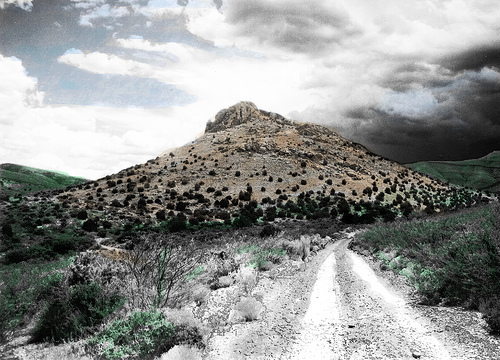
Victorio Peak is a high rocky outcropping in the Hembrillo Basin in southern New Mexico. This was one of Chief Victorio's hideouts, and was the site of a battle in 1880 between Victorio's Apaches and the U.S. Army Ninth Cavalry "Buffalo Soldiers." Additionally, an American gold prospector claimed to have found hidden treasure inside the Mountains in the late 1930s.[1]

Key Information

Geologic history

[edit]

The Tularosa Basin was developed in the north-south trending San Andres Mountains, and comprises north-south striking Late Paleozoic sedimentary rocks of Permian and Carboniferous age, that lie unconformably upon Precambrian metamorphics.[2] The regional dip of the Paleozoic rocks is gentle, around 10° to the west. The Permian rocks of the Abo and Yeso formations comprise mudrocks and sandstones which are freely weathering to create a series of steps capped by sandstones with intervening argillaceous rocks forming less steep slopes. These slopes and cap rocks were to be used to advantage by the Apaches in 1880.[3] The entrance to the Hembrillo Basin, Hembrillo Canyon, opens eastwards into the Tularosa Basin and White Sands National Park. The Canyon is partially barred by a roughly north-south trending diabase dike. Westwards is the valley of the Jornada del Muerto, the Sierra Caballo mountains and the Rio Grande.[4]

Namesake

[edit]

As the area was a well-known hideout of Chief Victorio, the peak was named after him. Briefings used by the U.S. Army prior to Operation Goldfinder labeled the mountain as Victoria Peak. Officials at the Range followed the lead of New Mexico historians, who erroneously believed the peak was named after Queen Victoria. Through diligent research, Howard Bryan, a reporter for the Albuquerque Tribune, linked Victorio with the Battle of Hembrillo Basin and discovered the peak's original namesake.[5]

Battle of Hembrillo Basin

[edit]

The Battle of Hembrillo Basin was fought between components of the United States Army's Sixth Cavalry and Ninth Cavalry against the Chiricahua and Mescalero Apache led by Chief Victorio.[6] Victorio pinned down a small American force of soldiers and withdrew from the battlefield when larger American forces arrived.

Treasure claims

[edit]

Milton "Doc" and Ova "Babe" Noss claimed to have discovered gold and artifacts inside the peak in 1933. Numerous books (viz., "The Gold House Trilogy" by John Clarence), news reports (see 60 Minutes and Unsolved Mysteries), and a 2023 docuseries "Gold, Lies & Videotape" purport to document the history of the discovery and disposition of the treasure.

References

[edit]

Further reading

[edit]
[edit]
Revisions and contributorsEdit on WikipediaRead on Wikipedia
from Grokipedia
Victorio Peak is a rocky summit rising to 5,499 feet (1,676 m) in the Hembrillo Basin of the San Andres Mountains, Dona Ana County, southern New Mexico, situated within the restricted White Sands Missile Range. Named for the 19th-century Warm Springs Apache chief Victorio, who utilized the area as a strategic hideout during conflicts with U.S. forces, including a 1880 battle against the Ninth Cavalry. The peak is most prominently associated with unverified claims of a massive treasure hoard allegedly discovered in 1937 by Milton Ernest "Doc" Noss, a chiropodist from Hot Springs, New Mexico, who reported finding a cavern system containing thousands of gold bars, coins, jewels, and historical artifacts potentially worth billions. Noss and associates reportedly extracted some items, including gold bars whose authenticity has been questioned, before sealing the entrance amid disputes and cave-ins, but subsequent efforts by his widow Ova and others failed to relocate the bulk of the supposed cache. In the 1970s, amid legal battles and public interest, the U.S. Army conducted searches on the missile range property, uncovering minor artifacts and human remains but no substantial treasure, with official denials of any significant recovery or removal of valuables. These events fueled ongoing legends attributing the hoard to sources like Spanish conquistadors, Mexican emperor Maximilian, or Apache raiders, though empirical evidence remains absent, rendering the tale a persistent but unsubstantiated mystery despite decades of exploration attempts.

Geography and Geology

Location and Topography

Victorio Peak is situated in Doña Ana County, southern New Mexico, within the restricted boundaries of the White Sands Missile Range. Its precise coordinates are 32°55′26″N 106°38′26″W, placing it in the Hembrillo Basin amid the San Andres Mountains. The summit reaches an elevation of 5,499 feet (1,676 meters) above sea level, forming a prominent rocky outcropping characteristic of the region's arid, rugged terrain. Topographically, the peak exhibits steep, precipitous slopes and craggy exposures, rising sharply from the surrounding basin floor and contributing to the defensive isolation of the area. This configuration, typical of the San Andres range's dissected desert landscape, includes sparse vegetation adapted to the cold desert climate (Köppen BWk).

Geologic History and Formation

Victorio Peak represents a resistant bioherm reef structure composed primarily of Permian limestone within the San Andres Mountains. These bioherms formed during the Leonardian to stages of the Permian Period, roughly 280 to 260 million years ago, when the region lay beneath shallow, warm marine waters on a carbonate platform along the western margin of the Pangaean . Reef-building organisms, including calcareous , sponges, and bryozoans, constructed massive, mound-like accumulations of skeletal material, creating localized thickenings in the stratigraphic section that resisted later erosion. The broader San Andres Mountains expose a sequence of sedimentary rocks, with Permian carbonates of the San Andres Formation and equivalents dominating the higher elevations, overlying older Mississippian and Pennsylvanian strata. Victorio Peak's prominence arises from differential weathering of these reefal limestones, which form karstic features including caves and fissures due to dissolution by over millions of years. The Hembrillo Basin, in which the peak is situated, developed as an erosional depression cutting into the eastern flank of the range, highlighting the structural grain of north-south trending folds and faults inherited from earlier . Uplift and exposure of Victorio Peak occurred primarily during the epoch, approximately 20 to 5 million years ago, as part of the Basin and Range extensional regime that fragmented the region into fault-block mountains. Normal faulting along the eastern margin of the San Andres Mountains elevated the range over 4,000 feet above the adjacent Tularosa Basin, preserving the peak as an erosional remnant amid ongoing arid weathering and sparse vegetation. This tectonic history underscores the peak's role as a window into Permian reef paleoenvironments, with its rugged reflecting both biogenic construction and post-depositional structural deformation.

Historical and Cultural Significance

Namesake: Chief Victorio and Apache Heritage

Chief Victorio (c. 1825–October 15, 1880) was a warrior and principal leader of the Warm Springs band (Chihenne) of the Tchihendeh division of the , whose traditional territory encompassed the Black Range and surrounding areas of southwestern . Born likely in the Black Range, Victorio grew up amid escalating conflicts with Mexican settlers and forces, honing skills in central to Apache survival strategies in the arid Southwest. By the 1870s, as U.S. expansion intensified post-Civil War, he emerged as a key resistor against forced relocations to reservations like San Carlos, leading raids to protect water sources and foraging grounds vital to his band's . The Chiricahua Apache, including Victorio's Warm Springs subgroup, maintained a heritage rooted in matrilineal clans, seasonal migrations between highland strongholds and lowlands, and a warrior ethos emphasizing mobility, marksmanship, and intimate knowledge of terrain for defense and raiding. This cultural framework, adapted to the harsh deserts and mountains, prioritized autonomy over sedentary agriculture, viewing land not as property but as a living network of sacred sites and resources. Victorio embodied this legacy, allying temporarily with figures like before asserting independent leadership, and rejecting U.S. assimilation policies that disrupted Apache social structures and spiritual practices tied to places like the Warm Springs themselves. Victorio Peak, situated in the San Andres Mountains of , bears the chief's name due to his documented use of the vicinity as a defensive during the , particularly amid campaigns against U.S. troops in 1879–1880. The rugged peaks provided natural fortifications aligning with Apache tactics of and evasion, underscoring Victorio's strategic reliance on ancestral landscapes for sustenance and resistance until his death in a Mexican at Tres Castillos. This naming reflects the peak's association with his band's heritage of territorial defiance rather than any formal commemoration.

Victorio's Use of the Area as a Hideout

Chief Victorio, leader of the Warm Springs Apache, utilized the rugged terrain of the Hembrillo Basin in the San Andres Mountains, encompassing Victorio Peak, as a temporary headquarters and refuge during the final stages of Victorio's War in early 1880. In late March 1880, following raids across southern New Mexico and evasion of U.S. forces, Victorio's band of approximately 80 warriors and families established a base in the basin, leveraging its steep canyons and defensible positions for protection against pursuit. By early April 1880, U.S. Army intelligence from scouts confirmed 's presence, prompting Companies E and I of the 9th , under Henry Carroll, to advance into Hembrillo Canyon on April 5. 's forces, numbering around 150 including allies, ambushed the cavalry on April 8, using the basin's rocky outcrops and narrow passes to their advantage in a day-long skirmish that inflicted casualties but allowed to break contact and flee southward toward . This engagement, known as the Battle of Hembrillo Basin, highlighted the area's strategic value as a hideout, though it proved insufficient for long-term evasion as 's band suffered losses and resource strain. Earlier in the campaign, had conducted running fights in the San Andres Mountains on January 30 and February 3, 1880, against Major Thomas K. Morrow's 9th Cavalry, employing the range's topography to delay and harass pursuers without committing to prolonged defense. These actions underscore the San Andres' role in 's guerrilla tactics, providing brief sanctuary amid broader movements between , , and Chihuahua. The peak's naming after reflects this association, formalized post-battle to commemorate his wartime presence in the vicinity.

Military History

Battle of Hembrillo Basin

The Battle of Hembrillo Basin occurred from April 5 to 7, 1880, in Hembrillo Canyon within the San Andres Mountains of , pitting a band of Warm Springs Apache, , and warriors led by Chief Victorio against U.S. Army forces primarily from the Ninth Cavalry. This engagement, the largest of , arose from U.S. efforts to subdue Victorio's group after their refusal to remain on the Reservation and subsequent raids across the U.S.-Mexico border. Victorio's band, estimated at 60–150 warriors with a total encampment of around 450 including women and children, had established a headquarters in the basin following earlier clashes. On April 5, Lieutenant John Conline's Troop A of the Ninth Cavalry initiated contact with a skirmish at the mouth of Hembrillo Canyon, detecting 's camp near Rock House Spring. The following day, April 6, Henry Carroll's battalion—Companies D and F of the Ninth Cavalry, comprising about 71 Buffalo Soldiers—advanced into the canyon and encountered an ambush in a V-shaped trap, leading to intense fighting that wounded Carroll twice and continued overnight. Reinforcements under Curwen McLellan (Sixth Cavalry, Company L, with 21 ) and Major James Morrow arrived on April 7, launching assaults from western bluffs including Victorio Ridge; the Apaches conducted effective rear-guard actions while retreating southward, ultimately evading capture despite U.S. numerical superiority of 300–710 troops under overall command of Colonel Edward Hatch and Major Benjamin . U.S. casualties totaled two killed (Privates Isaac James and William Saunders) and seven to eight wounded, while Apache losses remain uncertain but are estimated at three to 30 killed based on historical accounts. The Army secured the battlefield but failed to decisively defeat , who escaped toward , prolonging his campaign until his death later that year at Tres Castillos. Archaeological surveys have confirmed the engagements through over 1,100 artifacts, including 800+ cartridge cases from .45-70 Springfields and other calibers, military buttons, and items like a metal , mapped across sites such as Carroll’s Ridge and Apache Ridge in the 900-acre basin.

Treasure Legends and Investigations

Origins of Treasure Claims

The treasure legends surrounding Victorio Peak originated in 19th-century folklore attributing hidden caches to the Warm Springs Apache chieftain , who employed the Hembrillo Basin—including the peak named in his honor—as a stronghold during the of the 1870s and 1880s. Local accounts claim Victorio's band amassed bars, coins, jewelry, and artifacts through raids on U.S. wagon trains, stagecoaches hauling California-mined , and settler outposts, subsequently concealing the spoils in remote caverns to evade pursuing military forces. These narratives gained traction after Victorio's death on October 14, 1880, at Tres Castillos in , where he and remnants of his group were killed by Mexican troops following defeats by U.S. forces. Proponents of the describe the purported as comprising approximately 16,000 bars alongside Spanish-donated items, such as ornate saddles and religious icons, allegedly acquired via pillaging of missions or integrated into earlier deposits. However, these claims lack contemporaneous documentation or archaeological corroboration, relying instead on oral traditions among ranchers and prospectors that romanticized resistance while speculating on unrecovered frontier wealth. Compounding the Victorio attribution, some variants invoke pre-Apache origins, positing the cache as remnants of 18th-century Spanish missionary treasures or bullion transported from to fund colonial expeditions, later augmented by indigenous raiders. Such theories draw from broader Southwestern lost-mine lore, including echoes of the "Lost Padre Mine," but remain speculative without , serving primarily as cultural motifs that predated formalized 20th-century treasure hunts. No verified records from U.S. Army campaigns or captives substantiate large-scale hoarding at the site, underscoring the legends' basis in anecdotal embellishment rather than empirical fact.

Doc Noss Discovery and Early Exploitation (1937–1940s)

In November 1937, Milton Ernest "Doc" Noss, a chiropodist based in Hot Springs, New Mexico, discovered a concealed shaft leading into Victorio Peak while deer hunting in the Hembrillo Basin of the San Andres Mountains. Entering the tunnel, Noss encountered a vast cavern system containing stacked gold bars—later estimated by him at around 16,000—along with artifacts including leather saddles, historical documents, jeweled crowns, and human skeletons. Noss shared the find with his wife, Ova "Babe" Noss, and a few trusted associates, initiating secretive extraction efforts. Over the following months, they hauled out approximately 200 gold bars, each weighing 40 to 80 pounds, via narrow tunnels using ropes and manual labor; these were concealed in Noss's home and outbuildings in Hot Springs. The bars assayed at high purity (around 99%) but bore stamps indicating possible Spanish, French, or other foreign origins, which aroused suspicion under ownership laws and hindered legal sales. In spring 1938, the Nosses traveled to Santa Fe to formalize ownership, securing a state lease for the 160-acre Hembrillo Basin and filing mining claims to legitimize their operations. To safeguard the site from rivals, Noss dynamited the main entrance around , causing collapses that obscured the route to the treasure chamber and complicated subsequent entries. He attempted to melt and recast some bars to evade scrutiny, selling small quantities locally despite federal restrictions on private gold holdings during the era. Throughout the early 1940s, Noss hired miners and drilled exploratory tunnels into the peak, expending significant resources but failing to relocate the primary cache due to unstable caverns and shifting debris. These efforts yielded minor artifacts but no substantial additional gold, as cave-ins and Noss's lack of precise maps thwarted progress. By mid-decade, impending military expansion in the region—culminating in the establishment of White Sands Proving Ground—further restricted access, effectively halting Noss's operations. Noss's claims remained unverified by independent parties, with his personal history of legal troubles casting doubt on the accounts' reliability. Following Doc Noss's death in 1949, his widow Ova "Babe" Noss maintained legal claims to Victorio Peak through existing mining leases and paperwork, forming the Mining Company with associate Roscoe Parr to pursue further excavation. She displayed artifacts purportedly from the site, such as engraved silver items and antique swords, to support her assertions while seeking investors and workers. However, these efforts faced immediate challenges from competing claimants and regulatory hurdles, complicating unified action. In 1955, the U.S. Army expanded the to encompass Victorio Peak, effectively barring Ova Noss and other private parties from access under pretexts. This restriction persisted into the late 1950s, despite reports from four Holloman Air Force Base officers in 1958 who claimed to have rediscovered gold bars in a sealed entrance, dynamiting it shut after their military-led expedition request was denied. Ova Noss contested the Army's control through petitions, asserting her proprietary rights derived from prior leases. Tensions escalated in 1961 when Ova Noss petitioned the state government to halt suspected excavations at the peak, prompting a legislative order to cease operations; however, witnesses alleged that Captain Orby Swanner oversaw a secretive removal of valued at approximately $300 million, a claim the has consistently denied. In response, the permitted Ova Noss a 60-day search in 1963, conducted with a company and involving a 200-foot excavation, which yielded no treasure and ended amid financial shortfalls. The subsequently banned further private searches, citing range security. By the early 1970s, disputes proliferated among approximately 50 claimants, including Ova Noss, her daughter Violet Noss Yancey, and the 1958 airmen, represented by attorney in negotiations with the for excavation rights. Bailey's refusal to disclose client identities and precise locations stalled progress until , when the approved a joint 10-day expedition by Expeditions Unlimited—costing over $5,000 per day and employing advanced drilling technology—under Secretary Howard Callaway's authorization, though Roscoe Parr withheld participation. The March 19, , search, involving Noss family members and others, uncovered no verifiable treasure, reinforcing ongoing skepticism while highlighting persistent legal fragmentation among heirs and associates.

Evidence Supporting Treasure Existence

Milton "Doc" Noss and associates reportedly extracted approximately 200 bars from caverns within Victorio Peak between and , with eyewitness R.L. Coker, then aged 17, observing the initial discovery of the entrance and subsequent retrieval efforts. Noss's wife, Ova "Babe" Noss, examined one retrieved bar in 1938 or , noting its yellow color indicative of after cleaning off surface grime initially mistaken for iron. In 1961, treasure hunter Tony Jolley recovered 10 bars from a site linked to Noss's operations near Victorio Peak, selling them for $66,000, a transaction implying verification of their content through or market acceptance at the time. Additionally, four U.S. Air Force personnel, including Thomas Berlett, entered caverns via an excavated tunnel in 1958 and reported observing stacks of bars resembling cordwood. Capt. Orby Swanner similarly recounted to associate Gene Erwin in 1961 that Army units had removed valued at around $300 million from the peak. Geophysical surveys provide indirect support through detection of subsurface anomalies consistent with large caverns. A 1993-1994 3-D seismic using sources, geophones in fissures, and hydrophones in boreholes identified a major amplitude anomaly beneath Victorio Peak, characterized by over 80% amplitude reduction across a 100-foot range and altered traveltimes, interpreted as evidence of a potential cavern system requiring further drilling for confirmation. The Noss family retains artifacts, documents, and records purportedly from the site, presented to investigators as corroboration.

Skepticism, Debunkings, and Failed Expeditions

Skeptics have questioned the veracity of Milton "Doc" Noss's claims since their inception, pointing to his history of peddling fake gold bars to investors as evidence of potential fraud. Noss, a chiropodist rather than a seasoned prospector, reportedly used the narrative of a cave-in sealing the treasure in 1939 as a convenient excuse for failing to produce further artifacts, fueling theories that the entire discovery was a scheme to attract funding. No independent verification of the alleged Spanish gold bars, skeletons, or documents has ever been documented prior to Noss's death in 1949, and subsequent assays of purported samples yielded inconsistent results, often attributed to lead-painted replicas. Geological assessments have further undermined the legend, noting that Victorio Peak's limestone formations could host caverns but lack the structural stability or historical deposition patterns to conceal billions in looted artifacts from Spanish or sources without surface indications. Claims of vast quantities—estimated at 200 million ounces—exceed known historical plunder from the region, such as French and Indian War-era raids, rendering the hoard implausibly large absent corroborating records from colonial archives. Multiple expeditions have failed to yield evidence, reinforcing doubts. In 1963, Noss's widow Ova "Babe" Noss secured permission for a 60-day search with a company under state archaeological oversight, excavating tunnels into the peak but recovering no gold or artifacts. A high-profile 1977 effort led by contractor Norman Scott, involving by geophysicist Lambert Dolphin and over 100 participants, detected potential caverns but uncovered only empty voids after 10 days of and excavation, constrained by U.S. Army time limits on the . Scott dismissed claimants' assertions as misguided, with costs exceeding $53,000 and no reimbursable finds. Later attempts fared no better. returned in 1990 with advanced , mapping voids consistent with Noss's descriptions but yielding no accessible upon probing. From 1992 to 1996, investor Delonas funded a $2 million operation with seismic surveys and , approaching a suspected cavity before the halted operations over unpaid access fees, again with zero recovery. These repeated null results, despite diverse technologies and permissions, have led researchers to conclude the likely never existed, with persistent legends sustained by anecdotal testimonies rather than empirical proof.

Government Involvement Theories and Restrictions

Victorio Peak's location within the , expanded in to encompass the site, imposed strict access restrictions for and weapons testing purposes, rendering the area off-limits to civilians and prohibiting unauthorized treasure-hunting activities. Military patrols enforced these limits, with the Army bulldozing passages and sealing entrances to deter intrusions. Federal court rulings upheld the military's surface rights while barring subsurface entry without consent, further complicating claimant efforts. Official government investigations included a 1961 top-secret operation by U.S. Army and Treasury agents, prompted by Air Force personnel reports of gold bars, during which a steel door was installed over a shaft; the effort was halted following a court request by Ova Noss, Doc Noss's widow. In 1963, Ova Noss conducted a 60-day search with a mining firm under Denver Mint auspices, yielding no treasure. A 1977 Army-permitted two-week excavation by multiple claimant groups, including Noss heirs, used ground-penetrating radar to detect a potential cavern but recovered nothing amid 400 feet of debris blocking access. Later congressional authorizations in the 1990s allowed limited probes, such as a 1992 effort halted short of a suspected cave, but produced no verifiable findings. Theories of deeper government involvement posit that military forces secretly extracted treasure during the 1960s, possibly transporting bars—estimated by some at hundreds of millions in value—to secure sites like , with claimants like Captain Orby Swanner alleging supervised removals and others, including Norman Scott and Phil Koury, suggesting appropriation by personnel for personal gain. These claims, often tied to unverified witness accounts from 1958 discoveries and post-1961 activity like and movements, fuel speculation of a to conceal national enrichment or wartime spoils. The U.S. Army has consistently denied any treasure recovery or removal, asserting that conducted work was routine and no such cache exists, attributing persistent access denials solely to operational security needs rather than concealment. Lacking empirical corroboration beyond anecdotal reports, these theories remain unproven amid the site's verifiable primacy.

Modern Scientific Probes and Current Status

In 1977, conducted and resistivity surveys at Victorio Peak, confirming the presence of large caverns, tunnels, and fissures beneath the mountain, consistent with claims of subsurface voids potentially linked to treasure legends. These measurements supported limited excavation efforts but yielded no direct evidence of artifacts or . A 3-D seismic survey in January 1994, led by researchers including James Rector, utilized 2,000 source positions and 120 receiver channels to image subsurface structures, identifying a major amplitude anomaly under the peak spanning approximately 100 feet with over 80% reduction in direct arrival amplitude, interpreted as a potential large cavern. The anomaly aligned with historical descriptions of a chamber containing bars, coins, jewels, and remains, prompting plans for verification drilling later that year; however, no subsequent confirmation of from this data has been reported in geophysical literature. Post-1990s efforts shifted toward environmental and engineering assessments rather than dedicated treasure probes, with authorities funding surveys for security and infrastructure but finding no verifiable hoard. No peer-reviewed scientific investigations targeting the treasure have occurred since the mid-1990s, amid ongoing restrictions on access due to the site's location within the active . As of 2023, Victorio Peak remains under U.S. Army control, with treasure hunters classified as trespassers and no permitted excavations or geophysical surveys in recent decades. The absence of confirmed recoveries, combined with failed prior expeditions, leaves the existence of the alleged cache unverified, though geophysical data indicate anomalous subsurface features warranting further scrutiny if access were granted.

References

Add your contribution
Related Hubs
User Avatar
No comments yet.