



Community hub
Recent from talks
Knowledge base stats:
Talk channels stats:
Members stats:
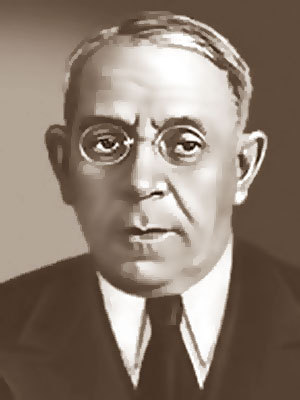
Vladimir Shchuko
Vladimir Alekseyevich Shchuko (Russian: Влади́мир Алексе́евич Щуко́, IPA: [ɕːʉˈko]; October 17, 1878 – January 19, 1939) was a Russian architect, member of the Saint Petersburg school of Russian neoclassical revival notable for his giant order apartment buildings "rejecting all trace of the moderne". After the Russian Revolution of 1917 Shchuko gradually embraced modernist ideas, developing his own version of modernized neoclassicism together with his partner Vladimir Gelfreikh. Shchuko and Gelfreikh succeeded through the prewar period of Stalinist architecture with high-profile projects like the Lenin Library, Moscow Metro stations and co-authored the unrealized Palace of Soviets. Shchuko was also a prolific stage designer, author of 43 drama and opera stage sets.
Born in Tambov in a military family, Vladimir Schuko joined Leon Benois's class of architecture at the Imperial Academy of Arts in 1896 and graduated in 1904. His academic mentors included Vladimir Mate and Ilya Repin, and his classmates were Nikolay Lanceray, Ivan Rylsky, Alexander Tamanian and Nikolai Vasilyev; the class of 1904 was by far the strongest the Academy ever had. Shchuko's 1904 graduation project, a palace for the viceroy of the Russian Far East, was declared best in his class but had no chance of being ever built during or after the Russo-Japanese War; it was undeniably neoclassical and demonstrated uncommon ability to retain the neoclassical spirit in a design substantially larger than any preceding neoclassical buildings. Twice, in 1904 and 1906, the Academy awarded him with state-sponsored study tours of Italy; in 1901 he also travelled to Svalbard, and was frequently engaged in preservation projects at home. Shchuko was a member of the influential non-governmental Commission for Study and Description of Old Petersburg, a preservation society led by Leon Benois, and later served on the board of the Museum of Old Petersburg established in 1907. As Nicholas Roerich said in a 1939 eulogy, "He deeply understood the Russian Empire style, he loved the Italian eighteenth century. He had naturally fine taste; anything emanating from him was noble in form and function".
His first real project, executed upon his return from Italy in 1907, was the facades of two adjacent apartment blocks on Saint Petersburg's Kamenny Island (Markov Buildings, 1908–1910), which became instantly popular and were copied by fellow architects and included in textbooks on Russian architecture. The first, at 65, Kamennoostrovsky Prospekt, employing his novel giant order, is still used as a reference in Russian textbooks on architecture. The building, with giant Ionic columns spanning four floors and topped with a fifth, hidden into an elaborate cornice, was based on the Italian Renaissance. Shchuko decorated a flat wall outside the main portico with loggias interspaced with carved relief, a pattern that became common in 1930s stalinist architecture. The second, at no. 63, puzzled contemporary critics as being monumental yet neither historic nor modern, "a style appropriate for contemporary urban architecture". Critics especially praised his stern treatments of windows recessed in a flat wall, another future staple of stalinist architecture. "The ramifications of Shchuko's neoclassicism appeared in many other, less obvious, forms during the retrospective phase of Soviet architecture—indeed, until the late 1950s." However, unlike his contemporary Ivan Fomin, Shchuko built little in Saint Petersburg. His other notable pre-revolutionary projects, the empire style Russian Pavilions, were built in Rome and Turin for the 1911 International Exhibition of Art and were soon dismantled.
In 1913 Shchuko began construction of the neoclassical Municipal Building in Kyiv; it was partially completed during World War I and rebuilt to Shchuko's revised draft in the 1920s. The building later housed the Communist Party headquarters in Ukraine, the Gestapo, and currently the Security Service of Ukraine. Apart from the Kyiv project, Shchuko had completed a single architectural job during the war, rebuilding the Memorial Hall at the Academy of Arts (1914–1915); another Saint Petersburg project, a bank building on Nevsky Prospect, was left unfinished.
Shchuko's first theatrical production was made for the 1907–1908 season of the Old-Time Theatre in Saint Petersburg, followed by another season in 1911–1912 (Calderon's Purgatory of St. Patrick). Shchuko's early theatrical production departed from the modernized revivalism of Mir iskusstva as the artist settled for exact recreation of the early 19th century romanticism. Later, in 1919-1920s, Shchuko was criticized for "Schillerisation of Shakespeare" through introducing irrelevant romanticism into medieval settings.
World War I and the subsequent Russian Civil War put a hold on nearly all construction projects for a decade, yet the theatre prospered. The architect turned to theatre again, joined the board of Nikolai Evreinov's Prival Komediantov cabaret in 1916. In 1918 Shchuko and Mstislav Dobuzhinsky collaborated with the Theatre of Artistic Drama as stage designers; the company collapsed after producing Tirso de Molina's El Burlador.
In February 1919 Shchuko, Dobuzhinsky and Benois moved to the newly opened Bolshoy Drama Theatre. Shchuko landed a full-time job as the chief designer, "amazingly appearing at the right time in the right place to create the atmosphere of a 'grand style' theatre". The company, leaning towards classical works, earned cash through "lightweight" melodramas like Alexey Tolstoy's 1925 Conspiring Empress, also designed by Shchuko, that became a long-running hit. Shchuko productions of the Civil War period (1919 Don Carlos, 1920 Othello and Arvid Järnefelt's Destruction of Jerusalem) preceded the monumental stereotypes of social realism of 1930s-1940s, however, starting with the 1921 Twelfth Night he reduced the apparent size and grandeur of his stage sets. Shchuko frequently employed theatre designer Orest Allegri, famous for his inventive handling of perspective illusion. Contemporary critics rate the 1919 Don Carlos as the artist's highest mark in theatre.
In 1925-1927 Shchuko also designed a series of Der Ring des Nibelungen opera shows and a ballet at Mariinsky Theatre. After relocation to Moscow in the end of the 1920s, Shchuko collaborated with Bolshoi Theatre and Maly Theatre, producing the 1937 Boris Godunov.
Hub AI
Vladimir Shchuko AI simulator
(@Vladimir Shchuko_simulator)
Vladimir Shchuko
Vladimir Alekseyevich Shchuko (Russian: Влади́мир Алексе́евич Щуко́, IPA: [ɕːʉˈko]; October 17, 1878 – January 19, 1939) was a Russian architect, member of the Saint Petersburg school of Russian neoclassical revival notable for his giant order apartment buildings "rejecting all trace of the moderne". After the Russian Revolution of 1917 Shchuko gradually embraced modernist ideas, developing his own version of modernized neoclassicism together with his partner Vladimir Gelfreikh. Shchuko and Gelfreikh succeeded through the prewar period of Stalinist architecture with high-profile projects like the Lenin Library, Moscow Metro stations and co-authored the unrealized Palace of Soviets. Shchuko was also a prolific stage designer, author of 43 drama and opera stage sets.
Born in Tambov in a military family, Vladimir Schuko joined Leon Benois's class of architecture at the Imperial Academy of Arts in 1896 and graduated in 1904. His academic mentors included Vladimir Mate and Ilya Repin, and his classmates were Nikolay Lanceray, Ivan Rylsky, Alexander Tamanian and Nikolai Vasilyev; the class of 1904 was by far the strongest the Academy ever had. Shchuko's 1904 graduation project, a palace for the viceroy of the Russian Far East, was declared best in his class but had no chance of being ever built during or after the Russo-Japanese War; it was undeniably neoclassical and demonstrated uncommon ability to retain the neoclassical spirit in a design substantially larger than any preceding neoclassical buildings. Twice, in 1904 and 1906, the Academy awarded him with state-sponsored study tours of Italy; in 1901 he also travelled to Svalbard, and was frequently engaged in preservation projects at home. Shchuko was a member of the influential non-governmental Commission for Study and Description of Old Petersburg, a preservation society led by Leon Benois, and later served on the board of the Museum of Old Petersburg established in 1907. As Nicholas Roerich said in a 1939 eulogy, "He deeply understood the Russian Empire style, he loved the Italian eighteenth century. He had naturally fine taste; anything emanating from him was noble in form and function".
His first real project, executed upon his return from Italy in 1907, was the facades of two adjacent apartment blocks on Saint Petersburg's Kamenny Island (Markov Buildings, 1908–1910), which became instantly popular and were copied by fellow architects and included in textbooks on Russian architecture. The first, at 65, Kamennoostrovsky Prospekt, employing his novel giant order, is still used as a reference in Russian textbooks on architecture. The building, with giant Ionic columns spanning four floors and topped with a fifth, hidden into an elaborate cornice, was based on the Italian Renaissance. Shchuko decorated a flat wall outside the main portico with loggias interspaced with carved relief, a pattern that became common in 1930s stalinist architecture. The second, at no. 63, puzzled contemporary critics as being monumental yet neither historic nor modern, "a style appropriate for contemporary urban architecture". Critics especially praised his stern treatments of windows recessed in a flat wall, another future staple of stalinist architecture. "The ramifications of Shchuko's neoclassicism appeared in many other, less obvious, forms during the retrospective phase of Soviet architecture—indeed, until the late 1950s." However, unlike his contemporary Ivan Fomin, Shchuko built little in Saint Petersburg. His other notable pre-revolutionary projects, the empire style Russian Pavilions, were built in Rome and Turin for the 1911 International Exhibition of Art and were soon dismantled.
In 1913 Shchuko began construction of the neoclassical Municipal Building in Kyiv; it was partially completed during World War I and rebuilt to Shchuko's revised draft in the 1920s. The building later housed the Communist Party headquarters in Ukraine, the Gestapo, and currently the Security Service of Ukraine. Apart from the Kyiv project, Shchuko had completed a single architectural job during the war, rebuilding the Memorial Hall at the Academy of Arts (1914–1915); another Saint Petersburg project, a bank building on Nevsky Prospect, was left unfinished.
Shchuko's first theatrical production was made for the 1907–1908 season of the Old-Time Theatre in Saint Petersburg, followed by another season in 1911–1912 (Calderon's Purgatory of St. Patrick). Shchuko's early theatrical production departed from the modernized revivalism of Mir iskusstva as the artist settled for exact recreation of the early 19th century romanticism. Later, in 1919-1920s, Shchuko was criticized for "Schillerisation of Shakespeare" through introducing irrelevant romanticism into medieval settings.
World War I and the subsequent Russian Civil War put a hold on nearly all construction projects for a decade, yet the theatre prospered. The architect turned to theatre again, joined the board of Nikolai Evreinov's Prival Komediantov cabaret in 1916. In 1918 Shchuko and Mstislav Dobuzhinsky collaborated with the Theatre of Artistic Drama as stage designers; the company collapsed after producing Tirso de Molina's El Burlador.
In February 1919 Shchuko, Dobuzhinsky and Benois moved to the newly opened Bolshoy Drama Theatre. Shchuko landed a full-time job as the chief designer, "amazingly appearing at the right time in the right place to create the atmosphere of a 'grand style' theatre". The company, leaning towards classical works, earned cash through "lightweight" melodramas like Alexey Tolstoy's 1925 Conspiring Empress, also designed by Shchuko, that became a long-running hit. Shchuko productions of the Civil War period (1919 Don Carlos, 1920 Othello and Arvid Järnefelt's Destruction of Jerusalem) preceded the monumental stereotypes of social realism of 1930s-1940s, however, starting with the 1921 Twelfth Night he reduced the apparent size and grandeur of his stage sets. Shchuko frequently employed theatre designer Orest Allegri, famous for his inventive handling of perspective illusion. Contemporary critics rate the 1919 Don Carlos as the artist's highest mark in theatre.
In 1925-1927 Shchuko also designed a series of Der Ring des Nibelungen opera shows and a ballet at Mariinsky Theatre. After relocation to Moscow in the end of the 1920s, Shchuko collaborated with Bolshoi Theatre and Maly Theatre, producing the 1937 Boris Godunov.