Hubbry Logo
Giant orderGiant orderMain
Open search
Giant order
Community hub
Giant order
logo
8 pages, 0 posts
0 subscribers
Be the first to start a discussion here.
Giant order
Giant order
from Wikipedia
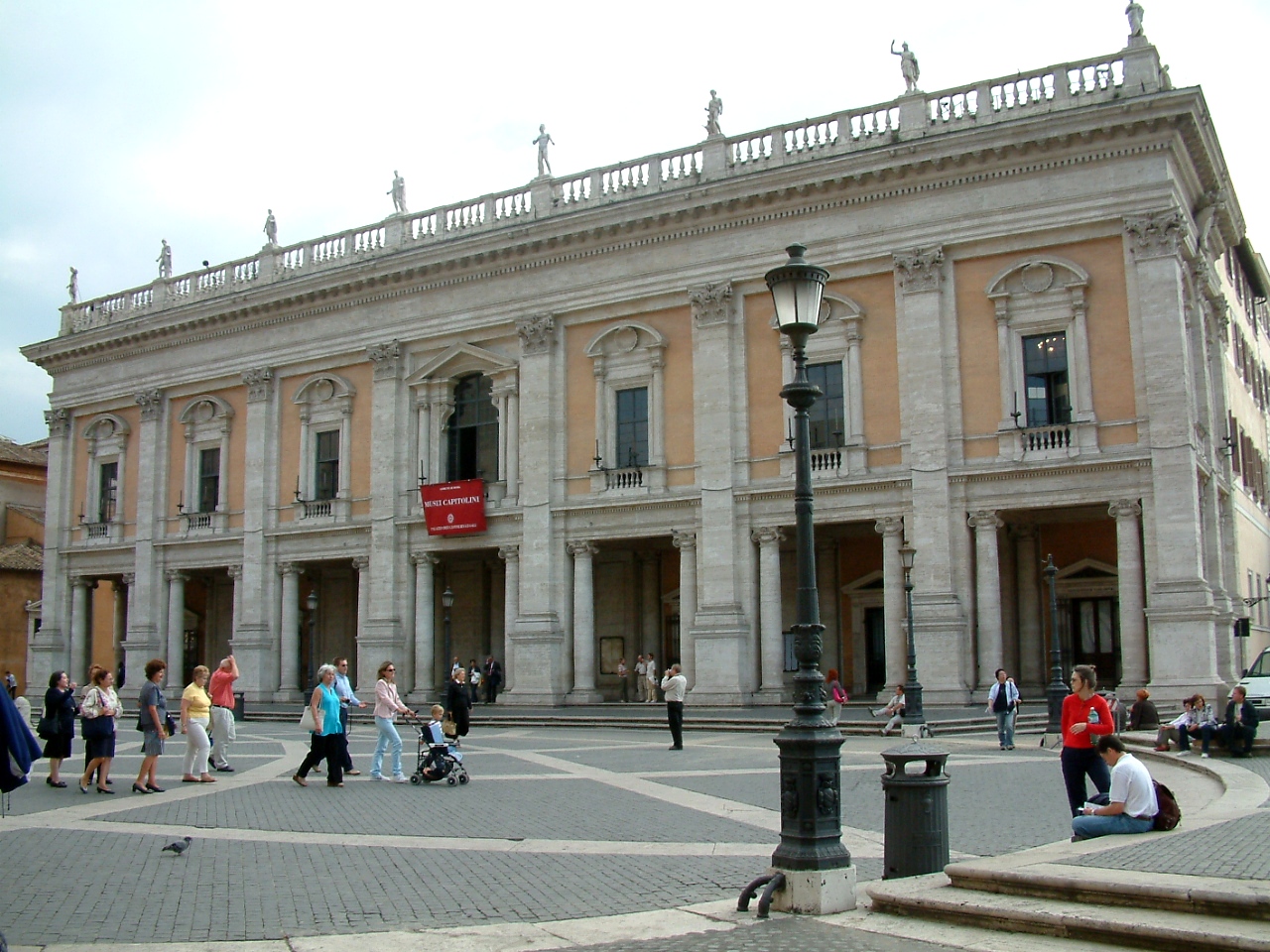
Michelangelo's Palazzo dei Conservatori in Rome

In classical architecture, a giant order, also known as colossal order, is an order whose columns or pilasters span two (or more) storeys. At the same time, smaller orders may feature in arcades or window and door framings within the storeys that are embraced by the giant order.[1]

The giant order was rare in antiquity. Vitruvius' depiction of the lost Basilica of Fanum contains columns spanning two stories.[2] Roman architectural historian Mark Wilson Jones also cites the columns at the Basilica of Pompeii, the Baths of Diocletian, and the Temple of Baachus at Baalbek as early examples of the giant order.[3] To an extent buildings with giant orders resemble a Roman temple adapted for post-classical use,[4] as many were (the survivors have now usually been stripped of later filling-in).

In Renaissance and Beaux-Arts architecture

[edit]
Facade of Sant'Andrea, Mantua

One of the earliest uses of this feature in the Renaissance was at the Basilica of Sant'Andrea, Mantua, designed by Leon Battista Alberti and begun in 1472; this adapted the Roman triumphal arch to a church facade. From designs by Raphael for his own palazzo in Rome on an island block it seems that all facades were to have a giant order of pilasters rising at least two stories to the full height of the piano nobile, "a grandiloquent feature unprecedented in private palace design". He appears to have made these in the two years before his death in 1520, which left the building unstarted.[5] It was further developed by Michelangelo at the Palaces on the Capitoline Hill in Rome (1564–1568), where he combined giant pilasters of Corinthian order with small Ionic columns that framed the windows of the upper story and flanked the loggia openings below.[4]

The giant order became a major feature of later 16th century Mannerist architecture, and Baroque architecture.[4] Its use by Andrea Palladio justified its use in the seventeenth century in the movement known as neo-Palladian architecture.

It continued to be used in Beaux-Arts architecture of 1880–1920 as, for example, in New York City's James A. Farley Building, which claims the largest giant order Corinthian colonnade in the world.[6]

[edit]

Notes

[edit]

References

[edit]
[edit]
Revisions and contributorsEdit on WikipediaRead on Wikipedia
from Grokipedia
In , the giant order, also known as the , is an order whose columns or pilasters span two (or more) storeys. This feature unifies multiple levels of a building's facade into a single vertical composition, emphasizing monumentality and grandeur. It serves both structural and aesthetic functions and is primarily employed on exteriors of public and religious buildings, contrasting with traditional single-story orders like Doric, Ionic, or Corinthian by its scale and dramatic verticality. Though giant columns were used in antiquity, the giant order emerged during the in , where architects revived ancient Roman forms and innovated to create multi-storey facades. It became prominent in Mannerist and Baroque architecture for expressing dynamism and power, and persisted into and later styles.

Definition and Characteristics

Definition

In , the giant order refers to an arrangement of columns or pilasters that extend the full height of two or more storeys on a building's facade, thereby unifying the vertical composition and imparting a sense of grandeur and monumentality. Unlike standard classical orders, which are proportioned to span a single storey and typically feature horizontal divisions such as cornices between levels, the giant order minimizes these interruptions to emphasize height and continuity. The giant order is frequently paired with smaller superimposed orders on the same facade, where the latter articulate elements like arcades, window surrounds, or doorways within the taller spans, creating layered depth while maintaining the overarching vertical thrust. Also termed the , this architectural feature has a minimum span of two storeys and is most commonly executed in the Doric, Ionic, Corinthian, or Composite styles, adapted at a larger scale. It was revived during the as a means to adapt classical proportions to multi-storey buildings.

Design Principles

The giant order in serves primary aesthetic goals of enhancing perceived height and grandeur while unifying multi-story facades into a cohesive vertical composition, thereby disrupting the conventional horizontal of stacked single-story orders. This approach creates a monumental scale that emphasizes verticality, fostering a of dynamic unity and perceptual through layered elements that interpenetrate planes. In giant orders, pilasters are commonly used over free-standing columns for their engaged form, which integrates efficiently with wall surfaces to distribute loads across tall elevations, though free-standing columns are also prevalent in certain designs. Such designs necessitate robust foundations and pedestals to accommodate the extended proportions, balancing ornamental emphasis with practical load-bearing requirements to support overlying entablatures and roofs. Proportional rules for giant orders adapt Vitruvian ideals to larger scales, typically setting column or height at 9 to 10 times the —such as 1:10 for Composite orders—to ensure stability and coherence, with intercolumniation often spanning one and a half to four times the column lower for rhythmic balance. Entablatures between stories are frequently simplified or omitted to avoid visual clutter, prioritizing overall and modular alignment over strict replication of smaller-order details. Integration techniques position giant orders to frame windows and doors seamlessly, with pilasters or columns flanking openings to maintain continuous vertical flow without abrupt interruptions, often employing rustication at the base on high pedestals to ground the composition and transition from solid foundation to elevated superstructure. This method, briefly revived by theorists like Alberti in adapting classical modules, ensures the order enhances facade readability while interlocking with for layered depth.

Historical Development

Ancient Precedents

The giant order, characterized by columns or pilasters spanning multiple stories, was exceedingly rare in ancient prior to its systematic revival in the , though isolated instances appeared in Roman buildings as described by the architect . These precedents primarily served to enhance the scale and grandeur of public structures, drawing on principles of proportional exaggeration for monumental effect. , in his treatise (Book V, Chapter 1), outlines the design of basilicas with elongated columns to create a sense of vertical unity and spaciousness, emphasizing that such proportions were suited to civic buildings like law courts and assembly halls. A seminal example is the Basilica at Fano (Fanum Fortunae), designed by himself around 27–19 BCE. This structure featured eighteen Corinthian columns, each 50 Roman feet (approximately 14.8 meters) tall with a 5-foot , rising uninterrupted from the ground to support an upper , effectively forming a two-story giant order that unified the facade and interior . The basilica's layout, with a central hall flanked by aisles and an , measured about 100 by 200 Roman feet, where the tall columns created dramatic interior while adhering to Vitruvian ratios of to (10:1 for Corinthian). Though the building was destroyed by the CE, its description in provided a theoretical model for scaling orders in large public venues. Another notable precedent is the at (ancient Heliopolis), constructed circa 150 CE in . The temple's interior walls are articulated with engaged Corinthian columns approximately 20 meters high, spanning the full height of the structure in a giant order that frames niches and enhances the dramatic verticality of the space. These monolithic elements, carved from local , contributed to the temple's imposing presence within the larger Heliopolitan complex, blending Roman with Eastern influences. In antiquity, giant orders were largely confined to basilicas and for creating interior and exterior drama, such as unifying multi-level facades in public baths like those of (298–306 CE), where superimposed elements in the echoed proportional scaling but rarely achieved true multi-story spans. Their application remained limited, avoiding widespread use in temples due to traditional single-story peripteral designs that prioritized horizontal processional emphasis over verticality. This restraint in ancient practice contrasted with later interpretations that expanded the form's potential.

Renaissance Revival

The giant order was revived in around the 1470s, driven by renewed scholarly engagement with Vitruvius's and direct study of Roman ruins, which inspired architects to adapt ancient monumental forms for contemporary buildings. The earliest prominent example appeared in Leon Battista Alberti's design for the Basilica of Sant'Andrea in , construction of which began in 1472 under the patronage of Ludovico III Gonzaga; here, four giant Corinthian pilasters articulate the facade, spanning the full height of the to evoke the scale and unity of Roman basilicas like that of Maxentius and Constantine. This innovation marked a deliberate fusion of classical temple fronts and triumphal arches, transforming the church into a pilgrimage destination while prioritizing visual grandeur over traditional medieval compartmentalization. Alberti's theoretical framework in (composed c. 1452, first published 1485) explicitly promoted giant orders as essential for achieving civic grandeur, arguing that oversized columns or pilasters could elevate public structures to convey authority and permanence, drawing on Vitruvian principles of utility, firmness, and delight extended by Alberti's emphasis on contextual appropriateness. Complementing this, Raphael's early architectural designs for unbuilt palazzi before 1520, notably the Palazzo Branconio dell'Aquila in (c. 1515–1520), experimented with multi-storey scaling through giant Doric pilasters that unified ground and levels, creating a bold, cohesive elevation that anticipated palace aesthetics. These theoretical and design explorations underscored the giant order's potential to impose rhythmic harmony across elevations, bridging individual stories into a single, imposing whole. Michelangelo further refined the giant order's application in his redesign of the Palazzo dei Conservatori on Rome's (1564–1568), where a colossal of pilasters rises across two stories on rusticated pedestals, unifying the irregular existing facade with the adjacent structures to form a cohesive civic ensemble around the piazza. This approach emphasized proportional balance—contrasting robust vertical pilasters with horizontal entablatures and ground-level Ionic columns—to heighten the hill's symbolic role as the political heart of , while the rustication at the base grounded the composition in robust, earthy materiality. Following these foundational uses, the giant order proliferated in Italian palazzi and churches during the late 15th and 16th centuries, valued for its capacity to impart a monumental, unified effect that signaled the era's shift from fragmented Gothic forms to the integrated rationality of classical revival. Architects employed it to amplify spatial drama and civic prestige, as seen in subsequent and residential commissions that echoed Alberti's and Michelangelo's precedents without replicating medieval vertical segmentation.

Usage in Major Architectural Periods

Mannerism and Baroque Applications

The giant order emerged prominently in Mannerist architecture during the late , where architects employed elongated proportions to introduce tension and deliberate asymmetry, departing from harmony. This approach is exemplified in the influences of Giulio Romano's (1524–1534), which featured partial uses of oversized elements that foreshadowed full giant orders in subsequent palazzi, creating visual instability through irregular alignments and exaggerated scales. Such applications became widespread in Italian urban palaces, where the giant order accentuated asymmetrical facades and heightened expressive distortions, as seen in the pilasters spanning multiple stories to emphasize verticality and unease. In the Baroque period of the , the giant order expanded into theatrical facades designed to evoke grandeur and dynamism, transforming building exteriors into dramatic spectacles. Gian Lorenzo Bernini's for (1656–1667) utilized a giant , with 284 columns each approximately 13 meters (43 feet) high arranged in quadruple rows to enclose the piazza and unify the vast space under a single architectural gesture. Similarly, Francesco Borromini's (1638–1641) incorporated twisted columns rising to the full height of the facade, approximately 10-15 meters (33-49 feet), their helical forms generating a sense of swirling movement that integrated the facade's concave-convex rhythms. These innovations amplified the order's role in creating immersive, emotionally charged environments that contrasted with the measured restraint of precedents. The giant order's adoption spread across Europe, justified in Andrea Palladio's theoretical writings and built works, which blended classical revival with innovative scale to influence neo-Palladian designs. Palladio's (Palazzo della Ragione) in (begun 1549) employed giant pilasters to articulate unified facades, providing a rational basis for the order's use in secular and public structures that emphasized symmetry and proportion. This dissemination reached France through extensions to the , where Claude Perrault's east facade (1667–1674) featured paired giant Corinthian columns spanning two stories, establishing a monumental rhythm that symbolized royal authority. In , Baroque palaces adopted the giant order for imposing exteriors, as in designs by architects like , where full-height pilasters enhanced the scale and illusion of power in country houses. The north facade of the Palace of Versailles (1669–1710) further exemplified this with colossal pilasters projecting absolutist power across its expansive wings. Stylistically, Baroque applications of the giant order often incorporated undulating entablatures that curved in wave-like patterns, paired with integrated to heighten emotional impact and sensory engagement. These elements, such as sculpted figures emerging from architectural frames, created a fluid interplay between structure and ornament, fostering a of motion and infinity that underscored the era's dramatic intensity.

Neoclassicism and Beaux-Arts Usage

In the 18th century, the giant order found renewed application in neoclassical architecture, where it was employed to enhance symmetrical compositions and evoke a sense of restrained monumentality. Architects integrated it into facades to unify multiple stories, drawing on classical precedents while avoiding the dramatic flourishes of earlier styles. In Britain, Robert Adam utilized classical orders in designs such as the east front of Culzean Castle (1772–1790), where paired Corinthian columns framed the entrance, creating a balanced elevation that emphasized proportion and elegance over ornamentation. Similarly, in France, the Panthéon in Paris (1758–1790, designed by Jacques-Germain Soufflot) incorporated engaged Corinthian pilasters in giant order on its facade, spanning two stories to articulate the structure's rational geometry and civic importance during the revolutionary period. These applications reflected a broader neoclassical emphasis on Vitruvian ideals of symmetry and scale, adapted for public and institutional buildings. The giant order reached its zenith in from approximately 1880 to 1920, particularly in and the , where it became a hallmark of monumental civic design. Taught rigorously at the École des Beaux-Arts, the curriculum reinforced Vitruvian principles of proportion and character, encouraging students to scale orders across multiple stories for dramatic effect in compositions that symbolized institutional authority and urban grandeur. In the U.S., the firm exemplified this approach in projects like the original Pennsylvania Station in New York (1904–1910), where giant-order freestanding Corinthian columns supported vast vaults in the concourse, merging structural boldness with classical to convey the power of transportation infrastructure. The James A. Farley (1912), also by the firm, featured a prominent giant Corinthian colonnade spanning two stories with columns over 50 feet (15 meters) high, underscoring the building's role as a federal landmark. These designs prioritized hierarchical massing and sculptural detailing, aligning with Beaux-Arts tenets of and scale to project stability and national prestige. Following , the giant order waned in favor of modernist aesthetics that rejected historical ornament, though its legacy persisted in transitional styles like , where scaled classical motifs appeared in streamlined facades. The École des Beaux-Arts' emphasis on Vitruvian scaling continued to influence theoretical discourse, providing a foundation for understanding proportional harmony in . Globally, the style spread through colonial applications, adapting giant orders to assert imperial presence; in , neoclassical structures employed classical columns to evoke authority in administrative contexts. In , neoclassical and Beaux-Arts revivals incorporated similar elements, symbolizing republican ideals amid post-colonial nation-building.

Notable Examples

Italian Renaissance and Baroque Examples

One of the earliest and most influential applications of the giant order in is found in the Basilica of Sant'Andrea in , designed by and construction of which began in 1472 under the patronage of Ludovico III Gonzaga. The facade features four giant Corinthian pilasters that span two storeys, framing a monumental triumphal arch entrance inspired by ancient Roman models such as the , thereby creating a sense of grandeur and processional movement that unifies the building's vertical composition. This design draws on Alberti's theories in , where he advocated for the giant order to enhance architectural scale and harmony, emphasizing proportion to evoke antiquity without overwhelming the structure's modest materials—primarily brick faced with to mimic stone. The pilasters support a classical and , integrating the church's barrel-vaulted interior with its exterior in a cohesive, temple-like form that marked a revival of colossal elements for ecclesiastical buildings. In , Michelangelo's redesign of the Palazzo dei Conservatori on the , executed between 1563 and 1568, demonstrates the giant order's role in civic to impose unity and monumentality on an existing medieval . The three-storey facade employs a colossal of pilasters that extends across the upper levels, binding the composition together and rising from a rusticated base that transitions from the ground-floor to the more refined upper stories, evoking the robustness of ancient Roman palaces. This giant order integrates a central supported by paired columns, allowing for public address while maintaining rhythmic continuity through subsidiary Ionic elements interposed between the larger pilasters, a technique that heightens the facade's and sculptural quality. Michelangelo's approach here, part of his broader Capitoline complex, used the giant order to symbolize civic authority, with the pilasters' pedestals and creating a powerful upward thrust crowned by a balustrade of statues. A striking evolution of the giant order appears in Francesco Borromini's in , constructed between 1638 and 1641 for the Discalced , where undulating colossal Composite columns span the full height of the to produce a facade of concave-convex rhythm and theatrical movement. These giant columns, paired and twisted to evoke organic waves, frame niches and the entrance portal, breaking from classical rigidity to convey spiritual ecstasy through their serpentine that dips and rises across the narrow urban site. Borromini's innovation integrated the order with the church's oval plan, using the columns' scale to compress and expand visual space, as detailed in his autograph drawings that emphasize geometric undulation for emotional impact. The facade's dramatic interplay of light on the Composite capitals and volutes heightened the Baroque emphasis on dynamism, making San Carlo a pivotal example of how the giant order could adapt to constrained spaces while amplifying architectural expression.

North American and European Neoclassical Examples

The in , designed by the architectural firm and constructed between 1904 and 1912, exemplifies Beaux-Arts neoclassicism through its monumental facade featuring a giant Corinthian of 20 fluted columns, each 53 feet (16 m) tall, spanning two stories. This colossal order envelops the postal facility's exterior, creating a sense of civic grandeur and emphasizing the building's role as a public landmark adjacent to the original Pennsylvania Station. The above the bears an inscribed quotation from President Theodore Roosevelt's 1903 speech, "Neither snow nor rain nor heat nor gloom of night stays these couriers from the swift completion of their appointed rounds," further enhancing its symbolic resonance as a temple to postal service efficiency. The in , designed by and completed in 1830, features a giant across its facade, with 18 colossal columns spanning the pronaos and unifying the building's neoclassical composition to evoke temples while serving as a public museum. The pilasters and engaged columns extend the order's scale, emphasizing rational symmetry and cultural prestige in the context of Prussian .

References

Add your contribution
Related Hubs
User Avatar
No comments yet.