Hubbry Logo
WasterWasterMain
Open search
Waster
Community hub
Waster
logo
8 pages, 0 posts
0 subscribers
Be the first to start a discussion here.
Waster
Waster
from Wikipedia

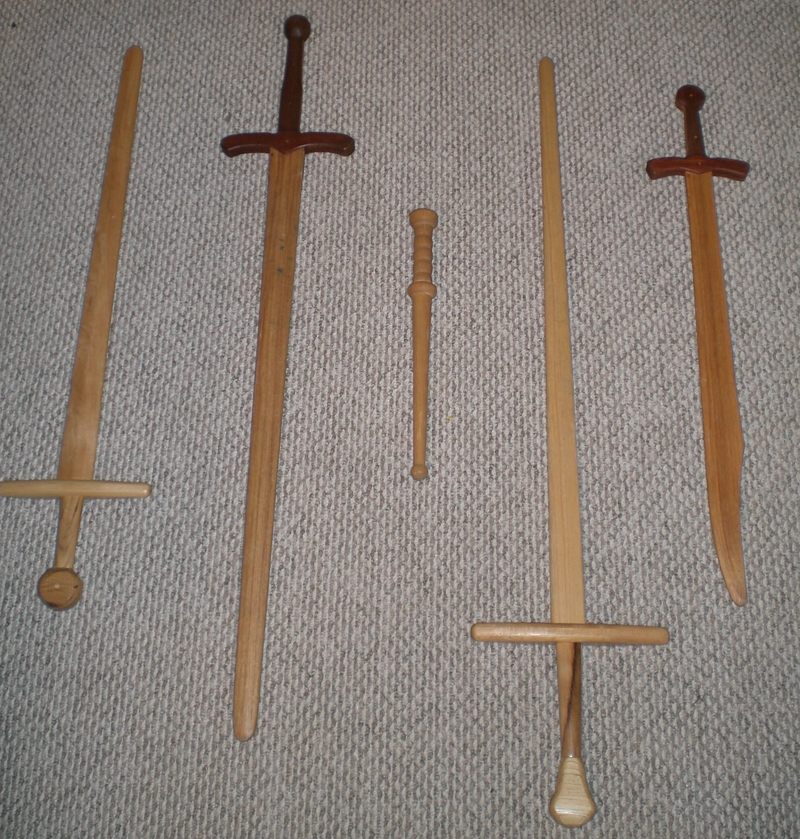
In martial arts, a waster is a practice weapon, usually a sword, and usually made out of wood, though nylon (plastic) wasters are also available. Nylon is safer than wood, due to it having an adequate amount of flex for thrusts to be generally safe, unlike wooden wasters. Even a steel feder has more flex than most wooden wasters. The use of wood or nylon instead of metal provides an economic option for initial weapons training and sparring, at some loss of genuine experience. A weighted waster may be used for a sort of strength training, theoretically making the movements of using an actual sword comparatively easier and quicker, though modern sports science shows that an athlete would most optimally train with an implement which is closest to the same weight, balance, and shape of the tool they will be using [citation needed]. Wasters as wooden practice weapons have been found in a variety of cultures over a number of centuries, including ancient China, Ireland, Iran, Scotland, Rome, Egypt, medieval and renaissance Europe, Japan, and into the modern era in Europe and the United States. Over the course of time, wasters took a variety of forms not necessarily influenced by chronological succession, ranging from simple sticks to clip-point dowels with leather basket hilts to careful replicas of real swords.

Key Information

Used commonly in the modern historical European martial arts community, the term refers to wasters fashioned to resemble western European weapons like the longsword or arming sword. Historically, the term "waster" was used in English to refer to cudgels or clubs used as weapons, in addition to wooden swords. The increasingly popular historical martial arts reconstruction groups, as well as the live action role-playing and renaissance festival groups, have provided an ample market for commercial waster retailers. As the martial art has grown and academic interest has risen in weapons other than the longsword and arming sword, other types of wasters have been produced commercially.

The concept of wooden practice weapons is not limited to the historical european martial arts. Some Japanese martial arts involving swordsmanship, such as kenjutsu and iaido, use bokken or shinai as practice weapons. Eskrima, a martial art from the Philippines, also uses a type of rattan stick as a practice weapon in place of a blade. The martial art of singlestick is more or less entirely derived from the use of wasters as practice weapons in place of broadswords.

Use

[edit]

Historically, students and soldiers used wasters as inexpensive and expendable training tools. The cost of high quality steel weapons, especially swords, would have made them a poor choice for practice weapons. Constant training would fatigue the blade, rendering it far less effective and reliable as a weapon. To prevent the destruction of an expensive weapon and to permit the necessary training and sparring intrinsic to any martial art, wooden practice weapons were created.

Today, especially in the reconstruction of historical European martial arts and Historical reenactment, wasters have experienced renewed interest. Wasters provide a number of benefits to the modern practitioner, many of which would have applied to historic trainees as well. The wood construction coupled with unsharpened edges and blunted tip, crossguard, and pommel of wooden swords provides a safer alternative to practising with a sharpened or unsharpened steel weapon. Wasters do not cut flesh, but provide a decidedly blunt impact. The lower cost of ownership in comparison to a steel weapon of the same variety makes the waster a much more affordable and expendable tool.[1][2] Many modern wasters are fashioned to replicate the original weapon with accuracy, including functional integral sword parts. This functionality allows the wooden weapon to be handled more like its steel counterpart.

Wasters are not without their faults. The all wooden construction usually makes wasters somewhat lighter and differently balanced than steel weapons. The difference of material properties between wood and steel creates a difference in performance when training and sparring. The wood wasters tend to recoil from strong contact with other wasters as may occur in a strong parry or absetzen,[3] a phenomenon colloquially referred to as "waster bounce". Steel weapons do not display this attribute to the same extent, usually binding and sliding with minimal rebound instead. The use of wooden wasters is somewhat safe as it lacks a cutting edge, but does not equate a safer alternative to steel training swords. The use of wood with rounded edges prevents any cutting injury when sparring but because wooden weapons typically are typically thicker bladed (compared to flat steel training swords like feders) while being of similar weight to steel weapons, they impact much harder than the thin blades of steel training swords (whose weight is concentrated at the hilt rather than the thin blade, compared to the evenly weighted waster). In addition, because of the waster's strong wooden construction, it does not bend at thrusts like feders or some steel training swords. It is for those reasons strong cuts or thrusts to unprotected body parts during sparring may lead to significant blunt force injuries (with the wooden weapon acting like a bludgeon).[4]

Modern historical martial arts reconstruction organizations, including the Association for Renaissance Martial Arts[5] and the Chicago Swordplay Guild[6] use wasters as the primary training tool of new practitioners. Wasters are used to learn, practice, and later spar with a variety of techniques including cuts, slices, thrusts and wards. During flourishes, a waster may be substituted for a blunt sword, especially if a lack of experience is a concern. Participants may also use wasters against a pell, a training pole roughly simulating a human target.[7] As the individual becomes more skilled, they will begin to use blunt steel weapons which offer a more realistic set of properties in comparison with a sharpened metal blade.

Construction

[edit]

Modern commercial producers use primarily Hickory, a hard and resilient wood, in the construction of their wasters. Some producers allow individuals to accent the waster with wood of other types including Jatobá and Purpleheart. Manufacturers usually apply a coating of linseed oil or other protective liquid and instruct users to regularly apply it. This prevents splintering and works to create a stronger, more enduring tool. Different specimens of wood, even of the same variety, are not necessarily identical in performance, and may display different characteristics during use.

Wasters generally contain many of the same parts as swords, though lack many of the minor aesthetic details. Here, the major parts of a typical longsword are labeled on a superimposed image of a modern-day waster. The blunted pommel, cross, edges, and tip are safety features.

The form of modern wasters follows from their use as replica training swords. Blades on wasters have a lenticular (lens-shaped) or diamond cross-section and defined edges. This shape continues into the hilt, which features a grip with an oval-shaped cross section oriented in the same plane as the blade. An integral part of historical swords, this oval shape permits the wielder to know the sword's rotational blade alignment by feeling for the position of the oblong grip in their hand. The pommel acts as suitable counterweight for the blade and a stable gripping surface, providing the sword's intrinsic balance and allowing the user a weighted leverage point for more powerful manipulation of the weapon. A functional cross acts as it does on a steel sword, protecting the hands and assisting in a number of guards and parries. During half-swording, the cross and pommel may also function as a striking portions of the weapon, used directly to cause injury as in the mordhau.

History

[edit]

Wooden practice swords have been in use since the Late Bronze Age, with an original sword found on Orkney's Mainland in Scotland still in existence at the National Museum of Edinburgh. A similar find in Ireland adds historical backing to the Irish myth, the Táin Bó Cúailnge, in which the use of a wooden training sword is mentioned. Egyptian soldiers practiced a sort of sport fencing using blunt sticks as a sort of primitive waster. The Romans used a form of wooden sword, the rudis, for combat training. Translations of Roman poets Horace and Juvenal provide evidence of this training weapon in use. One translation of Juvenal's poetry by Barten Holyday in 1661 makes note that the Roman trainees learned to fight with the wooden wasters before moving on to the use of sharpened steel, much in the way modern reconstruction groups progress. In fact, it is also found that Roman gladiators trained with a heavy wooden sword against a straw man or a wooden pole known as a palus (an early relative of the later wooden pell).[8] Wasters are mentioned in period works, including The Book of the Courtier. A number of Fechtbücher also mention the use of wasters or depict them in use by models showing proper technique.

During the 16th century, the Dussack came into use in German fencing schools. A true waster, the dussack was made almost entirely of wood (in all but one known case) and acted as safe and cheap training weapon. The weapon's unique shape did not lend well to the replication of traditional cruciform-hilted swords like the arming sword or longsword. Instead, the dussack resembled the großes Messer or "great knife", a weapon found more often amongst the common people than longswords, the cost of which allowed only relatively wealthy individuals to purchase them.

Swords

[edit]
Ash Longsword
Ash Arming Sword Waster
Talhoffer's Fechtbuch (1467), Plate 25. Two longsword fencers

Longsword wasters are generally between forty-two and fifty inches long and are also known colloquially as Hand-and-a-Half swords, allowing the use of both hands on the hilt while using them. These weapons incorporate a ridge or fuller, defined edges, and other sword components commonly found on steel swords. Many of the fundamentals taught by Johannes Lichtenauer[9][pages needed] and his students Sigmund Ringeck[10][pages needed] and Hans Talhoffer[11][pages needed] frequently involve the longsword.

MS I.33, fol. 4v. Student and priest using Arming swords and bucklers

Arming sword wasters span the broad gap of thirty-two to forty-two inches in length and, like their historical counterparts, have a shorter hilt than a longsword, allowing only one full hand to hold the grip. These wasters also commonly feature defined edges, pommels, and other typical sword elements. Arming swords are featured heavily in the combat of Manuscript I.33, the oldest manuscript on sword-and-buckler fighting, dating approximately to the turn of the 14th century.

Rudis/Rudius

The ceremonial rudius, a wooden gladius given ceremonially to gladiators when they won enough battles to become free men, is produced by some current day vendors and is twenty-eight to thirty inches long. The producers warn that the rudii are for ceremonial purposes, however, and should not be used in mock combat. In this sense, the waster supersedes its place as a tool for combat and becomes primarily a work of art.

Dussacks and falchion, two-handed sword, cut and thrust sword, gladius, Viking sword and rapier wasters are not widely available from commercial vendors, but may be special ordered or hand-crafted.

Daggers

[edit]

Rondel dagger[12] wasters, like the daggers themselves, are generally about eighteen inches in length, with a twelve-inch blade and six inch hilt. These weapons may forgo defined edges altogether and take on a more cylindrical shape as the rondel dagger acted historically as a thrusting and stabbing weapon. Hilted dagger wasters are also available, featuring functional crosses and defined edges, often found in lengths of about 18 inches.

See also

[edit]

General references

[edit]

Notes

[edit]
Revisions and contributorsEdit on WikipediaRead on Wikipedia
from Grokipedia
A waster is a heavy, sword-shaped wooden practice designed for safe in European swordsmanship, mimicking the size, weight, and balance of actual swords while avoiding the dangers of sharp edges or lethal strikes. Wasters have been employed since at least the , with early records from describing their use in youth battles, and later documentation in by 1222 and by 1434. Constructed from solid hardwood such as or , they feature flat blades, cross-guards, and pommels to replicate the handling characteristics of medieval and arming swords, longswords, or rapiers. These tools allowed practitioners to engage in full-contact , drills, and combat simulations without risking severe injury or damaging expensive metal weapons. Historically, wasters served multiple purposes beyond basic training, including judicial duels, tournament events like the German Kolbenturnier, and even as a basis for recreational sports such as 16th-century English "waster play" or 18th-19th century British single-stick contests. In modern (HEMA) reconstruction, wasters remain essential, often supplemented by synthetic or versions for durability and reduced maintenance. Their design emphasizes practicality, enabling students to develop technique, timing, and strength in a controlled environment.

Overview and Purpose

Definition

A waster is a blunt, non-lethal practice weapon designed to replicate the shape, balance, and weight of edged weapons like swords, enabling safe simulation of combat techniques without the risk of serious injury. Primarily made from wood or synthetic materials, it serves as a core tool in training, allowing practitioners to develop skills in handling and maneuvers akin to those with live . The term "waster" derives from Middle English wastere, originally denoting cudgels or clubs as expendable striking tools, evolving by the to specifically describe wooden mock swords intended for repeated use until worn out. This reflects its role as a disposable yet essential aid, with roots in the broader sense of something that "wastes" or destroys itself through practice. Early literary references, such as the 1561 English translation of Baldassare Castiglione's (1528), describe training with such wooden weapons among courtiers. Distinguishing features of wasters include fully blunted edges and tips to eliminate cutting hazards, coupled with a that closely mirrors authentic arms for realistic proprioceptive feedback during drills. In contrast to federschwert—blunted longswords that offer greater and impact simulation but require protective gear due to their hardness—or modern foam-based boffer weapons, which are lighter and more flexible for low-contact play but sacrifice heft and longevity for enhanced safety, wasters prioritize historical fidelity and robust construction for sustained, injury-minimizing practice.

Primary Uses

Wasters serve as essential tools in training, particularly for honing fundamental skills such as footwork, timing, cuts, thrusts, and parries, all while eliminating the hazards associated with live steel weapons. By replicating the balance and handling of actual swords without sharp edges, they enable practitioners to focus on precision and control in a safe environment. This practice builds and tactical awareness through repetitive drills derived from historical techniques. In solo training, wasters are commonly employed against stationary targets like pells—sturdy posts or dummies designed to absorb impacts—for developing strength and refining striking accuracy. Practitioners strike the pell to simulate combat scenarios, improving power generation and technique without the need for a partner, which makes it ideal for building endurance and consistency in movements. This method allows for focused repetition, targeting specific aspects like edge alignment or follow-through, essential for effective handling. For interactive practice, wasters facilitate sessions, ranging from light contact drills to more intense full-contact exchanges when paired with protective gear such as , jackets, and gloves. These sessions emphasize controlled engagements to practice defensive maneuvers and offensive combinations in dynamic settings, often in group formats to simulate real confrontations. Integration with safety equipment ensures that impacts remain non-lethal, promoting realistic pressure testing of skills. The primary advantages of wasters include their affordability, making high-quality accessible to beginners and established practitioners alike, as well as their portability for use in various settings without specialized storage. Compared to weapons, they significantly reduce the risk of severe injuries like cuts or fractures, permitting extensive, high-volume practice that would otherwise be impractical or dangerous. This safety profile supports sustained sessions, fostering long-term skill development. Advanced techniques such as half-swording—gripping the blade for thrusting or close-quarters control—and maneuvers with the waster are integral to training regimens, allowing exploration of weapon retention and transitions to unarmed combat. These are often incorporated into drills drawn from fechtbücher, the illustrated fencing manuals of historical masters, to replicate close-range tactics like binding blades or disarming opponents. Such exercises enhance versatility, how to adapt the sword in confined spaces. Today, modern (HEMA) communities represent the primary users of wasters, applying them to revive and authentically interpret medieval and combat systems.

Construction and Materials

Traditional Methods

Traditional wasters were primarily constructed from dense hardwoods such as , , or , selected for their durability, balance, and resistance to splintering during rigorous use. These materials allowed the training weapons to closely replicate the weight and handling characteristics of steel swords while minimizing the risk of breakage. The shaping process involved carving the wood to match the blade profiles of authentic period weapons, including lenticular or diamond cross-sections to simulate the geometry of steel blades. Artisans typically used hand tools like knives, adzes, or early lathes to rough out the form from a single piece of hardwood, followed by planing or scraping to refine the edges and blunted tip for safety. This ensured the waster maintained a flat, sword-like profile rather than a simple rounded stick, preserving realistic combat dynamics. Binding with cord or leather could further secure blunted edges in high-impact areas. Hilt assembly focused on functionality and replication of steel sword , incorporating wooden or occasionally metal guards to protect the hand, grips wrapped in or cord for secure hold, and pommels to counterbalance the . For two- or four-piece grips, components were fitted around the tang after shaping the pommel, then secured with wrappings of , strips, or wire to prevent slippage during use. These elements were often carved from the same as the or joined seamlessly to maintain overall integrity. Sizing standards varied by weapon type to ensure authenticity, with arming sword wasters typically measuring 32 to 42 inches in overall length to match historical one-handed blades. They were weighted and balanced to approximate the center of gravity of real arms, often making them slightly heavier for conditioning purposes, as noted in 15th-century regulations limiting lengths to about 2.5 feet for certain clubs. Quality considerations emphasized seasoning the wood through air-drying to prevent warping or cracking under stress, a practice common in medieval . Occasional iron reinforcements, such as for guards in later examples, added resilience to high-stress areas like the cross-guard. These methods were employed in medieval workshops to produce reliable training tools, as described in 15th-century treatises like those of King René d’Anjou.

Modern Adaptations

In the late 20th and early 21st centuries, synthetic materials revolutionized waster construction, replacing traditional wood with durable plastics like high-grade and specialized high-impact polymers to create flexible blades that absorb impacts and resist shattering during intense training. These materials maintain the balance and handling characteristics of historical designs while enhancing safety for modern practitioners, allowing for more realistic simulation of strikes without the risk of splintering or breakage common in wooden alternatives. Modern manufacturing techniques, including precision molding, enable the uniform production of wasters that closely replicate historical profiles and dimensions, facilitating mass replication for widespread in training programs. This approach ensures consistency in weight distribution and flexibility, drawing brief influence from traditional wooden methods to preserve design fidelity while incorporating contemporary engineering for superior performance. Safety enhancements in contemporary wasters include rounded tips to minimize injury risk, ergonomic rubber or grips that absorb shock and provide secure handling, and options for modular components that allow customization of lengths and profiles to align with specific historical treatises. These features support progressive training regimens, enabling users to adjust for skill levels without compromising form. Commercially, brands such as Purpleheart Armoury, Rawlings, and Red Dragon Armoury produce synthetic wasters tailored for (HEMA), offering a range of models with custom lengths from 40 to 50 inches and varying blade profiles to match diverse weapon types like longswords and messers. Durability testing demonstrates these wasters' resistance to repeated strikes, with many models certified for full-force and pell work when paired with appropriate protective gear, often enduring thousands of impacts without deformation.

Types and Variations

Sword-Based Wasters

Sword-based wasters are practice weapons designed to replicate the form, balance, and handling characteristics of historical European swords, allowing practitioners to train techniques safely without the risks associated with sharpened blades. These wasters typically consist of a wooden or synthetic blade with a cross-guard and pommel, shaped to mimic the proportions of actual swords for realistic simulation of cuts, thrusts, and parries. Historically, they were used in schools and martial exercises across medieval and Europe, as documented in records from the in 1455, which mention wooden "swerds" and "long blade of a swerde made in wafters" for royal training. Longsword wasters, intended for two-handed use, generally measure 42 to 50 inches (110 to 130 cm) in overall length, with blade lengths around 33 to 39 inches to match the dimensions of late medieval longswords from German and Italian traditions. These wasters feature a balanced , often around 2 to 3 pounds, to promote proper in techniques such as the German Kunst des Fechtens or Italian systems, where the weapon's point of balance is positioned near the guard for agile control. Blades are typically flat or lenticular in cross-section with a gradual taper toward the tip, enabling safe thrusting practice while approximating the geometry of historical examples like those depicted in treatises by . In Italian styles, such as Fiore dei Liberi's Fior di Battaglia (ca. 1410), wasters may incorporate broader blade profiles to emphasize cutting motions, reflecting regional preferences for versatile battlefield weapons over narrower thrusting designs common in some English contexts. Arming sword wasters, designed for one-handed use often in conjunction with a or , range from 32 to 42 inches (81 to 107 cm) in length, with blades of 28 to 35 inches featuring a fuller along the midline to reduce weight while maintaining structural integrity. This design draws from to 15th-century arming swords, prioritizing lighter overall mass (typically 1.5 to 2 pounds) for quick strikes and parries in close-quarters combat simulations. The includes a reinforced cross-guard, often wider and padded in modern reproductions to protect the hand during clashes, though historical versions relied on simple wooden crosspieces for basic deflection. Performance-wise, these wasters emphasize forward weight balance to train the wrist and arm mechanics essential for historical one-handed , avoiding extremes in lightness or heaviness that could distort technique development. Rapier wasters replicate the slender, thrusting-oriented design of 16th-17th century , typically measuring 40 to 48 inches (102 to 122 cm) in overall length with blade lengths of 35 to 42 inches. Weighing around 1.5 to 2.5 pounds, they feature narrow, flexible blades for precise point work and footwork drills, as described in English fencing master Joseph Swetnam's 1617 , which mentions wooden rapiers with covered points for safe practice. Modern versions often use or hardwood to withstand thrusting impacts while maintaining the weapon's light balance point near the . Common materials for these wasters include hardwoods like or for durability, or modern for impact resistance, ensuring they withstand repeated use in .

Non-Sword Wasters

Non-sword wasters extend (HEMA) training beyond the predominant sword forms, focusing on daggers, cutters, and impact weapons to replicate diverse scenarios. These tools emphasize safety while preserving the balance, weight, and handling characteristics of their historical counterparts, often constructed from wood or synthetics like high-impact plastics. Rondel dagger wasters, used for practicing close-quarters thrusting techniques, measure approximately 17-19 inches in overall length, featuring cylindrical grips that facilitate a firm, two-handed hold during drills. Their blunted points allow for controlled simulation of penetration strikes without risk of injury, aligning with medieval dagger fighting manuals that highlight grapples and joint locks. Dussack wasters replicate the curved, single-edged cutters prominent in 16th-century German fencing treatises, such as those by , with lengths ranging from 24-30 inches to support one-handed saber-like cuts and guards. These wooden or synthetic versions maintain the weapon's forward balance for dynamic footwork and edge alignment in paired exercises. Other non-sword wasters include those for maces and axes, which incorporate padded heads made from foam or layered wood to mimic the crushing impact of blunt force weapons while distributing force safely during strikes. These designs address the need for training impact-oriented techniques underrepresented in sword-focused curricula, using reinforced hafts to endure repeated chopping motions. Unique to many non-sword wasters are their shorter overall lengths, suited for close-quarters engagements, and robust to the of hacking or thrusting actions distinct from longer dynamics. While wasters remain the baseline for most HEMA practitioners, these variants broaden development across classes. Emerging variations in HEMA include wasters adapted for polearms, such as shortened synthetic halberds or spears with flexible shafts for safe group drills, and specialized trainers—lightweight shields paired with short weapons to practice parries and binds in team formations. These adaptations facilitate larger-scale simulations of battlefield tactics, enhancing coordination without compromising historical fidelity.

Historical Development

Ancient and Early Origins

The earliest evidence of wasters emerges from the Late Bronze Age in , with archaeological finds of wooden swords that mimic contemporary metal blades, suggesting their use in training or ritual contexts. A notable example is a yew-wood sword discovered in a peat bog at Grotsetter, , , radiocarbon dated to approximately 953–798 BCE. This artifact represents an early wooden sword from the Late Bronze Age. Similar organic artifacts preserved in bogs across and are often interpreted as votive offerings, though some may have had practical uses in societies where was scarce. While prehistoric wooden swords prefigure later wasters, the term typically refers to documented weapons from the medieval period onward. Roman military practices formalized the use of wooden wasters, with textual references detailing their role in legionary drills focused on formation and thrusting techniques. In his late 4th-century treatise , Flavius Vegetius Renatus describes recruits with weighted wooden swords (known as rudes) and wicker shields against stakes, simulating enemy encounters to build strength and precision without risking injury to live opponents or equipment. These exercises emphasized close-order , aligning with the Roman emphasis on disciplined phalanx-like maneuvers. Archaeological corroboration comes from a 1st-century CE wooden found in Carlisle, , preserved at the Tullie House Museum; this practice sword, dated to 72–83 CE, features a simple blade form suitable for drills. By the Viking era (c. 793–1066 CE), archaeological fragments of wooden swords, some faithful replicas of iron counterparts, have been recovered from sites across . Their purpose, possibly for training or as toys, remains uncertain. As societies transitioned into the , the proliferation of iron swords prompted a shift toward denser hardwoods like or for wasters, enhancing durability while preserving wood's inherent safety for practice. This adaptation ensured that martial instruction remained accessible and non-lethal, bridging pre-medieval traditions into later periods.

Medieval and Renaissance Periods

During the Medieval and periods, wasters achieved peak documentation and refinement, particularly in key treatises known as fechtbücher that outlined their role in structured . Italian master , in his 1410 treatise Flos Duellatorum, explicitly described the use of short wooden clubs called bastone (Italian for "stick") as safe training weapons for swordplay, emphasizing their application in developing progression from basic strikes to advanced techniques. In the German tradition, while Johannes Liechtenauer's 14th-century verses do not directly reference wasters, subsequent fechtbücher by his followers, such as those compiled in the 15th and 16th centuries, illustrate wooden practice swords integrated into the curriculum for building proficiency in handling before advancing to . Later works, including Paulus Hector Mair's circa 1540 manual and Joachim Meyer's 1570 Kunst Fechtbuch, further depict wasters as essential tools for simulating combat dynamics without risk, prescribing their use to reinforce the master's core principles of distance, timing, and leverage. Wasters were prominently featured in institutional settings, including formalized fencing schools and military training regimens across Europe. In Italy, the Bolognese Dardi school, founded by Lippo Bartolomeo Dardi in the early 15th century, incorporated wooden training swords into its curriculum for both civilian and military students, focusing on the spada da lato (sidesword) to prepare practitioners for real-world engagements. Regulations in these schools often stipulated waster quality, requiring them to mimic the weight and balance of steel counterparts to ensure effective skill transfer, as evidenced in guild oversight of training equipment. Military applications were similarly documented; for instance, the 1434 Portuguese Regimento by King Dom Duarte advocated wooden swords for knightly drills. By the 16th century, wasters extended to guild-based fencing halls in Germany and England, where they facilitated competitive sparring under supervised conditions to hone tactical awareness. The evolution of wasters during this era reflected broader changes in weaponry, transitioning from simple wooden replicas of arming swords to specialized forms tailored to emerging arm types. Early medieval wasters were basic, heavy constructs designed for strength-building with the , but by the 1500s, they adapted to include dussack wasters—curved, single-edged wooden versions mirroring the dussack sidearm that evolved from the messer. These dussack wasters, prominent in German fencing guilds from the early onward, emphasized cutting techniques and were used for over 250 years in structured drills, allowing fencers to practice the weapon's distinctive saber-like sweeps safely. This specialization paralleled the shift toward lighter, more agile blades, with wasters maintaining pedagogical value by replicating complexity and balance for realistic . Regional variations highlighted distinct emphases in waster design and application, shaped by local martial traditions. In German-speaking regions, wasters focused heavily on the , with robust, two-handed wooden models promoting the Liechtenauer school's aggressive, linear strikes and half-swording grips to simulate armored combat. Conversely, Spanish and Italian practices prioritized precursors to the , such as the in the Dardi tradition, where slimmer wasters facilitated footwork and thrusting drills suited to unarmored civilian duels. These differences underscored a broader divide: northern Europe's battlefield-oriented training versus southern Europe's emphasis on personal defense and agility. The prominence of wasters began to decline in the 17th century with the rise of buttoned foils and , which offered greater precision for the refined and smallsword styles dominating civilian . As weapons became more accessible and specialized—featuring blunted tips for safer thrusting—wooden wasters fell out of favor in formal schools by the late , though they lingered in military drills and folk practices like English cudgel-play until the . This shift rendered traditional wasters largely obsolete, paving the way for modern synthetic alternatives.

References

Add your contribution
Related Hubs
User Avatar
No comments yet.