Hubbry Logo
search
logo

Wave vector

logo
Community Hub0 Subscribers
Read side by side
from Wikipedia

In physics, a wave vector (or wavevector) is a vector used in describing a wave, with a typical unit being cycle per metre. It has a magnitude and direction. Its magnitude is the wavenumber of the wave (inversely proportional to the wavelength), and its direction is perpendicular to the wavefront. In isotropic media, this is also the direction of wave propagation.

A closely related vector is the angular wave vector (or angular wavevector), with a typical unit being radian per metre. The wave vector and angular wave vector are related by a fixed constant of proportionality, 2π radians per cycle.

It is common in several fields of physics to refer to the angular wave vector simply as the wave vector, in contrast to, for example, crystallography.[1][2] It is also common to use the symbol k for whichever is in use.

In the context of special relativity, a wave four-vector can be defined, combining the (angular) wave vector and (angular) frequency.

Definition

[edit]
Wavelength of a sine wave, λ, can be measured between any two consecutive points with the same phase, such as between adjacent crests, or troughs, or adjacent zero crossings with the same direction of transit, as shown.

The terms wave vector and angular wave vector have distinct meanings. Here, the wave vector is denoted by and the wavenumber by . The angular wave vector is denoted by k and the angular wavenumber by k = |k|. These are related by .

A sinusoidal traveling wave follows the equation

where:

  • r is position,
  • t is time,
  • ψ is a function of r and t describing the disturbance describing the wave (for example, for an ocean wave, ψ would be the excess height of the water, or for a sound wave, ψ would be the excess air pressure).
  • A is the amplitude of the wave (the peak magnitude of the oscillation),
  • φ is a phase offset,
  • ω is the (temporal) angular frequency of the wave, describing how many radians it traverses per unit of time, and related to the period T by the equation
  • k is the angular wave vector of the wave, describing how many radians it traverses per unit of distance, and related to the wavelength by the equation

The equivalent equation using the wave vector and frequency is[3]

where:

  • is the frequency
  • is the wave vector

Direction of the wave vector

[edit]

The direction in which the wave vector points must be distinguished from the "direction of wave propagation". The "direction of wave propagation" is the direction of a wave's energy flow, and the direction that a small wave packet will move, i.e. the direction of the group velocity. For light waves in vacuum, this is also the direction of the Poynting vector. On the other hand, the wave vector points in the direction of phase velocity. In other words, the wave vector points in the normal direction to the surfaces of constant phase, also called wavefronts.

In a lossless isotropic medium such as air, any gas, any liquid, amorphous solids (such as glass), and cubic crystals, the direction of the wavevector is the same as the direction of wave propagation. If the medium is anisotropic, the wave vector in general points in directions other than that of the wave propagation. The wave vector is always perpendicular to surfaces of constant phase.

For example, when a wave travels through an anisotropic medium, such as light waves through an asymmetric crystal or sound waves through a sedimentary rock, the wave vector may not point exactly in the direction of wave propagation.[4][5]

In solid-state physics

[edit]

In solid-state physics, the "wavevector" (also called k-vector) of an electron or hole in a crystal is the wavevector of its quantum-mechanical wavefunction. These electron waves are not ordinary sinusoidal waves, but they do have a kind of envelope function which is sinusoidal, and the wavevector is defined via that envelope wave, usually using the "physics definition". See Bloch's theorem for further details.[6]

In special relativity

[edit]

A moving wave surface in special relativity may be regarded as a hypersurface (a 3D subspace) in spacetime, formed by all the events passed by the wave surface. A wavetrain (denoted by some variable X) can be regarded as a one-parameter family of such hypersurfaces in spacetime. This variable X is a scalar function of position in spacetime. The derivative of this scalar is a vector that characterizes the wave, the four-wavevector.[7]

The four-wavevector is a wave four-vector that is defined, in Minkowski coordinates, as:

where the angular frequency is the temporal component, and the wavenumber vector is the spatial component.

Alternately, the wavenumber k can be written as the angular frequency ω divided by the phase-velocity vp, or in terms of inverse period T and inverse wavelength λ.

When written out explicitly its contravariant and covariant forms are:

In general, the Lorentz scalar magnitude of the wave four-vector is:

The four-wavevector is null for massless (photonic) particles, where the rest mass

An example of a null four-wavevector would be a beam of coherent, monochromatic light, which has phase-velocity

{for light-like/null}

which would have the following relation between the frequency and the magnitude of the spatial part of the four-wavevector:

{for light-like/null}

The four-wavevector is related to the four-momentum as follows:

The four-wavevector is related to the four-frequency as follows:

The four-wavevector is related to the four-velocity as follows:

Lorentz transformation

[edit]

Taking the Lorentz transformation of the four-wavevector is one way to derive the relativistic Doppler effect. The Lorentz matrix is defined as
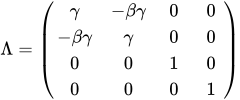
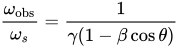
In the situation where light is being emitted by a fast moving source and one would like to know the frequency of light detected in an earth (lab) frame, we would apply the Lorentz transformation as follows. Note that the source is in a frame Ss and earth is in the observing frame, Sobs. Applying the Lorentz transformation to the wave vector

and choosing just to look at the component results in

where is the direction cosine of with respect to

So
Source moving away (redshift)

[edit]

As an example, to apply this to a situation where the source is moving directly away from the observer (), this becomes:


Source moving towards (blueshift)

[edit]

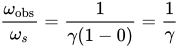
To apply this to a situation where the source is moving straight towards the observer (θ = 0), this becomes:

Source moving tangentially (transverse Doppler effect)

[edit]

To apply this to a situation where the source is moving transversely with respect to the observer (θ = π/2), this becomes:
See also

[edit]

References

[edit]

Further reading

[edit]
Revisions and contributorsEdit on WikipediaRead on Wikipedia
from Grokipedia
The wave vector, denoted as k\mathbf{k}, is a vector quantity in physics that characterizes the propagation of waves in space, with its direction indicating the direction of wave travel and its magnitude k=kk = |\mathbf{k}| representing the wave number, defined as k=2π/λk = 2\pi / \lambda where λ\lambda is the wavelength.[1][2] This vector generalizes the scalar wave number from one-dimensional waves to higher dimensions, serving as the spatial counterpart to angular frequency ω\omega in the temporal domain.[3] In the mathematical description of waves, particularly plane waves, the wave vector appears in the phase term of the wave function, expressed as ψ(r,t)=Aexp[i(krωt)]\psi(\mathbf{r}, t) = A \exp[i (\mathbf{k} \cdot \mathbf{r} - \omega t)], where r\mathbf{r} is the position vector, AA is the amplitude, and the dot product kr\mathbf{k} \cdot \mathbf{r} determines the phase variation across space.[1] The wave vector can also be derived as the gradient of the wave's phase, k=ϕ(r,t)\mathbf{k} = \nabla \phi(\mathbf{r}, t), highlighting its role in capturing local propagation properties even for non-plane waves.[1] For electromagnetic waves, k\mathbf{k} points in the direction of energy flow, remains perpendicular to both the electric and magnetic field vectors, and satisfies k=ω/ck = \omega / c in vacuum, where cc is the speed of light.[2] Beyond classical waves, the wave vector holds significance in quantum mechanics, where it relates to the momentum of a particle via p=k\mathbf{p} = \hbar \mathbf{k}, with \hbar being the reduced Planck's constant, thus bridging wave-particle duality.[3] In three-dimensional contexts, such as optics or acoustics, the components kx,ky,kzk_x, k_y, k_z describe the wave's spatial frequencies along each axis, enabling analysis of phenomena like diffraction and interference through the wave equation 2ψ=(1/v2)2ψ/t2\nabla^2 \psi = (1/v^2) \partial^2 \psi / \partial t^2, where Fourier decomposition often invokes k\mathbf{k}-space.[3] This concept is essential across fields including electromagnetism, quantum physics, and solid-state physics for modeling wave behaviors in complex media.[2]

Fundamentals

Definition

In physics, the wave vector k\vec{k} is a fundamental vector quantity that characterizes the spatial properties of a propagating wave, particularly its periodicity and direction of advancement. For a plane wave, it appears in the phase factor of the wave's mathematical representation, given by ei(krωt)e^{i(\vec{k} \cdot \vec{r} - \omega t)}, where r\vec{r} is the position vector, ω\omega is the angular frequency, and tt is time. This form encodes the wave's oscillatory behavior, with k\vec{k} determining how the phase varies spatially across the wavefronts.[4] The magnitude of the wave vector, denoted k=kk = |\vec{k}|, is known as the wave number, which quantifies the spatial frequency of the wave. It is defined as k=2πλk = \frac{2\pi}{\lambda}, where λ\lambda is the wavelength of the wave. This relation indicates that the wave number inversely scales with wavelength, representing the number of radians of phase change per unit distance along the direction of propagation. For instance, a wave with a wavelength of 1 meter has a wave number of 2π2\pi radians per meter.[5] For more general waves that are not strictly planar, such as those in inhomogeneous media where the refractive index varies with position, the wave vector becomes a local quantity k(r)\vec{k}(\vec{r}). It is defined as the gradient of the phase function, specifically k(r)=ϕ(r)\vec{k}(\vec{r}) = \nabla \phi(\vec{r}), where ϕ(r)\phi(\vec{r}) is the phase. This formulation allows the wave vector to adapt to spatial variations, capturing how the wave's local direction and wavelength adjust in response to the medium's properties.[1] The units of the wave vector are typically radians per meter (rad/m), reflecting its role in measuring angular phase shifts over distance. This unit convention aligns with the angular nature of the phase in the exponential representation, distinguishing it from linear measures like cycles per meter.[6]

Direction of the Wave Vector

The wave vector k\vec{k} points in the direction of maximum phase increase for a wave, as it represents the spatial gradient of the phase ϕ\phi in the wave function, such that k=ϕ\vec{k} = \nabla \phi.[1][7] For progressive waves, this orientation corresponds directly to the direction of wave propagation, perpendicular to the wavefronts of constant phase.[1][8] In the case of plane waves, the wave vector k\vec{k} is parallel to the wave's velocity vector v\vec{v}, ensuring that the phase advances uniformly along the propagation path.[1] In three dimensions, the components kxk_x, kyk_y, and kzk_z quantify the extent of propagation along the respective Cartesian axes, allowing the overall direction to be determined by the vector sum k=kxx^+kyy^+kzz^\vec{k} = k_x \hat{x} + k_y \hat{y} + k_z \hat{z}.[9] A representative example occurs in electromagnetic waves, where k\vec{k} aligns with the direction of the Poynting vector S=1μ0E×B\vec{S} = \frac{1}{\mu_0} \vec{E} \times \vec{B}, indicating the propagation of energy flow.[10][11] The orientation of k\vec{k} relative to particle or field oscillations distinguishes transverse and longitudinal waves: in transverse waves, such as light, the displacement or field variations are perpendicular to k\vec{k}, while in longitudinal waves, such as acoustic waves, the particle motion is parallel to k\vec{k}.[12]

Applications in Quantum and Solid-State Physics

De Broglie Relation

In 1924, Louis de Broglie proposed the hypothesis that every particle of matter, like electrons or other massive particles, is associated with a wave, known as a matter wave or de Broglie wave, extending the wave-particle duality observed in light quanta (photons) to all particles.[13] This matter wave is characterized by a wave vector k\vec{k}, where the particle's momentum p\vec{p} is related to the wave vector by p=k\vec{p} = \hbar \vec{k}, with =h/2π\hbar = h / 2\pi and hh being Planck's constant.[13] De Broglie's relation unifies the corpuscular and undulatory aspects of matter, positing that the wavelength λ=2π/k\lambda = 2\pi / k (where k=kk = |\vec{k}|) is inversely proportional to the particle's momentum magnitude pp, such that λ=h/p\lambda = h / p.[13] The derivation of this relation builds on the established energy-momentum relations for photons, where the energy E=pc=ωE = p c = \hbar \omega and ω=ck\omega = c k for light waves propagating at speed cc.[13] De Broglie generalized these to massive particles by hypothesizing that the energy and frequency satisfy E=ωE = \hbar \omega universally, while the momentum and wave vector follow p=k\vec{p} = \hbar \vec{k}, independent of the particle's mass or speed (provided the relations hold relativistically).[13] This extension assumes that the phase velocity of the matter wave exceeds cc, but the group velocity equals the particle velocity, ensuring consistency with special relativity for the signal propagation.[13] The de Broglie relation embodies wave-particle duality by linking the classical momentum of a particle to the quantum properties of its associated wave, where the wave vector k\vec{k} dictates the direction of propagation and the spatial modulation (via wavenumber kk) of the particle's probability distribution in its wave function.[13] In quantum mechanics, this implies that the wave vector determines the directional spread and interference patterns of the particle's de Broglie wave, influencing how the particle's position and momentum are probabilistically described.[14] A key experimental confirmation came from electron diffraction experiments, such as the 1927 work by Clinton Davisson and Lester Germer, who observed diffraction peaks in electron scattering from a nickel crystal, with scattering angles directly tied to the de Broglie wavelength λ=h/p\lambda = h / p calculated from the electrons' momentum.[15] These peaks matched predictions from wave interference, where changes in the incident electron energy altered the wave vector magnitude k=2π/λk = 2\pi / \lambda, shifting the diffraction angles accordingly.[15] For non-relativistic free particles, the de Broglie relations combine with the classical kinetic energy E=p2/2mE = p^2 / 2m to yield the dispersion relation ω=k22m\omega = \frac{\hbar k^2}{2m}, relating the angular frequency ω\omega to the wave vector magnitude kk for a particle of mass mm.[14] This quadratic dispersion arises from solutions to the time-dependent Schrödinger equation for plane waves and highlights the dispersive nature of matter waves, where different wavelength components travel at varying group velocities.[14]

In Solid-State Physics

In solid-state physics, the wave vector k\vec{k} is essential for describing the quantum mechanical states of electrons and phonons in crystalline materials, where the periodic lattice potential modifies free-particle behavior into Bloch waves. The crystal momentum k\hbar \vec{k} extends the de Broglie relation to bound electrons propagating through the lattice. This framework enables the analysis of electronic band structures and lattice dynamics, revealing how periodicity leads to allowed energy ranges and gaps that determine material properties like conductivity and insulation. Bloch's theorem states that the eigenfunctions of electrons in a periodic potential V(r)V(\vec{r}) with lattice periodicity take the form ψnk(r)=unk(r)eikr\psi_{n\vec{k}}(\vec{r}) = u_{n\vec{k}}(\vec{r}) e^{i \vec{k} \cdot \vec{r}}, where unk(r)u_{n\vec{k}}(\vec{r}) is a periodic function matching the lattice symmetry, and k\vec{k} labels the state as the wave vector associated with crystal momentum k\hbar \vec{k}. This representation arises from the Hamiltonian's translational invariance, allowing solutions as modulated plane waves rather than pure plane waves. The theorem implies that electron states are labeled by k\vec{k} within a finite volume in reciprocal space, capturing the wave's propagation direction and wavelength relative to the lattice.[16] Due to the periodicity, k\vec{k} is defined only up to reciprocal lattice vectors G\vec{G}, such that states with wave vectors k\vec{k} and k+G\vec{k} + \vec{G} are equivalent, as they differ by a phase factor that restores lattice invariance. The first Brillouin zone, the fundamental domain for k\vec{k}, is constructed as the Wigner-Seitz cell in reciprocal space—the set of points closer to the reciprocal lattice origin than to any other lattice point, bounded by planes perpendicular to G\vec{G} at their midpoints. Higher Brillouin zones extend this construction, but physical properties are typically analyzed within the first zone using the reduced zone scheme.[17] The energy spectrum features bands En([k](/page/K))E_n(\vec{[k](/page/K)}), where each band nn varies continuously with [k](/page/K)\vec{[k](/page/K)} inside the Brillouin zone, reflecting the dispersion of electron waves. At zone boundaries, where [k](/page/K)=G/2\vec{[k](/page/K)} = \vec{G}/2, Bragg-like scattering occurs, opening energy gaps between bands due to avoided crossings and preventing electron propagation at those energies. This band structure dictates whether materials are metals, semiconductors, or insulators, with gaps arising from the interference of waves diffracted by the lattice.[18] A key illustration is the nearly free electron model, which treats the lattice potential as a weak perturbation on free-electron parabola E=2k22mE = \frac{\hbar^2 k^2}{2m}. Without potential, bands would extend indefinitely, but the perturbation mixes states degenerate at k=G/2\vec{k} = \vec{G}/2, folding the dispersion back into the first Brillouin zone and splitting the degeneracy to form band gaps proportional to the Fourier component of the potential VGV_{\vec{G}}. For example, in simple metals like sodium, this model approximates conduction bands with small gaps at zone edges, validating the near-free behavior.[18] The wave vector similarly governs phonons, quantized lattice vibrations, through normal modes with wave vectors k\vec{k} in the reduced zone scheme. For a crystal with pp atoms per unit cell, there are 3p3p branches: three acoustic branches where frequencies ω(k)0\omega(\vec{k}) \to 0 as k0\vec{k} \to 0 (corresponding to in-phase atomic motion like sound waves) and 3p33p-3 optical branches with finite ω(0)\omega(0) (out-of-phase motion excitable by light). Acoustic branches are linear at long wavelengths, ω=vk\omega = v k with sound speed vv, while optical branches flatten due to short-range forces between unlike atoms. These dispersions, plotted versus k\vec{k} in the first Brillouin zone, explain thermal and elastic properties.[19] This theoretical foundation for wave vectors in periodic systems was established by Felix Bloch in his 1928 doctoral dissertation, which applied quantum mechanics to electron motion in crystal lattices and introduced the Bloch wave ansatz.[16]

Applications in Special Relativity

Lorentz Transformation

In special relativity, the wave vector is extended to a four-vector, known as the four-wavevector $ K^\mu = (\omega / c, \vec{k}) $, where ω\omega is the angular frequency, cc is the speed of light, and k\vec{k} is the three-dimensional wave vector. This four-vector transforms linearly under Lorentz transformations, preserving the structure of spacetime intervals.[20][21] The transformation properties arise from the invariance of the wave phase under Lorentz boosts. The phase of a plane wave, ϕ=krωt\phi = \vec{k} \cdot \vec{r} - \omega t, can be expressed covariantly as ϕ=KμXμ\phi = -K_\mu X^\mu, where Xμ=(ct,r)X^\mu = (c t, \vec{r}) is the four-position vector and the metric signature is (+,,,)(+,-,-,-). Since the phase is a scalar observable, it remains unchanged between inertial frames, implying that both KμK^\mu and XμX^\mu transform as four-vectors to maintain the invariance of their contraction.[20] For a Lorentz boost along the xx-direction with velocity vv, where β=v/c\beta = v/c and γ=1/1β2\gamma = 1/\sqrt{1 - \beta^2}, the components transform as follows:
kx=γ(kxβωc),ky=ky,kz=kz,ω=γ(ωβckx). \begin{align} k_x' &= \gamma \left( k_x - \beta \frac{\omega}{c} \right), \\ k_y' &= k_y, \\ k_z' &= k_z, \\ \omega' &= \gamma \left( \omega - \beta c k_x \right). \end{align}
These relations follow directly from applying the Lorentz boost matrix to the four-wavevector.[20][21] The transformation alters the magnitude of the parallel component of k\vec{k} while leaving the perpendicular components unchanged, leading to aberration of light, where the apparent direction of wave propagation shifts due to the relative motion of the observer. For instance, light approaching head-on in one frame appears at an angle in a boosted frame. For massless waves, such as electromagnetic waves in vacuum, the four-wavevector satisfies the null condition KμKμ=(ω/c)2k2=0K^\mu K_\mu = (\omega / c)^2 - |\vec{k}|^2 = 0, which is Lorentz invariant and enforces the dispersion relation ω=ck\omega = c |\vec{k}|. This invariance ensures that the speed of light remains constant across frames.[21]

Relativistic Doppler Effect

The relativistic Doppler effect arises from the Lorentz transformation applied to the four-wavevector $ k^\mu = (\omega/c, \vec{k}) $, which describes how the frequency and wave vector of a wave transform between inertial frames moving at relative velocity $ \beta c $. This effect modifies both the observed angular frequency $ \omega $ and the components of $ \vec{k} $, ensuring the invariance of the phase $ \phi = \vec{k} \cdot \vec{r} - \omega t $. For electromagnetic waves in vacuum, where the dispersion relation $ \omega = c k $ holds with $ k = |\vec{k}| $, the transformation preserves the null four-vector nature while altering the perceived wave properties based on the angle $ \theta $ between $ \vec{k} $ (in the source rest frame) and the boost direction.[22] The general formula for the observed frequency in the primed frame (observer frame) is
ω=ωγ(1βcosθ), \omega' = \omega \gamma (1 - \beta \cos \theta),
where $ \gamma = (1 - \beta^2)^{-1/2} $. The wave vector $ \vec{k}' $ adjusts such that its parallel component to the boost is $ k_\parallel' = \gamma (k_\parallel - \beta \omega / c) $, while the perpendicular component remains $ \vec{k}\perp' = \vec{k}\perp $; for light, this results in $ k' = \omega'/c ,scalingthemagnitudewiththefrequencyshift.Inthelongitudinalredshiftscenario,withthesourcerecedingalongthelineofsight(, scaling the magnitude with the frequency shift. In the longitudinal redshift scenario, with the source receding along the line of sight ( \theta = 0 $), the frequency becomes
ω=ω1β1+β, \omega' = \omega \sqrt{\frac{1 - \beta}{1 + \beta}},
and the wave vector magnitude decreases proportionally, reflecting the stretched wavelength. For an approaching source ($ \theta = \pi $), a blueshift occurs:
ω=ω1+β1β, \omega' = \omega \sqrt{\frac{1 + \beta}{1 - \beta}},
increasing $ k' $ and compressing the wave.[22] The transverse Doppler effect, when the propagation is perpendicular to the boost direction in the observer's frame ($ \theta' = \pi/2 $), yields a redshift solely from time dilation:
ω=ωγ, \omega' = \frac{\omega}{\gamma},
with the corresponding emission angle in the source frame given by $ \cos \theta = \beta $. Unlike the classical Doppler effect, which predicts no transverse shift and approximates $ \omega' \approx \omega (1 - \beta \cos \theta) $ for low speeds, the relativistic version incorporates $ \gamma $-dependent terms essential for velocities near $ c $. This distinction is critical in applications involving high relative speeds.[22] In astronomical contexts, the relativistic Doppler effect provides the foundational mechanism for interpreting redshifts in distant galaxy spectra, where the universe's expansion manifests as an integrated relativistic Doppler shift from the cumulative relative recession of emitters, analogous to the longitudinal case but distributed over cosmic scales.[23]
User Avatar
No comments yet.


