Hubbry Logo
Weinberg angleWeinberg angleMain
Open search
Weinberg angle
Community hub
Weinberg angle
logo
8 pages, 0 posts
0 subscribers
Be the first to start a discussion here.
Weinberg angle
Weinberg angle
from Wikipedia
Weinberg angle θW, and relation between couplings g, g, and e = g sin θW. Adapted from Lee (1981).[1]
The pattern of weak isospin, T3, and weak hypercharge, YW, of the known elementary particles, showing electric charge, Q,[a] along the Weinberg angle. The neutral Higgs field (upper left, circled) breaks the electroweak symmetry and interacts with other particles to give them mass. Three components of the Higgs field become part of the massive W and Z bosons.

The weak mixing angle or Weinberg angle[2] is a parameter in the Weinberg–Salam theory (by Steven Weinberg and Abdus Salam) of the electroweak interaction, part of the Standard Model of particle physics, and is usually denoted as θW. It is the angle by which spontaneous symmetry breaking rotates the original W0
and B0
vector boson plane, producing as a result the Z0
 boson, and the photon.[3] Its measured value is slightly below 30°, but also varies, very slightly increasing, depending on how high the relative momentum of the particles involved in the interaction is that the angle is used for.[4]

Details

[edit]

The algebraic formula for the combination of the W0
and B0
vector bosons (i.e. 'mixing') that simultaneously produces the massive Z0
boson
and the massless photon (γ) is expressed by the formula

     [3]

The weak mixing angle also gives the relationship between the masses of the W and Z bosons (denoted as mW and mZ),
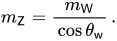
     

The angle can be expressed in terms of the SU(2)L and U(1)Y couplings (weak isospin g and weak hypercharge g, respectively),

      and

The electric charge is then expressible in terms of it, e = g sin θw = g cos θw (refer to the figure).

Because the value of the mixing angle is currently determined empirically, in the absence of any superseding theoretical derivation it is mathematically defined as

     [5]

The value of θw varies as a function of the momentum transfer, q, at which it is measured. This variation, or 'running', is a key prediction of the electroweak theory. The most precise measurements have been carried out in electron–positron collider experiments at a value of q = 91.2 GeV/c, corresponding to the mass of the Z0
 boson, mZ.

In practice, the quantity sin2 θw is more frequently used. The 2004 best estimate of sin2 θw, at q = 91.2 GeV/c, in the MS scheme is 0.23120±0.00015, which is an average over measurements made in different processes, at different detectors. Atomic parity violation experiments yield values for sin2 θw at smaller values of q, below 0.01 GeV/c, but with much lower precision. In 2005 results were published from a study of parity violation in Møller scattering in which a value of sin2 θw = 0.2397±0.0013 was obtained at q = 0.16 GeV/c, establishing experimentally the so-called 'running' of the weak mixing angle. These values correspond to a Weinberg angle varying between 28.7° and 29.3° ≈ 30°. LHCb measured in 7 and 8 TeV proton–proton collisions an effective angle of sin2 θeff
w
= 0.23142
,[6] though the value of q for this measurement is determined by the partonic collision energy, which is close to the Z boson mass.

CODATA 2022[4] gives the value

     [b]

The massless photon (γ) couples to the unbroken electric charge, Q = T3 +  1 / 2 Yw, while the Z0
 boson couples to the broken charge T3Q sin2 θw.

Footnotes

[edit]

References

[edit]
Revisions and contributorsEdit on WikipediaRead on Wikipedia
from Grokipedia
The Weinberg angle, also known as the weak mixing angle and denoted as θ_W, is a fundamental parameter in the electroweak sector of the of that quantifies the mixing between the SU(2)L and U(1)Y gauge interactions, unifying the electromagnetic and weak neutral currents. It is precisely defined as θ_W = arctan(g'/g), where g and g' are the respective coupling constants of the SU(2)L and U(1)Y gauge groups. This angle determines the relative strengths of the electromagnetic and weak forces at the electroweak scale, with the emerging as the massless combination of the neutral gauge bosons and the Z boson acquiring mass through via the . The concept originated in Steven Weinberg's seminal 1967 paper, where he proposed a model for leptons that spontaneously breaks an SU(2) × U(1) to reproduce the observed structure of weak and electromagnetic interactions, introducing the mixing of neutral gauge fields A3μ and Bμ into the Aμ and Zμ with couplings governed by g and g'. This framework, later refined by , laid the foundation for the electroweak theory, predicting neutral weak currents that were experimentally confirmed in 1973 at , validating the role of θ_W in processes like neutrino scattering. The theory's success earned Weinberg, , and Sheldon the 1979 for unifying the weak and electromagnetic forces. Physically, the Weinberg angle relates the masses of the electroweak bosons via cos θ_W = M_W / M_Z, where M_W and M_Z are the masses of the charged W± and neutral Z bosons, respectively, and influences observables such as the effective weak neutral coupling in and parity violation in . In the on-shell scheme, sin² θ_W is equivalently expressed as 1 - M_W² / M_Z², providing a direct link to measurable boson properties. Beyond the , θ_W serves as a probe for new physics, such as or grand unified theories, where its running with energy scale can deviate from predictions due to additional particles or interactions. Experimental determinations of sin² θ_W have been refined over decades through precision electroweak measurements at colliders like LEP, SLC, and the , as well as low-energy processes including in e+e- → μ+μ- and atomic parity violation. As of 2024, the world average, in the modified minimal subtraction (MS) scheme at the Z boson mass scale, is sin² θ̂_W (M_Z) = 0.23129 ± 0.00004, achieved via global fits to electroweak data that constrain the and test for deviations. Ongoing experiments at LHC and future facilities like the aim to measure θ_W to even higher precision, potentially revealing hints of .

Fundamentals

Definition

The Weinberg angle, denoted θW\theta_W, is a fundamental parameter in electroweak theory that serves as the mixing angle diagonalizing the electroweak Lagrangian, thereby combining the neutral component of the with the electromagnetic interaction to form the and Z fields. This mixing transforms the original gauge fields of the SU(2)L_L and U(1)Y_Y groups into the physical fields observed in processes. Conceptually, θW\theta_W parameterizes the relative strengths of the U(1)Y_Y gauge interaction, with coupling constant gg', and the SU(2)L_L gauge interaction, with coupling constant gg, through the relation tanθW=g/g\tan \theta_W = g'/g. The angle thus encodes the degree of unification between these two interactions at high energies, where the electroweak symmetry is restored. The sine and cosine of θW\theta_W relate the underlying gauge couplings to the observed electromagnetic coupling ee, with sin2θW\sin^2 \theta_W emerging as the primary measurable parameter that quantifies the fraction of the weak carried by the electromagnetic interaction, via e=gsinθW=gcosθWe = g \sin \theta_W = g' \cos \theta_W. This parameter is central to predictions for neutral current processes in the . The angle is named after physicist , who incorporated it into the unified electroweak framework in his seminal 1967 model (though originally introduced by in 1961).

Notation and Conventions

The Weinberg angle is standardly denoted by θW\theta_W, with its sine and cosine appearing frequently in electroweak calculations as sinθW\sin \theta_W and cosθW\cos \theta_W, respectively. It is commonly abbreviated as the weak mixing angle to emphasize its role in mixing the weak and hypercharge currents. In the Glashow-Weinberg-Salam model, the angle was originally denoted simply as θ\theta, the mixing angle between the neutral weak and electromagnetic fields, before the subscript WW became conventional to honor Weinberg's contribution and distinguish it in the literature. The parameter is defined in terms of the gauge couplings of the electroweak sector: the SU(2)L_L coupling gg and the U(1)Y_Y coupling gg', via the relation tanθW=g/g\tan \theta_W = g'/g. Different renormalization schemes lead to distinct conventions for expressing sin2θW\sin^2 \theta_W. In the on-shell scheme, it is defined using physical masses as sW2=1MW2/MZ2s_W^2 = 1 - M_W^2 / M_Z^2. The effective scheme employs sin2θWeff\sin^2 \theta_W^{\rm eff} (or s^l2\hat{s}^2_l for leptons), which incorporates radiative corrections to Z- couplings to fermions at the Z-pole. In the MS\overline{\rm MS} scheme, it is given by sin2θWMS\sin^2 \theta_W^{\overline{\rm MS}} (or s^Z2(MZ)\hat{s}^2_Z(M_Z)) as the running coupling ratio g^2(MZ)/(g^2(MZ)+g^2(MZ))\hat{g}'^2(M_Z) / (\hat{g}^2(M_Z) + \hat{g}'^2(M_Z)) at the mass scale.

Theoretical Context

Electroweak Unification

The electroweak theory represents a cornerstone of the , unifying the electromagnetic and weak interactions under a single gauge framework based on the SU(2)L×U(1)Y\mathrm{SU}(2)_L \times \mathrm{U}(1)_Y. This structure was first proposed by in 1961, who introduced a model where the weak interactions of leptons are mediated by charged vector bosons, with the electromagnetic interaction arising from a neutral component, though the model initially lacked a mechanism for boson masses. Independently building on this, in 1967 and in 1968 developed the full unification by incorporating , predicting that the original symmetry breaks to the observed U(1)EM\mathrm{U}(1)_\mathrm{EM} of at low energies. Central to this unification is the , which provides masses to the weak gauge bosons without violating gauge invariance. Through induced by a scalar Higgs field acquiring a , three of the four gauge bosons—the charged W±W^\pm and neutral ZZ—gain mass, while the photon remains massless as the generator of the unbroken U(1)EM\mathrm{U}(1)_\mathrm{EM}. This breaking mixes the original neutral gauge fields, with the Weinberg angle θW\theta_W parameterizing the rotation that orthogonalizes the massless from the massive ZZ boson in the neutral current sector. The angle thus quantifies the relative strengths of the and couplings, emerging naturally from the unification. These developments marked a pivotal shift in , resolving long-standing issues like the parity-violating nature of weak interactions and paving the way for predictions of neutral currents, later confirmed experimentally. The Glashow-Weinberg-Salam model not only unified two fundamental forces but also highlighted the role of in generating the diverse particle masses observed in nature.

Derivation in the Standard Model

In the , the electroweak interactions are described by the gauge group SU(2)_L × U(1)_Y, with the corresponding Lagrangian containing the kinetic terms for the gauge fields: Lgauge=14WμνaWaμν14BμνBμν,\mathcal{L}_\text{gauge} = -\frac{1}{4} W^a_{\mu\nu} W^{a\mu\nu} - \frac{1}{4} B_{\mu\nu} B^{\mu\nu}, where WμνaW^a_{\mu\nu} (a=1,2,3a=1,2,3) are the field strength tensors for the SU(2)_L gauge fields WμaW^a_\mu with coupling gg, and BμνB_{\mu\nu} is that for the U(1)_Y gauge field BμB_\mu with coupling gg'. Spontaneous symmetry breaking via the generates masses for the gauge bosons. The charged Wμ±W^\pm_\mu bosons acquire mass MW=12gvM_W = \frac{1}{2} g v, where vv is the Higgs . In the neutral sector, the Wμ3W^3_\mu and BμB_\mu fields mix through the term arising from the Higgs kinetic energy Dμϕ2|\mathbf{D}_\mu \phi|^2, leading to the mass-squared matrix (Wμ3Bμ)v24(g2ggggg2)(W3μBμ).\begin{pmatrix} W^3_\mu & B_\mu \end{pmatrix} \frac{v^2}{4} \begin{pmatrix} g^2 & g g' \\ g g' & {g'}^2 \end{pmatrix} \begin{pmatrix} W^{3\mu} \\ B^\mu \end{pmatrix}. This matrix is diagonalized by a rotation through the Weinberg angle θW\theta_W, defined such that tanθW=g/g\tan \theta_W = g'/g. The massless eigenvector corresponds to the field AμA_\mu, while the massive one is the ZμZ_\mu with mass MZ=12vg2+g2M_Z = \frac{1}{2} v \sqrt{g^2 + {g'}^2}
Add your contribution
Related Hubs
User Avatar
No comments yet.