

Whitechapel Bell Foundry
View on Wikipedia

The Whitechapel Bell Foundry was a business in the London Borough of Tower Hamlets. At the time of the closure of its Whitechapel premises, it was the oldest manufacturing company in Great Britain.[1]
The bell foundry primarily made church bells and their fittings and accessories, although it also provided single tolling bells, carillon bells and handbells. The foundry was notable for being the original manufacturer of the Liberty Bell, a famous symbol of American independence, and for re-casting Big Ben, which rings from the north clock tower (the Elizabeth Tower) at the Houses of Parliament in London.
The Whitechapel premises are a Grade II*[2] listed building. The foundry closed on 12 June 2017, after nearly 450 years of bell-making and 250 years at its Whitechapel site,[3] with the final bell cast given to the Museum of London along with other artefacts used in the manufacturing process,[4] and the building has been sold.[5][6]
Following the sale of the Whitechapel Bell Foundry, the bell patents were sold to the bell-hanging company Whites of Appleton in Oxfordshire, with which the foundry had a business relationship for 197 years. The rights to tower bell production are now under the ownership of Westley Group Ltd. Production of presentation and hand bells continues under the name Bells of Whitechapel Ltd.[7]
History
[edit]The bell founding industry around Aldgate and Whitechapel can be traced back to at least 1360, and a few years later, Geoffrey Chaucer, living in a room in the Aldgate itself, described the presence of a bell founding industry in the area.[8] The Master Founders (bell makers) of Aldgate and Whitechapel, can be traced back to 1420.
The Whitechapel Bell Foundry company began in 1570. The last premises at 32–34 Whitechapel Road, backing on to Plumbers Row, dates from 1670 and was formerly a coaching inn called "The Artichoke" which had been damaged in the Great Fire of London.[9] The Artichoke ceased trading in 1738 and the following year the Whitechapel Bell Foundry moved into the premises. The foundry remained at the site until May 2017.[3][10] It was one of only two bell foundries left in the UK and had been in continuous production for almost 450 years.[5]
The three bells manufacturer's mark can be seen on the bells and the three bells sign hung over the door of the Whitechapel site.[11] According to previous owners Alan and Kathryn Hughes, the foundry had been a family-owned company throughout its history continuing when Alan Hughes's grandfather bought the company in 1904,[9] until its sale to Westley group in 2017.[7]
The business had to adapt throughout the centuries and in modern times, with new churches being built less frequently, produced handbells and doorbells. It responded to a surge in orders for table bells, following the popularity of the ITV period drama Downton Abbey, with a third of its sales going overseas.[12] In 2013 the foundry launched an online shop selling house bells, musical instruments and personalised merchandise.[12] The large bell business has been largely unaffected by periods of financial depression, partly because from enquiry to completion an order takes on average 11 years.[9] During World War II the foundry was used as a munitions production line, making casings for the War Office.[11]
The government not only guaranteed the orders. They guaranteed good prices and they also guaranteed quick payment, which is something that the Church of England has never managed to do with us.
— Alan Hughes[11]
The foundry was particularly busy after the war, replacing bells lost or damaged by fire in bombing raids across London.[13] Hughes said "Our business runs counter to the national economy. If the economy goes down and unemployment rises, we start to get busy. Last year was our busiest in thirty years, an increase of 27% on the previous year. Similarly, the nineteen twenties were very busy." Hughes also tells a story of an order requested of his grandfather in the 1890s which his father quoted again for in the 1950s and he himself gave a quote for in the 1970s. The order was finally completed in 1998.[3]
In March 2017 a consortium of heritage groups, including Save Britain's Heritage, the East End Preservation Society, the Society for the Protection of Ancient Buildings, the Ancient Monuments Society and the Royal Academy of Arts attempted to have the foundry's Grade II*[2] premises re-listed as a Grade I listed building as an asset of community value to preserve the historical importance of the building within the wider east end community.[14][15]
The foundry was sold to US investor Raycliff who proposed their intention to convert the site into a 100[16] to 108[17] room hotel at the rear of the building with a bell themed cafe[18] while maintaining space for the production of smaller bells including hand bells.[19] Raycliff hired local architectural practice 31/44 for the design.[20][21][22] The plan has the support of Historic England,[23] described by one journalist as “a public body which gives paid advice to property developers to encourage them to get through the existing planning systems.”[24] The application has been controversial.[25][26][27][28] The application was called in by the government on 22 January 2020, preventing the London Borough of Tower Hamlets from proceeding with the planning application pending the outcome of further public inquiry. The London Bell Foundry, a not for profit company dedicated to saving the historic foundry as a working enterprise, made an offer to purchase the site in November 2022. [29][30][31][32]
- Whitechapel Bell Foundry - Bells cast by Mears & Stainbank for All Saints, Rothbury, Northumberland, c. 1893[33]
-
 Cast Bells by Whitechapel Bell Foundry, 1893 State Library of New South Wales
 -
 Church Bells in the workshop at Whitechapel Bell Foundry, 1893
 -
 Moulds for church bells in the workshop at Whitechapel Bell Foundry


Notable bells
[edit]
Many churches across the world have bells cast by the Whitechapel Bell Foundry, but arguably its two best-known examples are not in places of worship. In 1752 the foundry (known at the time as Lester and Pack)[34] cast the Liberty Bell, which was commissioned to celebrate the 50th anniversary of William Penn's 1701 Charter of Privileges, Pennsylvania's original constitution. As a result of damage sustained during its stormy passage across the Atlantic, the bell cracked when it was first rung, and after repeated repairs cracked again.[10]
Big Ben, which tolls the hour at the Palace of Westminster, was cast in 1858 and rung for the first time on 31 May 1859. "Big Ben" weighs 13½ tons and is the largest bell ever cast at the foundry.[10] This bell also cracked because too heavy a hammer was initially used. The crack and the subsequent retuning gives Big Ben its present distinctive tone. A profile template of Big Ben surrounds the entrance door of the Whitechapel Foundry, while the original moulding gauge is retained near the furnaces.[35] The final bill for Big Ben came to £572.[36]
Whitechapel has supplied bells to several cathedrals. Guildford Cathedral in Surrey had a peal of 10 bells (later augmented to 12),[37] Canterbury Cathedral augmented its bells to a peal of 14 in 1981,[38] and the National Cathedral in Washington, D.C. in 1962.[39] The foundry produced "Great Tom" at Lincoln Cathedral,[40] the "Clock Bells" at St Paul's Cathedral, the bells of Westminster Abbey[41] Upon the construction of its tower between 1924 and 1942, the foundry cast 14 bells for the Liverpool Cathedral which all include psalm texts engravings.[42] The bells are notable for being the heaviest change ringing peal of bells in the world. The foundry's bellfounder at that time, Albert Hughes, is commemorated in a stained glass window in the nave.[41]

Churches with bells from Whitechapel include ones as near as St Mary-le-Bow, Cheapside and as far as the Armenian Church, Chennai, India. English examples include St Dunstan's, Stepney and St Dunstan's, Mayfield; St Michael's, Beckwithshaw; St Mary-le-More, Wallingford[43] Church of St Thomas the Apostle, Killinghall; and St Michael and All Angels, Leaden Roding. American churches in the Anglican Communion, for example St. Michael's Church, in Charleston, South Carolina. Australian churches include St Bartholomew's Church, Burnley,[44] St Stephen's Anglican Church, Newtown; St Philip's Church[45] and St James' Church, Sydney.[46] In Canada, the towers of Notre-Dame Basilica in Montreal house one of the world's largest bells and a ten-bell carillon.[47]
Bells not in churches include civic focal points such as a clock tower; Thomas Mears II cast the bell for Herne Bay Clock Tower in 1837.[48] The Old Post Office in Washington, D.C., USA, has a ring of 10 bells in the key of D (tenor 26 cwt) that were cast by the Whitechapel Foundry in 1976, installed in 1982, and dedicated in 1983. The bells range in weight from 581 to 2953 pounds. These bells, referred to as The Congress Bells, were a gift to the US Congress from Britain's Ditchley Foundation to celebrate the bicentennial of American independence.
The sterling silver bell silver ships bell on post WW II HMS Ark Royals (4 - 1955) and (5 - 1985) is said by (by Taylor's of Loughborough to have been cast by Whitechapel Foundry.
Following the September 11 attacks on the United States in 2001, the company made a tribute bell, the Bell of Hope, as a gift from the people of London to the city of New York.[12] It is rung at 08:46 each year on the anniversary of the tragedy, the time the first plane hit the first tower.[49] It was designed by architect Paul Byard and was rung for the first time on American soil by the Bishop of New York, the Rt. Rev. Mark S. Sisk. The bell resided at Trinity Church (Manhattan),[50] before being moved to St. Paul's Chapel. In 2005 it was rung again four times for the people killed in the 7 July 2005 London bombings.[51]

The Whitechapel Bell Foundry designed the Olympic Bell seen at the opening ceremony for the London 2012 Olympic Games, although it was not cast on the premises. The furnaces at Whitechapel could not provide the 23 tons of molten metal required to make the bell, so it was manufactured at a factory in the Netherlands which normally produces ship's propellers.[52]
The Olympic Bell is the largest harmonically tuned bell in the world and the widest bell in Britain.[53] It now hangs in the Queen Elizabeth Olympic Park, but is not rung because it is deemed too loud to be rung without disturbing local residents.[54]
The Foundry cast the Royal Jubilee Bells used on the lead barge for the Thames Diamond Jubilee Pageant the same summer,[55] which now hang in the church of St James Garlickhythe.
Damon Albarn had three bells cast from the foundry for "On Melancholy Hill" for the Gorillaz album Plastic Beach, although they were not used on the final song. These were cast in the notes D, A and C-sharp. However one of the bells is often used on live versions of "We Got the Power".
The last bell to be cast at the foundry was on 22 March 2017,[7] and was given to the Museum of London along with historical artefacts from the premises. The manufacturing patents for the Whitechapel bells have been sold to the bell-hanging company, Whites of Appleton in Oxfordshire, with whom the foundry has had a business relationship for 197 years.[4][7]
Master founders
[edit]The names on this list are those that are cast into the surface of Whitechapel bells of different dates. Prior to Robert Mot, in 1574, the sign of three bells was often cast to indicate that it was a Whitechapel (or Aldgate) bell.[56][57]
- 1420 Robert Chamberlain of Aldgate
- 1426 William Chamberlain
- 1456 John Daniel
- 1470 John Daniel's Successor
- 1487 IW
- 1500–1515 Thomas Bullisdon
- 1506–1522 William Culverden
- 1523 Thomas Lawrence
- 1538 John Owen
- 1553 Thomas Kempe
- 1574 Robert Mot
- 1606 Joseph Carter
- 1610 William Carter
- 1616 Thomas Bartlet
- 1632 John Clifton
- 1640 Anthony Bartlet
- 1675 James Bartlet
- 1700 Richard Phelps
- 1735 Phelps and Lester
- 1738 Thomas Lester
- 1752 Lester and Pack
- 1769 Lester, Pack and Chapman
- 1769 Pack and Chapman[58]
- 1781 Chapman and Mears
- 1784 William Mears
- 1787 William and Thomas Mears
- 1791 Thomas Mears I
- 1805 Mears and Son
- 1810 Thomas Mears II
- 1844 Charles and George Mears
- 1861 George Mears and Co
- 1865 Mears and Stainbank
- 1873 Robert Stainbank
- 1884 Alfred Lawson
- 1904 Arthur Hughes
- 1916 Albert Hughes
- 1945 Albert and William Hughes
- 1950 Albert, William and Douglas Hughes
- 1964 William and Douglas Hughes
- 1972 William, Douglas and Alan Hughes
- 1993 Douglas and Alan Hughes
- 1997 Alan and Kathryn Hughes
Gallery
[edit]-

-
 Bell makers' memorial inside the foundry
 -
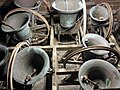 The bells of St Bees Priory shown in the "up" position. Cast by Charles & George Mears in 1857
 -
 The Robert Stainbank tenor bell from Todmorden Unitarian Church, West Yorkshire, during overhaul in 2014. The bell was cast in 1868.
 -
 Handbells on the workbench at the foundry
 -
 Template for Big Ben which hangs at the foundry
 -
 The oldest bell in Barbados (1696)
 -
 Guildford Cathedral bell cast at Whitechapel
 -
 Mears Bell, St James' Church, Sydney waiting to be re-hung after repairs in 2011


References
[edit]- ^ "500 Years of History" Whitechapel Bell Foundry website, accessed 26 December 2013.
- ^ a b Historic England. "Whitechapel Bell Foundry, 32-34 Whitechapel Road, 2 Fieldgate Street and workshops to the rear (1357529)". National Heritage List for England. Retrieved 3 July 2020.
- ^ a b c The Gentle Author. "So Long, Whitechapel Bell Foundry". Spitalfields Life. Retrieved 2 December 2016.
{{cite web}}:|last1=has generic name (help) - ^ a b Enfield, Laura. "Silence falls at Whitechapel Bell Foundry". The Wharf. Retrieved 27 May 2017.
- ^ a b Farrell, Sean (2 December 2016). "Whitechapel Bell Foundry to ring in new era as owner sells site". Guardian. Retrieved 2 December 2016.
- ^ "So Long, Whitechapel Bell Foundry". Spitalfields Life. 2 December 2016. Retrieved 6 December 2016.
- ^ a b c d "UK's oldest manufacturing company has cast its final tower bells at its Whitechapel Road site". Whitechapel Bell Foundry. Retrieved 27 May 2017.
- ^ London Bell foundry history https://www.thelondonbellfoundry.co.uk/the-past
- ^ a b c Harley, Nicola (2 December 2016). "Bell tolls for world's oldest foundry". Telegraph. Retrieved 2 December 2016.
- ^ a b c Winn, p. 201.
- ^ a b c Murray Brown, John. "Big Ben and Liberty Bell maker to close London foundry". Financial Times. Archived from the original on 10 December 2022. Retrieved 2 December 2016.
- ^ a b c Anderson, Elizabeth (31 December 2014). "Ringing in the New Year – Britain's oldest manufacturer on five centuries of bell making". Telegraph. Retrieved 2 December 2016.
- ^ "Bell foundry famous for creating Big Ben to close". Belfasttelegraph.co.uk. 2 December 2016. Retrieved 2 December 2016.
- ^ Hartman, Stephanie (16 March 2017). "Here's how you can help save the Whitechapel Bell Foundry from closing down". Time Out. Retrieved 27 May 2017.
- ^ Author, The Gentle. "Save The Whitechapel Bell Foundry". Spitalfields Life. Retrieved 27 May 2017.
{{cite web}}:|last1=has generic name (help) - ^ "Foundry Hotel". 31/44 Architects. Retrieved 29 June 2020.
- ^ Morrison, Richard (15 February 2019). "Ring the changes and allow development of a historic bell foundry". The Times. Retrieved 29 June 2020.
- ^ "The Bell Foundry". 31/44 Architects. Retrieved 29 June 2020.
- ^ Morley, Kate. "Ding-dong battle to save foundry that made Big Ben". Stuff. Retrieved 21 November 2018.
- ^ Moore, Rowan (3 March 2019). "Ringing the changes at the Whitechapel Bell Foundry". The Observer. Guardian News & Media Limited. Retrieved 3 July 2020.
Raycliff have also hired the local architectural practice 31/44 to design scrupulously sensitive adjustments to the old buildings and a dignified form for the hotel.
- ^ "The Bell Foundry". 31/44 Architects. Retrieved 3 July 2020.
- ^ "Foundry Hotel". 31/44 Architects. Retrieved 3 July 2020.
- ^ Pickford, James (25 December 2019). "Battle over Britain's historic bell foundry far from over". Financial Times. The Financial Times Ltd. Archived from the original on 10 December 2022. Retrieved 3 July 2020.
The Raycliff plan also has the support of Historic England, the statutory body, which has pointed to its inclusion of a small bell production unit.
- ^ Saumarez Smith, Charles (14 May 2021). "The sad, shameful demise of the Whitechapel Bell Foundry". Apollo Magazine. Retrieved 17 May 2022.
- ^ White, Bella (23 October 2019). "Whitechapel Bell Foundry owner hits back at anti-redevelopment campaign". EastLondonLines. Journalism Students at Goldsmiths, University of London. Retrieved 3 July 2020.
The owner of Whitechapel Bell Foundry has told EastLondonLines that campaigners objecting to the redevelopment of the site have 'misled the public'.
- ^ Gambetta, Georgina (15 November 2019). "Not saved by the bell:Whitechapel Bell Foundry plan approved despite anger". EastLondonLines. Journalism Students at Goldsmiths, University of London. Retrieved 3 July 2020.
Plans to transform the five-hundred-year-old Whitechapel Bell Foundry into a boutique hotel and multi-purpose space were approved last night despite strong opposition from local residents.
- ^ Morrison, Richard (15 February 2019). "Ring the changes and allow development of a historic bell foundry". The Times. Times Newspapers Limited. Retrieved 3 July 2020.
[T]he choice is between a properly financed scheme that will preserve this uniquely evocative site (and resuscitate it as a working foundry), or a vague and financially unsustainable plan from well-meaning people who don't even own the building.
- ^ Author, The Gentle (21 June 2018). "Hope For The Whitechapel Bell Foundry". Spitalfields Life. Retrieved 3 July 2020.
{{cite web}}:|last1=has generic name (help) - ^ "The Secretary Of State Steps In". Spitalfields Life. Retrieved 29 April 2020.
- ^ The Rt Robert Jenrick MP (22 January 2020). "Call in of planning proposal at The Bell Foundry, 32-34 Whitechapel Road, 2 Fieldgate Street and land to the rear, London E1 1EW - application numbers PA/19/00008/A1 and PA/19/00009/NC". Letter to Rt Hon Sir Edward Leigh MP.
- ^ "Whitechapel Bell Foundry". Whitechapel Bell Foundry. Retrieved 26 April 2020.
- ^ The London Bell Foundry
- ^ "Rothbury". Bells of the North-East of England. Retrieved 31 January 2022.
- ^ "Sons of the American Revolution holds September meeting". The Observer. Archived from the original on 14 June 2025. Retrieved 21 November 2018.
- ^ Whitechapel Bell Foundry The Story of Big Ben accessed 21 May 2007
- ^ Chaudhuri, Saabira. "Bell Tolls for London's Whitechapel Foundry, Which Made the Liberty Bell and Big Ben". WSJ. Retrieved 2 December 2016.
- ^ "Bell Ringing", Guildford Cathedral website, accessed 26 December 2013.
- ^ "Bells of Canterbury Cathedral", Canterbury Cathedral website, accessed 26 December 2013.
- ^ Dove's guide.
- ^ Pickford, Chris. "Great Bells of Britain". Archived from the original on 21 February 2014. Retrieved 3 November 2014.
- ^ a b Winn, p. 202.
- ^ Historic England. "ANGLICAN CATHEDRAL CHURCH OF CHRIST (1361681)". National Heritage List for England. Retrieved 11 June 2017.
- ^ James, Hedgecock (21 August 2012). "Wallingford S Mary le More". Dove's Guide for Church Bell Ringers.
- ^ "St Bartholomew's Burnley Bell Tower". St Bartholomew's Anglican Church, Parish of Burnley, Richmond. Retrieved 3 January 2017.
- ^ "Tower of St. Philips, Church Hill, Sydney". Construction and Local Government Journal (NSW : 1913–1930). NSW: National Library of Australia. 9 February 1927. p. 13. Retrieved 12 December 2013.
- ^ Higson, Andrew (29 January 2010). "Sydney, Queen's Square, St James". Dove's Guide for Church Bell Ringers. Retrieved 17 November 2013.
- ^ https://www.basiliquenotredame.ca/en/restoration-project
- ^ Bundock, Mike (2000). Herne Bay Clock Tower: A descriptive history. Herne Bay: Pierhead Publications. ISBN 978-0-9538977-0-4, page 20
- ^ "Bell of Hope rings for 9/11 attack victims – video". Guardian. 11 September 2016. Retrieved 2 December 2016.
- ^ "New York: The 9-11 bell dedication". Whitechapel Bell Foundry. Retrieved 2 December 2016.
- ^ Colby, Edward B. "9-11 Bell honors London victims". New York Daily News. Retrieved 2 December 2016.
- ^ "London 2012: Olympic bell made in Holland", The Telegraph (online edition), 20 April 2012, accessed 26 December 2013.
- ^ "London 2012 opening ceremony bell". Queen Elizabeth Olympic Park. Mayor of London. Retrieved 23 January 2017.
- ^ Whetstone, Sean (30 May 2016). "Olympic Bell re-installed next to Iron's new home". Claret and Hugh. Retrieved 23 January 2017.
- ^ "Thank you one and all: the people who helped make the Jubilee happen". Daily Telegraph. 10 June 2012.
- ^ Whitechapel Bell foundry Identifying bells accessed 21 May 2007
- ^ John Rennie – Bells that tolled across the world accessed 21 May 2007
- ^ Stahlschmidt, John Charles Lett (1887). The Church Bells of Kent, their Inscriptions, Founders, Uses and Traditions. London: Elliot Stock. p. 112.
Sources
[edit]- Foreman, Lewis; Foreman, Susan (2005). London: A Musical Gazetteer. London: Yale University Press. ISBN 978-0-300-10402-8.
- Winn, Christopher (2007). I Never Knew That About London. London: Ebury Press. ISBN 978-0-09-194319-6.
Further reading
[edit]- "Whitechapel Bell Foundry, 32–34 Whitechapel Road". Survey of London. Retrieved 12 September 2024.
External links
[edit]
- whitechapelbellfoundry.co.uk at the Wayback Machine (archived 27 November 2015)
- savethewhitechapelbellfoundry.com, campaign to keep the Whitechapel Bell Foundry as a fully working foundry
- thebellfoundry.co.uk at the Wayback Machine (archived 27 September 2021), website created by Raycliff Whitechapel LLP who bought the site in 2016
- British Pathé 1966 film of inside Whitechapel Bell Foundry
- Index to carillons and chimes by Whitechapel
- Factum architects' proposal to preserve the foundry
- The Sound of Bells—Mears and Stainbank Catalogue
| International | |
|---|---|
| National | |

Whitechapel Bell Foundry
View on GrokipediaHistorical Development
Origins and Early Operations (1570–1700)
The Whitechapel Bell Foundry traces its origins to 1570, when Robert Mot established operations in Whitechapel, London, as the first dedicated bell-casting business in the city following the English Reformation's suppression of monastic foundries.[4][7] Alternative historical records attribute precursor activity to Robert Doddes in 1567 or Mot himself in 1572, yielding the conventional founding year of 1570, though the enterprise may have evolved from earlier Aldgate-based founders dating to the 14th century.[1] Initially located in Essex Court (later Tewkesbury Court, now part of Gunthorpe Street), the foundry focused on bronze bell production using traditional sand-molding techniques, serving the growing demand for church bells amid post-Reformation ecclesiastical rebuilding.[7][4] Early operations under Mot emphasized church bells, with the earliest documented example cast in 1583 for Westminster Abbey, where it remains in use as a service bell.[4] A second bell for the same abbey followed in 1598, exemplifying the foundry's emerging reputation for durable castings marked by the "sign of three bells," a hallmark distinguishing Whitechapel products.[4] Mot's workshop also produced ordnance, including cannons extant from the late 16th century, reflecting the era's dual civilian and military applications of founding skills amid England's naval and continental conflicts.[1] These activities operated continuously through the 17th century, adapting to urban expansion and the Great Fire of 1666, which prompted site acquisitions like the former Artichoke inn by the 1670s for expanded facilities.[4] By the close of the period, the foundry had solidified its role in London's metallurgical trade, casting bells for parish churches across England while maintaining artisanal methods reliant on local tin and copper alloys, though records of specific 17th-century outputs remain sparse beyond ongoing ecclesiastical commissions.[7] The persistence of these operations laid the groundwork for later mastery, underscoring the foundry's resilience in a competitive field dominated by guild-regulated craftsmen.[4]Expansion Under the Mears Family (18th–19th Centuries)
The Mears family's involvement with the Whitechapel Bell Foundry began in the late 18th century, when William Mears, who had apprenticed under Pack and Chapman from 1762 to 1777, assumed sole proprietorship following the death of William Chapman in 1784.[8] Initially operating independently at Gould Square in Crutched Friars before partnering briefly with Chapman, William Mears consolidated control over the foundry at 32–34 Whitechapel Road, marking the transition from the Lester-Pack-Chapman era to family-led management that emphasized scaled production of church bells.[9] His brother Thomas joined the business, leading to operations under William and Thomas Mears by the early 1790s, during which they cast bells for numerous English parishes, including recastings and new peals that demonstrated improved tuning techniques inherited from prior founders. Under Thomas Mears (senior), who succeeded as principal founder around 1789, the foundry experienced significant commercial growth, evidenced by a 1810 promotional advertisement listing 1,858 bells cast at the site since 1738, encompassing domestic church orders and early exports such as those to St. Petersburg in 1747 and Philadelphia in 1754 (though predating Mears, these highlighted the foundry's established international scope).[1] This period saw the business rebranded simply as "Mears," reflecting family dominance until 1865, with output focusing on tuned peals for ringers and single tolling bells, supported by the foundry's location in London's East End facilitating access to tin, copper, and labor markets.[4] The Mears emphasized quality control in alloy composition—typically 78% copper and 22% tin—yielding durable, resonant bells that met Anglican church demands amid 19th-century parish expansions driven by population growth.[9] In the early 19th century, Thomas Mears (junior) continued operations, casting notable peals such as those for Herne Bay Clock Tower in 1837, while the foundry adapted to industrial-era demands by producing larger bells for civic and ecclesiastical projects.[4] Expansion peaked under brothers Charles and George Mears, who managed from 1844 to 1859, culminating in the 1858 casting of the 13.7-ton Great Bell (commonly known as Big Ben) for the Palace of Westminster's Elizabeth Tower, the largest bell ever produced at Whitechapel and a testament to scaled furnace capabilities and precision molding refined over generations.[7] This era also included exports to colonial outposts, such as bells for St. John's Anglican Church in Lunenburg, Nova Scotia (1814), underscoring the foundry's role in British imperial dissemination of campanology.[4] By mid-century, annual output routinely exceeded dozens of bells, with the Mears leveraging advertising and networks among clergy to dominate the UK market, though competition from rivals like John Taylor & Co. began emerging.[1] The family's tenure ended with George's death in 1859, but their innovations in bell profiles for better harmonics laid groundwork for later productivity.[9]20th-Century Operations and Challenges
In the early 20th century, the Whitechapel Bell Foundry operated under the Mears & Stainbank partnership, which had been established in 1865 and continued until 1968, focusing primarily on casting and tuning church bells using traditional sand-molding techniques largely unchanged since the 19th century.[1] Arthur Hughes assumed management in 1904, marking the beginning of family oversight that persisted through subsequent generations, including Albert Hughes in 1916 and Albert and William Hughes from 1945.[7] The foundry diversified slightly by producing handbells and fittings, but church bells remained the core output, with newsreels from the 1920s, 1954, and 1966 documenting the labor-intensive processes of melting bronze, pouring into molds, and tuning via striking.[1] During World War II, operations adapted to wartime demands, including the production of aluminum castings for the Admiralty, though the back foundry suffered incendiary damage that required repairs around 1950.[1] Post-war, a surge in demand materialized as many bells destroyed in bombings needed recasting, enabling the foundry to recast numerous peals and maintain steady employment, peaking at around 30–38 staff by 1976.[1] In 1958, proposals emerged to rebuild the damaged back foundry entirely behind the Whitechapel Road frontage, reflecting efforts to modernize amid material shortages and reconstruction pressures.[7] Notable projects included casting 58 bells for the Riverside Church carillon in New York and, in 1976, the Bicentennial Bell gifted by the UK to the United States.[1] Later in the century, challenges intensified with post-war infrastructure upgrades, such as a new engineering workshop built in 1979–81 and front building refurbishments funded by the Greater London Council in 1984–85, yet traditional methods limited full mechanization.[7] Urban constraints in Whitechapel, including restricted access due to nearby mosque activities and parking exemptions that hindered fire engine entry, compounded operational difficulties.[1] By the late 20th century, declining demand for new church bells—driven by reduced ecclesiastical construction and rising secularism—eroded profitability, while competition from larger foundries like John Taylor & Co. in Loughborough offered economies of scale.[1] Employment gradually fell to about 25 by the early 2000s through partial mechanization, signaling a broader contraction in the British bell-founding industry amid escalating material and labor costs.[1]Closure and Immediate Aftermath (2017)
In December 2016, Alan Hughes, the foundry's proprietor since 1972 and a fourth-generation family owner, announced the impending closure, describing it as a matter of deep regret for the world's most famous bell foundry and Britain's oldest continuous manufacturing enterprise.[10] The decision stemmed primarily from the absence of a family successor willing or able to continue operations amid rising costs and the practical difficulties of maintaining a specialized craft in central London, prompting Hughes to sell the site.[11][1] Operations at the Whitechapel Road premises formally ended on 12 June 2017, concluding 250 years at that location and approximately 447 years of bell founding overall.[1] The site, a Grade II* listed building, had been sold earlier that year to property developer Vincent Goldstein's Raycliff Assets for £5.1 million, with initial plans envisioning partial retention of the foundry for limited bell production alongside commercial redevelopment into hotel space and workspaces.[1][12] Immediately following the shutdown, negotiations focused on relocating the core bell-founding business away from the site to ensure continuity, though these efforts faced uncertainty as the site's future shifted toward property development.[7] Preservation groups, including early interventions by entities like the UK Historic Bell Preservation Trust, began advocating for safeguarding the facility's heritage equipment and processes, highlighting concerns over the potential irreversible loss of irreplaceable casting molds and expertise accumulated over centuries.[13] The closure elicited widespread public lamentation for the end of an unbroken artisanal lineage, with initial media coverage emphasizing the foundry's role in casting globally significant bells like Big Ben and the Liberty Bell.[12]Technical Aspects of Bell Founding
Casting Processes and Innovations
The Whitechapel Bell Foundry utilized traditional loam moulding for the majority of its bell castings, creating two-part moulds consisting of a hollow inner core and an outer cope from a mixture of loam, sand, horse manure, and goat hair to achieve the precise bell profile.[14][15] These moulds were meticulously dried over several days or weeks to expel moisture and prevent steam explosions during the pour.[15] Bells were cast mouth-down in a continuous pour of molten bell metal, an alloy of 78% copper and 22% tin heated to approximately 1,200°C in coke-fired furnaces, with gases removed using willow sticks prior to casting.[15] Inscriptions, decorations, and canons (the suspension loops) were formed directly in the moulds, allowing customization without post-casting machining.[15] For stability during cooling, larger moulds were often buried in sandpits to control contraction and minimize defects.[15] To accommodate increasingly large bells, the foundry innovated in infrastructure, enlarging its yard and installing a new furnace in 1846 capable of melting metal for an 11.5-ton bell destined for Montreal Cathedral.[7] By the late 20th century, Whitechapel supplemented loam with greensand techniques for certain castings, as documented in 1997 operations, blending established methods with minor adaptations for efficiency while preserving acoustic quality.[13] These processes remained largely unchanged from the 16th century, emphasizing empirical refinements over radical mechanization to ensure tonal resonance.[16]Materials and Quality Control
The primary material used in bells cast at the Whitechapel Bell Foundry was bell metal, a bronze alloy consisting predominantly of copper and tin, with the tin content typically ranging from 16 to 23 percent for general purposes and up to 27 percent for larger church bells to optimize resonance and durability.[17] This composition avoided additives like silver, as the bell's tone derived primarily from its shape rather than elemental impurities, while excess copper risked softening the alloy and excess tin induced brittleness.[17] The foundry adhered to this traditional formulation throughout its operations, as evidenced in bells like the Liberty Bell, cast in 1752 with approximately 70 percent copper and 25 percent tin, ensuring a balance of hardness for withstanding repeated strikes and acoustic properties for clear harmonics.[18] Quality control relied on craftsmanship and empirical testing rather than industrialized metrics, beginning with meticulous mould preparation using loam—a mixture of London clay, horse hair, and manure—to form the core and cope, which minimized defects during pouring of molten bell metal at around 1,100°C.[19] Post-casting, bells underwent visual and auditory inspection for cracks or flaws, with defective castings often recast; the foundry's bells demonstrated exceptional longevity, as seen in two 1583 castings at Westminster Abbey that remained functional into the 21st century without structural failure.[12] Tuning constituted the core quality assurance step, performed on a vertical lathe where skilled tuners, such as those following Rev. A.B. Simpson's 1896 innovations, precisely shaved interior metal to align the bell's partial tones—hum, strike, and tierce notes—with mathematical harmonics for a pure nominal pitch.[17][14] This process, refined over centuries at Whitechapel, ensured tonal consistency across sets, with final verification by striking and recording overtones, prioritizing auditory precision over chemical analysis of the alloy.[20] Handbells followed a similar but less intensive tuning due to smaller scale, maintaining the same bronze composition for uniformity.[14]Notable Products and Contributions
Iconic Bells Cast at Whitechapel
The Liberty Bell, cast in 1752 by Thomas Lester at the Whitechapel Bell Foundry, was commissioned by the Pennsylvania Provincial Assembly for the State House in Philadelphia (now Independence Hall) and weighs approximately 2,080 pounds (944 kg).[19][21] Upon arrival in Philadelphia, the bell cracked during testing, leading to a local recasting that incorporated the original metal along with additional tin to adjust its tone, but the initial mold and core were produced at Whitechapel, establishing the foundry's role in its creation.[21] This bell, inscribed with a passage from Leviticus 25:10 emphasizing liberty, has endured as a global emblem of American independence despite subsequent cracks, symbolizing both the fragility and resonance of democratic ideals.[19] The Great Bell of Westminster, commonly known as Big Ben, was cast at Whitechapel on April 10, 1858, by George Mears and weighs 13.5 long tons (13.7 metric tons), making it the largest bell ever produced there.[22][23] This recasting followed the failure of an initial 1856 bell from the Warner foundry in Stockton-on-Tees, which cracked during testing; Whitechapel's version incorporated remnants of the original alongside new bronze to achieve a deeper tone suitable for the Palace of Westminster's clock tower.[24][25] Installed in July 1859 after transport via Thames barge and road carriage, it has chimed hourly (except during wartime silences and maintenance) and cracked slightly in 1860, yet continues to function with a lighter clapper to prevent further damage.[22] Other notable bells include the tenor bell for the 2012 London Olympics opening ceremony, cast in 2012 and rung by athletes to mark the event's start, and sets for institutions like the U.S. National Cathedral, underscoring Whitechapel's export influence on commemorative and ecclesiastical ringing worldwide.[26][27]Other Significant Projects and Exports
The Whitechapel Bell Foundry produced and exported a wide array of bells beyond its most renowned commissions, including tower bells for churches in former British colonies and Commonwealth nations. Exports included approximately 500 tower bells to Australia, over 900 to Canada, and 600 to the United States, facilitating the installation of change-ringing peals and tolling bells in distant parishes.[12] Specific examples encompass the Mears bell at St James' Church in Sydney, Australia, and the Jessen Bell cast in 1814 for St. John's Anglican Church in Lunenburg, Nova Scotia, Canada, demonstrating the foundry's role in equipping Anglican and other denominations overseas.[2] In terms of sets of bells, the foundry supplied at least 44 rings to Australia, 23 to Canada, 4 to New Zealand, and 62 to the United States, often tuned for full-circle ringing traditions carried by British emigrants.[28] These exports extended to regions like South Africa and India, with individual bells such as the 1696 example recognized as the oldest in Barbados, underscoring early transatlantic and colonial trade in bell founding.[29] Beyond church tower bells, significant projects involved handbells, which accounted for roughly one-fifth of operations and were produced for musical ensembles and educational use worldwide.[30] The foundry also crafted carillon bells, clock bells, and single tolling bells for public and institutional purposes, including a set for the lead barge in Queen Elizabeth II's 2012 Diamond Jubilee Thames pageant.[31] These diverse outputs highlighted the foundry's versatility in meeting both ecclesiastical and secular demands.Key Personnel
Master Founders Through the Centuries
The Whitechapel Bell Foundry's master founders began with Robert Mot, who established the business in 1570 during the reign of Queen Elizabeth I, marking the start of continuous bell-casting operations at the site.[4] Early successors included Joseph Carter from the 1580s to 1609 and his son William Carter until 1616, followed by Thomas Bartlett from 1616 to 1632, during which the foundry produced bells for local churches amid growing demand in London's expanding parishes.[32] By the early 18th century, Richard Phelps assumed mastery around 1700, elevating the foundry's reputation through high-quality castings, including bells for Westminster Abbey and numerous London towers; he partnered with Thomas Lester from 1735, who took sole control in 1738 after Phelps's death.[1] Lester's tenure, extended through partnerships with Thomas Pack (1752–1769) and later Chapman (1769–1783), saw innovations in bell tuning and exports, such as the 1752 Liberty Bell for Philadelphia.[33] The transition to the Mears family occurred in the late 1780s, with William Mears initially, followed by Thomas Mears I (1794–1810) and Thomas Mears II (1810–1844), who standardized production and cast over 2,000 bells, including significant recastings for cathedrals.[4] The Mears era peaked under Charles and George Mears (1844–1861), who cast the 13.7-ton Great Bell of Westminster (Big Ben) in 1858 after an initial flawed version cracked.[1] In 1861, Robert Stainbank joined, forming Mears & Stainbank, which dominated until 1907; Stainbank's descendants, including Frederick and William Stainbank, maintained operations through the early 20th century, adapting to wartime demands and handbell production.[33] Arthur Hughes became master founder around 1904, overseeing modernization, while later 20th-century leaders like Alan and Dolores Hughes (from the 1970s) navigated economic pressures until the 2017 closure, preserving traditional sand-casting techniques amid declining UK commissions.[33]| Period | Master Founder(s) | Key Contributions |
|---|---|---|
| 1570–1580s | Robert Mot | Founded the foundry; initial bell production for local use.[4] |
| 1700–1738 | Richard Phelps (with Lester from 1735) | Elevated quality; cast bells for major London sites.[1] |
| 1738–1783 | Thomas Lester & partners (Pack, Chapman) | Tuning advancements; exported to America.[33] |
| 1784–1861 | Mears family (Thomas I/II, Charles & George) | Mass production; Big Ben casting.[4] |
| 1861–1945 | Mears & Stainbank (Robert et al.) | Family continuity; wartime adaptations.[33] |
| 1904–2017 | Hughes et al. (Arthur, Alan) | Modern preservation of craft amid challenges.[33] |