Hubbry Logo
Winterland BallroomWinterland BallroomMain
Open search
Winterland Ballroom
Community hub
Winterland Ballroom
logo
8 pages, 0 posts
0 subscribers
Be the first to start a discussion here.
Winterland Ballroom
Winterland Ballroom
from Wikipedia

Winterland, called at first New Dreamland Auditorium and later Winterland Arena and Winterland Ballroom, was an ice-skating rink and music venue in San Francisco operational from 1928 to 1979 and demolished in 1986.

Key Information

Built at the corner of Post Street and Steiner Street, it was converted for exclusive use for music in 1971 by concert promoter Bill Graham, who made it a popular stop for rock acts. Graham's related merchandising company Winterland Productions sold concert shirts, memorabilia and sports-team merchandise.

History

[edit]

New Dreamland Auditorium opened on June 29, 1928,[2] as a skating rink that could convert into a seated entertainment venue. The building cost $1 million, equivalent to $18.8 million in 2025.[3] The name change to Winterland came in the late 1930s; the building successfully operated through the Great Depression.

The New Dreamland was built on the site of the Dreamland Rink (midway on the west side of Steiner between Post and Sutter) and Sid Grauman's National Theatre (on the corner of Post and Steiner).[4]

In 1936, Winterland began hosting the Shipstads and Johnson Ice Follies.[5] Impresario Clifford C. Fischer staged an authorized production of the Folies Bergère, the Folies Bergère of 1944, at the Winterland Ballroom in November 1944.[6] The Ballroom hosted opera, boxing and tennis matches.[7]

As a music venue

[edit]

Starting on September 23, 1966, with a double bill of Jefferson Airplane and the Paul Butterfield Blues Band, Bill Graham began to occasionally rent the venue, which had an audience capacity of 5,400, for larger concerts that his nearby Fillmore Auditorium could not properly accommodate. After closing the Fillmore West in 1971, he began to hold regular weekend shows at Winterland.

Various popular rock acts played there, including such bands and musicians as Tom Petty and the Heartbreakers, Bruce Springsteen, the Rolling Stones, the J. Geils Band, the Who, Black Sabbath, James Gang, Kansas, Mahogany Rush, Quicksilver Messenger Service, UFO, REO Speedwagon, Queen, Slade, Boston, Cream, Yes, Fleetwood Mac, Kiss, the Doors, Jimi Hendrix, Steppenwolf, Lynyrd Skynyrd, Marshall Tucker Band, Outlaws, Charlie Daniels, Styx, Van Morrison, the Allman Brothers Band, Grateful Dead, the Band, Big Brother and the Holding Company (with Janis Joplin), Dan Hicks and His Hot Licks, Neil Young, Jethro Tull, Pink Floyd, Ten Years After, Wishbone Ash, Rush, Electric Light Orchestra, David Bowie, Genesis, Santana, Jefferson Airplane, Sons of Champlin, Sex Pistols, Traffic, Golden Earring, Grand Funk Railroad, Humble Pie, Bob Seger and the Silver Bullet Band, Robin Trower, Emerson, Lake & Palmer, Sha Na Na, Loggins and Messina, Lee Michaels, Heart, Journey, Deep Purple, J.J. Cale, Spirit, the Chambers Brothers, Alice Cooper, Frank Zappa and the Mothers of Invention, Foghat, Mountain, B.B. King, Montrose, George Thorogood and the Delaware Destroyers and Elvis Costello. Led Zeppelin first performed their song "Whole Lotta Love" there.

The Tubes headlined New Year's Eve 1975 with Flo and Eddie.

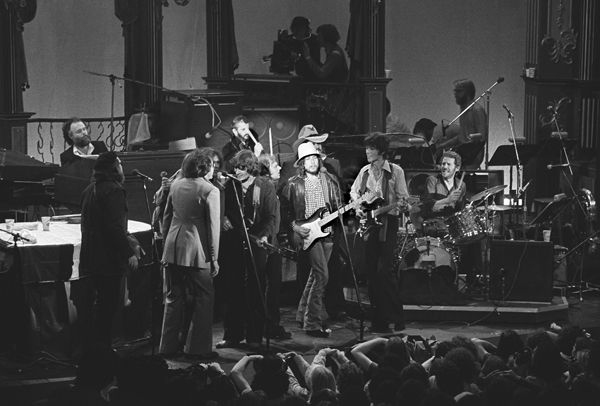
Many of the best-known rock acts from the 1960s and 1970s played at Winterland or played two blocks away across Geary Boulevard at the original Fillmore Auditorium. Peter Frampton recorded parts of the fourth-best-selling live album ever, Frampton Comes Alive!, at Winterland. The Grateful Dead made Winterland their home base, and The Band played their last show there on Thanksgiving Day 1976. That concert, featuring numerous guest performers including Neil Young, Eric Clapton, Bob Dylan, Joni Mitchell, and many others, was filmed by Martin Scorsese and released in theaters and as a soundtrack under the name The Last Waltz. Winterland also hosted the Sex Pistols' final show, on January 14, 1978.[8]

Final concerts

[edit]

During Winterland's final month of existence, shows were booked nearly every night. Acts included the Sex Pistols, the Tubes,[9] the Ramones, Smokey Robinson, Tom Petty and the Heartbreakers, and on December 15–16, 1978, Bruce Springsteen and the E Street Band. Springsteen's December 15 show was broadcast on local radio station KSAN-FM.

Winterland closed on New Year's Eve 1978 / New Year's Day 1979 with a concert by the Grateful Dead, New Riders of the Purple Sage, and the Blues Brothers. The show lasted over eight hours, with the Grateful Dead's performance — documented on DVD and CD as The Closing of Winterland — lasting nearly six hours, beginning at midnight with Bill Graham's favorite Dead song, "Sugar Magnolia". After the show, the crowd was treated to a hot, buffet-style champagne breakfast. The final show was simulcast live on radio station KSAN-FM and the local PBS TV station KQED.[10]

Winterland was eventually razed in 1985 and replaced by apartments.[11]

Live recordings at Winterland

[edit]

A number of films and recordings were made in whole or in part at the Winterland Arena.[12]

Concert films

[edit]

Live albums

[edit]

Further reading

[edit]

References

[edit]
[edit]
Revisions and contributorsEdit on WikipediaRead on Wikipedia
from Grokipedia
The Winterland Ballroom was a renowned in , , that operated as a major rock concert hall from 1966 to 1978 under the promotion of Bill Graham. Originally a five-thousand-seat arena, it became the largest space for regular rock shows in the city, hosting transformative performances that defined the era's music scene. Under Graham's management, Winterland expanded from smaller venues like , accommodating bigger crowds and diverse lineups that blended , , and emerging genres. Early bookings included , , and in September and October 1966, marking its debut as a concert space. Iconic events followed, such as the Jimi Hendrix Experience's shows on October 10–12, 1968, and ' performances on June 6 and 8, 1972, with as the opener. The venue reached its cultural peak in the mid-1970s, capturing live albums and films that endure as rock classics, including Peter Frampton's Frampton Comes Alive! recorded there in 1975. That same year, on November 25, The Band's farewell concert The Last Waltz—featuring guests like Bob Dylan, Neil Young, and Joni Mitchell—was filmed by Martin Scorsese at Winterland. It also played a pivotal role in punk's arrival, hosting the Sex Pistols' final concert on January 14, 1978, opened by local acts The Avengers and The Nuns, where Johnny Rotten delivered his infamous closing quip. The hall closed after a New Year's Eve show on December 31, 1978, headlined by the Grateful Dead, amid mounting repair costs that Graham deemed unfeasible.

Early History

Origins and Construction

The New Dreamland Auditorium was constructed in 1928 at the corner of Post and Steiner Streets in , , serving as a major entertainment venue from its opening on June 29 of that year. Built at a cost of $1 million for the era, the facility was designed primarily as an ice-skating rink capable of accommodating public recreation and large-scale skating events, with an arena layout that included a central ice surface surrounded by tiered seating. The structure featured basic infrastructure such as a mechanical refrigeration system embedded beneath the ice slab to maintain frozen conditions year-round, along with wooden flooring elements that allowed versatility for non-ice activities when the rink was covered. Its 5,400-seat capacity made it one of the city's largest venues for recreational gatherings at the time. In its early years during and , the auditorium hosted a variety of community events centered around skating, including public ice-skating sessions and performances by the Shipstad and Johnson Ice Follies, which drew thousands of local residents for seasonal shows. The venue also supported programs and other recreational pursuits, reflecting its role as a hub for affordable family entertainment and social activities in the Fillmore District. By the mid-20th century, it had become a staple for such gatherings, occasionally adapting its space for matches, exhibitions, and labor union rallies that emphasized community engagement over formal spectacles. The facility underwent a in the late to Winterland Arena, aligning with its emphasis on winter-themed ice activities, though its core functions remained focused on skating and through the . Ownership shifted in 1955 when Theater Circuit Inc. acquired the property, marking a period of stabilized management that preserved its recreational infrastructure amid growing urban development pressures in . This era solidified Winterland's preeminence as a versatile community space before later adaptations under promoters like Bill Graham in the .

Conversion to a Music Venue

The Winterland Ballroom, originally an ice skating rink known as the Dreamland Auditorium, began its transition to a music venue in 1966 when promoter Bill Graham rented the space for occasional rock concerts to accommodate growing crowds from his nearby Auditorium. The inaugural shows, held from September 23 to 25 and 30, featured , , and , marking the venue's entry into the burgeoning counterculture scene with performances that blended and influences. These early events tested the large arena's suitability for live music, revealing its cavernous, echoey acoustics as both a challenge and a distinctive feature that amplified the raw energy of the acts. Throughout the late 1960s, Graham continued sporadic bookings at Winterland with experimental shows featuring psychedelic and folk-leaning acts, such as the Jimi Hendrix Experience in 1968, to refine the space's potential as a concert hall. However, the venue remained primarily a skating facility until 1971, when Graham acquired the lease full-time following the closure of , establishing Winterland as his primary rock venue with a capacity of nearly 5,500. This shift prompted significant physical modifications, including the removal of the skating rink infrastructure, installation of professional lighting rigs, and upgraded sound systems to better suit amplified performances while preserving the arena's resonant echo. The conversion period was not without hurdles. Despite these issues, the adaptations during 1966–1971 laid the groundwork for Winterland's transformation into a cornerstone of the rock music era.

Operation as a Concert Hall

Key Artists and Performances

The Winterland Ballroom served as a central hub for the rock scene during its peak operational years from 1971 to 1978, hosting frequent residencies by local icons that solidified its status as a premier venue for psychedelic and jam-oriented acts. The , in particular, treated Winterland as their "home" stage, performing a total of 59 shows there between 1967 and 1978, with the majority occurring in the and drawing dedicated followings that filled the 5,400-capacity hall night after night. These extended sets exemplified the venue's suitability for improvisational music, contributing to the countercultural ethos of the era. Bands emerging from the and traditions, such as and , continued to grace the stage into the ; recorded portions of their 1973 live album Thirty Seconds Over Winterland during September 1972 performances, while delivered notable sets in 1973 and 1975 that captured their signature blend of folk-rock and . Earlier extensions of this scene included Janis Joplin's powerful appearances with Big Brother and the Holding Company in the late 1960s, which helped transition the venue's legacy from to rock cathedral. International heavyweights also packed Winterland with sold-out crowds averaging over 5,000 attendees, elevating its profile beyond regional acts. played four intimate shows there in June 1972 during their post-exile American tour, offering fans close-up access to the band in a mid-sized setting that contrasted with larger gigs. Similarly, The Who delivered two high-energy performances on March 27 and 28, 1976, as part of their orchestral tour supporting , showcasing Pete Townshend's windmill guitar style amid the venue's electric atmosphere. Led Zeppelin's explosive early tours in the late 1960s and 1970s included multiple nights at Winterland, such as their November 1969 stand, which highlighted their rising dominance in and blues-infused anthems. Winterland's programming reflected a broad genre diversity, attracting blues, soul, and emerging punk audiences alongside rock staples and routinely achieving sold-out status with crowds exceeding 5,000. Blues legend brought his commanding guitar work to the stage in 1967, influencing the venue's reputation for cross-genre appeal during its formative rock phase. Soul powerhouse , performing with , energized October 1970 shows that bridged R&B and rock energies. By the late 1970s, punk pioneers the Ramones injected raw velocity into their December 28, 1978, opening slot for , marking an early West Coast showcase for the genre amid Winterland's waning days. This eclectic roster underscored Winterland's pivotal role in nurturing the while hosting global talents that drew massive, enthusiastic turnouts.

Venue Features and Atmosphere

The Winterland Ballroom, originally constructed as an ice-skating rink in 1928, featured a capacity of 5,400 patrons, including seating that ringed the open and rising seats beneath the for improved sightlines. The venue's sloped , enabled by hydraulic jacks from its skating rink origins, allowed for adjustable inclines that enhanced visibility across the standing-room orchestra level, though this design contributed to its notorious "" acoustics, creating significant reverb in the large, hard-surfaced interior even when empty. Under promoter Bill Graham's management starting in 1971, the stage setup evolved to emphasize immersive visuals, incorporating colorful psychedelic projections via that projected abstract, fluid patterns onto screens and walls during performances. Graham also established a tradition of commissioning vibrant, artist-designed posters for each event, blending bold graphics with event details to promote shows and capture the era's countercultural aesthetic. Sound innovations at Winterland included the Grateful Dead's 1974 Wall of Sound system, a massive array comprising 586 JBL speakers and 54 Electro-Voice tweeters powered by 48 McIntosh amplifiers delivering 28,800 watts of continuous power, designed to provide clear, immersive audio without monitors by directing sound directly to the audience. This setup addressed the venue's acoustic challenges during the band's residencies, offering a pioneering example of high-fidelity live reinforcement. The audience experience at Winterland fostered a communal energy among enthusiasts, with the standing-room floor encouraging close-packed dancing and interaction, while balcony views added to the shared intensity of shows. Occasional disruptions, such as rowdy crowds leading to police interventions, underscored the venue's raw, unpolished vibe, though it remained a hub for like-minded fans. Logistical features were rudimentary by modern standards, with basic concession areas offering simple food and drink amid the excitement, and fire escapes providing essential egress in the aging structure converted from a rink without extensive updates.

Major Events and Closure

Iconic Concerts

One of the most celebrated events at Winterland Ballroom was The Band's farewell concert, "," held on Thanksgiving Day, November 25, 1976. This all-star performance featured the group joined by prominent guests including , , , , and , among others, in a grand send-off that blended with improvisational collaborations. The event, organized by guitarist to mark the end of the band's touring career, drew over 5,000 attendees and was filmed by director , elevating it beyond a typical show into a cinematic milestone that redefined concert documentaries. Its influence extended to music history by establishing a template for elaborate farewell spectacles, inspiring subsequent high-profile retirements and emphasizing narrative depth in live recordings, though the band would occasionally reunite later. In stark contrast, the ' final performance on January 14, 1978, epitomized punk rock's raw defiance and self-sabotage during their ill-fated U.S. tour. Plagued by technical failures—such as malfunctioning amplifiers, breaking guitar strings, and Johnny Rotten's strained vocals amid a disinterested crowd—the show devolved into chaos, with the audience hurling bottles and the band struggling through a sloppy set of songs like "Anarchy in the U.K." and "No Fun." At its conclusion, Rotten squatted at the stage's edge and delivered his infamous parting line: "Ah ha ha, ever get the feeling you've been cheated? Good night," signaling the group's immediate breakup as bassist stormed off and the Pistols effectively disbanded. This tumultuous gig marked a pivotal moment for punk's breakthrough in the U.S., exposing American audiences to the genre's abrasive energy and igniting the Bay Area's nascent punk scene by highlighting the movement's ethos against mainstream rock norms. Jimi Hendrix's appearances at Winterland in October 1968 represented an early pinnacle of experimental rock during the venue's transition to music programming. Over three nights (October 10–12), The Jimi Hendrix Experience delivered six shows, each showcasing Hendrix's innovative guitar techniques, including feedback manipulation, wah-wah effects, and psychedelic improvisations on tracks like "Voodoo Child (Slight Return)," "Red House," and covers such as Bob Dylan's "Like a Rolling Stone" and Cream's "Sunshine of Your Love." For instance, the October 12 sets opened with high-energy renditions of "Fire" and "Foxey Lady" in the first show, shifting to blues-infused explorations like "Little Wing" and the explosive "Star Spangled Banner" in the second, reflecting Hendrix's boundary-pushing fusion of rock, blues, and avant-garde elements. These performances, captured in later archival releases, underscored Winterland's role in fostering the counterculture's sonic experimentation and helped cement Hendrix's reputation for transformative live artistry. The Who's high-octane stop at Winterland on March 27–28, 1976, during their tour supporting material from the rock opera , exemplified the band's explosive live prowess with elaborate staging and orchestral flourishes integrated into select songs. Featuring drummer Keith Moon's thunderous fills and Pete Townshend's windmill guitar strums, the shows included full renditions of tracks like "The Real Me" and "Bell Boy," enhanced by backing tapes simulating orchestral arrangements to evoke the album's mod-era narrative. The performances culminated in the band's signature ritual of equipment destruction, with Townshend smashing guitars and Moon demolishing his in a cathartic frenzy that amplified the venue's electric atmosphere. This visit not only highlighted Winterland as a hub for spectacles but also reinforced The Who's influence on concert theatrics, blending narrative depth with visceral destruction to shape arena rock's evolution. Collectively, these concerts elevated Winterland's legacy by hosting transformative moments that transcended mere performances, influencing trends like multimedia farewells and punk's transatlantic spread while capturing the era's cultural shifts in .

Final Shows and Shutdown

In 1978, concert promoter Bill Graham announced the closure of Winterland Ballroom, citing the venue's deteriorating condition and escalating operational costs as primary factors that made renewal of the lease untenable. The aging structure, originally built as an in 1928, had become increasingly dilapidated, with maintenance expenses outweighing its viability amid San Francisco's shifting urban landscape. This decision marked the end of an era for the iconic space, which had hosted hundreds of performances since its conversion to a in 1971. The , who had performed at Winterland more than any other act, capped their extensive history there with a series of final shows in late 1978, culminating in a monumental on 31. Billed as the "Closing of Winterland," the event featured three extended sets by the band, along with guest appearances from , New Riders of the Purple Sage, and musicians like , extending well into the morning hours. Bill Graham made a dramatic entrance flying in on a oversized and delivered an emotional speech reflecting on the venue's legacy, thanking fans, artists, and staff for the memories created over the years. Attendees contributed to the nostalgic atmosphere by sharing personal stories and memorabilia, turning the night into a collective tribute to the hall's vibrant past. This concert served as the final performance at Winterland, after which the venue closed permanently. The building stood abandoned and rundown in a declining neighborhood until its in 1985.

Legacy and Media

Live Recordings

Several official live albums have been released capturing performances at the Winterland Ballroom, preserving the venue's role in rock history through high-fidelity audio. The Grateful Dead's , a double album recorded during their October 17–20, 1974, run at Winterland, was released in June 1976 by and later reissued by Rhino Records; it features tracks like "" and "Stella Blue," drawn from the band's multitrack recordings of the shows. Jefferson Airplane's , their final live album, compiles material from September 21–22, 1972, performances at the venue (along with earlier dates), and was issued in April 1973 by Grunt Records; standout tracks include "Have You Seen the Saucers" and "Volunteers," highlighting the band's intensity. The Grateful Dead's , documenting their December 31, 1978, concert that marked the venue's final show, was released as a four-CD set in December 2003 by Rhino/; it spans over four hours with songs such as "" and "," sourced from the original soundboard tapes. Concert films from Winterland have also been officially released, providing visual documentation alongside audio. , directed by and capturing the band's October 1974 Winterland residency, premiered in 1977 and was reissued on DVD in 2005 by Rhino Home Video; it includes full sets with improvisational jams like "Dark Star," filmed across the five nights. , Martin Scorsese's 1978 documentary of The Band's farewell concert on November 25, 1976, at Winterland, features guest appearances by artists including and ; the film, produced by Bill Graham, was restored in 4K and re-released by MGM in 2002. These films, such as which briefly references the 1976 Thanksgiving event, emphasize Winterland's intimate atmosphere through on-site footage. Soundtrack albums accompany these films, expanding the available recordings. The Grateful Dead Movie Soundtrack, a five-CD set from the 1974 shows, was released in March 2005 by Rhino Records, remastered from the original 16-track two-inch analog master tapes for enhanced clarity; it includes over six hours of material like "China Cat Sunflower" and "Playing in the Band." The Last Waltz, the triple album soundtrack to Scorsese's film, was issued in 1978 by Records, featuring 21 tracks such as "The Weight" (with ) and "Helpless" (with ), mixed from the live multitrack recordings. The proliferation of bootleg recordings from Winterland performances in the and , often circulated among fans via tapes of shows, prompted official archival releases in the through Rhino Records to provide superior quality alternatives. Series like Dick's Picks (starting 1993 but expanded under Rhino) and Road Trips (2005–2011) included full Winterland concerts, such as the nine-CD Winterland June 1977: The Complete Recordings released in April 2009, drawn from 16-track masters. These efforts addressed bootleg demand while preserving audio from the venue's peak. Technical aspects of these recordings highlight Winterland's suitability for professional capture, with the Grateful Dead frequently employing 16-track setups via remote recording units like those from , allowing for detailed post-production mixing. For instance, the 1974 Winterland shows for utilized 16-track analog tape, enabling isolated instrument tracks and immersive sound design in later remasters. Similarly, benefited from soundboard multi-tracks that captured the band's full sonic range, including extended improvisations, without venue distortion.

Cultural Significance and Post-Demolition Fate

Winterland Ballroom played a central role in shaping the and the broader movement of the and , serving as a key venue where and improvisational performances flourished under promoter Bill Graham's direction. It hosted acts that defined the era's experimental ethos, transitioning from hippie-driven communal experiences to the raw energy of emerging punk and eclectic scenes, thereby bridging musical subcultures and amplifying the city's reputation as a hub for innovative live music. Graham's legacy at Winterland extended his influence as a pioneer in rock promotion, where he elevated production to an form through high-quality sound systems, lighting, and thematic events that integrated diverse genres and audiences. The venue's operations under Graham also impacted live music and , establishing models for scalable production that prioritized artist-fan immersion while generating through ticket sales, concessions, and innovative pairings of acts. This approach influenced the shift toward larger arenas, such as the , where Graham later expanded his promotions to accommodate growing crowds and bigger productions, setting precedents for the modern concert industry. Winterland was demolished in September 1985 to make way for residential , with the aging structure cleared by bulldozers and a over the course of one week. The site at Post and Steiner streets now houses a complex of apartments built in the late , reflecting San Francisco's evolving urban landscape amid seismic safety considerations for older buildings in the region. In the , Winterland's legacy endures through fan pilgrimages to the former site, where visitors reflect on its amid the apartment buildings, and through ongoing merchandising by Winterland Productions, which continues to sell licensed apparel and memorabilia tied to the venue's iconic era. Recent 2020s retrospectives, including 2024 and 2025 explorations of the site's past, highlight its cultural impact, with videos drawing thousands of views to recount contributions and the ballroom's role in rock . These efforts, alongside 2025 tributes marking nearly five decades since closure, underscore Winterland's lasting influence on music fandom and preservation.

References

Add your contribution
Related Hubs
User Avatar
No comments yet.