


Community hub
Recent from talks
Contribute something
Nothing was collected or created yet.
Wireless network interface controller
View on Wikipedia | This article needs to be updated. (July 2013) |


A wireless network interface controller (WNIC) is a network interface controller which connects to a wireless network, such as Wi-Fi, Bluetooth, or LTE (4G) or 5G rather than a wired network, such as an Ethernet network. It consists of a modem, an automated radio transmitter and receiver which operate in the background, exchanging digital data in the form of data packets with other wireless devices or wireless routers using radio waves radiated by an antenna, linking the devices together transparently in a computer network. A WNIC, just like other network interface controllers (NICs), works on the layers 1 and 2 of the OSI model.
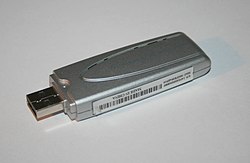
A wireless network interface controller may be implemented as an expansion card and connected using PCI bus or PCIe bus, or connected via USB, PC Card, ExpressCard, Mini PCIe or M.2.
The low cost and ubiquity of the Wi-Fi standard means that many newer mobile computers have a wireless network interface built into the motherboard.
The term is usually applied to adapters using the Wi-Fi (IEEE 802.11) network protocol; it may also apply to a NIC using protocols other than 802.11, such as one implementing Bluetooth connections.
Modes of operation
[edit]An 802.11 WNIC can operate in two modes known as infrastructure mode and ad hoc mode:
- Infrastructure mode
- In an infrastructure mode network the WNIC needs a wireless access point: all data is transferred using the access point as the central hub. All wireless nodes in an infrastructure mode network connect to an access point. All nodes connecting to the access point must have the same service set identifier (SSID) as the access point. If wireless security is enabled on the access point (such as WEP or WPA), the NIC must have valid authentication parameters in order to connect to the access point.
- Ad hoc mode
- In an ad hoc mode network the WNIC does not require an access point, but rather can interface with all other wireless nodes directly. All the nodes in an ad hoc network must have the same channel and SSID.
Specifications
[edit]The IEEE 802.11 standard sets out low-level specifications for how all 802.11 wireless networks operate. Earlier 802.11 interface controllers are usually only compatible with earlier variants of the standard, while newer cards support both current and old standards.
Specifications commonly used in marketing materials for WNICs include:
- Wireless data transfer rates (measured in Mbit/s)
- Wireless transmit power (measured in dBm)
- Wireless network standards supported, such as 802.11b, 802.11a, 802.11g, 802.11n, 802.11ac, 802.11ax
Most WNICs support one or more of 802.11, Bluetooth and 3GPP (2G, 3G, 4G, 5G) network standards.
Range
[edit]Wireless range may be substantially affected by objects in the way of the signal and by the quality of the antenna. Large electrical appliances, such as refrigerators, fuse boxes, metal plumbing, and air conditioning units can impede a wireless network signal. The theoretical maximum range of IEEE 802.11 is only reached under ideal circumstances and true effective range is typically about half of the theoretical range.[1] Specifically, the maximum throughput speed is only achieved at extremely close range (less than 25 feet (7.6 m) or so); at the outer reaches of a device's effective range, speed may decrease to around 1 Mbit/s before it drops out altogether. The reason is that wireless devices dynamically negotiate the top speed at which they can communicate without dropping too many data packets.
FullMAC and SoftMAC devices
[edit]In an 802.11 WNIC, the MAC Sublayer Management Entity (MLME) can be implemented either in the NIC's hardware or firmware, or in host-based software that is executed on the main CPU. A WNIC that implements the MLME function in hardware or firmware is called a FullMAC WNIC or a HardMAC NIC[2] and a NIC that implements it in host software is called a SoftMAC NIC.[3]
A FullMAC device hides the complexity of the 802.11 protocol from the main CPU, instead providing an 802.3 (Ethernet) interface; a SoftMAC design implements only the timing-critical part of the protocol in hardware/firmware and the rest on the host.[4]
FullMAC chips are typically used in mobile devices because:
- they are easier to integrate in complete products
- power is saved by having a specialized CPU perform the 802.11 processing;
- the chip vendor has tighter control of the MLME.
Popular example of FullMAC chips is the one implemented on the Raspberry Pi 3.
Linux kernel's mac80211 framework provides capabilities for SoftMAC devices and additional capabilities (such as mesh networking, which is known as the IEEE 802.11s standard) for devices with limited functionality.[5][3]
See also
[edit]References
[edit]- ^ Meyers, Mike: Network+ Certification All-in-One Exam Guide, McGraw-Hill, 2004, p. 230.
- ^ "Linux Wireless glossary". Definition of FullMAC. Retrieved 23 July 2020.
- ^ a b "Linux Wireless glossary". Definition of SoftMAC. Retrieved 23 July 2020.
- ^ Al-Sakib Khan Pathan (2010). Security of Self-Organizing Networks: MANET, WSN, WMN, VANET. Taylor & Francis. p. 28. ISBN 978-1-4398-1919-7.
- ^ "mac80211 documentation". kernel.org.
- ^ "FreeBSD 11.0 - man page for upgt (freebsd section 4) - Unix & Linux Commands". Retrieved 1 June 2016.
Wireless network interface controller
View on GrokipediaOverview
Definition and Purpose
A wireless network interface controller (WNIC), also known as a wireless adapter or Wi-Fi card, is a hardware device that connects a computing device to a wireless network, such as a WLAN (Wi-Fi) or WPAN (Bluetooth), using radio waves.[1][2][5] The primary purpose of a WNIC is to facilitate data transmission and reception between the host device—such as a computer or smartphone—and wireless networks, such as access points, routers, or peer devices. It achieves this by handling key physical layer functions, including modulation to encode digital data onto radio frequency carriers, encoding for error correction and data formatting, and signal processing to manage transmission and reception.[6][2] In its basic workflow, a WNIC converts digital data from the host into modulated radio signals for wireless broadcast and, conversely, demodulates incoming radio signals back into digital data for the host, adhering to protocols such as IEEE 802.11.[2][6] WNICs can be integrated as built-in components directly on the motherboard of devices like laptops and smartphones for seamless connectivity, or as external add-ons such as USB dongles or PCIe cards to enable wireless capabilities on older or desktop systems.[7][2]Historical Development
The development of wireless network interface controllers (WNICs) originated in the 1970s with foundational radio technologies for data networking, exemplified by the University of Hawaii's ALOHAnet in 1971, which linked seven computers across the Hawaiian Islands using UHF packet radio for the first large-scale wireless data communication system.[8] This early experimentation laid groundwork for wireless local area networks (WLANs), though commercial viability remained limited until the 1990s. Proprietary systems like NCR Corporation's WaveLAN, launched in 1990, represented the first commercial wireless products, offering 2 Mbps speeds in the 2.4 GHz band via PCMCIA cards for laptops and setting the stage for broader adoption.[9] The formalization of standards accelerated with the IEEE 802.11 specification ratified in 1997, defining medium access control and physical layer protocols for WLANs at up to 2 Mbps, which enabled interoperable WNICs and shifted the focus from bespoke hardware to standardized interfaces.[10] Parallel to Wi-Fi developments, Bluetooth technology emerged in the mid-1990s, with the Bluetooth Special Interest Group formed in 1998 and the first specification released in 1999, enabling short-range wireless personal area networks (WPANs) through compact WNIC modules in devices like mobile phones and laptops.[11] The late 1990s and early 2000s saw the consumerization of WNICs, highlighted by Apple's AirPort Card in 1999, a compact 802.11b-compatible module integrated into iMacs and iBooks, which popularized wireless connectivity for personal computing at 11 Mbps.[12] A key technological shift occurred in the 2000s toward integrated chipsets, reducing form factors from external cards to embedded solutions; Intel's Centrino platform in 2003 exemplified this by combining Wi-Fi chipsets with processors for laptops, enhancing power efficiency and performance.[13] Miniaturization further advanced around 2007, enabling seamless integration into smartphones like the first iPhone, which incorporated Wi-Fi for internet access and transforming WNICs from peripheral devices to ubiquitous components in mobile ecosystems.[14] Subsequent milestones emphasized performance enhancements: the IEEE 802.11n standard, ratified in 2009, introduced multiple-input multiple-output (MIMO) technology, allowing up to 600 Mbps through multiple antennas and spatial streams, which became a cornerstone for high-throughput WNICs. The rise of Wi-Fi 6 (IEEE 802.11ax) in 2019 brought orthogonal frequency-division multiple access (OFDMA) and improved multi-user MIMO for denser environments, with certification enabling widespread deployment in devices supporting up to 9.6 Gbps.[15] Ratified in 2024 and published in 2025, Wi-Fi 7 (IEEE 802.11be) promises theoretical throughputs exceeding 30 Gbps via ultra-wide channels and multi-link operation, further evolving WNIC designs for extreme reliability.[4] Market dynamics reflected these advances, with manufacturers like Broadcom, Intel, and Qualcomm dominating since the mid-2000s through comprehensive portfolios; Broadcom and Qualcomm together held over 40% share by the 2010s, driven by their scalable chipsets for laptops, smartphones, and IoT.[16] The explosion of mobile computing by the 2010s rendered WNICs nearly universal, with billions of units shipped annually as smartphones and tablets integrated them as standard features, fueling a transition from niche to essential connectivity hardware.[17]Hardware Design
Physical Form Factors
Wireless network interface controllers (WNICs) are available in diverse physical form factors designed to integrate seamlessly with host devices, ranging from laptops and desktops to smartphones and IoT gadgets. Common configurations include internal cards using Mini-PCIe or M.2 slots for laptop and desktop installations, external USB adapters via Type-A or Type-C ports, and integrated system-on-chip (SoC) modules embedded directly into mobile and compact devices. These form factors have evolved to prioritize compactness, performance, and ease of integration while accommodating varying power and thermal requirements.[18][19] The progression of WNIC interfaces began in the 1990s with PCMCIA (Personal Computer Memory Card International Association) slots, also known as PC Card, which provided a 68-pin interface supporting Type I, II, and III form factors for early laptop peripherals, including wireless cards that enabled 802.11b connectivity at speeds up to 11 Mbps. By the early 2000s, Mini-PCIe (mPCIe), introduced around 2002 as a half-height variant of the full PCIe standard, replaced PCMCIA due to its smaller footprint—approximately half the size—and support for both PCIe and USB signaling, making it suitable for thin laptops and industrial routers. The shift to M.2 form factors, standardized in 2012-2013 as an evolution from Next Generation Form Factor (NGFF), further reduced sizes to as small as 22 mm x 30 mm (under 1 cm² for key variants like 2230), enabling embedded designs in ultrabooks, tablets, and wearables while supporting higher data rates for 5G applications. USB interfaces, meanwhile, have persisted for external adapters, evolving from Type-A to reversible Type-C for broader compatibility across devices.[20][19][21] Internal form factors like Mini-PCIe and M.2 offer advantages in performance, including better signal strength through multiple integrated antennas and direct motherboard connectivity, which reduces latency and supports higher throughput compared to external options; however, they require device disassembly for installation, posing risks of static damage and limiting portability. External USB dongles provide plug-and-play convenience and easy transfer between systems, ideal for desktops or legacy devices without built-in wireless, but they often suffer from antenna limitations—typically single or external-only—leading to weaker reception in obstructed environments and potential USB bandwidth constraints. For power-intensive applications, mPCIe excels in heat dissipation and always-on reliability in industrial settings, whereas M.2 prioritizes energy efficiency and slim profiles for battery-powered IoT deployments.[22][19] Representative examples illustrate these designs: half-height PCIe cards, such as those for desktop towers, utilize full-length slots for robust antenna arrays; compact M.2 modules like the Intel Dual Band Wireless-AC 3160 in 2230 size integrate into laptops via PCIe/USB interfaces; USB Type-C adapters enable portable use on modern laptops and tablets; and coin-sized SoC modules, often under 1 cm², power wearables and smart home devices with embedded antennas for seamless connectivity.[18][22]Internal Components
The core elements of a wireless network interface controller (WNIC) include the radio transceiver, baseband processor, and MAC controller, which collectively handle signal transmission, processing, and protocol management. The radio transceiver, serving as the RF front-end, performs modulation and demodulation of radio frequency signals to enable wireless communication, typically integrating components such as low-noise amplifiers, power amplifiers, mixers, and filters for optimal signal integrity.[23] In single-chip designs like the CYW43364, this transceiver operates in the 2.4 GHz band with direct conversion architecture, providing high immunity to supply noise and supporting output powers up to 21 dBm.[23] The baseband processor manages digital signal processing tasks, including carrier sense, frequency and phase tracking, channel estimation, and error correction, ensuring reliable data recovery from modulated signals.[24] For instance, in RF-MIMO WLAN systems, the baseband processor implements MIMO-specific functions like least-squares channel estimation across multiple subcarriers and Max-SNR beamforming using matrix iterations.[24] The MAC controller oversees medium access control in accordance with IEEE 802.11 protocols, handling tasks such as frame buffering, CRC generation, encryption offload (e.g., AES-CCMP, TKIP), and maintenance of timing synchronization and network allocation vectors.[24] It often employs a hardware-software co-design, with a general-purpose processor like a 32-bit MIPS core augmented by accelerators for time-critical operations, as seen in implementations consuming around 1 W at 80 MHz on FPGA platforms.[24] In integrated chips such as the CYW43364, the MAC supports features like A-MPDU aggregation and QoS enhancements for efficient data flow.[23] Antenna systems in a WNIC facilitate signal radiation and reception, with options for internal printed circuit board (PCB) antennas or external connectors to accommodate diverse deployment needs. Internal PCB antennas are compact traces etched directly onto the controller's board, providing seamless integration for space-constrained devices while supporting basic omnidirectional patterns.[25] External connectors, such as RP-SMA interfaces, allow attachment of detachable antennas for improved range or directionality, commonly used in desktop or access point configurations.[25] For enhanced performance in modern standards, diversity antennas enable MIMO by employing multiple spatially separated elements to mitigate fading and increase throughput, as supported in chips like the CYW43364 with integrated switches for single or dual configurations.[23] Power management subsystems ensure efficient energy use, incorporating DC-DC converters and low-power modes to meet battery life requirements in portable devices. These include buck regulators and low-dropout (LDO) voltage supplies that dynamically adjust based on operational states, such as active transmission, doze, deep sleep, or power-down, minimizing consumption during idle periods.[23] Compliance with IEEE 802.11 power save modes is achieved through integrated units that support direct battery operation, as in the CYW43364's PMU with core-buck outputs up to 370 mA and multiple LDOs for analog and digital domains.[23] Memory and firmware components provide storage and execution capabilities for operational software, with flash memory holding the driver firmware and configuration data. On-chip SRAM (e.g., 512 KB) and ROM (e.g., 640 KB) support real-time processing, while one-time programmable (OTP) memory stores unique identifiers like MAC addresses.[23] Integration with the host CPU occurs via bus interfaces such as PCI Express, enabling efficient data transfer and control, as exemplified in low-power mobile chipsets like the Intel Dual Band Wireless-AC 3160.[18] A dedicated processor, such as an ARM Cortex-M3, runs the firmware to manage WLAN functions independently.[23]Standards and Protocols
Wi-Fi Standards
Wireless network interface controllers (WNICs) primarily adhere to the IEEE 802.11 family of standards, which define the physical and media access control layers for wireless local area networks (WLANs). These standards have evolved to support higher data rates, improved efficiency, and enhanced capabilities in frequency bands such as 2.4 GHz and 5 GHz. Early standards like 802.11a, 802.11b, and 802.11g, ratified between 1999 and 2003, provided foundational wireless connectivity with maximum theoretical data rates up to 54 Mbps using orthogonal frequency-division multiplexing (OFDM) modulation in 802.11a and 802.11g, and direct-sequence spread spectrum (DSSS) in 802.11b.[3][26] Subsequent advancements introduced multiple-input multiple-output (MIMO) technology and wider channel widths. The 802.11n standard, ratified in 2009, operates across 2.4 GHz and 5 GHz bands and achieves maximum theoretical data rates up to 600 Mbps through MIMO and channel bonding, which combines adjacent 20 MHz channels into 40 MHz for increased throughput.[27] The 802.11ac standard, introduced in 2013 and focused on the 5 GHz band, extends this with multi-user MIMO (MU-MIMO) and channel widths up to 160 MHz, enabling maximum theoretical speeds of 6.9 Gbps.[28][29]| Standard | Ratification Year | Frequency Bands | Max Theoretical Data Rate | Key Features |
|---|---|---|---|---|
| 802.11a/b/g | 1999–2003 | 2.4 GHz (b/g), 5 GHz (a) | 54 Mbps | OFDM (a/g), DSSS/CCK (b); basic wireless LAN support[3] |
| 802.11n | 2009 | 2.4/5 GHz | 600 Mbps | MIMO, channel bonding up to 40 MHz[27] |
| 802.11ac | 2013 | 5 GHz | 6.9 Gbps | MU-MIMO, channel bonding up to 160 MHz, beamforming[28] |
| 802.11ax (Wi-Fi 6) | 2019 | 2.4/5 GHz | 9.6 Gbps | OFDMA, enhanced MU-MIMO, target wake time for efficiency[30] |
| 802.11be (Wi-Fi 7) | 2024 | 2.4/5/6 GHz | 46 Gbps | Multi-link operation (MLO), 320 MHz channels, 4096-QAM modulation[4][31] |
Bluetooth and Other Protocols
Wireless network interface controllers (WNICs) frequently incorporate Bluetooth to support short-range personal area networking, enabling seamless connectivity between devices such as computers and peripherals. The Bluetooth protocol, standardized by the Bluetooth Special Interest Group (SIG), originated with version 1.0 in 1999, which established basic wireless communication but faced challenges with device interoperability. Subsequent versions addressed these issues: version 1.1 in 2002 improved compatibility, while version 1.2 in 2003 introduced adaptive frequency hopping (AFH) for better spectrum management. Enhanced Data Rate (EDR) arrived in version 2.0 in 2004, boosting speeds to 3 Mbps, and High Speed (HS) in version 3.0 in 2009 enabled up to 24 Mbps via Wi-Fi integration. Bluetooth 4.0 in 2010 marked a pivotal shift with the introduction of Low Energy (LE) mode, optimized for battery-powered devices. Later iterations—4.1 (2013) for improved coexistence with cellular networks, 4.2 (2014) for enhanced security and IPv6 support, 5.0 (2016) for doubled range and speed in LE, 5.1 (2019) adding direction finding, 5.2 (2020) with LE Audio, 5.3 (2021) for reliability enhancements, 5.4 (2023) featuring Periodic Advertising with Responses (PAwR), and 6.0 (2024) introducing Bluetooth Channel Sounding for precise distance measurement, Decision-Based Advertising Filtering, and enhancements to the Isochronous Adaptation Layer (ISOAL) for low-latency audio—have progressively tailored Bluetooth for diverse applications, including IoT ecosystems.[38] Bluetooth Low Energy (BLE), a core feature since version 4.0, significantly reduces power consumption compared to classic Bluetooth, making it ideal for intermittent data transmission in sensors, fitness trackers, and smart home devices integrated with WNICs. BLE operates in the 2.4 GHz ISM band with data rates up to 2 Mbps in later versions, prioritizing efficiency over high throughput to extend battery life in IoT deployments. To address potential interference in shared spectrum environments, AFH dynamically maps and avoids channels occupied by coexisting technologies like Wi-Fi, a mechanism refined across versions for robust performance in hybrid WNIC setups.[38][39] Beyond Bluetooth, WNICs support protocols like Zigbee, which builds on the IEEE 802.15.4 physical and MAC layers to form low-power, low-data-rate personal area networks suitable for mesh topologies. Defined in the IEEE 802.15.4-2020 standard, Zigbee operates at 250 kbps in the 2.4 GHz band (with options in sub-GHz bands globally), emphasizing self-healing networks for reliable, scalable connectivity without central infrastructure dependency. This makes Zigbee particularly effective for applications requiring many nodes, such as environmental monitoring or building automation, where WNICs act as gateways bridging Zigbee devices to broader networks.[40] Near Field Communication (NFC), another complementary protocol in some WNICs, facilitates ultra-short-range (under 4 cm) interactions at 13.56 MHz for secure pairing and data exchange. NFC's NFC Forum specifications, including the Bluetooth Secure Simple Pairing Using NFC (BTSSP) 1.3, enable out-of-band authentication for Bluetooth connections, allowing devices to exchange keys via a simple tap without numeric comparison or passkey entry, thus streamlining setup for peripherals and IoT pairings.[41] Hybrid controllers integrate multiple protocols into single-chip solutions to optimize space, power, and cost in WNIC designs. For instance, the Qualcomm QCA4020 SoC combines dual-band Wi-Fi (802.11n), Bluetooth 5 with LE support, and IEEE 802.15.4 radios for Zigbee 3.0 and Thread, featuring shared power management architectures that allow concurrent operation while minimizing interference through protocol arbitration. These designs employ techniques like time-division multiplexing and dynamic channel selection to enable efficient coexistence across Bluetooth, Zigbee, and Wi-Fi in resource-constrained environments.[42] In practical use cases, Bluetooth in WNICs primarily connects peripherals such as wireless keyboards, mice, headsets, and printers, supporting profiles like Human Interface Device (HID) and Advanced Audio Distribution (A2DP) for low-latency input and audio streaming in personal computing. Zigbee, conversely, excels in smart home mesh networks, interconnecting devices like lights, thermostats, and door locks for automated control and energy management, with the Connectivity Standards Alliance certifying interoperability to ensure seamless integration across ecosystems.[43]Operational Modes
Infrastructure Mode
In infrastructure mode, a wireless network interface controller (WNIC) associates with a central access point (AP) to join a wireless local area network (WLAN), enabling connectivity to a broader wired infrastructure. The AP serves as a bridge, translating frames between the IEEE 802.11 wireless protocol and IEEE 802.3 Ethernet, while managing client communications within a basic service set (BSS) identified by the AP's basic service set identifier (BSSID).[44][45] The association process starts with the WNIC scanning for APs by receiving periodic beacon frames, which broadcast the service set identifier (SSID) and network parameters, or by sending probe requests for active discovery. Upon selecting an AP, the WNIC initiates authentication using open system authentication, followed by secure key exchange via WPA2 or WPA3 protocols, typically with pre-shared keys (PSK) for personal networks or 802.1X/EAP for enterprise. This is followed by an association handshake: the WNIC sends an association request frame, and the AP responds with an association response including an association identifier (AID) if successful, establishing a virtual port for data exchange. All subsequent traffic from the WNIC routes through the AP to the wired distribution system or other clients, with the AP handling synchronization, cell identification, and frame forwarding.[46][44][45] Infrastructure mode offers centralized management, allowing administrators to configure security, quality of service, and policies uniformly across devices via the AP. It extends range through multiple APs forming an extended service set (ESS) with a shared SSID, supporting seamless roaming as the WNIC transitions between BSSs without disconnection. Security is bolstered by protocols such as WPA2 and WPA3, which implement robust encryption like AES-CCMP and protections against brute-force attacks via simultaneous authentication of equals (SAE).[44][47] This mode is the standard configuration in residential and enterprise settings, where WNICs in devices like laptops and smartphones default to connecting through home routers or office APs for reliable access to the internet and internal resources.[48]Ad-hoc and Mesh Modes
Ad-hoc mode, also known as Independent Basic Service Set (IBSS) mode, enables wireless network interface controllers (WNICs) to form temporary, peer-to-peer networks without relying on an access point (AP). In this decentralized setup, stations (STAs) communicate directly with each other, allowing for spontaneous connections among devices such as laptops or smartphones. The initiating STA acts as a coordinator by periodically transmitting beacon frames to synchronize the network and announce its presence, after which other STAs can join by detecting these beacons and associating based on the shared service set identifier (SSID). This mode is particularly suited for short-term applications like file sharing between personal computers or multiplayer gaming among nearby devices, where quick network formation is essential without infrastructure support. However, ad-hoc mode has seen reduced adoption in recent years due to its limitations, with many contemporary operating systems and devices restricting or deprecating IBSS functionality in favor of more secure and manageable alternatives.[49][50] In contrast to infrastructure mode, which depends on a central AP for coordination, ad-hoc mode supports fully autonomous operation but faces inherent limitations. Early implementations relied on WEP, which lacks robust security and is vulnerable to eavesdropping and key cracking due to its weak RC4 encryption and initialization vector reuse. Modern ad-hoc networks support WPA2/WPA3 with PSK-based RSN using AES-CCMP encryption, but typically without enterprise 802.1X authentication, leading to potential interoperability and management challenges. Additionally, the absence of a dedicated coordinator can lead to synchronization challenges, though these are mitigated by distributed beaconing among participating STAs.[51][52][53] Mesh mode, defined in the IEEE 802.11s amendment ratified in 2011, extends WNIC capabilities to create self-organizing, multi-hop wireless mesh networks (WMNs) where nodes relay data packets across multiple hops to reach destinations. This standard integrates mesh functionality at the MAC layer, allowing stations—termed mesh points (MPs)—to form a transparent broadcast domain that supports unicast, broadcast, and multicast traffic without fixed infrastructure. Unlike simple ad-hoc networks limited to single-hop communications, 802.11s enables scalable topologies for up to approximately 32 forwarding nodes, with applications in public safety scenarios like disaster recovery for emergency video surveillance and personnel tracking, as well as campus or urban environments akin to smart city deployments for seamless wide-area connectivity.[54][55] The setup process in mesh mode involves dynamic topology formation through neighbor discovery, where MPs exchange mesh-specific information elements (IEs) via beacons and probe responses to establish secure peer links. Route discovery and maintenance are handled by the default Hybrid Wireless Mesh Protocol (HWMP), which combines reactive on-demand routing (inspired by Ad-hoc On-Demand Distance Vector, AODV) with proactive tree-based routing toward mesh portals or roots, using messages like Path Requests, Path Replies, and Root Announcements to adapt to changing link conditions. This self-configuring and self-healing mechanism ensures resilient multi-hop paths, though it introduces higher latency compared to direct connections due to the overhead of relaying and route computations. Security in 802.11s builds on 802.11i for link-layer protection but remains vulnerable to routing-specific attacks, such as false path advertisements, highlighting ongoing challenges in securing forwarding operations.[55][56]Technical Specifications
Frequency Bands and Channels
Wireless network interface controllers (WNICs) primarily utilize the unlicensed 2.4 GHz, 5 GHz, and 6 GHz frequency bands for Wi-Fi transmissions, as defined in IEEE 802.11 standards. The 2.4 GHz band operates from 2.400 to 2.4835 GHz and supports up to 13 channels (numbered 1 to 13), each with a standard 20 MHz width, though 40 MHz widths are possible for higher throughput at the cost of increased overlap. In the United States, the FCC limits usage to channels 1 through 11 to prevent interference with adjacent services. Channels in this band are spaced 5 MHz apart, but only non-overlapping sets like 1, 6, and 11 (or 1, 5, 9, 13 in regions allowing channel 13) are recommended to minimize co-channel interference from neighboring networks.[57] The 5 GHz band spans approximately 5.15 to 5.85 GHz and provides a wider spectrum with channels 36 through 165, enabling channel widths from 20 MHz up to 160 MHz for improved capacity in modern standards like 802.11ac and 802.11ax. Unlike the 2.4 GHz band, the 5 GHz band offers numerous non-overlapping 20 MHz channels (up to 24 in some configurations), reducing interference potential. However, channels 52 to 144 fall under Dynamic Frequency Selection (DFS) requirements, where WNICs must passively scan for radar signals from weather or military systems and automatically vacate the channel within 10 seconds if detected, switching to a clear alternative. This mechanism ensures coexistence with incumbent radar users but can introduce brief connection interruptions.[58] The 6 GHz band, allocated from 5.925 to 7.125 GHz and enabled by Wi-Fi 6E (802.11ax extension) and Wi-Fi 7 (802.11be), introduces channels 1 through 233 at 20 MHz spacing, supporting widths up to 320 MHz for ultra-high-capacity networks with minimal legacy device interference. This band vastly expands available spectrum, offering up to 59 non-overlapping 20 MHz channels or seven 160 MHz channels, primarily for indoor use under standard power rules.[59][60] Regulatory variations significantly affect band and channel availability globally. In the United States, the 5 GHz band is segmented into UNII sub-bands: UNII-1 (channels 36-48, indoor only), UNII-2/2e (channels 52-144, DFS-required), and UNII-3 (channels 149-165, higher power for outdoor). In Europe, ETSI standards permit channels 36-140 in the 5 GHz band with stricter power limits and exclude channels 149-165 in many countries to protect satellite services, while the 6 GHz band is limited to 5945-6425 MHz (channels 1-93). As of November 2025, the RSPG has recommended allocating the upper 6 GHz band (6425-7125 MHz) primarily for mobile services, potentially limiting further Wi-Fi expansion pending European Commission approval.[61] These differences require WNICs to comply with regional firmware settings to avoid legal violations.[62][63] WNICs support automatic band selection, where the device or driver dynamically chooses the optimal band (e.g., preferring 5 GHz or 6 GHz for speed when available) based on signal quality, access point capabilities, and environmental factors. Manual selection is also possible through adapter properties in operating system device managers, allowing users to prioritize a specific band like 2.4 GHz for extended range or 5/6 GHz for performance, often via options such as "Preferred Band" in Intel or similar drivers.[64][64]Data Rates and Throughput
The physical layer (PHY) data rates of wireless network interface controllers (WNICs) represent the theoretical maximum speeds at which data can be transmitted over the air interface, primarily determined by the Modulation and Coding Scheme (MCS) index in IEEE 802.11 standards. The MCS index specifies the modulation type, coding rate, and number of spatial streams, with higher indices enabling faster rates under ideal conditions. For instance, in 802.11ax (Wi-Fi 6), the highest MCS index (11) uses 1024-QAM modulation with a 5/6 coding rate, achieving up to 1,201 Mbps per spatial stream on an 80 MHz channel, scaling to a theoretical maximum of 9.6 Gbps with eight spatial streams and a 160 MHz channel width.[65][66] In practice, achievable throughput—the actual data transfer rate experienced by applications—is significantly lower than these PHY rates, typically 50-70% of theoretical values due to protocol overheads such as preambles, headers, acknowledgments, and inter-frame spacing. This efficiency gap arises because only a portion of each transmission carries user data, with the rest dedicated to control and error correction. A simplified model for maximum throughput can be expressed as:where efficiency accounts for the payload fraction (often 60-80%) and overhead includes fixed costs per packet.[67][68] Advancements in 802.11ax and later standards enhance throughput by enabling concurrent data streams to multiple devices. Multi-user Multiple Input Multiple Output (MU-MIMO) supports up to eight simultaneous downlink and uplink streams, allowing spatial multiplexing across users to increase aggregate capacity without widening channels. Orthogonal Frequency Division Multiple Access (OFDMA) further improves efficiency by dividing channels into resource units (RUs) for parallel transmissions to different clients, reducing latency and contention in dense environments. Additionally, aggregation of MAC Protocol Data Units (MPDUs) via A-MPDU combines multiple frames into a single transmission, minimizing overhead and boosting utilization to up to 95% in low-error scenarios.[69][70][71] Throughput is commonly measured using tools like iPerf, which simulates TCP/UDP traffic to quantify end-to-end performance. In typical home Wi-Fi setups with 802.11ax WNICs on 80 MHz channels and 2x2 MIMO, real-world throughput ranges from 100 Mbps for basic configurations to around 900 Mbps under optimal conditions, reflecting the balance of theoretical capabilities and practical efficiencies.[72][73]
Performance Characteristics
Transmission Range
The transmission range of a wireless network interface controller (WNIC) refers to the maximum distance over which it can reliably communicate with other devices using radio signals, primarily governed by the frequency band employed in standards like Wi-Fi. In the 2.4 GHz band, typical indoor ranges reach up to 45 meters, while outdoor line-of-sight distances can extend to approximately 90 meters, benefiting from lower attenuation at this frequency.[74] The 5 GHz band offers shorter coverage, typically 15-30 meters indoors due to increased signal absorption by obstacles, and 6 GHz signals exhibit even greater attenuation, limiting ranges to under 20 meters indoors in practical deployments.[75][76] The primary physical factor influencing this range is free-space path loss (FSPL), which quantifies signal attenuation in unobstructed propagation. This is modeled by the Friis transmission equation's path loss component, expressed as: where is the distance in meters, is the frequency in Hz, and is the speed of light (approximately m/s).[77] Higher frequencies like 5 GHz and 6 GHz result in greater FSPL for the same distance, reducing effective range compared to 2.4 GHz. Antenna gain can mitigate this loss by adding to the effective isotropic radiated power (EIRP) in the link budget; for instance, directional antennas with 5-10 dBi gain can extend usable range by focusing energy, though isotropic radiators in standard WNICs provide omnidirectional but shorter coverage.[78] Regulatory constraints further limit transmission range by capping EIRP to prevent interference. In the European Union under ETSI EN 300 328, the maximum EIRP for 2.4 GHz Wi-Fi devices is 20 dBm (100 mW), which directly bounds signal strength and thus achievable distance in compliance with spectrum sharing rules.[79] Similar FCC regulations in the US allow up to 30 dBm transmit power but effectively cap EIRP around 36 dBm with standard antennas, influencing WNIC design to balance range and legality.[80] To overcome inherent range limitations, WNICs can integrate with extenders such as repeaters, which receive and retransmit signals to amplify coverage, or mesh nodes that form a distributed network of interconnected devices, each relaying data to blanket larger areas without a single point of failure.[81] These solutions effectively multiply the base range by chaining signals, though each hop introduces minor latency. Interference from other sources can further degrade these extended ranges, but this is addressed through channel selection rather than power adjustments.[81]Factors Affecting Performance
The performance of a wireless network interface controller (WNIC) can be significantly degraded by various interference sources. Co-channel interference arises when multiple access points operate on the same frequency channel, leading to signal collisions and reduced throughput in dense environments.[82] Non-Wi-Fi interferers, such as microwave ovens and Bluetooth devices operating in the 2.4 GHz band, introduce sporadic noise that disrupts packet transmission and increases error rates.[83] To mitigate these issues, clear channel assessment (CCA) mechanisms in Wi-Fi protocols evaluate the medium's occupancy before transmission, allowing devices to defer access during detected interference and thereby improving overall reliability.[84] Environmental factors further impair WNIC efficiency through signal attenuation and propagation anomalies. Obstructions like walls cause substantial path loss, with typical attenuation ranging from 10 dB for brick structures to 12 dB for concrete, cumulatively weakening signals across multiple barriers.[85] Multipath fading occurs when signals reflect off surfaces, creating multiple arrival paths that interfere constructively or destructively at the receiver, resulting in fluctuating signal strength and potential packet loss.[86] Device-specific elements also influence WNIC performance. Antenna orientation affects signal polarization and gain; misalignment between transmitter and receiver can reduce effective coverage by up to several dB, exacerbating connectivity issues in mobile scenarios.[87] Variations in transmit power output, often adjusted dynamically by the WNIC to comply with regulatory limits or conserve energy, can lead to inconsistent signal levels across different operational modes.[88] Overheating in WNIC hardware, triggered by prolonged high-load usage, diminishes amplifier efficiency and may throttle output power to prevent damage, thereby lowering sustained throughput. Optimization techniques can counteract these degraders. Channel scanning tools enable administrators to identify and select less congested frequencies, reducing interference exposure during network planning.[90] Configuring quality of service (QoS) settings in WNIC drivers prioritizes critical traffic, such as voice or video, ensuring more predictable performance amid environmental and device constraints.[91]Architectural Variants
FullMAC Architecture
The FullMAC architecture, also known as hardMAC, refers to a design in wireless network interface controllers (WNICs) where the medium access control (MAC) layer processing is primarily implemented in the chip's hardware or firmware, thereby offloading these operations from the host operating system's CPU.[92] In this setup, the firmware handles key MAC functions such as packet transmission, reception, and management tasks, exposing only a simplified configuration interface to the host driver.[92] This self-contained approach allows the WNIC to operate more independently, managing aspects like the MAC layer management entity (MLME) internally without requiring extensive host intervention.[93] Implementation in FullMAC chips often includes on-chip support for security protocols, such as encryption and decryption for WPA/WPA2 using an integrated supplicant, which processes authentication and key management without burdening the host MCU.[94] Beacon management, including generation and transmission of periodic beacons for network discovery and synchronization, is similarly performed autonomously by the firmware, enabling efficient operation in various network environments.[92] Examples of FullMAC implementations include the Silicon Labs WF200 Wi-Fi co-processor, which supports full 802.11 MAC responsibilities, and Broadcom chipsets commonly used in mobile devices for their integrated firmware handling of these layers.[94][95] Key advantages of FullMAC architecture include significantly lower CPU utilization on the host, as MAC processing occurs in dedicated hardware or firmware, making it particularly suitable for resource-constrained embedded devices where power efficiency is critical.[96] Additionally, the offloaded processing can result in faster association and roaming times, as firmwares capable of generating association request security information elements (RSN IE) streamline connections between access points.[97] These benefits contribute to reduced latency in tasks like network joining, enhancing overall performance in battery-powered or low-power applications. However, FullMAC designs offer less flexibility for developing custom drivers or modifying MAC behaviors, as the core protocol stack is embedded in proprietary firmware that cannot be easily altered by the host system.[98] This reliance on vendor-provided firmware also leads to vendor lock-in, limiting interoperability and requiring dependence on the manufacturer's updates for compatibility or feature enhancements.[99]SoftMAC Architecture
The SoftMAC architecture refers to a design in which the medium access control (MAC) layer functions of a wireless network interface controller (WNIC) are implemented primarily in software on the host system, rather than in dedicated hardware or firmware on the device itself; the WNIC is responsible only for the physical (PHY) layer operations, such as modulation and signal transmission.[100] In Linux environments, this is exemplified by the mac80211 framework, which provides a standardized interface for drivers to manage 802.11 frame parsing, generation, and higher-layer protocol handling in the kernel or userspace.[100] This approach offers significant advantages in terms of flexibility, particularly for research and development, as it allows developers to experiment with custom MAC protocols using inexpensive, commodity WNICs without requiring proprietary hardware modifications.[101] For instance, systems like SoftMAC enable overriding standard 802.11 behaviors—such as acknowledgment mechanisms, backoff algorithms, and carrier sense detection—through software overlays on drivers like Madwifi for Atheros chipsets, facilitating real-world testing of adaptive or heterogeneous MAC designs.[101] Additionally, SoftMAC supports easier updates to accommodate evolving standards, such as IEEE 802.11n features or quality of service (QoS) enhancements, via driver revisions rather than firmware flashes; notable examples include older Intel PRO/Wireless 2200BG cards supported by the open-source ipw2200 driver, which leveraged SoftMAC for broad compatibility in early Linux wireless stacks.[102][100] In implementation, the host processor assumes responsibility for key MAC tasks, including frame aggregation to improve efficiency, QoS scheduling for prioritized traffic, and management of association procedures like MLME (MAC layer management entity) states, all while interfacing with the PHY via low-level driver APIs.[100] This software-centric model integrates with configuration subsystems like cfg80211 for device registration and control, enabling features such as monitor mode for packet sniffing or mesh networking support.[100] However, it demands substantially more computational resources from the host CPU, as real-time frame processing and protocol logic shift from hardware acceleration to software execution.[103] Despite its versatility, SoftMAC introduces drawbacks related to performance overheads, including increased latency from software-based processing of time-sensitive operations like acknowledgments and contention resolution, which can degrade responsiveness in high-throughput scenarios.[103] Furthermore, the elevated CPU utilization leads to power inefficiency, making it less suitable for battery-constrained mobile devices where hardware-offloaded alternatives minimize energy draw.[103] These trade-offs highlight SoftMAC's niche in flexible, host-driven environments over power-optimized, embedded applications.References
- https://www.cisco.com/c/en/[us](/page/United_States)/support/docs/wireless/3504-wireless-controller/214380-3504-wireless-lan-controller-temperature.html