


Community hub
0 subscribers8 pages, 0 posts
Recent from talks
All channels
Be the first to start a discussion here.
Be the first to start a discussion here.
Be the first to start a discussion here.
Be the first to start a discussion here.
Contribute something
Welcome to the community hub built to collect knowledge and have discussions related to Yamaha XV250.
Nothing was collected or created yet.
Yamaha XV250
View on Wikipediafrom Wikipedia
 | This article needs additional citations for verification. (October 2018) |
 | |
| Manufacturer | Yamaha |
|---|---|
| Production | 1988 - Present |
| Successor | Yamaha DragStar 250 |
| Engine | 249 cc, air-cooled, SOHC, 60-degree V-twin |
| Top speed | 85 miles per hour (137 km/h) (claimed) |
| Wheelbase | 58.7 in (1,490 mm) |
| Weight | 302 lb (137 kg) (dry) |
| Fuel consumption | 78 mpg‑US (3.0 L/100 km) |
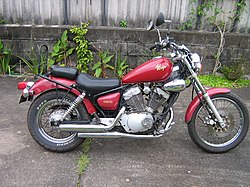
The Virago 250 is an entry-level cruiser motorcycle built by Yamaha Motor Company. It has a top speed of 75mph. (Claimed top speed of 85)
V Star 250 (2008–present)
[edit]In the 2008 model overview, the Virago 250 has been replaced with the V Star 250, but the specs remain very similar to the Virago 250.
- NOTE: Australia still offers the Virago 250 (XV250) as well as the V Star 250 (XVS250),
Specifications
[edit]Official
[edit]Source:[1]
| General | |
|---|---|
| Engine Type | 249cc, air-cooled, SOHC, 60-degree V-twin |
| Horse power | |
| Bore x Stroke | 49mm x 66mm |
| Compression Ratio | 10:1 |
| Carburetion | 26mm Mikuni |
| Ignition | Digital TCI |
| Transmission | 5-speed |
| Final Drive | Chain |
| Chassis | |
| Suspension/Front | 33mm telescopic fork; 5.5" travel |
| Suspension/Rear | Twin shocks w/adjustable spring preload; 3.9" travel |
| Brakes/Front | 282mm disc |
| Brakes/Rear | 130mm drum |
| Tires/Front | 3.00-18 |
| Tires/Rear | 130/90-15 |
| Dimensions | |
| Length | 86.2" (~220 cm) |
| Width | 32.1" (~81.5 cm) |
| Height | 44.9" (~114 cm) |
| Seat Height | 27" (~68.5 cm) |
| Wheelbase | 58.7" (~150 cm) |
| Ground Clearance | 5.7" (~14.5 cm) |
| Dry Weight | 302 lb (~137 kg) |
| Fuel Capacity | 2.5 G (~9.5 L) |
| Fuel Economy | 78 mpg (~34 km/L) |
Unofficial (Practical)
[edit] |
| General | |
|---|---|
| Fuel | Gasoline (Unleaded Petrol) or 1994 and before Super LRP |
| Max Load | 350 lbs (~160 kg) |
| Instrument Panel | Turn lights, Neutral, Hi-beam |
| Mileage between oil changes | 3000 mi (4800 km) |
| Air Filter | Foam (wet) |
References
[edit]- ^ 2008 V Star 250 Specifications, Yamaha, retrieved 2009-06-21
External links
[edit]| Standard | |||||||||||||
|---|---|---|---|---|---|---|---|---|---|---|---|---|---|
| Sport | |||||||||||||
| MotoGP | |||||||||||||
| Touring / Sport touring | |||||||||||||
| Power cruiser | |||||||||||||
| Cruisers |
| ||||||||||||
| Supermoto | |||||||||||||
| Dual-sport / Enduro / Off-road | |||||||||||||
| Agricultural | |||||||||||||
| Motocross | |||||||||||||
| Scooter | |||||||||||||
| Tricycle | |||||||||||||
| First models | |||||||||||||


Yamaha XV250
View on Grokipediafrom Grokipedia
Introduction
Model Overview
The Yamaha XV250 is a lightweight, air-cooled 249 cc V-twin cruiser motorcycle designed for beginner riders and urban commuting, offering easy handling and low maintenance costs.[5] As Yamaha's smallest V-twin cruiser, it combines classic styling elements like a low-slung seat and teardrop fuel tank with reliable performance suitable for short-distance travel and skill-building.[8] Launched in 1988, the model has enjoyed continuous production, spanning over 35 years as of 2025 and establishing it as a staple in Yamaha's entry-level cruiser segment.[8][5] It debuted as an affordable option positioned below larger cruisers like the XV1100 Virago, appealing to riders seeking an accessible introduction to V-twin power without overwhelming size or complexity.[9]Naming and Market Positioning
The Yamaha XV250 has undergone several name changes across different markets and production periods to align with regional branding strategies. Initially introduced in the United States as the Route 66 from 1988 to 1990, it was marketed under the Virago 250 name globally starting in 1988, with a brief hiatus in the U.S. before its return there as the Virago in 1995, continuing until 2007. In some Asian and European markets, it was known as the DragStar 250 (XVS250) starting around 2000 during overlapping periods.[10] From 2008 onward in North America, the model was rebranded as the V Star 250 to integrate it into Yamaha's broader V Star cruiser lineup, emphasizing a unified family of American-style motorcycles.[11][12] Positioned as an entry-level cruiser, the XV250 targets novice riders seeking an accessible introduction to the cruiser style, with features like a low seat height of approximately 686 mm (27 inches) and a lightweight curb weight of around 147 kg (324 lb) that enhance maneuverability and confidence for beginners. Its affordability, with historical MSRP ranging from $3,000 to $5,000 USD, further supports its role as a budget-friendly option for urban commuters and those pursuing short-distance rides without demanding high power outputs. The design evokes classic American cruiser aesthetics, such as a low-slung profile and V-twin engine styling, appealing to riders who desire stylistic appeal over performance intensity.[13][6] Demographically, the model caters primarily to beginner riders, urban dwellers needing practical daily transport, and casual cruisers interested in relaxed, low-maintenance riding. Regional variations in naming reflect market preferences: the Virago designation saw strong adoption in Japan and Europe for its established cruiser heritage, while the U.S. rebranding to V Star 250 aimed to broaden appeal within Yamaha's domestic cruiser portfolio, boosting sales alignment with larger models.[14]History and Development
Origins and Early Production (1988-1994)
The Yamaha XV250 was introduced in 1988 as part of Yamaha's Virago cruiser lineup, designed to provide an entry-level V-twin motorcycle that captured the essence of American cruising culture.[15] Inspired by the iconic U.S. Route 66 highway, which symbolized freedom and adventure, the model aimed to appeal to novice riders seeking a lightweight, nostalgic alternative to larger cruisers amid the post-1980s surge in beginner-friendly motorcycles.[15][16] Development focused on scaling down the Virago series' established V-twin architecture to a 249cc air-cooled engine, mimicking the styling and riding position of bigger American-style bikes while prioritizing ease of handling for urban commuting and short tours.[15][1] Launched in 1988 for North American and European markets at a price of $2,299 in the U.S. and ¥229,000 in Japan, the initial XV250 was marketed under the "Route 66" name in the United States to emphasize its thematic ties to Americana.[15][1][17] The debut model featured a teardrop-shaped fuel tank, prominent chrome accents on the engine fins and exhaust, basic analog instrumentation, and a 5-speed transmission, with a low 27-inch seat height and 328-pound wet weight to enhance accessibility.[15][16] Early production from 1988 to 1990 emphasized U.S.-centric styling with the Route 66 branding, including forward footpegs and a wide, soft solo seat for a relaxed posture.[17] Introduced in 1988 in Japan as the Virago 250, with minor refinements such as improved rear shock adjustability for better ergonomics on varied road conditions.[16][1] Through 1994, the first-generation model maintained core design stability, with no major mechanical overhauls but subtle updates to wiring and instrumentation for enhanced reliability in international markets.[2] Initial market reception highlighted the XV250's strengths in reliability and low-maintenance operation, making it a popular choice for beginners in the growing entry-level cruiser segment.[16] Contemporary reviews praised its peppy low-end power for city riding and smooth clutch action, though noted vibrations at highway speeds as a limitation for longer trips.[15] The model's simple construction and durable chain drive contributed to its reputation as a dependable daily rider, filling a niche for affordable cruisers post the Harley-Davidson revival of the 1980s.[16][2]Virago Era and Updates (1995-2007)
The Yamaha XV250 Virago continued production through the mid-1990s with a focus on refinement for entry-level riders, maintaining its core air-cooled V-twin engine and cruiser styling while receiving minor enhancements to electronics and ergonomics for improved usability. In markets like the UK and Europe, the model was formally launched in 1995 as a smaller sibling to larger Virago variants, emphasizing its low seat height of 27 inches and lightweight design at 324 pounds (147 kg) for easy handling in urban commuting scenarios.[9] Over the subsequent years, updates were iterative rather than revolutionary, with refinements to the carburetor system in later models contributing to smoother throttle response and better low-speed performance, alongside options for aftermarket accessories like windshields to enhance touring comfort. By the early 2000s, features such as improved wiring harnesses supported more reliable electrical systems, and the bike's fuel efficiency averaged around 65 mpg (approximately 28 km/L), making it particularly popular for daily commuting in Europe and Japan where its 9.5-liter tank provided practical range without frequent refueling.[9][18] Production during this era underscored the model's longevity, with consistent availability reflecting steady demand in the lightweight cruiser segment, though exact annual figures are not publicly detailed. The Virago 250 faced direct competition from the Honda Rebel 250, a similarly sized parallel-twin cruiser noted for its simplicity and lower price point, yet the Yamaha distinguished itself through its V-twin torque delivery and chain drive for low-maintenance ownership.[19] Yamaha's engineering emphasis on durability resulted in high owner satisfaction, with reliability ratings of 5 out of 5 from users and minimal reported issues, contributing to low recall rates during the period and strong retention of used market value—models from the mid-2000s often commanding $2,000 to $3,500 depending on condition.[9]Rebranding to V Star 250 (2008-Present)
In 2008, Yamaha rebranded the XV250 from its previous Virago designation to the V Star 250 specifically for the North American market, aiming to integrate it more seamlessly into the company's established V Star cruiser family. This shift emphasized a unified branding strategy for entry-level cruisers, highlighting the model's V-twin heritage while maintaining its core mechanical design unchanged. Cosmetic enhancements accompanied the rebranding, including updated badging, matte black engine finishes, and subtle styling tweaks to align with the broader V Star aesthetic, enhancing its visual appeal without altering performance fundamentals.[20][21] Following the rebranding, Yamaha introduced minor refinements to improve usability and compliance. In 2012, the model received a drag-style straight handlebar replacement for the previous buckhorn design, promoting a more relaxed riding position and modern cruiser ergonomics, alongside a switch from glass to mini blade fuses for easier maintenance. The 2020 model year saw no significant mechanical updates, though Yamaha's overall production faced temporary disruptions due to the global COVID-19 pandemic, affecting supply chains across its motorcycle lineup before resuming normal operations. These changes kept the V Star 250 focused on its role as an accessible, low-maintenance option for novice riders.[22][23] As of 2025, the V Star 250 remains in active production, continuing its legacy as an affordable entry-level cruiser with an MSRP of $4,799 USD, reflecting only incremental pricing adjustments over recent years. Its lightweight construction, low 27-inch seat height, and smooth V-twin power delivery have made it a staple in rider training programs, such as those offered by the Motorcycle Safety Foundation (MSF), where it is frequently used for its forgiving handling and stability for beginners. Globally, the model sustains steady demand among new riders and urban commuters, supported by Yamaha's commitment to long-term parts availability for its enduring platform. No major redesign has been announced, underscoring the bike's proven reliability and minimal need for overhaul in its niche.[6][24][25]Design and Engineering
Engine and Drivetrain
The Yamaha XV250 features an air-cooled, single overhead camshaft (SOHC), 60-degree V-twin engine with a displacement of 249 cc, designed for reliable low- to mid-range performance in a lightweight cruiser package. The engine employs a long-stroke configuration with a bore of 49 mm and stroke of 66 mm, achieving a compression ratio of 10:1, and uses a Mikuni 26 mm carburetor for fuel delivery across all standard models.[3][26] The drivetrain consists of a 5-speed constant-mesh transmission paired with a multiplate wet clutch, ensuring smooth gear shifts suitable for novice riders, and a chain final drive with a stock 16/45 sprocket ratio that balances acceleration and cruising efficiency.[3][27] This powerplant delivers 21 hp at 8,000 rpm and 21.6 Nm of torque at 6,000 rpm, emphasizing torquey low-end response for effortless city navigation and moderate highway use, with inherent V-twin balance and rubber-isolated engine mounts contributing to reduced vibration.[18][28] Routine maintenance is straightforward, requiring 1.6 L of 10W-40 engine oil during changes with filter replacement, valve clearance adjustments every 7,000 km to maintain optimal performance, and the engine's robust construction supports longevity beyond 50,000 km with proper care.[29][30][31]Chassis, Suspension, and Brakes
The Yamaha XV250, marketed as the V Star 250 in North America, utilizes a double-cradle steel frame made from high-tensile tubes, which ensures structural rigidity and contributes to the motorcycle's low seat height of 685 mm for enhanced stability during low-speed maneuvers and cruising.[32] This frame design supports a wheelbase of 1,491 mm (58.7 in), paired with a 32-degree rake and 119 mm (4.7 in) trail, delivering the characteristic cruiser handling that prioritizes straight-line composure over aggressive cornering.[5] The suspension setup emphasizes comfort for entry-level riders and urban commuting. Up front, 33 mm telescopic forks provide 140 mm (5.5 in) of travel, absorbing minor road imperfections effectively while maintaining straightforward geometry.[3] The rear features dual shocks with adjustable preload, offering 99 mm (3.9 in) of travel to accommodate varying rider weights and loads, resulting in a plush ride quality suited to pothole-strewn streets without excessive dive under braking.[3] For braking, a single 282 mm hydraulic disc at the front, equipped with a single-piston caliper, works in tandem with a 130 mm rear drum brake to provide progressive and reliable stopping performance appropriate for the bike's 147 kg curb weight and modest speeds.[3] Anti-lock braking system (ABS) is not standard or optional on any variant, keeping the system simple and cost-effective for beginners.[33] The frame's steel construction is engineered for durability, with routine inspections recommended as part of the manufacturer's 7,000 km maintenance interval to preserve ride quality over time.[34]Ergonomics and Styling
The Yamaha XV250 features a low seat height of 685 mm, enabling most riders to flat-foot comfortably at stops and enhancing accessibility for beginners and shorter individuals.[18] Forward-mounted foot controls and a drag-style handlebar promote a relaxed, upright riding posture typical of cruiser motorcycles, reducing strain during casual commuting.[26] This ergonomic setup prioritizes ease of handling over aggressive sport positioning, making it suitable for urban navigation and light touring. The bike's styling embodies classic cruiser aesthetics, highlighted by a round halogen headlight, teardrop-shaped 9.5-liter fuel tank, and bobbed rear fender that contribute to its compact, nostalgic profile.[35] Chrome accents on the engine guards and kickstand add visual polish, accentuating the V-twin engine's exposed elements for a timeless, American-inspired look. Color schemes have evolved over the model's lifespan, starting with black and silver combinations in the 1988 debut and progressing to options like pearl white and midnight black in contemporary versions.[36] Comfort is supported by a padded solo seat that can be upgraded with a two-up configuration for passengers, providing adequate cushioning for short to medium rides.[37] An optional windscreen is available to mitigate wind fatigue, while the engine's design incorporates vibration isolation measures, allowing comfortable travel for distances up to 200 km without excessive numbness in hands or feet.[38] The 2008 rebranding to V Star 250 introduced retro pinstriping along the tank and fenders, enhancing its vintage appeal while maintaining the core silhouette. By 2015, subtle modernizations included updated instrumentation accents, blending heritage styling with improved visibility without compromising the traditional lines.[38]Specifications
Core Engine Specifications
The Yamaha XV250 features a 249cc displacement engine.[3] Its configuration is an air-cooled SOHC 60° V-twin with 2 valves per cylinder.[3] The bore and stroke dimensions are 49.0 mm x 66.0 mm.[3] The compression ratio is 10.0:1.[3] The fuel system utilizes a Mikuni BDS26 carburetor, paired with TCI digital ignition.[3] Cooling is provided by an air-cooled system with finned cylinders.[3]Dimensions and Capacities
The Yamaha XV250 features compact dimensions suited for urban riding and beginner accessibility, with an overall length of 2,190 mm, width of 710 mm, and height of 1,060 mm.[3] These measurements contribute to a maneuverable profile, while the seat height of 686 mm and ground clearance of 145 mm enhance low-speed handling and stability for shorter riders.[35] The wheelbase measures 1,490 mm, providing a balanced stance with a minimum turning radius of approximately 2.8 m.[39] In terms of weight, the motorcycle has a dry weight of 137 kg and a wet weight of 147 kg when fully fueled and oiled.[18] Fuel capacity stands at 9.5 L, supporting extended rides with efficient consumption, while the engine oil capacity is 1.4 L for routine changes.[40] Tire specifications include a front size of 3.00-18 and rear of 130/90-15, optimizing grip and ride comfort on paved surfaces.[13] These attributes underscore the XV250's lightweight and space-efficient design, which aligns with ergonomic benefits for novice operators as noted in broader styling discussions.[3]| Specification | Measurement |
|---|---|
| Overall Length | 2,190 mm |
| Overall Width | 710 mm |
| Overall Height | 1,060 mm |
| Seat Height | 686 mm |
| Ground Clearance | 145 mm |
| Wheelbase | 1,490 mm |
| Minimum Turning Radius | 2,800 mm |
| Dry Weight | 137 kg |
| Wet Weight | 147 kg |
| Fuel Capacity | 9.5 L |
| Engine Oil Capacity | 1.4 L |
| Front Tire Size | 3.00-18 |
| Rear Tire Size | 130/90-15 |