Hubbry Logo
Yamaha YZ250FYamaha YZ250FMain
Open search
Yamaha YZ250F
Community hub
Yamaha YZ250F
logo
8 pages, 0 posts
0 subscribers
Be the first to start a discussion here.
Yamaha YZ250F
Yamaha YZ250F
from Wikipedia
YZ250F
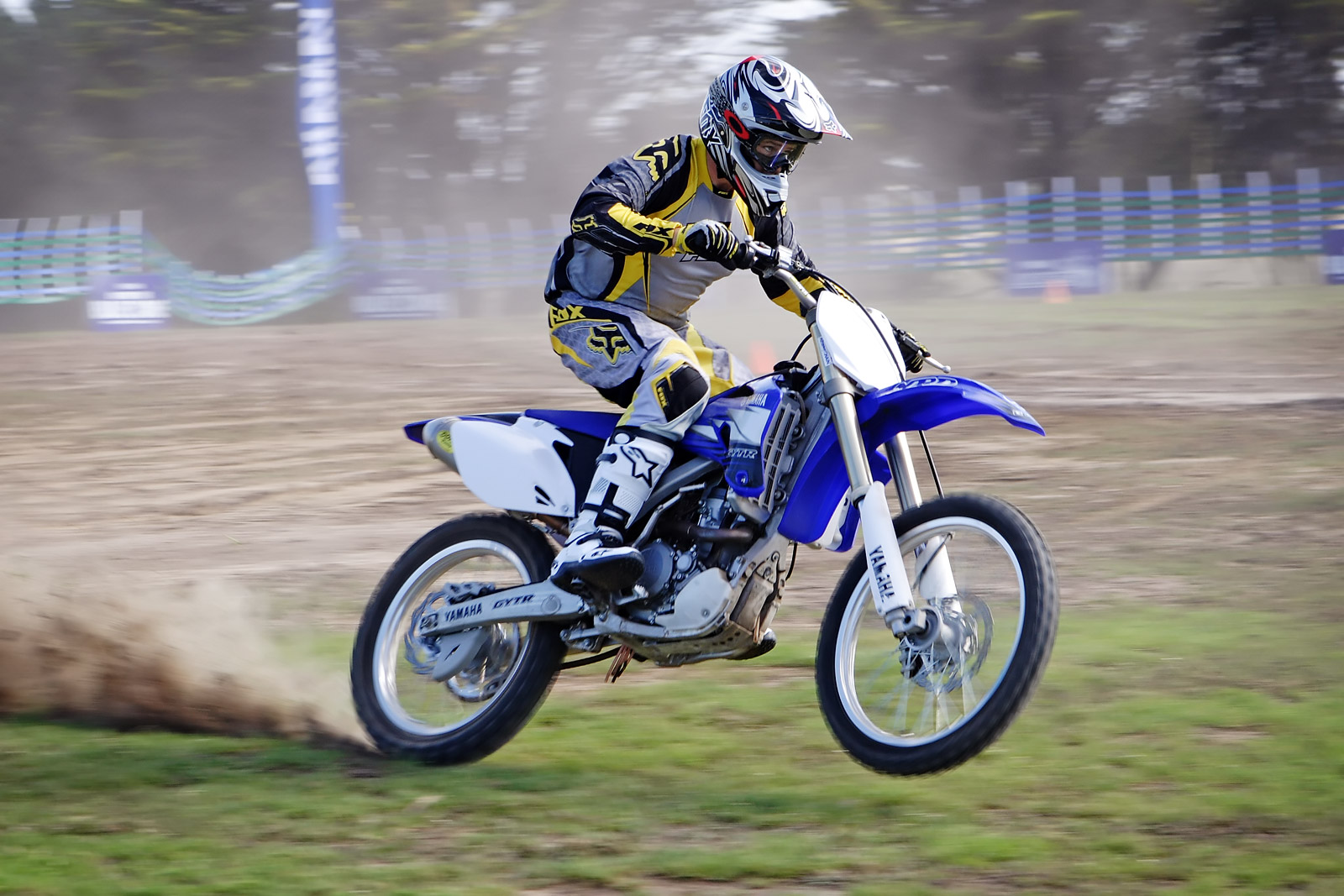
2007 Yamaha YZ250F
ManufacturerYamaha Motor Company
Production2001-present
ClassMotocross
Engine249 cc (15.2 cu in) single-cylinder, water-cooled, four-stroke, DOHC
Bore / stroke77 mm × 53.6 mm (3.03 in × 2.11 in)
Power39hp[1]
Torque78 N•m ft·lbf[1]
Transmission5-speed
SuspensionKYB
Brakesdisc (front,back)
Tires80/100-21, 100/90-19
Wheelbase57.8 inches
DimensionsL: 85 inches
W: 32.5 inches
H: 51.2 inches
Seat height38.7 inches
Weight204 lb (93 kg) (dry)
Fuel capacity1.6 Gallons (2024 Model)
RelatedYamaha YZ450F
Yamaha YZ250
Yamaha YZ125

The Yamaha YZ250F is a motocross motorcycle first released in 2001 by Yamaha. It features a DOHC, four-stroke engine and initially had a steel frame and subframe in 2001–2002. In 2003 it received an aluminum subframe, which was replaced in the 2006 model with an all-aluminum frame.

The YZ250F has been praised for combining the broad-power characteristics of a four-stroke engine with the light handling more common in smaller, 125 cc two-stroke motorcycles.[2]

Despite the similar name to the YZ250, very few parts have been shared between the models through their history.

Significant advances

[edit]
2003 Automatic decompression exhaust cam
2006 Aluminium frame
2008 New engine
2010 New engine layout, with lower center of gravity
2014 Rear slant cylinder, 4-Valve head, Fuel Injection
2019 Electric starter

See also

[edit]

References

[edit]
Revisions and contributorsEdit on WikipediaRead on Wikipedia
from Grokipedia
The Yamaha YZ250F is a 250 cc four-stroke motorcycle manufactured by , introduced in 2001 as the company's first production four-stroke in the competitive 250 cc class, featuring a liquid-cooled DOHC designed for high-revving performance and agile handling on tracks. Since its debut, the YZ250F has undergone significant evolutions, including the adoption of a reverse and downdraft in 2014 for improved power delivery, the addition of electric start and a new in 2019, suspension refinements in 2024, and a linkage overhaul in 2025 that enhanced its stability and track performance. The model's 2025 iteration retains a 250 cc displacement with a 77.0 x 53.6 mm bore and stroke, 13.8:1 , five-speed transmission, and KYB suspension system providing 12.2 inches of front travel and 12.3 inches rear, all contributing to a claimed wet weight of 231 pounds. In professional racing, the YZ250F has established a legacy of dominance, powering riders to multiple FIM Motocross World Championship titles in the MX2 class, such as Antonio Cairoli's victories in 2005, 2007, and 2009, as well as Maxime Renaux's win in 2021. It has also secured consecutive wins in industry shootouts, including Dirt Rider's 250F Motocross Shootout from 2021 to 2025, underscoring its balance of power, ergonomics, and reliability that appeals to both amateur and elite competitors.

Overview and Development

Introduction

The Yamaha YZ250F is a liquid-cooled, double overhead camshaft (DOHC), (five in early models, four from 2010), single-cylinder in the 250 cc class, featuring carburetion in early models and from 2014 onward. Introduced by in 2001, it represents a pivotal shift in design, combining advanced engine technology with a lightweight chassis optimized for high-performance track conditions. Production has continued uninterrupted, with the 2026 model introduced in 2025, reflecting ongoing refinements to maintain competitiveness in the evolving landscape. The 2026 model includes enhancements like an ECU lock function and updated . The YZ250F played a key role in Yamaha's transition from two-stroke engine dominance to four-stroke innovation, as the company pioneered the first production 250 cc four-stroke motocross bike to meet the sport's growing demand for smoother power delivery and broader usability. This model helped propel the industry-wide adoption of four-strokes, offering riders enhanced torque and reliability over traditional two-strokes while preserving Yamaha's reputation for agile handling. Primarily utilized in and competitions, the YZ250F serves as a versatile platform for riders seeking race-ready performance without extensive modifications. It is specifically positioned for elite series such as the AMA Supercross 250 class, Pro Motocross 250 class, and FIM MX2 World Championship, where its balanced design excels in demanding environments like jumps, ruts, and tight corners. Since its debut, the YZ250F has seen iterative updates across generations to adapt to regulatory changes and technological advancements in the sport.

Origins and Introduction

The Yamaha YZ250F was introduced in 2001 as Yamaha's first production four-stroke in the 250 cc class, marking a pivotal shift in the company's strategy amid the growing popularity of four-stroke engines in professional racing. Developed under the leadership of Yoshiharu Nakayama, general manager of Yamaha's Motor Sports Engineering Division, the project began as an unofficial weekend initiative with a small team of three engineers aiming to create a competitive four-stroke alternative to dominant two-stroke machines. This effort was motivated by the AMA Pro Racing rulebook, which permitted 250 cc four-strokes to compete in the 125 cc class, allowing Yamaha to leverage its experience from earlier models like the YZ400F and target younger riders, trail enthusiasts, and veterans seeking a more tractable power delivery without sacrificing performance. Key engineering goals centered on balancing power, weight, and reliability for demanding tracks, with a focus on making the bike lighter and more compact than traditional 250 cc two-strokes while delivering high-revving performance akin to 125 cc machines. The design prioritized a liquid-cooled, double-overhead-camshaft (DOHC) to ensure smooth, controllable and reduced vibration, addressing common four-stroke drawbacks in off-road conditions. Nakayama's team rejected an aluminum frame in favor of for better durability and cost-effectiveness, drawing from testing, and aimed for a that could rev to 13,500 rpm with low-friction components for enhanced responsiveness. The YZ250F made its racing debut on October 22, 2000, at a mud event in , where rider Ernesto Fonseca secured a 1-1 victory, demonstrating its potential against two-stroke rivals shortly after Honda's RC450 debut at the same venue. It was subsequently showcased to the U.S. press at Glen Helen Raceway later that year, with production models reaching showrooms in early 2001 at a price of $5,499. Initial specifications included a 249 cc displacement, five-valve DOHC , 37 mm Keihin FCR , five-speed transmission, and a dry weight of approximately 224 pounds, making it competitive in both 125 cc and 250 cc classes. Early reception highlighted the YZ250F's smooth power delivery and ease of use, with testers noting it as the least tiring bike available, enabling longer sessions without fatigue due to its tractable and precise handling. Reviewers praised its flickable and high-revving nature, positioning it as a fun, versatile option that outperformed expectations in and settings. However, it faced criticism for its relatively heavy feel compared to lighter 125 cc two-strokes and a challenging starting procedure, though these were seen as minor trade-offs for its innovative four-stroke design.

Model Evolution

Early Years (2001–2005)

The Yamaha YZ250F debuted in 2001 as Yamaha's entry into the 250cc four-stroke class, featuring a liquid-cooled, DOHC five-valve with a 77.0 mm bore and 53.6 mm stroke, achieving a 12.5:1 for responsive power delivery. The bike utilized fully adjustable KYB suspension, including a 46mm inverted front and a rear shock with linkage, providing plush initial compliance while resisting bottoming under aggressive riding. At approximately 224 pounds dry, it offered nimble handling akin to a 125cc two-stroke, though its powerband demanded constant input to avoid bogging due to limited low-end . This model marked Yamaha's broader transition toward four-stroke dominance in , building on the success of the YZ426F. Subsequent years brought progressive refinements to enhance usability. For 2002, Yamaha introduced a revised ignition map and reworked low-speed circuitry in the 37mm Keihin FCR , with updated jetting (178 main, 40 pilot) to improve response and low-rpm for better corner exits. Suspension received a more rigid , 5mm-longer rear shock, and new linkage ratios, while contributing to overall stability without significant . In 2003, an automatic decompression exhaust cam simplified starting, addressing rider feedback on kick-start effort, and minor adjustments further smoothed power delivery. The 2004 iteration fine-tuned these elements, with optimized suspension valving for enhanced traction and a slightly broader powerband through refined , maintaining the bike's competitive edge in handling; the front was upgraded to 48 mm diameter. The 2005 model year highlighted Yamaha's heritage with the limited-production 50th Anniversary Special Edition, restricted to 100 units and featuring a distinctive body with white-and- strobe graphics, seat, and commemorative emblems evoking the company's racing colors. While standard models retained the kick-start system, some aftermarket electric start conversions emerged to ease , though not as options. Exhaust refinements focused on durability rather than emissions-specific changes, preserving the narrow but rev-happy powerband. Early YZ250F models grappled with a dry weight hovering around 230 pounds and a somewhat peaky powerband, issues progressively mitigated through ECU-mapped ignition tweaks and optimizations across these years.

Mid-Generation Refinements (2006–2013)

The 2006 Yamaha YZ250F underwent a significant redesign, introducing an all-new lightweight aluminum frame that enhanced overall handling and reduced weight compared to the previous model. This frame, constructed from a combination of forged and extruded aluminum components, provided improved rigidity and agility on the track, allowing for sharper cornering and better stability during jumps. Complementing the chassis update, the suspension was upgraded with 48mm Kayaba inverted forks featuring speed-sensitive system (SSS) valving, which offered 90 percent speed-sensitive for superior absorption of small bumps and high-speed impacts without sacrificing plushness over rough terrain. The rear shock also received SSS technology, contributing to a more balanced ride that addressed rider feedback from earlier models. In 2008, Yamaha focused on engine refinements to boost mid-range and usability, including a redesigned that increased the from 12.5:1 to 13.5:1, along with updated jetting via a new double-taper needle and ignition mapping adjustments. These changes resulted in smoother power delivery across the rev range, particularly between 5,000 and 9,000 rpm, making the bike more tractable for technical sections without compromising top-end power. Additional tweaks, such as revised oil passages and stiffer primary gear tolerances, improved durability under racing conditions, while minor stiffening enhanced feedback to the rider. The chassis geometry included a rake angle (also referred to as caster angle or steering head angle) of 26.5 degrees and trail of 79 mm (3.1 inches). Although the model retained its carbureted , these optimizations contributed to cleaner response and reduced emissions through more efficient . The 2010 model brought further chassis evolution with a revised bilateral beam aluminum frame, crafted from 20 pieces for greater compactness and a lower center of gravity, which improved turning radius and front-end feel during aggressive maneuvers. Engine updates included lighter aluminum valve spring retainers replacing steel ones, allowing higher revs with less fatigue, and refined carburetor settings with optimized air funnel shapes to enhance mid-range torque by up to 10 percent over previous years. Suspension received subtle valving tweaks for better compliance on choppy tracks, maintaining the SSS design's effectiveness. These modifications collectively refined the bike's balance, making it a more competitive package for professional riders seeking precision without added weight. By 2012 and 2013, refinements emphasized rider and power delivery, paired with revised seat foam and bodywork for improved comfort during long motos. Engine mapping updates via ECU recalibration broadened the powerband, providing more linear from low rpm while achieving peak output of approximately 37 horsepower at 11,500 rpm. Suspension saw fork revalving and a reduced offset from 25mm to 22mm for sharper steering response, alongside minor linkage adjustments in the rear for consistent . These years solidified the YZ250F's reputation for tunable performance. Throughout the 2006–2013 period, Yamaha prioritized reliability enhancements, incorporating stronger crankshaft designs with improved material alloys to withstand the high-stress demands of motocross abuse, reducing the risk of failures in competitive environments. Valve maintenance intervals were standardized at every 30 hours of operation, but design improvements like titanium-coated rockers and precision-machined components minimized wear, allowing engines to endure 50–60 hours between major services with proper care. These evolutions ensured the mid-generation YZ250F models were not only performant but also dependable for both amateur and pro use.

Modern Updates (2014–Present)

The 2014 redesign of the Yamaha YZ250F introduced significant changes to enhance handling and performance, including a repositioning of the that tilted the from a 10.5-degree forward cant to a 6.2-degree rearward cant, effectively moving it approximately 2 inches forward within the frame to improve mass centralization. This adjustment, combined with a 3.5mm offset toward the to reduce , contributed to better overall balance and responsiveness on the track. Additionally, the model featured a revised DOHC with updated cam profiles, narrower valve angles of 23.7 degrees, and a 13.5:1 , allowing the engine to rev higher while maintaining efficient filling through a downdraft design. Building on this foundation, the 2019–2022 models incorporated digital and convenience-focused updates, notably the introduction of the Power Tuner app, which enables riders to customize ECU fuel and ignition mapping directly via a smartphone connection over , providing real-time data logging and track-side adjustments without specialized tools. The 2019 iteration also added a standard ultra-lightweight paired with a compact starter motor, facilitating push-button electric starting for easier operation during races or practice sessions, a first for the YZ250F lineup in this class; the was increased to 13.8:1. These enhancements emphasized user-friendly tunability and reduced weight, with the app becoming a standard feature across subsequent years for fine-tuning engine maps to suit varying track conditions. In 2022, four-position adjustable handlebar mounts were introduced for rider customization. From 2023 to 2025, refinements focused on chassis dynamics and rider ergonomics, including updates to the KYB Speed Sensitive System (SSS) suspension, where the 48mm forks received new valving with delta-shaped piston shims for improved separation between compression and functions, enhancing stability and traction over rough terrain. The rear shock was similarly revised with a lighter spring rate, increased reservoir capacity by 30cc for better heat dissipation during prolonged use, and a stiffer linkage ratio to minimize pitch during cornering. The Yamaha Racing Edition, available starting in 2023, featured factory-inspired OEM graphics, integrated handguards, and premium components like a exhaust for this special variant. For the 2025 model specifically, an updated handlebar switchbox with raised rib detailing was added to prevent inadvertent activation of the map switch or kill button while gloved, alongside enhanced cooling measures in the suspension reservoir to sustain performance under extended track demands. A complete suspension and linkage overhaul in 2024 further improved stability and track performance. Looking forward, Yamaha has emphasized compliance with evolving environmental standards, modifying the YZ250F's exhaust system to meet Euro 5 emissions requirements and 2025 FIM noise regulations while preserving power delivery. The company is also exploring hybrid and electric technologies through prototypes, including the YE-01 Racing Concept electric prototype based on the YZ developed in with partners like Electric Motion, signaling potential future integrations of electrified powertrains in off-road models.

Technical Specifications

Engine Design

The Yamaha YZ250F features a cc liquid-cooled, single-cylinder, with a double overhead camshaft (DOHC) and four-valve , providing efficient airflow and high-revving capability tailored for demands. The displacement measures precisely 249 cc, achieved through a bore of 77.0 mm and a of 53.6 mm, resulting in an oversquare design that favors mid-to-high rpm power delivery while maintaining compactness. This architecture, with its forged aluminum piston and offset cylinder, minimizes friction and enhances durability under racing conditions. Fuel delivery transitioned to electronic in the 2014 , utilizing a 44 mm Keihin throttle body for precise atomization and throttle response, replacing the prior carbureted . Subsequent updates in 2020 shifted to a Mikuni 44 mm throttle body, further refining mapping for better low-end tractability. The ignition employs a digital capacitive discharge ignition (CDI) , integrated with the (ECU) for adjustable mapping via the Yamaha Power Tuner smartphone app, enabling riders to customize air/ ratios and across multiple preloaded maps. Power output for early models was approximately 40 hp, with the 2025 model producing 38.3 hp at the rear wheel. The torque curve emphasizes usability, with peak torque of about 18 lb-ft occurring in the rpm, delivering strong pull for corner exits and jumps without excessive top-end focus. Key maintenance features include titanium intake valves for reduced weight and improved revving, paired with a hydraulic cam chain that automates adjustment to minimize mechanical noise and service intervals. In 2019, updates enhanced internal components, including better lubrication pathways, contributing to extended engine life in competitive use.

Chassis and Suspension

The Yamaha YZ250F employs a semi-double cradle aluminum frame introduced in 2006, which replaced the earlier to reduce weight while maintaining structural integrity for absorbing off-road impacts. This frame configuration uses a combination of cast and extruded aluminum components to achieve a lightweight yet durable structure optimized for demands. In 2014, the model transitioned to a bilateral beam aluminum frame, enhancing lateral rigidity and overall flex for improved stability during high-speed cornering and rough navigation. The bilateral beam design weighs approximately 15 kg, contributing to the bike's nimble handling without compromising impact resistance. For 2025, revisions to the suspension and linkage improved stability and track performance. The suspension system features a KYB Speed Sensitive System (SSS) 48mm inverted coil-spring at the front, fully adjustable for compression and to handle varied track conditions and rider preferences. This setup provides 310 mm of front , allowing effective absorption of jumps and bumps while preserving control. At the rear, a KYB single shock with a linkage system offers fully adjustable preload, compression, and settings, delivering 313 mm of for balanced traction and compliance over uneven surfaces. These components emphasize , with the linkage design distributing forces to protect against extreme off-road stresses. Braking is handled by a single 270 mm front hydraulic disc paired with a Nissin caliper, providing progressive suited to aggression. The rear brake uses a 240 mm hydraulic disc, ensuring reliable modulation without electronic aids. The absence of ABS maintains the pure, unassisted feel essential for , where precise lever control is paramount for safety and performance. Ergonomics include 1-1/8-inch aluminum tapered handlebars mounted on four-position adjustable clamps, allowing customization for rider comfort and aggressive positioning. Wide, adjustable footpegs enhance grip and leverage during dynamic maneuvers, while the seat height measures 38.2 inches, promoting a forward-leaning posture ideal for intense track riding. This setup supports centralization of mass, including the , to optimize balance under impact.

Dimensions and Performance

The Yamaha YZ250F maintains consistent core dimensions across its generations, with a of 1,475 that supports agile cornering while ensuring straight-line stability on tracks. Ground clearance stands at 350 , enabling the bike to clear obstacles and maintain traction over uneven surfaces. The wet weight is 105 kg (231 lb) as of the 2025 model, reflecting refinements in frame materials and componentry for improved . The YZ250F's handling benefits from its low center of gravity and suspension setup, contributing to quick direction changes. In testing, the stock Dunlop Geomax MX33 tires provide confident grip on loose surfaces. Fuel capacity is 6.1 liters, suitable for extended practice sessions.

Racing Achievements

International Success

The Yamaha YZ250F achieved its breakthrough in international competition with Antonio Cairoli securing the 2005 FIM MX2 World Championship, marking the model's first four-stroke title in the class after its debut in 2001. Riding for Team Yamaha De Carli, the Italian rider dominated the season with six Grand Prix overall victories and 12 individual race wins across 15 rounds, contributing to 10 podium finishes overall. Cairoli repeated his success in 2007, clinching a second consecutive MX2 title on the YZ250F with consistent performances that solidified Yamaha's position in the four-stroke era. The bike's evolution continued to yield results, culminating in Maxime Renaux's 2021 MX2 World Championship victory for the Yamaha Factory MX2 team, where he claimed five Grand Prix overall wins and eight race victories en route to the crown. Up to 2023, YZ250F variants powered riders to three FIM MX2 rider world championships, alongside multiple manufacturer titles, including the 2022 MX2 constructor honors. In the FIM Motocross of Nations, the YZ250F has contributed to several national team successes through factory-supported riders. Notably, in 2010 at Thunder Valley, Yamaha rider Zach Osborne delivered strong performances in the MX2 moto for Team on the YZ250F, while Team USA claimed ; Yamaha's involvement extended to multiple team podiums across editions, including Australia's 2023 silver medal with Dean Ferris on the YZ450F.

Domestic Championships

The Yamaha YZ250F has established a strong legacy in the AMA Pro Motocross 250 Class, securing multiple championships that highlight its competitive edge in the United States. In 2014, Jeremy Martin clinched the title aboard the YZ250F for Monster Energy/Star Racing Yamaha, achieving five overall victories en route to a dominant season finale at Tooele, Utah. Martin repeated as champion in 2015, further solidifying the bike's prowess in the outdoor series. More recently, Haiden Deegan captured back-to-back 250MX titles in 2024 and 2025 with Monster Energy Yamaha Star Racing, including seven overall wins and 13 moto victories in the 2025 season, culminating in a championship-clinching performance at Budds Creek. In the Monster Energy AMA Supercross 250 Class, the YZ250F has contributed to nine divisional titles for Yamaha, underscoring its versatility across East and West regions. Notable successes include Aaron Plessinger's 2018 West title, marked by multiple main event wins leading to a points lead at the season's end. Additional titles came from riders like Dylan Ferrandis in 2020 West and in 2025 West, with Deegan wrapping up the crown early through a series of dominant performances. Overall, the YZ250F has amassed more than 50 overall wins in AMA Pro 250 Class events, reflecting its reliability and performance in high-stakes national competition. At the level, Yamaha's BLU CRU program demonstrated the bike's grassroots dominance by securing 11 class titles at the 2025 AMA National Championship at Loretta Lynn's Ranch, along with 32 moto wins across various youth and senior divisions. Beyond the U.S., the YZ250F excelled in the 2015 Australian MX Nationals, where Yamaha riders achieved a sweep in the MX2 class through the efforts of Jay Wilson, who claimed the championship with round wins on his JCR Yamaha YZ250F, alongside strong contributions from Hunter Lawrence and Wilson Todd in supporting categories like MXD.

Notable Riders and Teams

The Yamaha YZ250F has been instrumental in the careers of several prominent riders who have achieved significant success in AMA and FIM competitions, often supported by factory teams emphasizing advanced customizations. Jeremy Martin, riding for the Yamalube/Star Racing Yamaha team, clinched the 2014 AMA 250 on the YZ250F, marking a highlight in the bike's competitive evolution with consistent podium finishes throughout the season. has emerged as a leading figure on the platform, securing the 2024 Pro 250 Class title and the 2025 Monster Energy AMA Supercross 250SX West Championship aboard the Monster Energy Yamaha Star Racing YZ250F, demonstrating exceptional adaptability in both outdoor and stadium environments. French rider Gautier Paulin contributed to early YZ250F development in international racing, competing in the 2010 AMA Supercross Lites class on a factory Yamaha YZ250F prepared by the team, where he earned multiple top finishes before transitioning to larger displacements. The Yamaha Star has been a cornerstone of the YZ250F's racing legacy, capturing multiple AMA 250 Class titles since 2010, including the Supercross championship in 2021 through rider Justin Cooper. This squad's success stems from in-house engineering, incorporating lightweight GYTR performance components such as exhausts and carbon fiber accents to reduce overall weight while maintaining durability. Additionally, teams leverage Yamaha's Power Tuner app for real-time data logging, enabling precise adjustments to fuel mapping and suspension settings based on track conditions and rider feedback. Haiden Deegan's prominence extends beyond the track, where his substantial presence—garnering millions of followers—has inspired a surge in youth participation in , positioning him as a modern ambassador for the sport's accessibility and excitement.

References

Add your contribution
Related Hubs
User Avatar
No comments yet.