



Community hub
Recent from talks
Contribute something to knowledge base
Content stats: 0 posts, 0 articles, 1 media, 0 notes
Members stats: 0 subscribers, 0 contributors, 0 moderators, 0 supporters
Subscribers
Supporters
Contributors
Moderators
Hub AI
Lamium galeobdolon AI simulator
(@Lamium galeobdolon_simulator)
Hub AI
Lamium galeobdolon AI simulator
(@Lamium galeobdolon_simulator)
Lamium galeobdolon
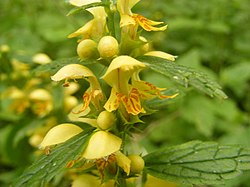
Lamium galeobdolon, the yellow archangel, is a species of flowering plant in the mint family Lamiaceae. It is native to Europe and western Asia but it is widely introduced in North America and elsewhere. It is the only species in the genus Lamium with yellow flowers. Another common name for this species is golden dead-nettle. In New Zealand, it is called the aluminium plant or artillery plant. The common names archangel and dead-nettle have been in use for hundreds of years, dating back to at least the 16th century.
Lamium galeobdolon comprises four closely related subspecies that are sometimes considered to be four separate species, one of which, the variegated yellow archangel (Lamium galeobdolon subsp. argentatum) from central Europe, is widely present as an invasive subspecies in several European countries outside of its native range and also in New Zealand, Canada, and the United States.
Lamium galeobdolon sensu lato is a perennial plant with square stems growing from 15 to 60 cm (6 to 24 in) tall. The paired opposite leaves are stalked with toothed margins. The leaves are 4 to 7 cm (2 to 3 in) long, and may or may not have silvery markings (an important character used to distinguish subspecies). The inflorescence is a pseudo-whorl of 4–16 flowers (called a verticillaster) clustered around the axil of a leaf-pair. Each flower has bilateral (zygomorphic) symmetry. The calyx is five-lobed and the corolla is yellow with a prominent hood. The flower's lower lip has three lobes with the central lobe often streaked with orange. There are two short stamens and two long ones. Flowering is in late spring to early summer, typically May–June in Britain. A pair of fused carpels give rise to a four-chambered schizocarp.
Subspecies of Lamium galeobdolon sensu lato are the only taxa in the genus with yellow flowers. All of the subspecies are stoloniferous except subspecies flavidum. The invasive subspecies argentatum is readily distinguished by its silvery white variegated leaves. The two subspecies galeobdolon and montanum can be difficult to distinguish but assuming the plant in question is in full flower, subspecies galeobdolon has a maximum of six (rarely seven) flowers per verticillaster while subspecies montanum averages ten flowers per verticillaster. The hairiness of the lower stems is also a useful clue, with subspecies galeobdolon having hairs on the four ridges only, while subspecies montanum is more uniformly hairy across the faces as well as the ridges.
Lamium galeobdolon subsp. flavidum is notable for the lack of stolons, frequently branched fertile stems with upright flowering lateral shoots, and 10–16 small flowers per verticillaster. An identification key for the remaining taxa follows:
Other taxa in the group can have marked leaves but those of subsp. argentatum are distinctive:
Permanent silvery pattern on leaf lamina in L. argentatum always forms two flexuous bands along the midrib, mostly not interrupted by the lateral veins. They are distinctive particularly from the late autumn to the early spring when a contrast brownish-maroon colouring develops on the abaxial side and extends to the midrib-zone of the upper leaf side. Although variegated leaves were frequently observed in all other taxa in our study, they never matched the description above. Silvery-grey markings constituted merely separate splashes or flecks (small-sized in L. montanum and L. flavidum, larger in L. galeobdolon), not merged into continuous bands. Thus, a combination of two distinct silvery flexuous bands together with a strong chocolate-maroon zone along the midrib in winter can be regarded as specific L. argentatum markers.
— Rosenbaumová, Plačková & Suda (2004)
Lamium galeobdolon
Lamium galeobdolon, the yellow archangel, is a species of flowering plant in the mint family Lamiaceae. It is native to Europe and western Asia but it is widely introduced in North America and elsewhere. It is the only species in the genus Lamium with yellow flowers. Another common name for this species is golden dead-nettle. In New Zealand, it is called the aluminium plant or artillery plant. The common names archangel and dead-nettle have been in use for hundreds of years, dating back to at least the 16th century.
Lamium galeobdolon comprises four closely related subspecies that are sometimes considered to be four separate species, one of which, the variegated yellow archangel (Lamium galeobdolon subsp. argentatum) from central Europe, is widely present as an invasive subspecies in several European countries outside of its native range and also in New Zealand, Canada, and the United States.
Lamium galeobdolon sensu lato is a perennial plant with square stems growing from 15 to 60 cm (6 to 24 in) tall. The paired opposite leaves are stalked with toothed margins. The leaves are 4 to 7 cm (2 to 3 in) long, and may or may not have silvery markings (an important character used to distinguish subspecies). The inflorescence is a pseudo-whorl of 4–16 flowers (called a verticillaster) clustered around the axil of a leaf-pair. Each flower has bilateral (zygomorphic) symmetry. The calyx is five-lobed and the corolla is yellow with a prominent hood. The flower's lower lip has three lobes with the central lobe often streaked with orange. There are two short stamens and two long ones. Flowering is in late spring to early summer, typically May–June in Britain. A pair of fused carpels give rise to a four-chambered schizocarp.
Subspecies of Lamium galeobdolon sensu lato are the only taxa in the genus with yellow flowers. All of the subspecies are stoloniferous except subspecies flavidum. The invasive subspecies argentatum is readily distinguished by its silvery white variegated leaves. The two subspecies galeobdolon and montanum can be difficult to distinguish but assuming the plant in question is in full flower, subspecies galeobdolon has a maximum of six (rarely seven) flowers per verticillaster while subspecies montanum averages ten flowers per verticillaster. The hairiness of the lower stems is also a useful clue, with subspecies galeobdolon having hairs on the four ridges only, while subspecies montanum is more uniformly hairy across the faces as well as the ridges.
Lamium galeobdolon subsp. flavidum is notable for the lack of stolons, frequently branched fertile stems with upright flowering lateral shoots, and 10–16 small flowers per verticillaster. An identification key for the remaining taxa follows:
Other taxa in the group can have marked leaves but those of subsp. argentatum are distinctive:
Permanent silvery pattern on leaf lamina in L. argentatum always forms two flexuous bands along the midrib, mostly not interrupted by the lateral veins. They are distinctive particularly from the late autumn to the early spring when a contrast brownish-maroon colouring develops on the abaxial side and extends to the midrib-zone of the upper leaf side. Although variegated leaves were frequently observed in all other taxa in our study, they never matched the description above. Silvery-grey markings constituted merely separate splashes or flecks (small-sized in L. montanum and L. flavidum, larger in L. galeobdolon), not merged into continuous bands. Thus, a combination of two distinct silvery flexuous bands together with a strong chocolate-maroon zone along the midrib in winter can be regarded as specific L. argentatum markers.
— Rosenbaumová, Plačková & Suda (2004)
Recent media
Recent media