Hubbry Logo
GynoeciumGynoeciumMain
Open search
Gynoecium
Community hub
Gynoecium
logo
8 pages, 0 posts
0 subscribers
Be the first to start a discussion here.
Gynoecium
Gynoecium
from Wikipedia
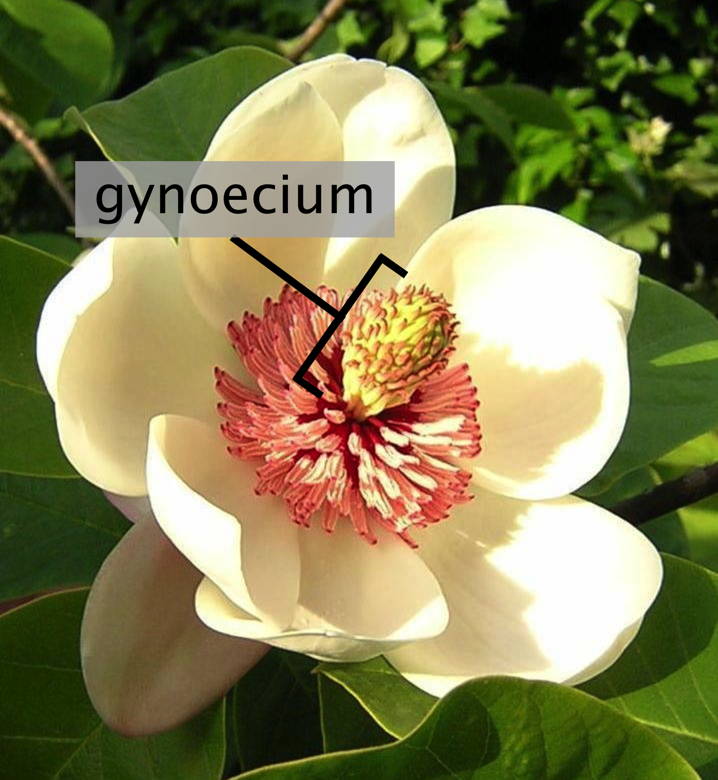
Flower of Magnolia × wieseneri showing the many pistils making up the gynoecium in the middle of the flower
Hippeastrum flowers showing stamens, style and stigma
Hippeastrum stigmas and style
Moss plants with gynoecia, clusters of archegonia at the apex of each shoot.

Gynoecium (/ɡˈnsi.əm, ɪˈnʃi.əm/; from Ancient Greek γυνή (gunḗ) 'woman, female' and οἶκος (oîkos) 'house', pl. gynoecia) is most commonly used as a collective term for the parts of a flower that produce ovules and ultimately develop into the fruit and seeds. The gynoecium is the innermost whorl of a flower; it consists of (one or more) pistils and is typically surrounded by the pollen-producing reproductive organs, the stamens, collectively called the androecium. The gynoecium is often referred to as the "female" portion of the flower, although rather than directly producing female gametes (i.e. egg cells), the gynoecium produces megaspores, each of which develops into a female gametophyte which then produces egg cells.

The term gynoecium is also used by botanists to refer to a cluster of archegonia and any associated modified leaves or stems present on a gametophyte shoot in mosses, liverworts, and hornworts. The corresponding terms for the male parts of those plants are clusters of antheridia within the androecium. Flowers that bear a gynoecium but no stamens are called pistillate or carpellate. Flowers lacking a gynoecium are called staminate.

The gynoecium is often referred to as female because it gives rise to female (egg-producing) gametophytes; however, strictly speaking sporophytes do not have a sex, only gametophytes do.[1][page needed] Gynoecium development and arrangement is important in systematic research and identification of angiosperms, but can be the most challenging of the floral parts to interpret.[2]

Introduction

[edit]

Unlike (most) animals, plants grow new organs after embryogenesis, including new roots, leaves, and flowers.[3] In the flowering plants, the gynoecium develops in the central region of the flower as a carpel or in groups of fused carpels.[4] After fertilization, the gynoecium develops into a fruit that provides protection and nutrition for the developing seeds, and often aids in their dispersal.[5] The gynoecium has several specialized tissues.[6] The tissues of the gynoecium develop from genetic and hormonal interactions along three-major axes.[7][8] These tissue arise from meristems that produce cells that differentiate into the different tissues that produce the parts of the gynoecium including the pistil, carpels, ovary, and ovules; the carpel margin meristem (arising from the carpel primordium) produces the ovules, ovary septum, and the transmitting track, and plays a role in fusing the apical margins of carpels.[9]

Pistil

[edit]
A syncarpous gynoecium in context. The gynoecium (whether composed of a single carpel or multiple "fused" carpels) is typically made up of an ovary, style, and stigma as in the center of the flower.

The gynoecium may consist of one or more separate pistils. A pistil typically consists of an expanded basal portion called an ovary, an elongated section called a style and an apical structure called a stigma that receives pollen.

  • The ovary (from Latin ovum, meaning egg) is the enlarged basal portion which contains placentas, ridges of tissue bearing one or more ovules (integumented megasporangia). The placentas and/or ovule(s) may be borne on the gynoecial appendages or less frequently on the floral apex.[10][11][12][13][14] The chamber in which the ovules develop is called a locule (or sometimes cell).
  • The style (from Ancient Greek στῦλος, stylos, meaning a pillar) is a pillar-like stalk through which pollen tubes grow to reach the ovary. Some flowers, such as those of Tulipa, do not have a distinct style, and the stigma sits directly on the ovary. The style is a hollow tube in some plants, such as lilies, or has transmitting tissue through which the pollen tubes grow.[15]
  • The stigma (from Ancient Greek στίγμα, stigma, meaning mark or puncture) is usually found at the tip of the style, the portion of the carpel(s) that receives pollen (male gametophytes). It is commonly sticky or feathery to capture pollen.

The word "pistil" comes from Latin pistillum meaning pestle. A sterile pistil in a male flower is referred to as a pistillode.

Carpels

[edit]
Aquilegia vulgaris with five free carpels

The pistils of a flower are considered to be composed of one or more carpels.[note 1] A carpel is the female reproductive part of the flower—usually composed of the style, and stigma (sometimes having its individual ovary, and sometimes connecting to a shared basal ovary) —and usually interpreted as modified leaves that bear structures called ovules, inside which egg cells ultimately form. A pistil may consist of one carpel (with its ovary, style and stigma); or it may comprise several carpels joined together to form a single ovary, the whole unit called a pistil. The gynoecium may present as one or more uni-carpellate pistils or as one multi-carpellate pistil. The number of carpels is denoted by terms such as tricarpellate (three carpels).

Carpels are thought to be phylogenetically derived from ovule-bearing leaves or leaf homologues (megasporophylls), which evolved to form a closed structure containing the ovules. This structure is typically rolled and fused along the margin.

Although many flowers satisfy the above definition of a carpel, there are also flowers that do not have carpels because in these flowers the ovule(s), although enclosed, are borne directly on the floral apex.[12][17] Therefore, the carpel has been redefined as an appendage that encloses ovule(s) and may or may not bear them.[18][19][20] However, the most unobjectionable definition of the carpel is simply that of an appendage that encloses an ovule or ovules.[21] Carpels vary enormously in size from a few micrometres in Balanophora involucrata[22] and in many orchids to 2.5 m (8 ft 2 in) long and 12 cm (4+12 in) wide in Entada gigas.[23][24]

Centre of a Ranunculus repens (creeping buttercup) flower showing multiple unfused carpels surrounded by longer stamens
Cross-section through the ovary of Narcissus showing multiple connate carpels (a compound pistil) fused along the placental line where the ovules form in each locule
Pistil of Begonia grandis

Types

[edit]

If a gynoecium has a single carpel, it is called monocarpous. If a gynoecium has multiple, distinct (free, unfused) carpels, it is apocarpous. If a gynoecium has multiple carpels "fused" into a single structure, it is syncarpous. A syncarpous gynoecium can sometimes appear very much like a monocarpous gynoecium.

Comparison of gynoecium terminology using carpel and pistil
Gynoecium composition Carpel
terminology
Pistil terminology Examples
Single carpel Monocarpous (unicarpellate) gynoecium A pistil (simple) Avocado (Persea sp.), most legumes (Fabaceae)
Multiple distinct ("unfused") carpels Apocarpous (choricarpous) gynoecium Pistils (simple) Strawberry (Fragaria sp.), Buttercup (Ranunculus sp.)
Multiple connate ("fused") carpels Syncarpous gynoecium A pistil (compound) Tulip (Tulipa sp.), most flowers

The degree of connation ("fusion") in a syncarpous gynoecium can vary. The carpels may be "fused" only at their bases, but retain separate styles and stigmas. The carpels may be "fused" entirely, except for retaining separate stigmas. Sometimes (e.g., Apocynaceae) carpels are fused by their styles or stigmas but possess distinct ovaries. In a syncarpous gynoecium, the "fused" ovaries of the constituent carpels may be referred to collectively as a single compound ovary. It can be a challenge to determine how many carpels fused to form a syncarpous gynoecium. If the styles and stigmas are distinct, they can usually be counted to determine the number of carpels. Within the compound ovary, the carpels may have distinct locules divided by walls called septa. If a syncarpous gynoecium has a single style and stigma and a single locule in the ovary, it may be necessary to examine how the ovules are attached. Each carpel will usually have a distinct line of placentation where the ovules are attached.

Pistil

[edit]

Pistils begin as small primordia on a floral apical meristem, forming later than, and closer to the (floral) apex than sepal, petal and stamen primordia. Morphological and molecular studies of pistil ontogeny reveal that carpels are most likely homologous to leaves.[citation needed]

A carpel has a similar function to a megasporophyll, but typically includes a stigma, and is fused, with ovules enclosed in the enlarged lower portion, the ovary.[25]

In some basal angiosperm lineages, including Degeneriaceae and Winteraceae, a carpel begins as a shallow cup where the ovules develop with laminar placentation, on the upper surface of the carpel. The carpel eventually forms a folded, leaf-like structure, not fully sealed at its margins. No style exists, but a broad stigmatic crest along the margin allows pollen tubes access along the surface and between hairs at the margins.[25]

Two kinds of fusion have been distinguished: postgenital fusion that can be observed during the development of flowers, and congenital fusion that cannot be observed i.e., fusions that occurred during phylogeny. But it is very difficult to distinguish fusion and non-fusion processes in the evolution of flowering plants. Some processes that have been considered congenital (phylogenetic) fusions appear to be non-fusion processes such as, for example, the de novo formation of intercalary growth in a ring zone at or below the base of primordia.[26][27][28] Therefore, "it is now increasingly acknowledged that the term 'fusion', as applied to phylogeny (as in 'congenital fusion') is ill-advised".[29]

Gynoecium position

[edit]

Basal angiosperm groups tend to have carpels arranged spirally around a conical or dome-shaped receptacle. In later lineages, carpels tend to be in whorls.

The relationship of the other flower parts to the gynoecium can be an important systematic and taxonomic character. In some flowers, the stamens, petals, and sepals are often said to be "fused" into a "floral tube" or hypanthium. However, as Leins & Erbar (2010) pointed out, "the classical view that the wall of the inferior ovary results from the "congenital" fusion of dorsal carpel flanks and the floral axis does not correspond to the ontogenetic processes that can actually be observed. All that can be seen is an intercalary growth in a broad circular zone that changes the shape of the floral axis (receptacle)".[28] And what happened during evolution is not a phylogenetic fusion but the formation of a unitary intercalary meristem. Evolutionary developmental biology investigates such developmental processes that arise or change during evolution.

If the hypanthium is absent, the flower is hypogynous, and the stamens, petals, and sepals are all attached to the receptacle below the gynoecium. Hypogynous flowers are often referred to as having a superior ovary. This is the typical arrangement in most flowers.

If the hypanthium is present up to the base of the style(s), the flower is epigynous. In an epigynous flower, the stamens, petals, and sepals are attached to the hypanthium at the top of the ovary or, occasionally, the hypanthium may extend beyond the top of the ovary. Epigynous flowers are often referred to as having an inferior ovary. Plant families with epigynous flowers include orchids, asters, and evening primroses.

Between these two extremes are perigynous flowers, in which a hypanthium is present, but is either free from the gynoecium (in which case it may appear to be a cup or tube surrounding the gynoecium) or connected partly to the gynoecium (with the stamens, petals, and sepals attached to the hypanthium part of the way up the ovary). Perigynous flowers are often referred to as having a half-inferior ovary (or, sometimes, partially inferior or half-superior). This arrangement is particularly frequent in the rose family and saxifrages.

Occasionally, the gynoecium is born on a stalk, called the gynophore, as in Isomeris arborea.

Placentation

[edit]

Within the ovary, each ovule is born by a placenta or arises as a continuation of the floral apex. The placentas often occur in distinct lines called lines of placentation. In monocarpous or apocarpous gynoecia, there is typically a single line of placentation in each ovary. In syncarpous gynoecia, the lines of placentation can be regularly spaced along the wall of the ovary (parietal placentation), or near the center of the ovary. In the latter case, separate terms are used depending on whether or not the ovary is divided into separate locules. If the ovary is divided, with the ovules born on a line of placentation at the inner angle of each locule, this is axile placentation. An ovary with free central placentation, on the other hand, consists of a single compartment without septae and the ovules are attached to a central column that arises directly from the floral apex (axis). In some cases a single ovule is attached to the bottom or top of the locule (basal or apical placentation, respectively).

The ovule

[edit]
Longitudinal section of carpellate flower of squash showing ovary, ovules, stigma, style, and petals

In flowering plants, the ovule (from Latin ovulum meaning small egg) is a complex structure born inside ovaries. The ovule initially consists of a stalked, integumented megasporangium (also called the nucellus). Typically, one cell in the megasporangium undergoes meiosis resulting in one to four megaspores. These develop into a megagametophyte (often called the embryo sac) within the ovule. The megagametophyte typically develops a small number of cells, including two special cells, an egg cell and a binucleate central cell, which are the gametes involved in double fertilization. The central cell, once fertilized by a sperm cell from the pollen becomes the first cell of the endosperm, and the egg cell once fertilized become the zygote that develops into the embryo. The gap in the integuments through which the pollen tube enters to deliver sperm to the egg is called the micropyle. The stalk attaching the ovule to the placenta is called the funiculus.

Role of the stigma and style

[edit]

Stigmas can vary from long and slender to globe-shaped to feathery. The stigma is the receptive tip of the carpel(s), which receives pollen at pollination and on which the pollen grain germinates. The stigma is adapted to catch and trap pollen, either by combining pollen of visiting insects or by various hairs, flaps, or sculpturings.[30]

The style and stigma of the flower are involved in most types of self incompatibility reactions. Self-incompatibility, if present, prevents fertilization by pollen from the same plant or from genetically similar plants, and ensures outcrossing.

The primitive development of carpels, as seen in such groups of plants as Tasmannia and Degeneria, lack styles and the stigmatic surface is produced along the carpels margins.[31]

See also

[edit]

Notes

[edit]

References

[edit]

Bibliography

[edit]
Revisions and contributorsEdit on WikipediaRead on Wikipedia
from Grokipedia
The gynoecium is the female reproductive organ of a flower in angiosperms (flowering plants), consisting of one or more carpels that collectively house the ovules and enable seed production following pollination and fertilization. Each carpel is a modified leaf-like structure comprising three main parts: the ovary at the base, which contains one or more ovules (each enclosing a female gametophyte or embryo sac); the style, a stalk that elevates and connects the ovary to the stigma; and the stigma, the uppermost receptive surface where pollen grains land and germinate. The term derives from Greek words meaning "female house," reflecting its role as the protective enclosure for female reproductive elements. In functional terms, the gynoecium—often referred to as the pistil when carpels are fused or separate—serves as the site for , where pollen tubes deliver sperm cells to the ovules, leading to and formation within the seeds. Gynoecia exhibit variation in structure across angiosperm species, classified primarily as apocarpous (with free, unfused carpels, as in the buttercup family ) or syncarpous (with fused carpels forming a single pistil, as in the lily family ). This diversity influences development, as the mature transforms into the , with the gynoecium's locules (chambers) determining fruit type and arrangement. Overall, the gynoecium is essential for angiosperm reproduction, distinguishing flowering plants from other seed plants by enclosing ovules within ovaries for enhanced protection and dispersal mechanisms.

Overview

Definition and Function

The gynoecium is the female reproductive organ of the flower in angiosperms, consisting of one or more carpels that form the innermost whorl and enclose the ovules to facilitate fertilization. It represents a defining feature of flowering plants, where it occupies the central position in the floral structure, surrounded by the androecium and . The term "gynoecium" derives from the Greek words gynē (meaning or ) and oikos (meaning house), symbolizing its role as the "female house" of the flower. Exclusive to angiosperms and absent in gymnosperms, the gynoecium performs essential functions in , including the protection of developing ovules within the to shield them from environmental threats and pathogens. Its stigma serves as the receptive surface for grains, capturing them during and initiating compatibility reactions to ensure selective fertilization. Following deposition, the gynoecium guides the growth of pollen tubes through the style and specialized transmitting tissues toward the , enabling the delivery of sperm cells for —a hallmark unique to angiosperms. Post-fertilization, the gynoecium supports maturation into while often developing into a that aids in seed protection and dispersal, thereby promoting the plant's .

Historical Context

The understanding of the gynoecium, the female reproductive structure of flowering plants, emerged gradually through early botanical observations that began to recognize its role in plant sexuality. In the , anatomists provided foundational descriptions of the gynoecium's structure. , in his Anatomy of Plants (1682), was among the first to use to examine floral parts, identifying the pistil as the female sex organ analogous to counterparts and describing its components, including the and stigma, in detail. Grew's work emphasized the gynoecium's role in seed production, laying groundwork for later sexual interpretations. Building on such early anatomical insights, in the 1730s, introduced his of classification in works such as (1735) and Genera Plantarum (1737), which categorized plants primarily based on the number and arrangement of stamens and pistils, thereby establishing the gynoecium—comprising the pistil—as central to floral sexuality and distinguishing it from male organs. This framework marked a key milestone by analogizing to sexuality, facilitating the identification and ordering of through gynoecial characteristics like style length and stigma form. By the late 18th century, advanced conceptual models in (1790), proposing an archetype theory where carpels and other floral organs represent modified leaves undergoing progressive transformations, thus viewing the gynoecium as a foliar derivative rather than a wholly distinct structure. The saw further refinements through detailed studies of gynoecial components and their integration into broader classification. Robert Brown contributed significantly in the with his microscopic examinations, particularly in "On the Organs and Mode of Fecundation in Orchideae and Asclepiadeae" (1821–1822), where he elucidated structure within the , identifying integuments and nucellus and clarifying their developmental role in angiosperm . Concurrently, Alphonse de Candolle advanced systematic in Prodromus Systematis Naturalis Regni Vegetabilis (1824–1873), incorporating gynoecium features—such as carpel fusion and —into natural classification systems that emphasized phylogenetic relationships over purely artificial traits. These efforts shifted focus from mere morphology to functional and comparative aspects of the gynoecium. In the , interpretations evolved from static morphological views to dynamic developmental perspectives, influenced by Arthur J. Eames' foliar theory. Eames, in his 1931 paper "The Vascular Anatomy of the Flower with Refutation of the Theory of Carpel Polymorphism" and later Morphology of the Angiosperms (1961), argued that carpels originate as folded leaf-like structures, supported by vascular evidence, promoting a unified understanding of gynoecium that integrated embryological and anatomical data. This refinement highlighted the gynoecium's evolutionary plasticity, bridging historical archetypes with modern experimental .

Basic Anatomy

Carpels

The carpel represents the basic structural and functional unit of the gynoecium in angiosperms, serving as a modified megasporophyll that encloses and protects the ovules. Classically viewed as a leaf-like organ that folds inward along its margins to form a closed structure, the carpel originates from floral tissues under the control of genes such as AGAMOUS and CRABS CLAW, which establish its identity and polarity. This folding creates a protective , distinguishing angiosperms from other seed plants where ovules remain exposed. Morphologically, the carpel consists of three primary regions: the basal , which houses the attached along the inner walls; the elongated style, which conducts tubes from the stigma to the ; and the apical stigma, a receptive surface often featuring papillae or secretions for capture and . The ventral suture, formed by the fused margins of the folded carpel, serves as the primary site for attachment via marginal , while the dorsal side typically bears vascular bundles. In its simplest form, a carpel is a single, unfused unit (simple carpel), but variations arise in fusion states, with typically anatropous in orientation within the locule. Carpels aggregate to form the gynoecium, either remaining free as separate units in an apocarpous condition or fusing congenitally or post-genitally in a syncarpous condition, the latter prevalent in over 80% of angiosperm species. In apocarpous gynoecia, each carpel functions independently, as seen in Ranunculus species where numerous free carpels develop into achenes forming an aggregate fruit. Syncarpous examples include Arabidopsis thaliana, featuring two fused carpels forming a single pistil. This aggregation enhances reproductive efficiency by centralizing pollen tube guidance through structures like the compitum in fused carpels.

Pistil

The pistil represents the unified female reproductive organ within the gynoecium of a flower, formed either by a single carpel or by multiple fused carpels that collectively produce a cohesive structure consisting of the , style, and stigma. This integration arises from the carpel, the fundamental megasporophyll unit modified for enclosure, where the pistil assembles these elements into a functional whole. In terms of components, the originates from the fused or singular basal regions of the carpels and houses the ovules, while the style serves as an elongated conduit linking the to the stigma, facilitating growth post-pollination. Compound pistils, characteristic of syncarpous gynoecia, result from the congenital fusion of two or more carpels, creating a single pistil with potentially multiple locules depending on the degree of fusion. Pistils are distinguished as simple or compound based on carpel number and fusion. A simple pistil comprises a solitary carpel, typical in monocarpellary flowers such as those of the pea (Pisum sativum) in the family, where the is unilocular and develops into a fruit. In contrast, a compound pistil forms from multiple united carpels, as in the bicarpellary syncarpous gynoecium of the (Solanum lycopersicum) in the family, featuring a bicarpellate that yields a fruit with internal septa. Functionally, the pistil operates as a singular receptive unit for , capturing on the stigma, guiding it through the style to the for fertilization, thereby ensuring in angiosperms.

Classification

Fusion Types

The gynoecium is classified based on the degree of fusion among its constituent carpels, a key morphological feature that influences and fruit development in angiosperms. In an apocarpous gynoecium, the carpels remain free and distinct from one another, each functioning as an independent pistil without congenital or postgenital fusion. This condition is considered primitive in evolution and is exemplified in the buttercup family (), where multiple unfused carpels develop into separate follicles or achenes. The lack of fusion allows for independent maturation of each carpel, often resulting in aggregate fruits such as those seen in raspberries (, ), where the clustered drupelets facilitate animal-mediated by detaching individually from the receptacle. In contrast, a syncarpous gynoecium features two or more carpels that are congenitally fused, forming a single compound pistil with unified ovarian tissue, though styles and stigmas may remain separate or also fuse to varying degrees. This fused state is more common in derived angiosperm lineages and is characteristic of the nightshade family (), where carpels unite completely to produce a single that develops into simple fruits like berries, as in tomatoes ( lycopersicum). The fusion enhances structural integrity and often leads to internal septation (e.g., axile ), promoting synchronized development and dispersal mechanisms such as explosive dehiscence or fleshy pericarp attraction to dispersers. In some families, such as , the gynoecium is apocarpous, with carpels that are free or slightly connate at the base, allowing limited cohesion. Such variations in fusion can influence cohesion, with implications for protection and dispersal; for instance, in , the follicles may dehisce independently yet retain some clustered integrity for wind or animal dispersal. Overall, carpel fusion types determine morphology, directly impacting ecological roles in dissemination across diverse habitats.

Carpel Number Variations

The gynoecium in angiosperms exhibits significant diversity in carpel number, ranging from a single carpel to multiple carpels, which influences morphology and reproductive strategies. This variation arises from developmental processes that determine activity during gynoecium formation, allowing adaptation to diverse and dispersal mechanisms. Unicarpellate gynoecia consist of a single carpel forming a simple pistil, typically resulting in unilocular ovaries that develop into fruits like . A prominent example is found in the family, where the gynoecium is unicarpellate, producing a dehiscent pod that splits along two sutures to release seeds, as seen in pea plants (Pisum sativum). This configuration is common in and supports efficient through explosive dehiscence. Bicarpellate gynoecia feature two carpels, which may be free or fused, often yielding bilocular ovaries with axile . In the family, such as tomatoes (Solanum lycopersicum), the gynoecium is bicarpellate and syncarpous, forming a fruit with seeds embedded in a fleshy pericarp derived from both carpels. Similarly, capsules in the Primulaceae family, like those in species, arise from 5 fused carpels. Multicarpellate gynoecia involve three or more carpels, which can be apocarpous (free) or syncarpous (fused), leading to complex fruit structures with multiple locules. The family exemplifies this with typically five carpels; in strawberries ( × ananassa), the gynoecium is apocarpous and multicarpellate, forming numerous achenes on a fleshy receptacle. In contrast, fused multicarpellate forms in , such as apples ( domestica), develop into fruits where the contributes to the edible portion surrounding the core with five carpels. Evolutionary trends in carpel number among angiosperms show a progression from primitive multicarpellate, apocarpous conditions with helically arranged carpels in early fossils to derived reductions in number, often toward unicarpellate or bicarpellate states in advanced clades. This reduction is evident across major lineages, such as from many carpels in basal to fewer in core , driven by genetic regulation of floral meristems and linked to enhanced fruit enclosure and seed protection. In some groups like , unicarpellate forms represent a derived state from ancestral multicarpellate ancestors in the order.

Position and Orientation

Ovary Position

The position of the ovary within the gynoecium is classified based on its relation to the attachment points of the other floral whorls—sepals, petals, and stamens—on the receptacle. In a superior , these floral parts are attached below the base of the ovary, which remains free and positioned above the receptacle without fusion to surrounding structures such as a . This configuration is characteristic of hypogynous flowers, where the ovary develops independently atop the receptacle. A representative example occurs in the (mustard family), such as in mustard plants ( spp.), where the superior ovary facilitates direct exposure and typical fruit development like siliques. In contrast, an inferior ovary is embedded within the receptacle, with the sepals, petals, and stamens attached above the ovary's summit, often resulting in epigynous flowers where the and androecium appear to arise from the top of the ovary. The ovary walls fuse with the surrounding receptacle tissue, positioning the gynoecium below the other floral elements. This arrangement is common in families like (citrus family), exemplified by citrus fruits ( spp.), where the inferior ovary contributes to the characteristic structure with its leathery exocarp derived partly from receptacle tissue. Diagnostic identification relies on observing the attachment points of petals and sepals, which emerge from tissue above the ovary in longitudinal sections. Half-inferior ovaries represent an intermediate condition, where the —a cup-like extension of the receptacle—fuses only partially with the lower portion of the , leaving the upper part free and resulting in perigynous flowers. In this setup, floral parts attach around the midpoint of the , blending features of both superior and inferior positions. Examples include certain species, such as roses (Rosa spp.), where the half-inferior supports the development of hypanthium-enclosed fruits like hips. Petal attachment at the 's equator serves as a key diagnostic trait for this variation.

Relation to Perianth and Androecium

In hypogynous flowers, the gynoecium is positioned at the top of the receptacle, with the (calyx and corolla) and androecium attaching below it, resulting in a superior that is fully exposed above the other floral whorls. This configuration is exemplified by lilies ( spp.), where the open arrangement allows unobstructed visibility and access to the stigma and anthers. In contrast, perigynous flowers feature the gynoecium surrounded by a cup-shaped formed from the fused bases of the and androecium, creating a half-inferior embedded partially within this structure. Cherries () represent this type, with the elevating the and stamens around the for balanced enclosure. Epigynous flowers differ markedly, as the perianth and androecium fuse and attach above the gynoecium, which is embedded within the receptacle, leading to an positioned below the other whorls. Orchids (Orchidaceae family) illustrate this, where the floral tube formed by the fused conceals the ovary, integrating it seamlessly with surrounding tissues. These positional relationships, akin to the ovary superiority or inferiority discussed in floral positioning, influence overall floral architecture by determining how the gynoecium interacts spatially with protective and attractive structures. Functionally, these arrangements impact efficiency and accessibility, adapting flowers to specific . In hypogynous flowers, the superior 's exposure promotes direct pollinator contact, facilitating transfer and allowing easy access from basal nectaries, which enhances visitation rates in open-pollinated species. Perigynous structures provide moderate protection while permitting efficient rewards via the disk, balancing exposure for generalist pollinators like bees in fruits like cherries. Epigynous flowers, with their inferior hidden beneath the , often restrict access to specialized pollinators, such as moths in orchids, where is concealed to promote precise and reduce inefficient visits.

Internal Organization

Placentation

Placentation refers to the arrangement and attachment of ovules within the of the gynoecium in flowering plants, where the serves as the specialized tissue to which ovules are affixed. This arrangement is influenced by carpel fusion and the presence of , which are partitions formed by the inward growth of fused carpel walls. In apocarpous gynoecia with separate carpels, placentation is typically marginal, while syncarpous gynoecia with fused carpels exhibit more varied types such as axile or parietal, often involving to divide the into locules. Marginal placentation occurs when ovules are borne along the ventral suture—the fused margins of a single carpel—in unicarpellate or apocarpous gynoecia, resulting in a single locule without . This primitive type is common in early-diverging angiosperm lineages and families like , as seen in pea plants (Pisum sativum), where ovules align in two rows along the carpel edge. are absent here, but in apocarpous cases, each carpel's marginal isolates ovules to minimize competition. An example in apocarpous gynoecia is Magnolia grandiflora, where ovules attach along the margins of separate carpels. Parietal placentation features ovules attached directly to the inner walls of the in a syncarpous gynoecium with a single locule, derived from the fusion of multiple carpels without complete formation. This type supports a high number of ovules per locule and is observed in families such as (e.g., mustard, Brassica nigra) and , where placentae form along the peripheral suture lines. Incomplete may partially divide the , but the unilocular nature allows ovules to attach broadly to the walls. Axile placentation is characterized by ovules attached to a central axis formed by the fusion of from multiple fused carpels, creating a multilocular . This advanced and most common type occurs in many and monocots, such as in lilies ( spp.), where meet at the center to support ovules along the axis. The role of here is crucial, as they partition the into distinct locules, each with its own set of ovules, enhancing and potentially reducing resource competition. Free central placentation involves ovules borne on a free-standing central column within a single-locule syncarpous , lacking that connect to the walls except at the base. This rare type, often with fewer ovules, is found in families like Primulaceae (e.g., primroses) and represents a derived condition from axile placentation where have been lost. The central column provides the anatomical basis for ovule attachment without wall partitions. Basal placentation is a where a single attaches at the base of a unilocular syncarpous or apocarpous , typically without . Common in families like (e.g., sunflowers), it supports minimal numbers and often evolves from free central types. This arrangement simplifies the internal structure, with the localized at the bottom. Apical placentation, a rare variant, positions ovules at the apex of the gynoecium in a unilocular , associated with low ovule counts in certain superasterid lineages. Septa are absent, and the anatomical basis involves attachment near the top, distinct from other types in its inverted positioning.

Ovules

The is the megasporangium in angiosperms, consisting of a central nucellus enclosed by one or more protective , within which the sac develops as the female gametophyte. The nucellus provides nutritive tissue to the developing sac, while the form outer layers that protect the internal structures and contribute to coat formation later. A key feature is the micropyle, a narrow canal formed primarily by the inner , serving as the entry point for the during fertilization to access the sac. Most angiosperm ovules are bitegmic, possessing two integuments—an outer one typically thicker and an inner one that often forms a tubular sheath around the nucellus—though unitegmic ovules occur in some derived lineages like certain . Ovules are anatomically positioned within the , attached to the by a stalk called the funicle, which supplies vascular connections to the at the ovule's base. This attachment supports nutrient delivery during development. Ovules exhibit diversity in orientation relative to the funicle and placenta, classified into types based on curvature. The anatropous ovule, the most common type found in the majority of angiosperm families, features an inverted body with a 180-degree turn, positioning the micropyle adjacent to the placenta for efficient pollen tube guidance. Orthotropous ovules are straight and upright, with the micropyle, nucellus, and funicle aligned in a single axis, occurring in families such as Piperaceae and Saururaceae. Campylotropous ovules display a partial curvature of the nucellus, resulting in a bent main axis while the funicle remains straight, as seen in groups like Brassicaceae. Following , where one sperm fertilizes the egg to form the and another fuses with the central cell to produce , the transforms into a , with the integuments hardening into the protective seed coat and the nucellus often persisting as perisperm in some taxa.

Functional Components

Stigma

The stigma represents the receptive apical portion of the gynoecium, serving as the primary interface for pollen deposition during . It typically features an expanded surface that facilitates pollen capture, with variations in structure adapted to different pollination mechanisms. In many angiosperms, the stigma is positioned at the distal end of the style or directly on the carpel apex, ensuring efficient contact with incoming grains. Morphologically, stigmas exhibit diverse forms, often characterized by an expanded surface that can be wet or dry. Wet stigmas produce visible exudates that coat the surface, promoting adhesion and hydration; a classic example occurs in species of the family, such as poppies, where copious secretions create a sticky environment. In contrast, dry stigmas lack substantial exudates and instead feature a papillate surface with elongated cells that provide mechanical support for attachment; grasses in the family exemplify this type, relying on 's own resources for initial hydration. These morphological distinctions, first systematically classified by Heslop-Harrison and Heslop-Harrison, reflect adaptations to environmental and pollinator-specific conditions. Stigmatic secretions play crucial roles in pollen interaction, particularly in wet types where the fluid aids and provides water for pollen rehydration. This , rich in sugars, , and proteins, ensures pollen grains remain in place post-deposition and initiate . Additionally, proteins within the stigmatic fluid, such as S-RNases or PRN-like molecules in certain lineages, enable recognition by detecting incompatible pollen and triggering rejection responses. In dry stigmas, where secretions are minimal, pollenkitt—a lipid-rich, viscous from the pollen exine—facilitates attachment by forming an interface with the papillate surface. Stigma types further diversify its morphology, including capitate forms with a head-like expansion, lobed structures divided into distinct segments for increased surface area, and types where receptive tissue extends down the style. These configurations enhance the stigma's efficiency as the initial interface, where grains first encounter chemical and physical cues determining compatibility and subsequent growth. The stigma connects distally to the style, which transmits compatible downward.

Style

The style is the elongated, stalk-like portion of the gynoecium that connects the stigma to the , forming a through which tubes grow toward the ovules. This is typically lined or filled with specialized transmitting tissue, which secretes an rich in sugars, proteins, and other nutrients to facilitate elongation and nutrition. The transmitting tissue provides chemical cues, such as proteins and , that direct growth by influencing polarity and pathfinding. Styles vary in internal architecture: solid styles, as in many orchids, consist of compact transmitting tissue through which pollen tubes penetrate intercellularly, while hollow styles, exemplified by lilies, feature a central lined with transmitting tissue along which pollen tubes grow on the surface. In both cases, the style ensures directed pollen tube transmission over varying distances, with elongation in some species enabling long-distance guidance in deep flowers. Styles may be absent in flowers with sessile stigmas, such as those in basal angiosperms like , where pollen tubes travel directly from the stigma to the without an intervening . The style also plays a key role in reproductive barriers, particularly in gametophytic systems common in angiosperms, where ribonucleases (S-RNases) secreted by stylar transmitting tissue degrade in incompatible tubes, arresting their growth and preventing self-fertilization. This mechanism ensures by selectively inhibiting self-pollen while allowing compatible tubes to proceed.

Development and Diversity

Ontogenetic Development

The gynoecium develops from the floral in the fourth whorl of the flower, where primordia are initiated following the specification of outer organs. In model angiosperms like , the floral meristem produces sequential whorls: sepals in the first, petals in the second, stamens in the third, and carpels in the fourth, with the carpel primordia arising as hemispherical outgrowths from the meristem surface. This initiation is regulated by the C-class gene AGAMOUS (AG), a that confers carpel identity and terminates meristem activity to prevent . In ag mutants, the fourth whorl develops as another flower instead of carpels, highlighting AG's essential role in establishing gynoecial boundaries. Following formation, carpel margins grow inward and undergo postgenital fusion, where adjacent epidermal surfaces adhere without cellular merging, sealing the ovarian cavity. This fusion process, observed across , ensures protection and is preceded by marginal activity that expands the carpel flanks to form the walls and internal . The marginal meristems, located along the carpel edges, contribute to bilateral growth, generating the ventral suture and -bearing through localized cell divisions and expansions. maturation involves further inward folding of these margins, creating a locule that houses developing initiated from placental tissue. The style and stigma emerge apically as the gynoecium elongates, primarily through intercalary growth zones below the primordia that insert new cells, extending the central axis without altering basal structures. This zonal expansion, driven by auxin-mediated signaling, refines the style's cylindrical form and positions the stigma for pollen reception. Genetic factors beyond the ABC model, such as the related genes CRABS CLAW (CRC) and SPATULA (SPT), further pattern apical domains; crc mutants exhibit unfused carpels with reduced style elongation, while spt mutants show ectopic stigmatic tissue on valve margins. Mutants disrupting these pathways reveal developmental anomalies, such as reduced style and stigmatic tissues with aberrant morphology in Arabidopsis sty1 mutants. These defects underscore the precise coordination of meristematic and fusion events for functional gynoecium assembly.

Evolutionary Aspects

The gynoecium in angiosperms evolved from megasporophylls of gymnosperm-like ancestors, with the defining innovation being the enclosure of ovules within a folded, protective carpel structure that distinguishes flowering plants from their seed plant predecessors. This transition to "angio-ovuly," where ovules are internalized before pollination, likely occurred around 140 million years ago during the Early Cretaceous, marking a pivotal step in angiosperm radiation. Fossil evidence supports this origin, with Early Cretaceous specimens like Archaefructus from northeastern China exhibiting simple flowers featuring enclosed ovules within follicle-like carpels, indicative of an apocarpous gynoecium in primitive forms. Phylogenetic diversification of the gynoecium unfolded rapidly following this origin, progressing from simple, free-carpel (apocarpous) configurations in to more integrated, fused-carpel (syncarpous) forms in derived lineages. In the to all other angiosperms, Amborella trichopoda, the gynoecium consists of several free carpels (typically 4–8) each bearing a single with marginal , reflecting an ancestral state that prioritized ovule protection through multiplicity rather than fusion. As angiosperms diversified into major clades like monocots and during the mid-Cretaceous, syncarpous gynoecia became prevalent, particularly in core , where carpel fusion enhanced and facilitated complex fruit development for dispersal. In some , such as water lilies (), carpels contain multiple , supporting higher reproductive output. These evolutionary changes carried adaptive significance, enabling angiosperms to exploit new ecological niches. The shift to inferior ovaries, where the gynoecium is positioned below other floral parts, provided mechanical protection against damage from animal pollinators with robust mouthparts, such as bees and beetles, which became dominant in ecosystems. This combination of , fusion, and multiplicity underpinned the adaptive success of the gynoecium, driving angiosperm diversification amid coevolving pollinators and dispersers.

References

Add your contribution
Related Hubs
User Avatar
No comments yet.