Hubbry Logo
ZaisuZaisuMain
Open search
Zaisu
Community hub
Zaisu
logo
8 pages, 0 posts
0 subscribers
Be the first to start a discussion here.
Zaisu
Zaisu
from Wikipedia

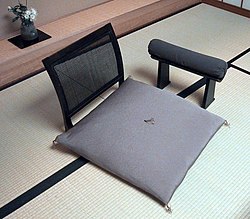
A zaisu, pictured here with zabuton and kyōsoku [ja]

A zaisu (Japanese: 座椅子) is a Japanese chair with a back and no legs.[1] They are often found in traditional rooms with tatami mats, and are often used for relaxing under heated kotatsu tables. Zaisu come in many styles, and can either have a cushion built in or be used with a zabuton. For an even more relaxed seating arrangement, one may also use a Japanese style armrest called a kyōsoku (脇息).[2]

Use

[edit]

Traditionally, the correct sitting style in Japan is seiza, kneeling with the weight on top of the lower legs, which are folded underneath the body. However this can become painful after long periods of time or for people who are not used to it, so many prefer the zaisu, where the back is supported and legs can be positioned more comfortably.

Zaisu are very common in Japan, particularly in houses with traditional Japanese-style rooms (washitsu)[1] where low tables and sitting on a floor of tatami mats are commonplace. They are used for relaxing on a cold night under a heated kotatsu table.[3]

References

[edit]
[edit]
Revisions and contributorsEdit on WikipediaRead on Wikipedia
from Grokipedia
A zaisu (座椅子) is a traditional Japanese chair featuring a backrest but no legs, designed specifically for floor-level seating on mats. It provides ergonomic support for the back while allowing the user to sit in a cross-legged or folded-leg position, serving as a comfortable alternative to the formal posture. Commonly found in traditional Japanese homes, the zaisu is often placed in rooms with flooring and used for relaxation under heated kotatsu tables during winter. Its design reflects core elements of Japanese interior culture, emphasizing low-profile furniture that harmonizes with minimalist aesthetics and facilitates prolonged sitting for activities like tea ceremonies, , or casual gatherings. The term derives from za (座), meaning "to sit," and isu (椅子), meaning "chair," highlighting its role as a seated support adapted to floor-based living. In modern contexts, zaisu chairs continue to embody principles of simplicity and functionality, with variations in materials such as wood, rattan, or upholstery to suit contemporary interiors while preserving their cultural essence. They address ergonomic needs by promoting better spinal alignment.

History and Origins

Traditional Development

The origins of zaisu are deeply rooted in ancient Japanese floor-sitting customs, which emphasized low or absent seating to harmonize with the minimalist architecture of homes built on raised floors and tatami mats. During the Heian period (794–1185 CE), seating was typically limited to zabuton cushions placed directly on the floor or tatami, with no elevated furniture; individuals adopted postures like seiza (kneeling with buttocks on heels) for formal occasions such as prayer and court rituals, reflecting a cultural preference for proximity to the ground that symbolized humility and connection to nature. This era established the foundational practice of floor-based repose without back support, as evidenced in historical records of noble living spaces where tatami served both as flooring and rudimentary cushioning. During the (1603–1868 CE), floor-sitting practices with cushions and posture became more formalized as a in civic life and ceremonies. These developments responded to the demands of daily activities in rooms, where traditional required low postures. Zaisu represents an indigenous innovation that evolved from these rudimentary supports into a dedicated form providing ergonomic relief for and other postures, preserving Japan's floor-sitting heritage. Zaisu as a distinct furniture form emerged in the late 19th to early , coinciding with the (1868 onward) and subsequent modernization, blending traditional minimalism with accommodations for comfort. This period marked zaisu's establishment, rooted in centuries of floor-seating evolution yet responsive to changing domestic needs. Foreign chair influences later shaped variations, but zaisu's core design remained an adaptation of pre-existing indigenous practices.

Introduction of Chair Influences

The arrival of Westerners in during the , facilitated by Portuguese traders through the , marked an early encounter with foreign concepts that contrasted with established Japanese floor-sitting practices rooted in mat culture. These exchanges introduced various goods and ideas but were largely incompatible with the low-profile zashiki rooms, prompting adaptations in design. Chairs had been introduced to Japan on multiple occasions prior, including from around 2,000 years ago alongside cultural imports like , yet persistent floor-based norms limited widespread adoption until hybrid solutions emerged. The zaisu exemplifies a cultural hybrid, preserving the no-leg structure to harmonize with flooring and formal zashiki spaces while integrating backrest , thus bridging foreign comfort with domestic spatial constraints. This adaptation reflected Japan's selective assimilation of external influences, prioritizing functionality within traditional . Following the in 1868, the influx of Western furniture accelerated modernization, yet zaisu proliferated in public venues like inns as a nationalist adaptation, offering back-supported seating that maintained amid growing imports of high-legged chairs. These legless designs became staples in guest rooms, placed alongside low tables to support or relaxed postures without disrupting aesthetics.

Design and Features

Physical Structure

The zaisu employs a legless base design that rests directly on the floor, typically featuring a low profile of 5–10 cm in height to enable seamless contact and compatibility with mats while distributing weight evenly across a broad surface area. This configuration ensures stability without elevating the user significantly above the ground, adapting to the demands of floor-based living. The backrest is typically 40–50 cm tall and reclined at a slight angle to provide targeted support that discourages slouching while facilitating upright posture. This angled support aligns with the natural curve of the spine, enhancing comfort over prolonged periods. The is commonly built from to achieve and a form. The seating area consists of a contoured cutout or flat platform roughly 40 cm by 40 cm, contoured to fit cross-legged () or extended leg positions comfortably. Optional armrests, termed kyōsoku, extend along the sides to offer additional leverage for rising from the floor and bolster overall stability. Ergonomically, the zaisu fosters neutral spine alignment by supporting the lower back and permitting flexible leg arrangements, which contrasts with the rigid kneeling posture and mitigates associated strain on joints and muscles during extended sessions. This design promotes improved circulation and reduced risk of , making it suitable for sustained floor sitting.

Materials and Variations

Zaisu chairs are commonly constructed from hardwoods such as or for their frames, valued for durability and aesthetic appeal in traditional Japanese craftsmanship. These woods provide a yet sturdy base, often paired with or for padded versions to enhance comfort during prolonged sitting. In more austere traditional models, seats feature rush weaving using natural igusa grass to create breathable, flexible surfaces that conform to the user while maintaining structural integrity. Variations in zaisu design reflect functional and stylistic diversity, including basic unpadded models suited for formal settings where prioritizes posture alignment over cushioning. Cushioned versions integrate padding for relaxed use, blending seat and back support. Modern variants may incorporate , recycled fabrics, or adjustable reclining mechanisms while echoing traditional forms. Typical dimensions for adult zaisu are approximately 40-55 cm in width, 45-60 cm in depth, and 40-50 cm in height, accommodating floor-seating . Overall weight typically ranges from 3 to 8 kg, contributing to their portability and ease of rearrangement in domestic environments.

Usage and Applications

In Traditional Japanese Settings

In traditional Japanese washitsu rooms, characterized by flooring, zaisu are typically placed in sets around a low table to facilitate family meals or gatherings, maintaining the floor-level essential to the space. This arrangement allows occupants to sit comfortably without elevating the seating above the tatami surface, aligning with the room's minimalist aesthetic and the zaisu's legless design for seamless integration. Zaisu are frequently paired with , a heated low table covered by a for winter warmth, where they provide essential back support during extended periods of relaxation or conversation. In such setups, the zaisu enables users to lean back while tucking their legs under the , enhancing comfort in uninsulated traditional homes during cold seasons. Within inns, zaisu offer guests an alternative to prolonged posture around low tables, preserving the undisturbed flow of the floor while supporting relaxed seating for meals or rest. In tea houses, similar arrangements position zaisu near for ceremonies, ensuring participants can maintain proper form without fatigue. in these settings dictates that the most honored guest faces the alcove, with zaisu oriented accordingly to honor the room's focal point of art or seasonal display. For home gatherings, such as New Year's meals, zaisu accommodate elderly or fatigued family members by providing backrest support during multi-hour sessions around the , blending practicality with cultural observance. This use underscores the zaisu's role in sustaining traditional routines across generations in tatami-based interiors.

Modern and Contemporary Adaptations

Following , zaisu experienced a surge in popularity within urban Japanese apartments, where space constraints and the rise of in the encouraged casual floor seating for family viewing and lounging. Mass-produced versions incorporating frames and cushions became widely available, making them accessible for everyday use in modern homes. Zaisu have been exported to Western markets as "floor chairs," often rebranded to appeal to consumers interested in , gaming, or ergonomic seating. These adaptations typically feature adjustable reclines and cushioned supports to enhance comfort during prolonged floor sitting, aligning with growing interest in minimalist and low-profile furniture. A notable example of contemporary redesign is the 2023 collaboration between Japanese furniture maker Cellutane and the Pokémon franchise, which released the Sizzlipede Zaisu Chair. This limited-edition piece integrates the /Bug-type Pokémon's segmented with the traditional legless structure, targeting fans while maintaining functional back support for relaxed seating. As of 2025, zaisu continue to evolve with sustainable materials, such as designer variants using for eco-friendly construction, reflecting broader trends in environmentally conscious Japanese craftsmanship. In the region, their appeal has grown amid hybrid work-from-home setups, where compact, versatile seating supports informal office use in small living spaces.

Cultural and Social Role

Significance in Japanese Lifestyle

The zaisu chair reflects the simplicity and functionality central to Japanese design philosophy, characterized by its low-profile form and use of natural materials like or , fostering a grounding connection to the floor. This design promotes understated elegance that aligns with cultural values of and authenticity. In social contexts, the zaisu provides inclusive, low seating in homes that accommodates guests during gatherings around low tables like the . Its design enables flexible group arrangements on mats, where participants sit in close proximity to promote shared interaction. The zaisu supports relaxed postures suitable for reflection, integrating comfort into daily routines. In Japan's aging society, where over 28% of the population was 65 or older by 2020—rising to nearly 30% by 2024—the zaisu offers back support that eases joint strain for the elderly, allowing sustained comfort in floor-based living without abandoning cultural norms. This evolution highlights how zaisu bridges heritage and modern , ensuring in an era of demographic shift toward extended lifespans.

Comparisons with Other Seating Forms

The zaisu distinguishes itself from the , a traditional Japanese floor cushion primarily used for padding during formal posture, by incorporating a rigid backrest that provides lumbar and upper back support to alleviate strain during extended sitting periods. While offer cushioning for the legs and hips on mats, they lack structural support for the spine, making the zaisu a more ergonomic option for prolonged use in relaxed settings like gatherings. In contrast to Western floor poufs or chairs, which rely on soft, malleable fillings like beads for a formless lounging experience, the zaisu employs a sturdy wooden frame to promote upright posture and long-term durability. This rigid construction prevents the sinking that can lead to poor spinal alignment in bean bags, instead encouraging a supported, cross-legged position compatible with flooring and traditional Japanese spatial constraints. Compared to other Asian seating forms, such as those in Korean ondol-heated homes, the zaisu emphasizes portability and adaptability to unheated surfaces, whereas setups favor minimal, low-profile cushions like bangsuks that integrate directly with the warmed, fixed floor for multifunctional use. Korean floor seating, influenced by the system's emphasis on even heat distribution, typically avoids elevated or framed structures to maintain seamless contact with the heated surface, highlighting the zaisu's design priority for mobility in non-heated Japanese interiors. Unlike elevated Western-style chairs introduced during Japan's Meiji-era modernization, the zaisu preserves floor-level positioning, which aligns with Japanese spatial that minimizes visible hierarchies by ensuring all participants sit at the same height to foster communal equality. This adaptation underscores the zaisu's role in maintaining cultural norms of modesty and shared presence without the vertical distinctions of raised seating.

References

Add your contribution
Related Hubs
User Avatar
No comments yet.