Hubbry Logo
OndolOndolMain
Open search
Ondol
Community hub
Ondol
logo
8 pages, 0 posts
0 subscribers
Be the first to start a discussion here.
Ondol
Ondol
from Wikipedia
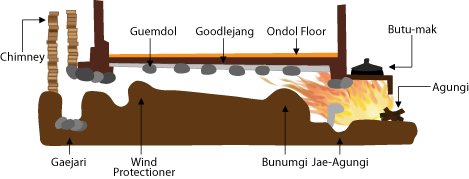
An illustration of the ondol system
Korean name
Hangul
온돌
Hanja
溫突/溫堗
Revised Romanizationondol
McCune–Reischauerondol
IPA[on.dol]
Alternate name
Hangul
구들
Revised Romanizationgudeul
McCune–Reischauerkudŭl
IPA[ku.dɯl]

Ondol (ON-dol; /ˈɒn.dɒl/,[1] Korean온돌; Hanja溫突/溫堗; Korean pronunciation: [on.dol]) or gudeul (구들; [ku.dɯl]) in Korean traditional architecture is underfloor heating that uses direct heat transfer from wood smoke to heat the underside of a thick masonry floor. In modern usage, it refers to any type of underfloor heating, or to a hotel or a sleeping room in Korean (as opposed to Western) style.

The main components of the traditional ondol are an agungi (아궁이; [a.guŋ.i]), a firebox or stove, accessible from an adjoining room (typically kitchen or master bedroom), a raised masonry floor underlain by horizontal smoke passages, and a vertical, freestanding chimney on the opposite exterior wall providing a draft. The heated floor, supported by stone piers or baffles to distribute the smoke, is covered by stone slabs, clay and an impervious layer such as oiled paper.

History

[edit]

Origin

[edit]

Use of the ondol has been found at archaeological sites in present-day North Korea. A Neolithic Age archaeological site, circa 5000 BC, discovered in Sonbong, Rason, in present-day North Korea, shows a clear vestige of gudeul in the excavated dwelling (움집).

Early ondols began as gudeul that provided the heating for a home and for cooking. When a fire was lit in the furnace to cook rice for dinner, the flame would extend horizontally because the flue entry was beside the furnace. This arrangement was essential, as it would not allow the smoke to travel upward, which would cause the flame to go out too soon. As the flame would pass through the flue entrance, it would be guided through the network of passages with the smoke. Entire rooms would be built on the furnace flue to create ondol floored rooms.[2]

Etymology

[edit]

The term gudeul is a native Korean word. According to Korean folkloric historian Son Jin-tae [ko](孫晋泰) (1900 – missing during the 1950–53 Korean War), gudeul originated from guun-dol (Korean), which means "heated stone", and its pronunciation has changed into gudol or gudul, and again into gudeul.

The term ondol is Sino-Korean and was introduced around the end of the 19th century.[3] Alternate names include janggaeng (장갱; 長坑), hwagaeng (화갱; 火坑), nandol (난돌; 暖突), and yeondol (연돌; 烟突).[4]

Paleolithic to Neolithic Age

[edit]

The ruins that are said to have been first discovered using the ondol for a long time include the Hoeryong Odong ruins of Hoeryong in Hoeryong, North Hamgyong Province, North Korea, and the remains of Gulpo Port, which are believed to be a Neolithic residence (house) around 5000 BC in Unggi County, North Hamgyong Province. It is said that there are clear traces of the ondol found there at the time.

The Bronze Age

[edit]

Since then, it is estimated that the ondol has been handed down for more than 2,000 years in the Korean Peninsula, considering that it originated from a primitive heating method with a fireplace and a year similar to the method of the Three Kingdoms from the Bronze Age.

The Three Kingdoms period

[edit]

The ondol was also painted on the mural of the Goguryeo tomb of Anak No. 3 in Hwanghae-do around the 4th century, which was proof that the ondol was also used in Goguryeo.

Goryeo to Joseon

[edit]

From the end of the Goryeo dynasty, the ondol began to appear in the form of canisters made of rooms. It was mainly used by the wealthy and mostly used in rooms for the sick and the elderly. It was considered a luxurious heating system in terms of difficulty in making, management, and fuel consumption.

In the Joseon dynasty, the ondol was used to establish a hierarchical order of seats in the room with the lower neck, a point close to the furnace, as the upper seat. In the Annals of the Joseon Dynasty on May 14, the 17th year of King Taejong's reign (1417), there is a record of making an ondol room for the sick among the students of Seonggyungwan, who were just established at the time. From this, it can be seen that the ondol room was not entirely used. After that, in the 7th year of King Sejong (1425), the ondol of Seonggyungwan was increased to 5 steps, and it was not until the 16th century that all of them became ondol rooms.

In general, all beds were used and wooden floors were used. On February 4, 1563, there was a fire accident in the king's bedroom. Among the explanations of the circumstances at this time, a small ondol structure was made on the king's bed to heat the seat, and at this time, the stone was inadvertently placed incorrectly, and the fire broke out when the fire touched the bed. The article in the Annals of the Joseon Dynasty on March 5, 1624, shows that the Nine's room was also changed to an Ondol room because the Nine's room was not good for the Nine to stay in Panbang, although all the seawalls where the servants of the Four Godfathers lived were ondol during the Gwanghaegun period.

The climate was exceptionally cold, so through the 16th and 17th centuries, which is also called the Little Ice Age, ondol became more and more common, and in the late Joseon dynasty, ondol was widely used in thatched houses of ordinary people.

Current

[edit]

Traditional ondol systems provide long-lasting warmth after heating but consume significant fuel, requiring large amounts of firewood. This heavy demand for fuel contributed to deforestation on the Korean Peninsula from the late Joseon Dynasty through the 1950s and 1960s. Starting in the 1960s, firewood was replaced by coal briquettes (yeontan) while retaining the stone slab structure (gudeuljang). However, the incomplete combustion of coal briquettes led to numerous carbon monoxide poisoning incidents. In 1962, to address these issues and improve efficiency, hot-water boilers utilizing the ondol system were developed, reducing both fuel consumption and the risk of poisoning.

Use

[edit]

Ondol had traditionally been used as a living space for sitting, eating, sleeping and other pastimes in most Korean homes before the 1960s. Koreans are accustomed to sitting and sleeping on the floor, and working and eating at low tables instead of raised tables with chairs.[5] The furnace burned mainly rice paddy straws, agricultural crop waste, biomass or any kind of dried firewood. For short-term cooking, rice paddy straws or crop waste was preferred, while long hours of cooking and floor heating needed longer-burning firewood. Unlike modern-day water heaters, the fuel was either sporadically or regularly burned (two to five times a day), depending on frequency of cooking and seasonal weather conditions.

With the traditional ondol heating, the floor closer to the furnace was normally warm enough, and the warmest spots reserved for elders and honored guests. Ondol had problems such as environmental pollution and carbon monoxide poisoning resulting from burning coal briquettes.[6] Thus, other technology heats modern Korean homes.

The famous American architect Frank Lloyd Wright was building a hotel in Japan and was invited to a Japanese family's house. The homeowner had experienced the ondol in Korea, and had built an ondol room in his house. Wright reportedly was so impressed [citation needed] that he invented radiant floor heating which uses hot water as the heating medium. Wright introduced floor heating to American houses in the US in the 1930s. [7]

Instead of ondol-hydronic radiant floor heating, modern-day houses such as high-rise apartments have a modernized version of the ondol system. Many architects know the advantages and benefits of ondol, and they are using ondol in modern houses. Since the ondol has been introduced to many countries, it is beginning to be considered as one of the systems of home heating. Modern ondol are not the same as the original version. Almost all Koreans use modern versions, so it is hard to find the traditional ondol system in Korean houses.[8] North Korea still utilizes the basic traditional design of the Ondol that use mostly coal instead of biomass to survive the harsh winters.

Advantages and disadvantages

[edit]

One of the advantages of an ondol is that it can maintain heat for an extended period. In a traditional Korean house, people usually extinguish the fire before going to sleep at night, since it can stay warm until the morning. An ondol conducts heat evenly throughout the whole room, although the part of the room closest to the agungi is much warmer. Comparing the ondol with the Western radiator: the heat from the radiator rises towards the ceiling, but an ondol keeps both the floor and the air in the room warm. The advantage of the ondol is that people do not have to worry about breakdown and repair of the ondol. [citation needed] The Ondol is part of the house, therefore, it is less likely to run into problems. Any combustible materials can be used as fuel for the ondol; there are no special fuel requirements. In contrast to heaters, such as fireplaces or charcoal-based heaters that leave ash in the room, an ondol does not cause pollution in the room leaving it clean and warm.[9][10]

The ondol has some disadvantages. Mud and stones are the main materials that make up the ondol. Such materials take quite a long time to heat up, therefore the room takes a long time to warm up. In addition, it is difficult to adjust the temperature of the room.[9]

Dol bed

[edit]

The dol bed, or stone bed, is a manufactured bed that has the same heating effect as ondol. The dol bed industry is estimated to be worth 100 billion South Korean won, comprising 30 to 40 percent of the entire bed industry in South Korea; dol beds are most popular with middle-aged people in their 40s and 50s.[11][12]

See also

[edit]

References

[edit]
[edit]
Revisions and contributorsEdit on WikipediaRead on Wikipedia
from Grokipedia
Ondol is a traditional Korean underfloor heating system that utilizes direct heat transfer from a wood or coal fire in an external furnace to warm the floor through a network of flues and heat-retaining stone slabs, providing efficient and even warmth to living spaces. Originating in ancient Korea during the Old Joseon period (circa 2333–108 BCE), ondol evolved as an indigenous innovation to combat the region's harsh winters, with evidence of early forms dating back to the Bronze Age (900–800 BCE) and significant development during the Three Kingdoms period (57 BCE–668 CE). The system works by channeling hot smoke and air from a kitchen fireplace—often called agungi—through parallel underfloor channels (gorae) beneath thick stone or clay slabs (gudeuljang), which absorb and radiate heat upward while the smoke exits via a chimney (yeonga), ensuring prolonged warmth after each heating session. This design not only heats the floor but also serves dual purposes for cooking, making it highly resource-efficient and space-saving, with no visible heating elements or noise, and it promotes a cultural practice of sitting, eating, and sleeping directly on the warm floor, often covered with oiled hanji paper for moisture regulation and comfort. Historically accessible to all social classes, ondol shaped Korean architecture and daily life, fostering a barefoot indoor culture and influencing health practices due to its gentle, radiant heat that improves circulation and reduces allergens. In the 20th century, it was modified to use anthracite coal (1950s–1970s) and later inspired modern underfloor systems worldwide after American architect Frank Lloyd Wright encountered it in the early 20th century, during his time in Japan, and advocated its principles, inspiring the widespread adoption of modern underfloor heating systems in Europe and beyond. Recognized as an important element of Korean cultural heritage, traditional ondol persists in rural Korean homes and hanok structures, while contemporary versions in urban apartments employ electric or hot-water boilers—often integrated with renewable energy sources as of 2025—maintaining its legacy of energy efficiency and cultural ingenuity.

Definition and Etymology

Definition

Ondol is a traditional Korean underfloor heating system designed to provide even warmth to living spaces by circulating hot smoke generated from a wood-fired through flues embedded beneath the floor. This mechanism relies on the of wood or other fuels in an enclosed furnace, where the resulting heat and smoke are directed under the floor surface to radiate warmth upward into the room. The core principle of ondol involves primarily through conduction, as the hot smoke warms the stone or materials, which then release stored heat gradually via and to maintain a comfortable indoor . To ensure and air quality, the smoke is vented out through a after passing through the flues, minimizing indoor while maximizing . Unlike Western fireplaces, which primarily heat the air directly via , or modern systems that distribute hot air or water through ducts, ondol emphasizes direct floor heating to create radiant warmth that rises naturally, allowing occupants to sit or lie comfortably on the heated surface. This system was widely adopted in traditional Korean homes, contributing to a distinct indoor climate that extended comfort during the region's harsh winters.

Etymology

The term ondol derives from Sino-Korean roots, written in Hanja as 溫突, combining on (溫, meaning "warm") and dol (突, phonetic for the Korean word "dol" meaning "stone"), commonly interpreted as "warm stone" to describe the heated stone floor central to the system. Some historical Chinese records interpret it as "warm hollows." This nomenclature emphasizes the thermal properties of the stone slab that retains and radiates heat. An older native Korean term for the system is gudeul, literally meaning "baked stone" or "heated stone," reflecting the process of firing the floor materials to enhance heat retention. The underfloor flues are referred to as gorae. Gudeul appears in colloquial usage predating the more formal ondol, which gained prominence in the during the Dynasty as Sino-Korean terminology became standardized in architectural descriptions. The evolution of these terms is documented in historical texts, with ondol first emerging explicitly in the Annals of the Joseon Dynasty during King Sejong's reign (1418–1450), marking its formal recognition as a distinct heating technique. Prior to this, gudeul-like descriptions appear in Three Kingdoms-era accounts, underscoring the system's longstanding linguistic ties to stone-based warmth.

History

Prehistoric Origins

The earliest evidence of heating practices in Korean prehistoric dwellings emerges from the Paleolithic period, where simple fire pits were used to warm interiors of caves and rudimentary shelters. These basic methods relied on direct exposure to flames for warmth, reflecting the initial human adaptation to cold climates through controlled fire use in semi-permanent living spaces. During the period, archaeological excavations at sites like Amsa-dong in , dating to circa 3000 BCE, reveal pit houses equipped with central pit hearths that allowed for smoke dispersal across the floor, serving as a precursor to more advanced heating systems. These structures, often semi-subterranean with thatched roofs, incorporated hearths positioned to heat the living area while permitting smoke to vent through openings or channels in the , enhancing in communal settings. Such arrangements indicate an evolving understanding of heat retention in domestic environments, though still primitive compared to later innovations. By the , around 1000 BCE, prehistoric heating transitioned toward structured flues in semi-permanent settlements, as demonstrated by remnants at the Unggi site in Hamgyeongbuk-do, present-day , where stone-lined channels directed smoke under floors to radiate heat evenly. This development, often termed an early form of gudeul, marked the foundational concept of radiant heating by utilizing combustion byproducts to warm living surfaces without filling the space with smoke. Artifacts from this era across the Korean Peninsula, including brick and stone components, confirm the widespread adoption of these flues in variants, setting the stage for subsequent refinements.

Ancient and Medieval Development

The ondol system saw significant adoption and refinement during the period (57 BCE–668 CE), particularly in royal palaces and elite structures of , where it transitioned from rudimentary forms to more advanced configurations for centralized heating. Archaeological evidence from Goguryeo settlements and illustrates sophisticated flue systems, such as those constructed with long stone slabs forming single-channel passages beneath floors to distribute heat efficiently from a furnace. For instance, excavations at sites like the Pungnap-dong Historic Site reveal early pit-house adaptations with stone flues, while murals in Anak Tomb No. 3 depict palace complexes incorporating heating for multiple buildings, underscoring its role in royal and upper-class residences. In the Goryeo Dynasty (918–1392 CE), ondol underwent further institutionalization and expansion, integrating into Buddhist temples and urban dwellings to achieve uniform room-wide warmth, marking a shift toward broader architectural application. By the mid-13th century, the system had evolved into a full-floor heating method connected to external furnaces, with remnants from temple sites like Hoeamsa demonstrating its use in religious buildings for sustained heat during extended rituals and monastic life. Urban homes in capital areas, as referenced in historical regulations from the , increasingly featured ondol for elite and merchant classes, promoting even heat distribution across living spaces and reflecting Goryeo's cultural emphasis on communal warmth in spiritual and civic contexts. During the early period (1392–1598 CE), ondol achieved standardization within architecture, facilitating interconnected multi-room heating networks that enhanced efficiency in institutional and residential designs. Historical records from educational complexes like Seonggyeonggwan detail the implementation of linked flue systems across dormitories and lecture halls, ensuring consistent warmth for scholars and officials. Palaces such as Yeongyeongdang exemplified this advancement with integrated agungi furnaces and yeondol channels serving multiple chambers, solidifying ondol's role as a cornerstone of architectural uniformity.

Joseon Era Advancements

During the late Dynasty (17th–19th centuries), ondol systems reached their peak of technical refinement and societal integration, building briefly on medieval designs that had established basic underfloor flues. Innovations focused on enhancing heating efficiency and minimizing indoor smoke exposure, such as the strategic separation of the kitchen furnace (agungi) from living spaces via walls or dedicated exhaust paths, which channeled smoke more effectively through independent chimneys while retaining radiant heat beneath the floors. This technique, evident in refined residential layouts, reduced smoke infiltration compared to earlier configurations and allowed for more consistent warmth across larger areas, as documented in historical analyses of heating practices. Ondol became ubiquitous in both elite and commoner dwellings, reflecting Confucian ideals of spatial hierarchy and communal living. In (scholar-official) homes, such as the literati-style Choong Ui Dang in , ondol facilitated organized room divisions with heated floors designating status—higher-ranking individuals occupied warmer sections near the furnace—while integrating seamlessly with wooden architecture for year-round use. By the , the system had expanded from single guest rooms to entire bedrooms and main halls in typical households, promoting ondol's adoption among commoners in thatched-roof homes across urban and rural settings; royal palaces, like the Juhamnu Pavilion built in 1776 under King Jeongjo, incorporated advanced ondol variants for elite comfort. This widespread use underscored ondol's role in shaping Korean domestic culture, with nearly 97% of Korean households relying on it by the early . The system's decline began in the amid rapid urbanization, population growth during the , and escalating fuel demands that depleted forests near cities. Annual requirements of 5.6–7.3 million cubic meters of fuelwood and millions of tons of forest litter led to widespread , bare mountains, and landslides, as critiqued by scholar Seo Yu Gu (1764–1845) who described ondol as fostering "three social menaces" through resource strain. Foreign influences, including Japanese colonial policies from 1910, further eroded traditional practices by promoting Western-style housing and land reforms, resulting in partial abandonment of ondol by the early in favor of imported heating methods.

Modern Revival and Adaptations

Following the rapid urbanization and modernization of in the mid-20th century, interest in preserving traditional architecture and its ondol heating systems emerged in the late 1960s, amid concerns over loss during industrialization. Government-led restoration programs gained traction in the early 2000s, with cities like and providing subsidies and loans—up to KRW 50 million per household in the early 2000s, increasing to up to KRW 180 million as of 2023—for renovations, often integrating updated ondol systems to maintain authenticity while improving safety and efficiency. These efforts revived ondol in restored villages, blending the traditional masonry flues with electric heating elements or hot-water circulation to eliminate risks like associated with older wood or coal-based methods. Modern adaptations of ondol, commonly using hydronic systems with boilers and embedded pipes, prioritize energy efficiency and even heat distribution, drawing from Joseon-era designs but optimized for contemporary building standards. By the , these variants had become standard in residential construction, installed in over 90% of South Korean homes, including nearly all urban apartments, reflecting their widespread acceptance for reducing compared to systems. This "modern ondol" maintains the floor's for sustained warmth while allowing precise temperature control via centralized boilers, contributing to lower heating costs in high-density housing. Internationally, ondol principles have influenced technologies beyond Korea. In , where traditional tables provided localized warmth, many households adopted ondol-inspired radiant floor systems in the late for more uniform heating, particularly in urban apartments. Since the , eco-friendly adaptations have appeared in and , with companies offering low-profile radiant panels based on ondol's direct to promote savings and in retrofits and new builds. These global exports highlight ondol's role as a precursor to efficient, low-emission heating solutions amid rising demand for green .

Design and Construction

Core Components

The traditional ondol system relies on several interconnected physical elements designed for efficient distribution in Korean homes. These core components include the agungi, gorae, ondol floor, and chimney, each constructed from locally available natural materials to facilitate through conduction and . The agungi, or firebox, serves as the primary furnace where occurs, typically fueled by . Positioned externally or in an adjoining space like the , it features a that often supports a cooking caldron above the fire, allowing dual use for heating and meal preparation. Constructed from heat-resistant stone or clay bricks, the agungi generates hot gases that are directed into the underfloor channels, with its design ensuring controlled airflow to prevent excessive smoke buildup. The gorae consists of underground flues or channels that transport hot smoke and gases from the agungi beneath the living space . These passages, typically made of clay or stone, run parallel under the , sometimes starting as separate ducts that merge toward the exit to promote even heat distribution. The gorae's dimensions and layout are critical for minimizing heat loss while allowing gases to circulate effectively before venting; sizes vary by region and house design, often around 30 cm in height and width. The ondol floor, known as gudeul, forms the heated surface of the room and is engineered for superior and retention. It comprises a base layer of thick stone slabs (gudeuljang), usually or similar rock, laid over the gorae channels and supported by stone piers or baffles to allow smoke passage. Above this, a layer of clay or provides insulation and seals gaps, followed by a finishing of oiled hanji fiber) for a smooth, waterproof surface that enhances radiant emission. This multi-layered structure, raised slightly above ground level, absorbs from below and radiates it steadily into the room. Dimensions and materials can vary regionally, with slab thickness typically around 9 cm in historical examples. The , referred to as jumul or gulttuk, acts as the vertical exhaust stack that draws out and cooled gases, creating natural draft for the entire system. Located opposite the agungi, often at the room's far end or exterior wall, it is built tall to enhance upward pull and prevent backflow of fumes into the living area. Made of stacked stones or clay pipes, the chimney's height and positioning ensure optimal airflow, with a narrow opening at the base connecting to the gorae for seamless gas expulsion.

Building and Installation Methods

The construction of traditional ondol systems begins with site preparation, which involves excavating the underfloor space within the foundations of a (traditional Korean house) to accommodate the furnace, flues, and . This excavation typically occurs along the exterior walls to integrate the system seamlessly with the building's structure, creating channels for heat distribution while maintaining . The assembly sequence follows a methodical process to ensure efficient heat flow and durability. First, the gorae (flue passages) are installed by digging parallel channels beneath the floor level, lining them with stones or bricks to form enclosed pathways for smoke and heat from the agungi (furnace). These flues are positioned to connect the furnace to the chimney, with flat, thick stone slabs placed over the channels to form the heated floor surface, supported by stone piers or baffles for even distribution. Insulation is achieved through the thermal mass of the stones, and the entire system is sealed with layers of clay or mortar to prevent smoke leakage and retain heat, often finished with an impervious layer such as oiled paper for the living surface. In modern adaptations, ondol installation incorporates reinforcements for enhanced structural integrity, particularly in urban settings where building codes require seismic resistance and compliance. Hot water circulation replaces direct , with systems featuring a 135 mm base, embedded (XLPE) pipes spaced at 230 mm intervals, and a 24 mm mortar finish over insulation layers like autoclaved (ALC) to optimize . These modifications allow ondol to be integrated into contemporary apartments and revivals while adhering to energy standards.

Operation and Usage

Traditional Heating Process

The traditional heating process of ondol involves loading , such as or logs, into the agungi, a firebox typically integrated into the structure. The fuel is ignited using kindling, and the fire is actively maintained for short periods, typically around meal times, with fires lit 2–3 times a day to generate intense heat, with smoke and hot gases directed through the gorae flues beneath the floor slabs. This initial firing phase rapidly warms the stone and clay layers of the gudeul, the heated floor surface, while also serving dual purposes for cooking in the adjacent space. Once the active burning subsides, the system's —comprising thick stone slabs and insulating —retains and radiates residual for 8–12 hours, often extending warmth through the night without further fuel addition. Heat circulation occurs as the combustion gases traverse the interconnected gorae channels, evenly distributing warmth across the floor and reaching surface temperatures of 33–40 °C in well-maintained systems, promoting radiant heating from below. To sustain the burn and manage combustion byproducts, ash is periodically removed through a side access door on the agungi, preventing blockages and ensuring efficient toward the exterior . Maintenance of the traditional ondol emphasizes annual cleaning of the gorae flues to remove accumulated , which could otherwise reduce efficiency and pose risks. This involves accessing cleanout points to sweep out , a task typically performed in late summer before the heating season. Seasonal adjustments, such as moderating firing intensity during humid periods, further aid in controlling indoor moisture levels amid Korea's with high summer and cold winters.

Integration with Daily Life

In traditional Korean households, the ondol system profoundly influenced daily routines by enabling a floor-centric that emphasized communal activities and direct contact with the heated surface. Families gathered on the warm ondol floors for meals, often sitting cross-legged around low tables or directly on mats, fostering close-knit interactions in multi-generational homes where space was multifunctional—serving for eating, working, and socializing without the need for elevated furniture. This setup, prevalent since the Joseon Dynasty, transformed rooms into adaptable spaces that shifted from daytime activities like studying or crafting to evening rest, with the consistent underfloor warmth encouraging prolonged floor-based engagement throughout the day. Sleeping directly on the ondol-heated floors was a cornerstone of this lifestyle, providing radiant warmth that penetrated bedding and supported rest without additional structures in most regions. This practice, integrated into architecture, allowed families to sleep comfortably on thin mats atop the floor, preserving body heat overnight and aligning with the cultural norm of floor sleeping that persisted into modern times. The ondol's floor warming also contributed to hygiene in densely occupied homes by reducing dampness through constant low-level heat that dried out the masonry surfaces, preventing mold growth in Korea's humid climate. This dryness, combined with the cultural practice of removing shoes at the threshold, minimized the introduction of outdoor dirt and created an environment less hospitable to pests like insects and rodents, as there were no carpets or moist crevices to harbor them; in multi-generational settings, this promoted overall health by lowering respiratory issues and skin irritations associated with damp living conditions.

Advantages and Disadvantages

Key Benefits

The ondol system's energy efficiency stems from its radiant heating mechanism, which utilizes in the floor to store and release heat gradually, requiring only a single firing of the furnace to maintain warmth for an entire day or longer in well-constructed setups. This contrasts sharply with traditional open fires, which achieve only 10-15% by losing most heat through and chimney exhaust, whereas ondol-like radiant systems reach 80-90% by maximizing heat absorption and minimizing drafts through even floor-level distribution. Studies on ondol simulations confirm its favorable energy performance, using less fuel overall compared to convective heating methods while providing consistent indoor comfort. Health benefits of ondol arise from its provision of even, gentle warmth at floor level, which promotes blood circulation in the lower body without the dry air or uneven temperatures associated with overhead heating. Historically applied to aid the weak and elderly, this radiant heat improves physiological responses like and in the feet, potentially reducing strain on the cardiovascular system. Additionally, by avoiding circulation, ondol minimizes the spread of dust, allergens, and airborne particles, which can alleviate respiratory issues such as allergies and ; radiant floor systems like ondol have been linked to cleaner indoor air and lower incidences of related problems. Environmentally, ondol aligns with through its reliance on local wood fuels and passive design principles that optimize natural heat retention without mechanical aids. This traditional approach has seen revival in energy-efficient applications, such as in remote or regions.

Potential Drawbacks

One significant concern with traditional ondol systems involves the risk of (CO) poisoning due to poor ventilation or cracks in the flues, which allowed toxic fumes from wood or to seep into living spaces. Historical data from Korea indicate that between 1965 and 1976, gas leaks from ondol structures accounted for 54.2% of accidental CO poisoning incidents, contributing to thousands of severe cases and deaths over decades. In the , the widespread use of briquettes in ondol setups exacerbated this issue, leading to numerous fatalities in enclosed rooms, particularly during sleep, as the system lacked adequate exhaust mechanisms. Maintenance of traditional ondol was labor-intensive, requiring frequent cleaning of flues and channels to remove buildup, which could otherwise lead to blockages causing uneven heating or potential hazards from ignited residues. Without regular upkeep, such as inspecting and repairing cracks or clearing ash deposits, the risked inefficient heat distribution, with some areas remaining cold while others overheated, due to the absence of insulation in early designs. This hands-on process often involved seasonal deep cleaning, making it demanding for households without dedicated labor. In hot climates or during summer months, ondol's radiant heat retention posed challenges, as residual warmth from the floor could exacerbate overheating, necessitating separate cooling strategies like natural ventilation through open windows or fans. Traditional setups, optimized for cold winters, lacked built-in cooling capabilities, leading to discomfort in humid, warm conditions without additional interventions. Modern adaptations, such as hot water or electric systems, have largely mitigated CO risks by eliminating direct , while integrating CO sensors and detectors in homes with gas boilers further enhances safety. However, the summer limitation persists, often requiring hybrid systems with for balanced climate control.

Cultural and Modern Impact

Role in Korean Culture

Ondol embodies a profound symbolism in Korean culture, representing through its reliance on natural materials like stone, clay, and wood to channel heat efficiently, aligning with traditional ecological principles that emphasize in Korea's harsh climate. This system fosters communal living by creating a shared warm on the floor, where members gather without furniture barriers, promoting closeness and collective warmth during winters—a motif that underscores Korean values of familial unity and resilience. In Korean literature and , ondol often evokes nostalgic images of winter coziness and maternal care, with the scent of burning in the heating symbolizing enduring comfort and cultural memory. As a core element of architecture, ondol has left an indelible legacy in shaping traditional Korean built environments, where the heated floor integrates seamlessly with wooden structures to create adaptable living spaces that respond to seasonal changes. This centrality contributed to the World Heritage recognition of the Historic Villages of Korea (Hahoe and Yangdong) in 2010, which celebrate these sites as exemplary clan villages preserving Dynasty designs and lifestyles, including ondol, as vital expressions of Korea's architectural and social heritage. Ondol played a significant social role in reinforcing gender and age hierarchies within Korean households, as the arrangement of heated rooms dictated spatial divisions that aligned with Confucian ideals, placing elders and men in warmer, more central areas while women managed peripheral duties like stoking the fire. Floor-seating around the ondol further embedded these dynamics, with seating positions reflecting status and facilitating rituals that upheld familial order and gender-specific roles in daily interactions. These traditions persist today through cultural preservation efforts, such as stays in heritage villages, where visitors experience ondol to appreciate its role in maintaining social and .

Contemporary Applications and Global Influence

In contemporary South Korea, as of the 2020s, ondol systems have evolved into modern hydronic or electric variants integrated into nearly all residential buildings, providing efficient underfloor radiant heating that dominates household energy use for warmth. These hybrid systems often combine traditional floor heating with air conditioning for year-round climate control, incorporating smart thermostats and timers to optimize energy consumption by maintaining temperatures around 20–22°C during winter. Government initiatives, such as the Ondol for Hope Project launched in Seoul in 2011, foster community welfare by providing support networks and subsidies for vulnerable households, including aid for heating costs, drawing on the symbolism of ondol's warmth to ensure access to reliable support amid rising energy costs. In rural areas, redesigned ondol applications promote energy efficiency in remote villages, supported by policy efforts to revive traditional elements in sustainable housing. Recent developments include ondol-inspired heating systems in automotive applications, such as in Genesis vehicles (2024), and smart inspection robots for ondol pipes (2024). Globally, ondol-inspired radiant floor heating has gained traction as a low-carbon alternative. In , similar draws from ondol principles for energy-efficient homes, reflecting shared East Asian architectural influences. In the United States, companies such as ONDOL-USA market radiant systems explicitly inspired by ondol for designs, where the even heat distribution minimizes energy loss and supports net-zero goals in sustainable projects like eco-friendly residences. These adaptations highlight ondol's role in reducing heating emissions compared to conventional systems. Looking ahead, ondol systems are increasingly integrated with sources, such as solar thermal panels or heat pumps, to enhance efficiency and lower reliance on fossil fuels in response to pressures. Electric ondol variants, for instance, pair with photovoltaic systems to provide carbon-neutral heating, aligning with South Korea's national plans that emphasize resilient against warming temperatures. Challenges include initial installation costs and the need for better insulation in older structures, but ongoing innovations position ondol as a key element in global sustainable heating strategies.

References

Add your contribution
Related Hubs
User Avatar
No comments yet.