


Community hub
Recent from talks
Contribute something
Nothing was collected or created yet.
Battle of Mount Zemaraim
View on Wikipedia | This article uses texts from within a religion or faith system without referring to secondary sources that critically analyse them. (June 2024) |
| Battle of Mount Zemaraim | |||||||||
|---|---|---|---|---|---|---|---|---|---|
| Part of Jeroboam's Revolt | |||||||||
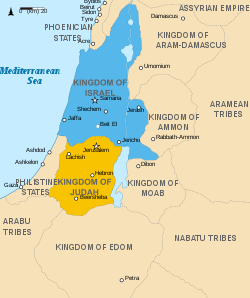
 Map of the two kingdoms in the 9th century BC, prior to the battle | |||||||||
| |||||||||
| Belligerents | |||||||||
| Kingdom of Judah | Kingdom of Israel | ||||||||
| Commanders and leaders | |||||||||
| King Abijah of Judah | King Jeroboam of Israel | ||||||||
| Strength | |||||||||
| 400,000 warriors | 800,000 warriors | ||||||||
| Casualties and losses | |||||||||
| Unknown | 500,000 dead | ||||||||
The Battle of Mount Zemaraim was a battle in the Bible reported to have been fought in Mount Zemaraim, when the army of the Kingdom of Israel led by the king Jeroboam I encountered the army of the Kingdom of Judah led by the king Abijah I.[1] About 500,000 Israelites were said to have lain dead after this single engagement, though most modern commentators consider the numbers to be either wildly exaggerated or symbolic, and some have even questioned its fundamental historicity.[2]
Biblical narrative
[edit]According to the scripture, the friction all began when the late king Rehoboam increased the royal taxes throughout the Kingdom of Israel after Solomon died in about 931 BC.[3] This created discontent among all the Israelite tribes of the kingdom, excepting Judah and Benjamin, and the people's discontent soon became a rebellion when the king, against the advice of the elders, refused to lessen the burdens of royal taxation.[4] The ten northern tribes of Israel eventually broke up from the kingdom and made a new Kingdom of Israel with the former fugitive and exile Jeroboam as king,[5] provoking a civil war. Rehoboam then went to war against the new kingdom with a force of 180,000 soldiers,[6] but was advised against fighting his brethren, so he returned to Jerusalem.[7]
Ever since the unified kingdom was divided, there had been constant border issues between the two parties, and both attempted to settle them. Abijah succeeded to the throne after the death of his father Rehoboam, and attempted to reunite all of Israel, including Judah, under his rule. According to biblical sources, Abijah had an army of 400,000, all of them handpicked or conscripted, and Jeroboam had 800,000 warriors.[8]
Before the battle, Abijah addressed the armies of Israel, urging them to submit and to let the Kingdom of Israel be whole again. Abijah then rallied his own troops with an address to all the people of Israel:
Listen to me, Jeroboam and all Israel: 5 "Do you not know that the LORD God of Israel gave the rule over Israel forever to David and his sons by a covenant of salt? 6 "Yet Jeroboam the son of Nebat, the servant of Solomon the son of David, rose up and rebelled against his master, 7 and worthless men gathered about him, scoundrels, who proved too strong for Rehoboam, the son of Solomon, when he was young and timid and could not hold his own against them. 8 "So now you intend to resist the kingdom of the LORD through the sons of David, being a great multitude and having with you the golden calves which Jeroboam made for gods for you. 9 "Have you not driven out the priests of the LORD, the sons of Aaron and the Levites, and made for yourselves priests like the peoples of other lands? Whoever comes to consecrate himself with a young bull and seven rams, even he may become a priest of what are no gods. 10 "But as for us, the LORD is our God, and we have not forsaken Him; and the sons of Aaron are ministering to the LORD as priests, and the Levites attend to their work. 11 "Every morning and evening they burn to the LORD burnt offerings and fragrant incense, and the showbread is set on the clean table, and the golden lampstand with its lamps is ready to light every evening; for we keep the charge of the LORD our God, but you have forsaken Him. 12 "Now behold, God is with us at our head and His priests with the signal trumpets to sound the alarm against you. O sons of Israel, do not fight against the LORD God of your fathers, for you will not succeed.
However, his plea to Jeroboam was not heeded. Jeroboam had set up an ambush to come from the rear of Abijah's army, so that the latter's army would be fighting on his army's front and rear,[9] executing a giant pincer movement. All of the soldiers of Judah pleaded to God for help, and then the priests blew the trumpets.[10] Abijah was quick in countering this move made by Jeroboam; he ordered his warriors to fight bravely and countered the pincer movement executed by Jeroboam to his warriors, almost utterly crushing the latter's huge army.
King Abijah and the warriors of Judah who were under his command had won, killing 500,000 Israelite warriors in the process.[11] The rest of the Israelite army fled from the battlefield heading back north, and the forces of Judah then staged a relentless pursuit against them, taking the cities of Bethel, Jeshanah and Ephron during the ensuing pursuit.[12] The factor for Judah's success in the battle is mainly attributed to Abijah and his troops' devotion to their God.[13]
Jeroboam was crippled by this severe defeat to Abijah and thus posed little threat to the Kingdom of Judah for the rest of his reign;[14] however, despite being victorious, Abijah failed to reunify Israel and Judah.
Historicity
[edit]Most modern historians consider the numbers to be either wildly exaggerated or symbolic, and some have even questioned the battle's fundamental historicity.[2] A chronology proposed by Edwin Thiele suggests the battle would have taken place around 913 BC.[citation needed]
Yohanan Aharoni, in his book The Carta Bible Atlas, claims that the battle of Mount Zemariam was actually part of the fratricidal war that lasted throughout the reigns of Rehoboam, Abijah, and Asa. According to him, most of the battles took place in the territory of the tribe of Benjamin, including the battle of Mount Zemariam.[15]
In Rabbinic literature
[edit]Despite the miraculous victory described in the Bible, Rabbinic literature criticizes Abijah's actions in this war. Regarding the verse that appears at the end of the war "Jeroboam did not regain power during the time of Abijah. And the Lord struck him down and he died." (2 Chronicles 13:20), Rabbi Samuel ben Nahman said "You think that Jeroboam was struck down, but no, it was Abijah who was struck down." The Midrash lists three sins of Abijah for which he was struck, according to this interpretation. Rabbi Johanan bar Nappaha said that by referring to Jeroboam's rebellion against Rehoboam as a rebellion of "villains" (בני בליעל) even though Ahijah the Shilonite took part in it, he humiliated Ahijah. Rabbi Shimon ben Lakish said that Abijah sinned in his speech describing the sins of the Kingdom of Israel, because in doing so he publicly shamed the people of Israel. Another opinion refers specifically to Abijah's activities after the victory, and criticizes the fact that after the conquest of Beth El, Abijah did not destroy the golden calf that Jeroboam had set up there.[16]
In addition, Abijah's is described as cruel. The Rabbinical text interpreted "a great blow" (2 Chronicles 13:17) to mean that Abijah was not satisfied with killing the Israelite warriors, but also ensured that the bodies could not be identified.[17]
See also
[edit]References
[edit]- ^ 2 Chronicles 13:2b-18
- ^ a b Gomes, Jules Francis (2006). The sanctuary of Bethel and the configuration of israelite identity. Berlin: De Gruyter. p. 205. ISBN 9783110189933.
- ^ "1 kings 12:17-12:22 NIV - - Bible Gateway".
- ^ 1 Kings 12:4, 1 Kings 12:14
- ^ 2 Chronicles 15:9
- ^ 1 Kings 12:21, 2 Chronicles 11:1
- ^ 1 Kings 12:22–24, 2 Chronicles 11:2–4
- ^ 2 Chronicles 13:3
- ^ 2 Chronicles 13:13
- ^ 2 Chronicles 13:14
- ^ 2 Chronicles 13:17
- ^ 2 Chronicles 13:19
- ^ KJV
- ^ 2 Chronicles 13:20
- ^ Aharoni, Yohanan (1967). אטלס כּרטא לתקופת המקרא [The Carta Bible Atlas] (in Hebrew). Carta Jerusalem. p. 78.
- ^ "בראשית רבה סה כ – ויקיטקסט". he.wikisource.org (in Hebrew). Retrieved 2025-02-07.
- ^ "ויקרא רבה לג ה – ויקיטקסט". he.wikisource.org (in Hebrew). Retrieved 2025-02-07.
| Hebrew Bible battles |
|  | ||||||||||
|---|---|---|---|---|---|---|---|---|---|---|---|---|
Battle of Mount Zemaraim
View on GrokipediaHistorical Background
Division of the United Kingdoms
The United Monarchy fragmented circa 931 BCE after Solomon's death, when the northern Israelite tribes repudiated the authority of his successor, Rehoboam, installing Jeroboam I as king of the northern Kingdom of Israel while Rehoboam governed the southern Kingdom of Judah, primarily consisting of the tribes of Judah and Benjamin along with supporting Levites.[6] [7] The split arose from accumulated grievances over Solomon's burdensome taxation and forced labor for grand construction projects, which the northern assembly petitioned Rehoboam to mitigate; he instead consulted younger advisors and vowed harsher treatment, declaring his intent to replace his father's "whips" with "scorpions," prompting the northern declaration, "What portion do we have in David?" and their secession.[8] [6] This rupture fulfilled an earlier prophecy attributed to the prophet Ahijah, who tore his garment into twelve pieces—ten for Jeroboam—citing divine judgment on Solomon's idolatry and foreign cultic influences, though one tribe would remain with Rehoboam's line for David's sake.[7] Jeroboam, previously exiled for rebellion and returned from Egypt, immediately fortified his rule by erecting golden calf idols at Bethel and Dan as worship sites, appointing non-Levitical priests, and instituting rival festivals to the Jerusalem calendar, aiming to sever northern religious ties to Judah's temple and avert pilgrimages that might foster reunification.[8] [9] Archaeological findings, such as destruction layers and Egyptian records of Pharaoh Shishak's (likely Sheshonq I) campaign into Judah in Rehoboam's fifth regnal year—coinciding with post-division vulnerability—lend external corroboration to the era's political instability and the kingdoms' separate trajectories, evidenced by distinct material cultures emerging in the Iron Age II period.[6] [9] The division entrenched dynastic, territorial, and cultic rivalries, setting the stage for recurrent military clashes between Israel and Judah over border regions and ideological supremacy.[7]Reigns of Abijah and Jeroboam I
Jeroboam I, a former official under Solomon, became king of the northern kingdom of Israel after leading the secession of ten tribes following Solomon's death around 931 BCE, amid Rehoboam's refusal to lighten the burdensome labor and taxes.[10] [11] His reign lasted 22 years, until approximately 910 BCE, during which he consolidated power by establishing alternative worship sites to deter pilgrimages to Jerusalem, erecting golden calves at Bethel and Dan and appointing non-Levitical priests.[12] This schism deepened religious and political divisions, as Jeroboam's innovations defied the Mosaic covenant's centralization of worship at the temple.[13] Abijah (also called Abijam in some texts), son of Rehoboam and grandson of Solomon, succeeded to the throne of Judah in Jeroboam's eighteenth year, circa 913 BCE, reigning three years until about 911 BCE.[14] [11] Biblical accounts portray Abijah as continuing his father's sins, lacking undivided loyalty to Yahweh, though he maintained alliances like that with Syria against Israel.[15] Tensions with Jeroboam, rooted in the kingdom's split and Israel's idolatrous practices, culminated in open warfare during Abijah's rule, with Judah's forces prevailing despite being outnumbered, as detailed in the Chronicler's narrative.[16] The reigns overlapped amid ongoing border skirmishes and ideological clashes, with Jeroboam's dynasty facing prophetic condemnation for idolatry while Abijah's brief tenure highlighted Judah's claim to Davidic legitimacy.[17] [18] Extra-biblical corroboration for specific events remains absent, though the conventional chronology aligns internal biblical regnal synchronisms.[19]Biblical Account
Abijah's Speech and Initial Confrontation
Abijah assembled an army of 400,000 valiant fighting men from Judah and Benjamin and advanced into the territory controlled by the northern kingdom of Israel, initiating hostilities against Jeroboam who commanded 800,000 selected troops.[20] Jeroboam responded by deploying forces to encircle Judah's army, setting an ambush behind Abijah's lines while presenting a main force in front.[21] Positioning himself atop Mount Zemaraim in the hill country of Ephraim, Abijah delivered a public address to Jeroboam and the assembled Israelites, emphasizing the legitimacy of the Davidic dynasty and the northern kingdom's rebellion against divine order.[22] In his speech, Abijah recounted how the Lord God of Israel had granted an everlasting covenant of salt to David and his sons, charging that Jeroboam, formerly a servant of Solomon, had rebelled without justification, expelled the legitimate Aaronic priests, and instituted idolatrous worship with golden calves to deter loyalty to Jerusalem.[23] He contrasted Judah's fidelity—maintaining the ordained priests, Levites, and daily offerings—with Israel's apostasy, warning that opposition to Judah equated to fighting against the Lord himself, whose presence led Judah's forces as a powerful protector akin to a divine army.[24] Following the speech, Judah's troops sounded trumpets and raised a battle cry, signaling reliance on divine aid rather than numerical superiority, as Abijah urged Israel to recognize the futility of resisting God's appointed rule.[25] This rhetorical challenge and immediate martial posture marked the onset of confrontation, with Judah's actions framed in the account as an appeal to covenantal fidelity amid the ambush threat.[26]Description of the Battle and Outcome
Jeroboam positioned his forces to envelop Abijah's army, deploying troops in front while sending an ambush to strike from behind, creating a pincer movement against Judah.[27] As Judah realized the trap, with enemies on both flanks, the men of Judah cried out to the Lord, the priests sounded trumpets, and they shouted in battle cry, prompting divine intervention that routed Jeroboam's army before Abijah's forces.[28] The text attributes the sudden reversal to God's deliverance, enabling Judah to press the attack and slaughter 500,000 chosen warriors of Israel in the ensuing chaos.[29] Judah pursued the fleeing Israelites, capturing key cities including Bethel and its surrounding villages, Jeshanah, and Ephron with its dependencies, thereby strengthening Abijah's hold in northern territories.[30] Jeroboam never recovered military strength, succumbing to a divinely inflicted disease that led to his death, while Abijah expanded his household with additional wives, sons, and daughters.[31] The Chronicler frames the outcome as a consequence of Judah's reliance on Yahweh and the priestly order, contrasting it with Israel's apostasy through unauthorized worship sites and calves.[32]Geography and Identification
Location in Ephraimite Hills
The hill country of Ephraim, also known as Mount Ephraim, encompasses the central highlands of ancient Israel, a rugged, elevated region characterized by limestone ridges, deep wadi valleys, and steep slopes rising from the Jordan Valley to elevations often exceeding 2,500 feet (760 meters). This terrain formed the core territory of the tribe of Ephraim, extending roughly from the vicinity of Bethel northward toward the Jezreel Valley, with southern boundaries abutting the tribal lands of Benjamin and Judah.[33] [34] The area's strategic geography facilitated defensive positions and controlled passes, making it a frequent site of inter-tribal and later kingdom conflicts due to its position astride north-south routes.[35] Mount Zemaraim is explicitly situated within this Ephraimite hill country, as described in the biblical account where King Abijah of Judah ascends it to address the Israelite forces under Jeroboam I, indicating a frontier location accessible via Judah's northward incursion into northern territory.[36] [37] The site's elevation provided a vantage for rhetorical confrontation before battle, overlooking potential assembly grounds in the surrounding valleys, consistent with the tactical use of high ground in ancient Near Eastern warfare.[38] This positioning underscores the battle's occurrence near the Judah-Israel border, where Ephraim's hills transitioned into Benjaminite holdings, a zone of disputed control post-Solomon's division circa 930 BCE.[39] A related city named Zemaraim, allotted to the tribe of Benjamin (Joshua 18:22), appears in biblical lists between Beth-arabah (near the Jordan) and Bethel, suggesting the mountain derived its name from or adjoined this settlement in the eastern Benjamin-Ephraim borderlands.[40] Scholarly proposals for its modern identification include the ruin at es-Samra (or es-Sumrah), approximately 4 miles (6.4 km) north of Jericho, aligning with the eastern slopes overlooking the Jordan Rift.[41] [42] Alternative suggestions place it nearer Ramallah and El-Bireh, on the western fringes of the Ephraimite highlands closer to Bethel, based on boundary analyses in Iron Age settlement patterns.[43] These identifications remain tentative, lacking definitive archaeological corroboration such as inscriptions or fortified remains tied to Abijah's era (circa 913–911 BCE), though the region's persistent occupation supports plausibility.[44]Proposed Modern Sites and Terrain Features
Scholars identify Mount Zemaraim with locations in the border region between Benjamin and Ephraim, based on biblical references to its position in the hill country of Ephraim (2 Chronicles 13:4) and proximity to sites like Bethel. One proposed site is Khirbet es-Samarah (also spelled es-Samra), approximately 7 kilometers northeast of biblical Bethel (modern Beitin), selected for its commanding ridge that overlooks the Ephraimite-Benjaminite frontier, aligning with the narrative of Abijah addressing troops from an elevated position. An alternative identification links Zemaraim, the associated Benjaminite city (Joshua 18:22), tentatively to Ras et-Tahuneh, supported by Iron Age pottery and settlement remains uncovered in archaeological surveys of the Benjaminite hill country, though direct epigraphic evidence for the name is absent.[45][46] The terrain features of the proposed sites consist of rugged, elevated limestone ridges typical of the central hill country, with steep slopes and wadis facilitating ambushes or defensive positions, as Ephraim's highlands provided natural barriers and vantage points for ancient battles. These elevations, rising to around 800-900 meters above sea level near Ramallah and El-Bireh, would have offered strategic oversight of passes connecting Judah to northern territories.[47][48]Military Composition and Tactics
Forces of Judah and Israel
The biblical account in 2 Chronicles 13 reports that King Abijah of Judah assembled an army of 400,000 valiant warriors, described as chosen men capable of engaging in battle.[49] These forces were drawn primarily from the tribes of Judah and Benjamin, forming the core of the southern kingdom's military after the schism with Israel.[50] Notably, the Judahite army included a substantial contingent of priests and Levites who had defected from the northern kingdom, motivated by Jeroboam I's institution of non-Levitical priests and idolatrous golden calves at Bethel and Dan, which they viewed as a violation of Mosaic covenantal requirements. This religious element distinguished Judah's forces, as evidenced by their use of sacred trumpets during the confrontation to invoke divine aid.[51] In contrast, Jeroboam I of Israel fielded 800,000 selected troops, doubling Judah's numerical strength and positioning the northern kingdom for an apparent advantage.[49] Composed of warriors from the ten northern tribes, Israel's army lacked the centralized Levitical priesthood, relying instead on appointees from "the lowest of the people" to officiate at Jeroboam's cult sites, which the Chronicler portrays as a strategic and spiritual weakness.[52] Jeroboam's forces employed ambush tactics, dividing into two groups to envelop Judah's lines, indicating a focus on maneuver over ritual elements.[53]| Kingdom | Leader | Reported Army Size |
|---|---|---|
| Judah | Abijah I | 400,000 chosen men of valor[49] |
| Israel | Jeroboam I | 800,000 chosen men[49] |