Hubbry Logo
BeitinBeitinMain
Open search
Beitin
Community hub
Beitin
logo
8 pages, 0 posts
0 subscribers
Be the first to start a discussion here.
Beitin
Beitin
from Wikipedia

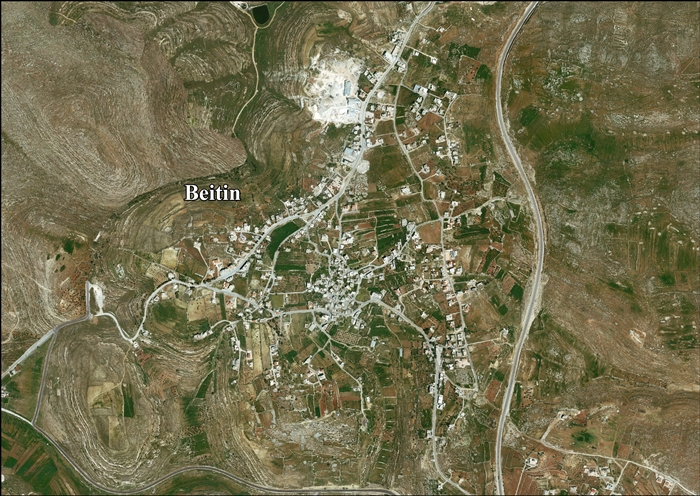
Beitin (Arabic: بيتين, romanizedBaytīn) is a Palestinian village in the Ramallah and al-Bireh Governorate in the central West Bank, located 5 kilometers (3.1 mi) northeast of Ramallah along the Ramallah-Nablus road. The Palestinian village of Dura al-Qar' and Ein Yabrud lie to the north, Rammun to the east, Deir Dibwan to the southeast and al-Bireh to the southwest. The Israeli settlement of Beit El is northwest of Beitin.

Key Information

Beitin was established in the mid-19th century by settlers from the nearby Burqa.[4] It stands on the site of the ancient town and biblical sanctuary of Bethel,[4][5][6] which was left abandoned after the Crusader period. The area remained uninhabited until the late Ottoman period, when modern Beitin was founded.[4]

Geography

[edit]

There are several springs around Beitin, which is known for its olive, almond, fig and plum groves.[7]

History

[edit]

Early history and archaeology

[edit]

Beitin is identified with the ancient settlement of Bethel, and preserves its ancient name.[6][5][4] The site was first settled during the Chalcolithic period. Sherds from the Early, Intermediate, Middle and Late Bronze Age, as well as the Iron Age I and II, the Persian, Hellenistic, Roman,[8] the Byzantine[8][9] and Crusader/Ayyubid periods have been found.[8] At the ruins of the Crusader watchtower (al-Burj), residential remains from the Mamluk period were discovered.[10]

In the Hellenistic and Roman periods, Bethel was mentioned in 1 Maccabees, Josephus' writings, and in several patristic texts.[5] The town was garrisoned by Bacchides (during the Maccabean revolt) and later by Vespasian (during the First Jewish–Roman War).[5] In Byzantine times, Bethel held annual festivals on October 18. The population was Eastern Orthodox Christian and monks from the Sinai Peninsula, particularly Zosimas of Palestine, were known to have visited the town.[11] A church dating from the fifth century CE was found at the site.[5]

Bethel was abandoned after the 1187 defeat of the Crusaders at the hands of Saladin and the ensuing destruction of Christian sites. It remained obscure and unmentioned by various sources from the 13th to the 19th century, including Yaqut, Mujir al-Din, and European travelers, likely indicating a state of ruin since the fall of the Crusader kingdom.[4]

Ottoman period

[edit]
The ruins of Bethel in the mid-19th century

Beitin was absent from Ottoman censuses of the 16th century. When visited by Robinson in 1838 and Schwartz before 1845, it still lay in ruins. However, by Guérin's visit in 1863, it had become inhabited, with its residents originating from the nearby Burqa.[4]

After Beitin was reestablished, the village came under the administration of the Mutasarrif ("Governorate") of Jerusalem.[12] In the early 19th century, people from Transjordan and other places migrated to Beitin[11][13] and built a mosque near the site of the old church.[14]

In 1838 Edward Robinson noted Beitin as a place "in ruins or deserted," located immediately north of Jerusalem.[6][15]

In 1863 Victor Guérin found the village to have 400 inhabitants,[16] while an Ottoman village list from around 1870 showed that Beitin had an adult male population of 140, in a total of 55 houses (thus excluding women and children).[17][18]

In 1882 the PEF's Survey of Western Palestine described Beitin as a village "built on the side of a flat spur which rises slightly on the north. On the south-east is a flat dell, with good fig and pomegranate gardens, and there are other fig-trees round the village and among the houses. The cottages have a ruinous appearance, with rough stone walls. There is one square white house in two stories, which is visible from a great distance. The ground is very open, and the slopes gentle; the village slopes down gradually south-east. The surrounding ground is quite bare of trees, of white chalk, very barren and stony on the south; of hard limestone cropping up on the north; the fields divided off by low drystone walls. The contrast of the grey rocks, the red ploughland and the dark green figs is very striking. The remains of a good-sized tower exist towards the north, and on the south the walls of a church of Crusading date, once dedicated to St. Joseph. The population is stated at 400. The place is supplied from a fine spring on the south, which wells up in a circular basin. The spring is double, and was surrounded with a large reservoir, 314 feet long north-west and south-east, by 217 feet; of massive stones. The eastern and southern walls are standing about 10 feet high. The spring is perennial..."[19]

In 1896 the population of Betin was estimated to be about 360 persons.[20]

In 1907, small gardens and a few old tombs were found in the vicinity, and the Muslim population was known for its strength and fearlessness.[21]

British Mandate period

[edit]
Young people in Beitin, ca 1925-30, postcard by Karimeh Abbud

In the 1922 census of Palestine conducted by the British Mandate authorities, Baitin had a population of 446; all Muslims,[22] increasing at the time of the 1931 census to 566, still all Muslim, in 135 houses.[23]

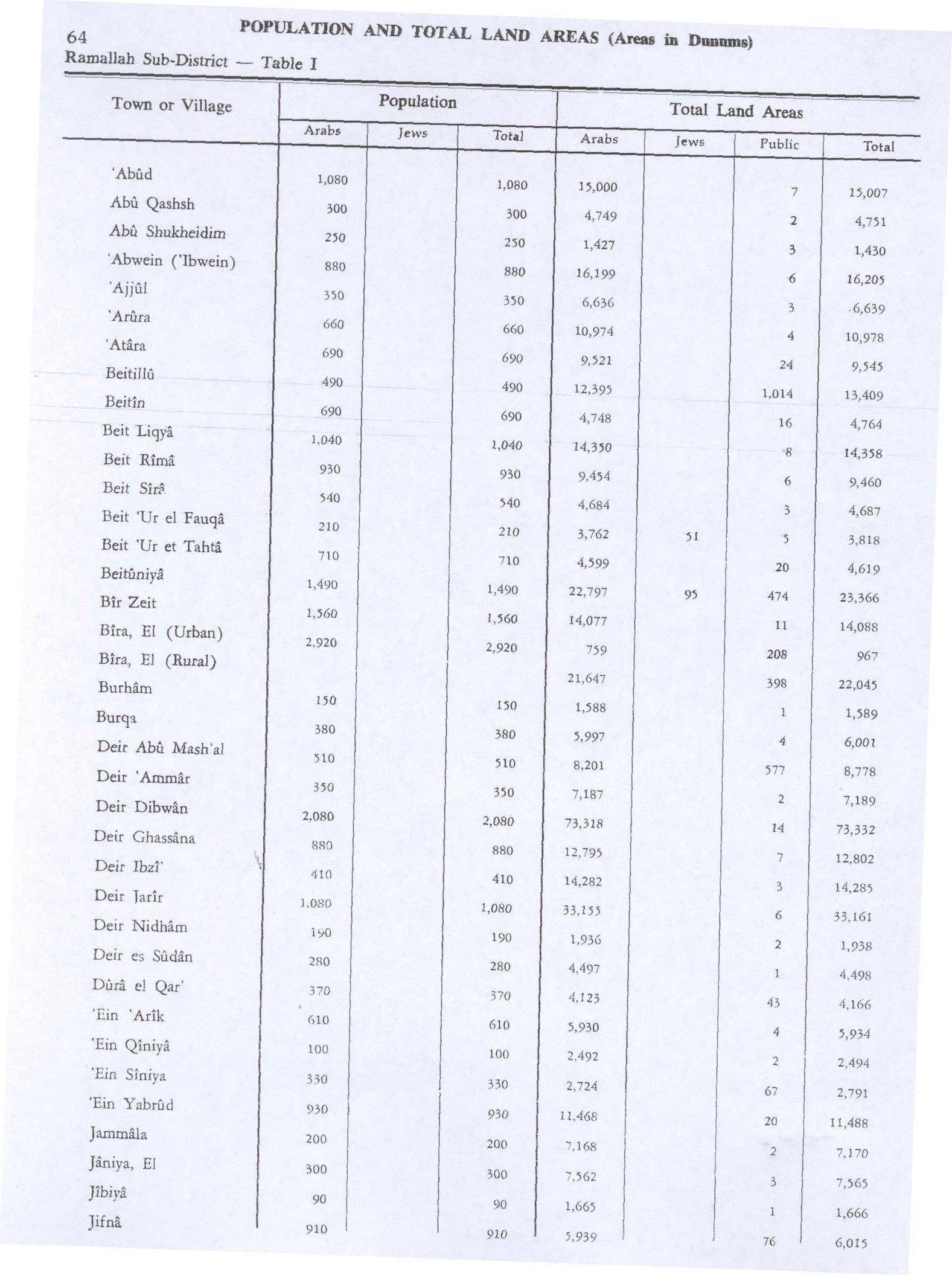
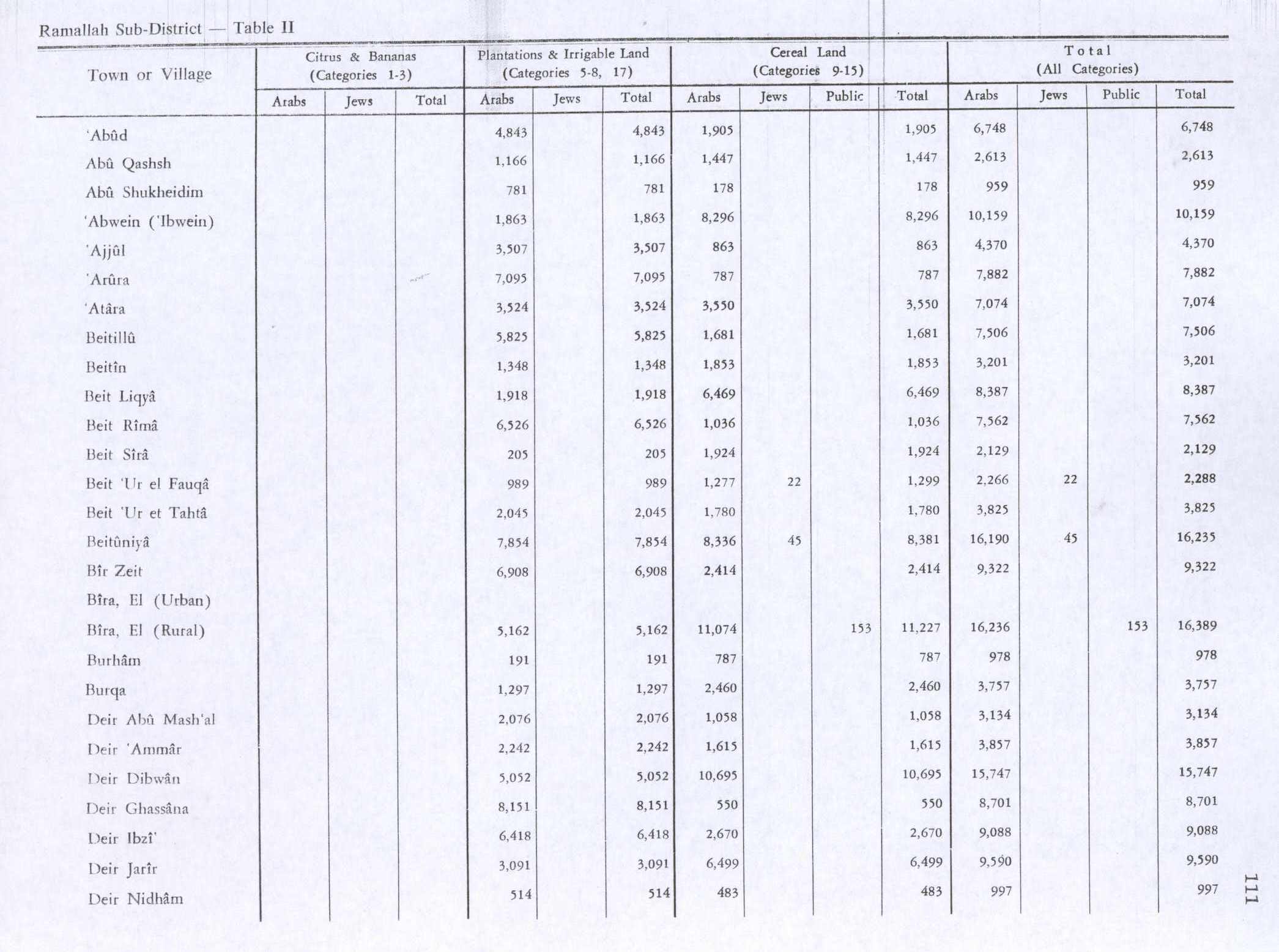
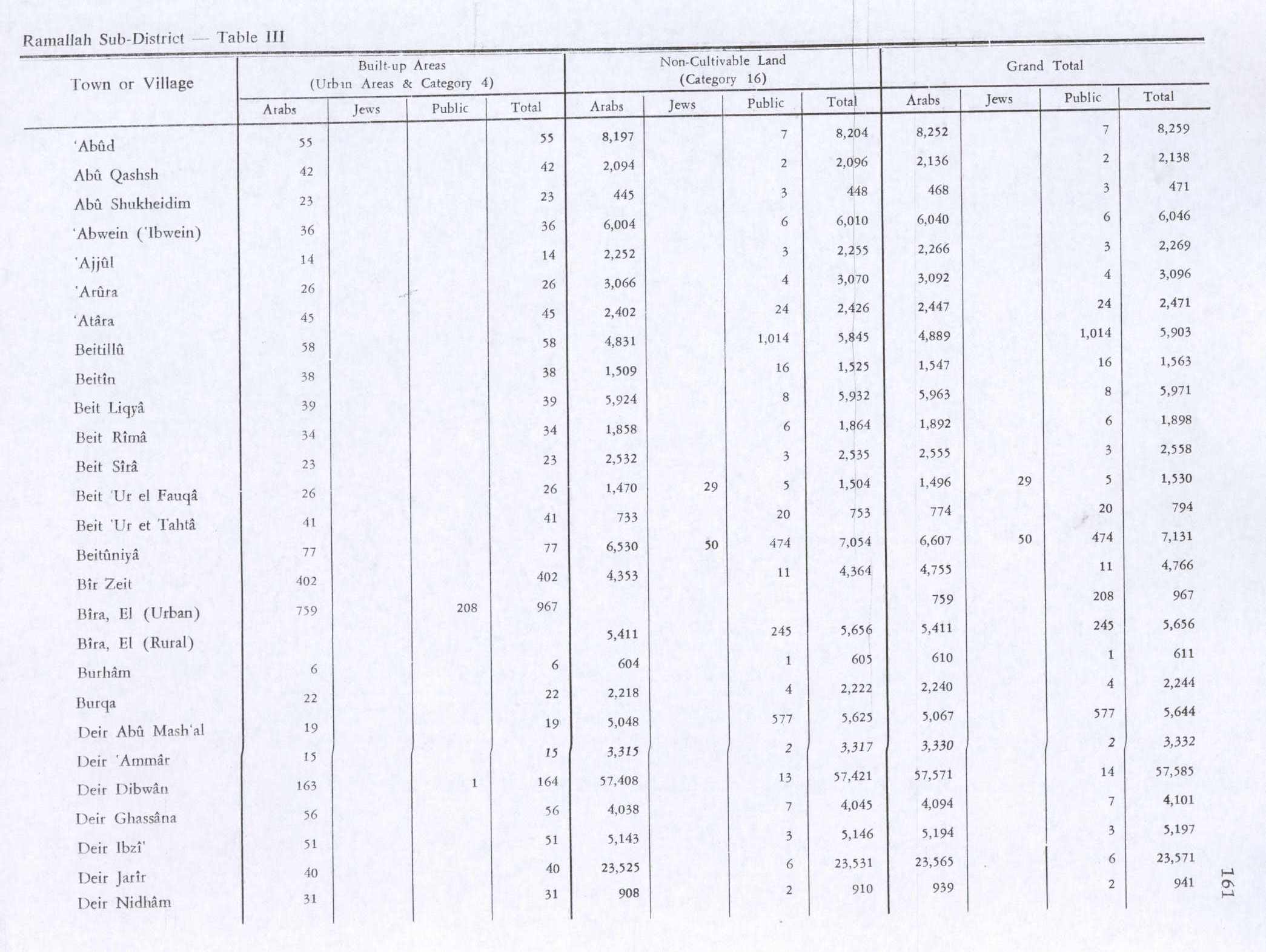
In the 1945 statistics the population was 690 Muslims,[24] while the total land area was 4,764 dunams, according to an official land and population survey.[25] Of this, 1,348 were allocated for plantations and irrigable land, 1,853 for cereals,[26] while 38 dunams were classified as built-up areas.[27]

Jordanian period

[edit]

In the wake of the 1948 Arab–Israeli War, and after the 1949 Armistice Agreements, Beitin came under Jordanian rule.

In 1961, a Jordanian census found the population to be 1,017.[28]

Post-1967

[edit]

After the Six-Day War in 1967, Beitin has, with the rest of the West Bank, been held under Israeli occupation. The population in the 1967 census conducted by the Israeli authorities was 958, of whom 134 originated from the Israeli territory.[29]

After the 1995 accords, 19,1% of the village land is classified as Area B, while the remaining 80.9% is defined as Area C land (full Israeli control). Beitin village land has also been taken in order to construct the illegal Israeli outpost Givat Asaf.[30][31]

On 19 December 2011, Israeli settlers were accused of carrying out a second price tag attack in only four days, in which five Palestinian-owned cars were burnt and the walls of several houses were sprayed with graffiti.[32] During the first incident (15 December 2011), the assailants not only vandalized a mosque, but also attacked an IDF military base in the West Bank, injuring a top Israeli commander.[33] According to witnesses of the second incident, the Israeli army dispersed the settlers without arresting any of them,[32] presumably also those who attacked the Israeli commander, although four days earlier the incident had prompted Israeli Prime-Minister, Benjamin Netanyahu, to say: "We won't let them attack our soldiers. We won't let them ignite a religious war with our neighbors. We won't let them desecrate mosques. We won't let them harm Jews or Arabs."[33]

Landmarks

[edit]

Church ruins

[edit]

The ruins of the Byzantine church are known in Arabic as "al-Muqater" or "Khirbet al-Kenise" ("Ruins of the Church").[11][34] According to Röhricht, when the Crusaders arrived, they found a ruined church. They built another and placed it first under the Abbey of St. Joseph of Arimathea, later under the Canons of the Holy Sepulcher.[11][35] The ruins of the church were drawn in the 1880s.[36][37]

Tower ruins ("al-Burj")

[edit]
Ruins of al-Burj, 1935

Another ruin, called "al-Burj Beitin" ("the Tower of Beitin") or simply al-Burj is located in the western part of the village.[11] They were also drawn in the 1880s.[38] The ruins of the Burj are about 1 meter tall, and apparently built on the older ruins of a Byzantine monastery.[39] Some have believed that it was constructed on the site where Abraham built an altar.[14][40] According to biblical scholar Edward Robinson who visited Palestine in the 19th century, al-Burj Beitin consisted of dilapidated stones that used to form part of a fortress and a Greek church.[6] Al-Burj was used as a watch tower by the Crusaders.[11]

Demographics

[edit]
Roadside view of Beitin, 2011

In 1997, Palestinian refugees accounted for exactly 30% of the population, which was 1,510 at the time.[41]

According to the Palestinian Central Bureau of Statistics (PCBS), Beitin had a population of over 3,050 inhabitants in 2006.[42] In 2007, a PCBS census recorded a population of 2,143 (1,128 men and 1,015 women). There were 717 homes in the village and the average household size consisted of 4.9 family members.[43]

References

[edit]

Bibliography

[edit]
[edit]
Revisions and contributorsEdit on WikipediaRead on Wikipedia
from Grokipedia
Beitin is a Palestinian village in the of the , situated approximately 5 kilometers northeast of at an elevation of 900 meters above along the ridge running north from . The village is traditionally identified with the biblical city of Bethel, a key site in ancient Israelite history noted for its religious significance, including the establishment of a by and later as a center of the northern kingdom's cult under I. This identification, proposed by Robinson in and accepted by most scholars, has been contested by some archaeologists who contend that Beitin's location fails to match biblical geographic criteria, such as proximity to Ai and visibility from certain vantage points described in , proposing alternatives like nearby el-Bireh. As of mid-year 2021 projections from the Central Bureau of Statistics, Beitin's population stood at 2,223, predominantly engaged in and cultivation on terraced lands, with the village experiencing restrictions on movement and development due to nearby Israeli settlements and military checkpoints. Archaeological excavations at the site have uncovered remains potentially linked to ancient Bethel, though interpretations remain debated amid limited access and ongoing regional conflicts.

Geography

Location and Physical Features

Beitin lies in the within the central hill country, positioned approximately 5 kilometers northeast of along the Ramallah-Nablus road. The village is bordered by Deir Dibwan to the east, Ein Yabrud to the north, to the west, and to the south. The topography features a at an elevation of 894 meters above , characteristic of the limestone hills in the region, with surrounding valleys such as el-Gayeh to the east providing natural drainage. This elevated position offers views over the adjacent terrain and proximity to historical north-south passageways traversing the hill country.

Climate and Environment

Beitin lies within the Mediterranean climatic zone of the central highlands, featuring hot, dry summers and mild, wet winters. Average high temperatures in , the warmest month, reach approximately 30°C, while January, the coolest, sees average lows of about 5°C. Annual mean temperatures hover around 18–22°C, with diurnal variations influenced by the village's elevation of roughly 860 meters above . Precipitation totals average 547 mm annually, concentrated in the rainy season from to , supporting seasonal agricultural cycles but leaving summers arid. Variability in rainfall is notable, with historical data from nearby stations showing fluctuations between 300 mm and over 1,500 mm in extreme years, though long-term averages align with 500–700 mm for the region. The local environment consists of terraced hillsides dominated by olive groves, which cover much of the , alongside including trees, evergreen oaks, and scrub vegetation adapted to semi-arid conditions. types are primarily terra rosa and rendzina, prone to due to steep slopes and historical pressures like and , though terracing mitigates runoff. Water availability depends heavily on rainfall recharge of local aquifers, supplemented by household cisterns for storage, as the village lacks dedicated springs or wells. remains limited, relying on traditional dry farming techniques for crops like olives and cereals, with extraction constrained by regional hydrogeological limits and shared basin dynamics.

Biblical Identification and Ancient Significance

Association with Bethel in Scripture

Beitin is traditionally identified with the biblical city of Bethel due to its proximity to —approximately 10 miles north—and its position relative to the ancient site associated with Ai, aligning with scriptural geography describing Bethel as situated between these landmarks. This identification, first proposed by Edward Robinson in 1838, relies on the phonetic similarity of the modern Arabic name "Beitin" to the Hebrew "Bethel" (meaning "House of God") and the site's strategic elevation on a north-south watershed route, which matches descriptions of Bethel as a key patriarchal and later royal sanctuary. In Genesis 12:8, Abraham travels to the hill country east of Bethel, pitches his tent with Bethel on the west and Ai on the east, and builds an to the , marking the site's early significance as a amid Canaanite territory. Subsequently, Genesis 28:10-19 recounts fleeing from , stopping at a place then called Luz where he dreams of with angels ; upon waking, Jacob names the site Bethel, declaring it the "House of God" and "gate of ," and sets up a stone pillar anointed with oil as a commemorative marker. Genesis 35 further details Jacob's return to Bethel at God's command, where he builds an , receives divine reaffirmation of his to , and buries foreign gods under an , underscoring the location's role in covenantal renewal and purification for the patriarchal family. Bethel's prominence continued into the period of the divided kingdom, as described in 1 Kings 12:28-29, where establishes a at Bethel to rival Jerusalem's temple, erecting a and appointing non-Levitical priests, thereby instituting alternative worship sites at Bethel and Dan to retain northern loyalty and avert to Judah. Prophetic activity centered there as well; Amos 7:10-13 records Amaziah, the priest of Bethel, confronting the prophet for denouncing the site's idolatrous practices as the "king's " and royal residence, highlighting Bethel's entrenched role in state-sponsored critiqued for moral and theological corruption. These references collectively portray Bethel as a focal point of Israelite religious and political history, with Beitin's location providing geographic continuity for such events without reliance on material excavations.

Archaeological Evidence for Ancient Settlement

Excavations at Beitin, conducted primarily by in a 1927 test pit and jointly with James L. Kelso from 1934 to 1960, uncovered stratified remains indicating occupation from the period through the Byzantine era, with notable continuity in the and Iron Ages. Middle (ca. 2200–1550 BCE) layers yielded substantial fortifications, including city walls, alongside pottery typologies consistent with Canaanite , suggesting a fortified settlement during this peak urban phase. Iron Age strata (ca. 1200–586 BCE) revealed domestic structures, storage facilities, and pottery sherds indicative of transition from Canaanite to early Israelite patterns, including collared-rim jars associated with highland settlements around 1200 BCE. Scribal artifacts, such as ostraca and seals, point to administrative activities, supporting Beitin's role as a regional center, though no monumental temple from I's era (ca. 930–909 BCE) has been identified, with evidence limited to possible open-air cultic installations inferred from altar fragments and ritual deposits. Later surveys and digs, including those by Keio University since 2012, confirmed these earlier findings through additional Bronze Age tombs and Iron Age pottery, with radiocarbon dating aligning occupation peaks to Middle Bronze II and Iron II periods, countering claims of sparse Late Bronze evidence by emphasizing intermittent but persistent settlement rather than abandonment. Artifact typologies, including bichrome ware from Late Bronze contexts and four-room houses in Iron I, align with broader Canaanite-to-Israelite cultural shifts, though debates persist on the site's precise correlation to biblical Bethel due to gaps in monumental architecture.

Historical Development

Classical, Byzantine, and Early Islamic Periods

In the Roman period following Pompey's conquest of in 63 BCE, Beitin, traditionally identified with biblical Bethel, maintained settlement continuity as a modest village along the central connecting northward. Archaeological surveys indicate occupation evidenced by ceramic remains from the 1st century BCE to the 3rd century CE, reflecting integration into the Roman administrative framework without major disruptions. The site's strategic location on this trade and pilgrimage corridor likely supported economic stability, as Roman-era infrastructure enhancements facilitated commerce and military movement through the region. During the Byzantine era (4th–7th centuries CE), the village underwent , marked by the construction of a basilical church featuring an , flooring, and possible wooden-roof supports over stone foundations. This structure, dated to the 5th–6th centuries CE via and artifact typology, signifies the site's role in the expanding Christian landscape of under imperial patronage. of Caesarea, in his Onomasticon compiled around 330 CE, locates Bethel (Beitin) as a village approximately 12 Roman miles north of , aligning with the site's topography and aligning with Jerome's Latin translation, which preserved this identification into the medieval period. Despite debates over precise occupation intensity—some surveys noting sparse to Roman remains—the church's presence confirms active habitation and religious function amid regional prosperity driven by and agrarian surplus. The early Islamic conquest of in 636–638 CE introduced minimal archaeological disruption at Beitin, with pottery sequences from Umayyad (661–750 CE) and early Abbasid (750–9th century) layers demonstrating settlement persistence through unglazed wheel-thrown wares and imported amphorae indicative of sustained . This continuity, observed in excavation profiles spanning the 7th–9th centuries CE, contrasts with broader regional transitions where urban centers declined but rural sites like Beitin endured due to their agricultural viability and position on inherited Roman-Byzantine roads. Local adaptation under Muslim rule preserved village morphology, as fiscal policies emphasized land productivity over radical restructuring, fostering demographic stability absent major revolts or depopulation events documented elsewhere in the .

Ottoman Period (1517–1917)

Beitin fell under Ottoman administration following the conquest of the region in 1517, integrated into the Nablus Sanjak of the Damascus Eyalet. Early Ottoman tax registers from the 16th century, such as those compiled in the late 1500s, do not record Beitin as a settled village, suggesting sparse or temporary habitation amid a landscape dominated by agricultural hamlets focused on grains and olives in the surrounding hills. By the mid-19th century, following the reforms, Beitin emerged as a small Muslim-majority village, with French explorer Victor Guérin documenting approximately 400 inhabitants in 1863, primarily engaged in subsistence farming of olives, grains, and vegetables on terraced lands. An Ottoman statistical survey around 1870 listed 68 adult males, implying a total population of roughly 300-400, underscoring its modest scale within the Jerusalem Mutasarrifate after administrative reorganizations in the . The village experienced stagnation and occasional depopulation due to burdensome taxation systems that disproportionately affected rural producers, recurrent plagues sweeping through Ottoman in the , and insecurity from raids that disrupted hill country settlements. These factors contributed to a persistent low , estimated at about 360 by 1896, with centered on groves and cultivation under the and later systems.

British Mandate and Jordanian Era (1917–1967)

Following the British capture of the region from Ottoman forces in December 1917, Beitin was administered as part of the Ramallah sub-district within the of . The village experienced steady demographic growth amid limited infrastructure development, with the population recorded at 446 inhabitants—all —in the , increasing to 566 in 1931 and 690 by 1945. Agriculture formed the economic backbone, characterized by subsistence farming on 4,764 dunums of , nearly all Arab-owned, with no Jewish land holdings documented. In , land use included 1,853 dunums for cereal crops, 310 dunums of groves, and 1,348 dunums for irrigated plantations, supporting local self-sufficiency but constraining broader economic . The 1936–1939 , which originated in rural areas including around , imposed severe disruptions through British counterinsurgency measures, collective punishments, and economic halts, exacerbating stagnation in villages like Beitin and hindering agricultural output and trade. After the 1948 Arab-Israeli War, Jordanian forces occupied the , formally annexing it in 1950 and integrating Beitin into the kingdom's administrative framework. The village population expanded to 1,017 by the Jordanian census, reflecting modest growth partly from an influx of refugees displaced from coastal and other areas during the conflict. Economic patterns persisted with reliance on traditional farming, though land disputes over pre-1948 sales attempts surfaced sporadically without leading to significant external settlement, maintaining the village's primarily agrarian and stable character.

Modern Era and Israeli Administration

Post-1967 Capture and Governance

Following the Six-Day War from June 5 to 10, 1967, Israeli Defense Forces captured the West Bank, including Beitin, from Jordanian control, placing the territory under direct Israeli military administration. The IDF established a military government that applied Israeli military orders to maintain security and order, interpreting the Fourth Geneva Convention's provisions on belligerent occupation as inapplicable in full due to the disputed legal status of the territories—lacking a prior legitimate sovereign, as Jordan's 1950 annexation was recognized internationally only by Britain and Pakistan. This framework allowed for provisional measures like infrastructure maintenance while prioritizing defense needs, with Beitin's residents subject to curfews, permits, and military oversight amid the broader shift of over one million Palestinians under Israeli rule. In 1981, reorganized civilian governance by creating the Civil Administration under the IDF, tasked with handling non-security affairs such as utilities, , and education in villages like Beitin. This body coordinated services, including electricity supply from Israeli grids (reaching over 95% of West Bank households by the 2000s) and water infrastructure projects, though implementation often involved coordination with local councils and faced delays due to security protocols like checkpoints. Israeli authorities maintain that such administration reflects administrative necessity in disputed areas with historical Jewish ties, rejecting the "occupation" label in favor of "belligerent control" pending negotiated resolution, as articulated in post-1967 legal opinions emphasizing defensive conquest and UN Security Council Resolution 242's call for secure borders. The 1995 Oslo II Accord divided West Bank control into Areas A, B, and C, designating Beitin—located in Ramallah Governorate—as Area B, granting the Palestinian Authority (PA) responsibility for civil administration and policing while retaining Israeli oversight for external security. This shared model, covering about 21% of the West Bank, enabled PA management of local services in Beitin but preserved Israeli veto on broader policies, with checkpoints and military patrols continuing to regulate movement. Palestinians view this as perpetuating occupation under international law, citing UN resolutions and ICJ advisory opinions affirming the territories' status as occupied Palestinian land, whereas Israel counters with claims of disputed sovereignty rooted in pre-1948 international mandates and the absence of a binding Palestinian claim prior to 1967. These divergent interpretations have sustained legal debates, with no mutual recognition altering Beitin's hybrid governance framework.

Development and Infrastructure Changes

Electricity and networks, initially connected in 1961, were maintained and expanded under oversight following the 1967 capture, enabling near-universal access—99% of housing units—for essential services in Beitin. The Electricity Company provided power, supporting residential and agricultural needs despite periodic high costs and required renovations to the distribution grid. , coordinated via the Water Authority, delivered an annual total of 84,070 cubic meters, equating to about 84 liters daily, supplemented by 30 household rainwater cisterns and rehabilitated springs. Road infrastructure saw partial paving of 10 km of secondary routes and 4 km of main roads, though conditions remained poor; agricultural access roads totaled 8 km, with 2 km suited for tractors. Educational facilities grew to include two public schools—one for boys and one for girls—enrolling 495 students across 24 classes with 41 teachers by the 2010-2011 , addressing earlier shortages in specialized equipment and structures. Under Palestinian Authority village council initiatives post-Oslo Accords, local projects included the 2009 establishment of the Beitin Services Center for public administration, funded by community and Ministry of Local Government resources. However, with 80.9% of village lands classified as Area C under Israeli planning control, building permits for expansions faced restrictions, limiting autonomous development efforts. Economically, pre-Second Intifada commuting to Israel for employment fostered growth in commerce and agriculture, transforming Beitin into a regional hub; post-2000 road closures and permit limitations curtailed this, raising transport costs to Ramallah from 2 NIS to 7 NIS one-way and shifting reliance toward local sectors like farming, which employed 30% of the workforce. These changes, amid Israeli security measures, supported material stability enabling sustained habitation, though contested over land use in Area C.

Landmarks and Cultural Sites

Ruins of Ancient Structures

The primary ancient ruins in Beitin consist of the and church complex at Burj Beitin, located on the southeastern hill of the village. This site features foundations of a large church structure measuring approximately 40 meters east-west by 28 meters north-south, constructed primarily from blocks and stone slabs. The is semi-circular with a diameter of about 7 meters and stands up to 120 cm high in preserved sections, floored with mosaics depicting geometric patterns such as guilloche borders, wavy lines, and grape motifs, though many are damaged. Excavations conducted by in 2013 and 2015, along with a Palestinian-Japanese project from 2011 to 2014, have exposed these elements, confirming the site's Byzantine origins dating to the AD. The complex includes a delicately crafted gate made of curved stones and additional rooms with pavements, indicative of a monastic facility rather than purely defensive architecture, though a later tower (burj) was incorporated atop the during the period for possible protective functions. Evidence of earlier and Roman activity, such as nearby graves, underscores the site's long occupational history, but the visible predominantly reflect Byzantine construction. Preservation efforts have revealed only partial structures within a roughly 50 by 50 meter area, with scattered fragments and collapsed sections limiting full reconstruction. Ongoing threats from modern construction in the surrounding village and historical pose risks to these exposed features, necessitating continued archaeological oversight.

Religious and Historical Monuments

Beitin's religious landscape is dominated by two mosques: Beitin al-Kabir Mosque and Omar bin al-Khattab Mosque, which function as primary prayer halls for the village's Muslim residents. These structures emerged during the village's establishment and expansion in the mid-19th century under Ottoman administration, accommodating the population from nearby and reflecting the shift to a Muslim-majority community following earlier abandonments. The mosques serve not only daily worship but also communal gatherings, underscoring Islamic practices that have persisted since the Ottoman era, with no reported Christian religious sites in the modern village. Their presence aligns with broader patterns in Palestinian villages, where local masjids reinforce cultural and social cohesion amid ongoing regional tensions. Among historical monuments, Burj Beitin—locally termed the Tower of Ibrahim and —stands as a semi-intact ruin originating from a 4th-century Byzantine church later repurposed as a fortress. This structure, featuring a square enclosure with remnants of walls and possible associations in local tradition, marks the site's historical depth and draws interpretive interest due to Beitin's traditional identification with biblical Bethel, a linked to patriarchal narratives in Jewish scripture. While archaeological consensus places ancient Bethel at or near Beitin, the monument's visibility bolsters dual heritage claims: Palestinian continuity through enduring landmarks and ancient Israelite presence via biblical .

Demographics and Society

The population of Beitin was recorded at 2,014 in the 2007 (PCBS) census, comprising 954 s and 1,060 s, reflecting a distribution of approximately 47.4% male and 52.6% female. PCBS mid-year projections indicate subsequent growth, with estimates reaching 2,223 in 2017, 2,272 in 2018, 2,321 in 2019, 2,371 in 2020, and 2,371 in 2021, driven by natural increase at an annual rate of about 1.7% during this period. Extrapolating these trends to 2024-2025 yields an approximate current population of 2,500 to 2,600 residents, consistent with low but steady demographic expansion in rural localities. Demographically, Beitin's residents are overwhelmingly Palestinian Arabs of Sunni Muslim adherence, with no documented Christian population in recent censuses or profiles, indicating a homogeneous ethnic and religious composition typical of inland Ramallah Governorate villages. Historical data prior to 1997 is sparse at the locality level, but the village exhibited growth from Mandate-era baselines—estimated in the low hundreds during the early —to over 1,500 by the late , accelerating post-1967 due to return migration and before stabilizing amid broader Palestinian patterns. This emigration, often to urban centers like or abroad for economic opportunities, has tempered growth rates since the 2000s, with PCBS noting net out-migration in similar governorate locales contributing to moderated expansion. Age structure data from the 2007 highlights a youthful profile, with significant portions under 15 years, underscoring reliance on natural increase for demographic despite pressures. Overall trends reflect resilience in core family-based communities, with limited diversification in ethnic or religious makeup.

Social and Economic Life

The economy of Beitin relies primarily on , which involves the cultivation of fruit trees such as apricots and other crops on village lands, alongside limited stone quarrying activities from three local quarries that contribute to regional construction material production. Small-scale services, including four local stores, support daily needs but represent a minor sector, with overall industrial development constrained by geographic and access restrictions. Social organization in Beitin centers on and networks, which influence community decision-making and are mediated through the village council responsible for local administration and resolving disputes. is provided via municipal schools serving basic and secondary levels, emphasizing foundational and skills amid broader regional challenges in . Key challenges include chronic water shortages, with supply from the Jerusalem Water Authority frequently interrupted during summer months, limiting and household use. High unemployment, particularly among youth, stems from road closures and barriers restricting labor mobility and market access, affecting roughly half the workforce as reported in assessments of movement impediments. These factors drive some residents toward informal labor or dependency on remittances, underscoring vulnerabilities in sustaining traditional livelihoods.

Political Status and Conflicts

Israeli Settlements and Checkpoints

The Israeli settlement of , located adjacent to Beitin in the , was established in 1977 by members of the movement as part of efforts to reclaim areas associated with biblical sites, including the ancient city of Bethel mentioned in the . The settlement, which houses approximately 6,000 residents as of recent estimates, serves both ideological purposes—rooted in Jewish historical and religious claims to the region known as —and practical security rationales, with proponents arguing it creates a buffer against potential threats in the strategically located hills north of . Israeli authorities maintain that such communities enhance defensive capabilities amid ongoing hostilities, though critics, including Palestinian residents of nearby villages like Beitin, contend they encroach on local lands and resources. Security infrastructure around Beit El includes checkpoints that regulate movement between Beitin, Ramallah, and the settlement itself. The Beit El checkpoint, situated on land from Beitin, underwent significant enlargement starting in March 2012 to accommodate increased traffic and improve screening for explosives and weapons, according to Israeli military assessments aimed at preventing terrorist attacks originating from Palestinian areas. From the Israeli perspective, these measures are essential defensive tools, justified by historical patterns of violence, such as suicide bombings during the Second Intifada, which necessitated fortified access controls to protect civilians in settlements and Israel proper. Palestinians, however, describe the expanded checkpoint as a barrier that severely restricts daily commutes, commerce, and access to essential services, exacerbating economic hardships in villages like Beitin by imposing delays and arbitrary denials. Land allocation for Beit El has involved designations of "state land," military requisitions, and occasional purchases, but disputes persist over portions built on privately owned Palestinian property, including areas claimed by Beitin residents. For instance, the Ulpana neighborhood within was constructed on land later verified as privately held by , leading to its partial evacuation following Israeli orders in 2012 to uphold property rights. Israeli arguments emphasize historical Jewish continuity in the territory—predating modern Arab claims—and reject the characterization of the land as occupied from a sovereign entity, viewing it instead as disputed following the 1967 defensive war against Jordanian control. In contrast, the of Justice's 2024 advisory opinion declared Israel's settlement activities unlawful under , citing violations of the Fourth Convention's prohibition on transferring civilian populations into occupied territory and calling for their dismantlement, though disputes the ICJ's jurisdiction and framing, asserting no such transfer occurs voluntarily and that security imperatives override. These conflicting legal interpretations underscore broader tensions, with Palestinian sources documenting ongoing encroachments while Israeli entities prioritize verifiable ownership through Ottoman-era records and post-1967 surveys.

Incidents of Violence and Security Measures

In the vicinity of Beitin, Palestinian residents have repeatedly thrown stones at Israeli vehicles and security personnel near the adjacent settlement, endangering drivers and prompting IDF warnings or return fire when immediate threats to life were identified. For instance, on July 30, 2025, masked individuals hurled stones at cars approaching , injuring a teen and leading to targeted IDF shooting at the attackers. Similar incidents, including firebomb throws near roads, have occurred periodically, with IDF forces responding to neutralize assailants and mitigate risks from escalating attacks amid a post-October 7, 2023, surge in terrorism that claimed multiple Israeli lives. Israeli settlers from Beit El have also perpetrated violence against Beitin residents, often under the guise of retaliation or "price tag" actions following Palestinian assaults or settlement-related tensions. On July 14, settlers threatened a local herder and stole 25 sheep, actions documented in UN monitoring of escalating West Bank frictions. More lethally, on April 13, 2024, armed settlers shot 17-year-old Omar Ahmad Abdulghani Hamed in the head during a nighttime incursion into Beitin, killing him amid clashes where gunfire was exchanged. Israeli officials condemned the killing, attributing it to extremist elements, though prosecutions remain rare despite investigations. Security measures by the IDF in response to these threats include operational raids to dismantle terrorist networks and seize weapons, as well as physical barriers like the security fence, which empirical data shows reduced bombings originating from the area by over 90% after its phased rollout from onward—correlating with a drop from 138 attacks in to near zero by 2007. In Beitin-specific cases, such as the July 26, 2025, attack on local vehicles, IDF troops detained suspects on site to curb vigilante escalation while prioritizing counterterrorism against infiltration attempts. Critics from Palestinian and international groups argue these measures, including arrests during heightened alerts, sometimes lack proportionality and contribute to civilian hardships, though Israeli assessments emphasize their necessity amid verified plots and the 2023-2025 spike in attacks killing over 30 Israelis.

References

Add your contribution
Related Hubs
User Avatar
No comments yet.