



Community hub
Recent from talks
Knowledge base stats:
Talk channels stats:
Members stats:
Zodiac
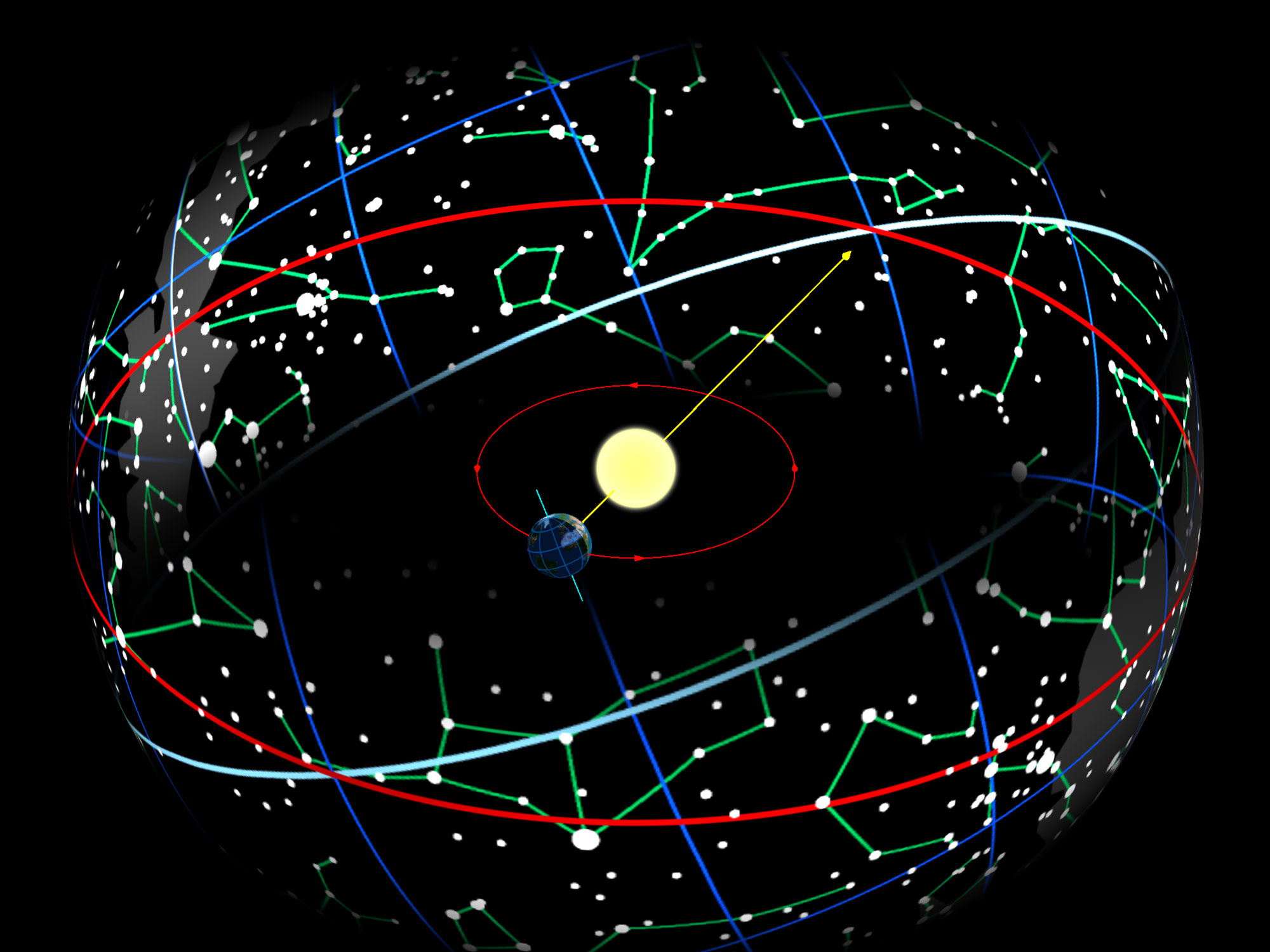
The zodiac is a belt-shaped region of the sky that extends approximately 8° north and south celestial latitude of the ecliptic – the apparent path of the Sun across the celestial sphere over the course of the year. Within this zodiac belt appear the Moon and the brightest planets, along their orbital planes. The zodiac is divided along the ecliptic into 12 equal parts, called "signs", each occupying 30° of celestial longitude. These signs roughly correspond to the astronomical constellations with the following modern names: Aries, Taurus, Gemini, Cancer, Leo, Virgo, Libra, Scorpio, Sagittarius, Capricorn, Aquarius, and Pisces.
The signs have been used to determine the time of the year by identifying each sign with the days of the year the Sun is in the respective sign. In Western astrology, and formerly astronomy, the time of each sign is associated with different attributes. The zodiacal system and its angular measurement in 360 sexagesimal degree (°) originated with Babylonian astronomy during the 1st millennium BC, probably during the Achaemenid Empire. It was communicated into Greek astronomy by the 2nd century BC, as well as into developing the Hindu zodiac. Due to the precession of the equinoxes, the time of year that the Sun is in a given constellation has changed since Babylonian times, and the point of March equinox has moved from Aries into Pisces.
The zodiac forms a celestial coordinate system, or more specifically an ecliptic coordinate system, which takes the ecliptic as the origin of latitude and the Sun's position at vernal equinox as the origin of longitude. In modern astronomy, the ecliptic coordinate system is still used for tracking Solar System objects.
The English word zodiac derives from zōdiacus, the Latinized form of the Ancient Greek zōdiakòs (ζῳδιακός), meaning "of or relating to little animals", Zōdion (ζῴδιον) being the diminutive of zōon (ζῷον, "animal"). The name reflects the prominence of animals (and mythological hybrids) among the twelve signs. In English, the term "zodiac" may also be used in reference to or translation for the similar twelve year cycle (also sometimes applied to other time units than years) of the East Asian-derived systems referred to as the Chinese zodiac (see also, Earthly Branches): similarities include the use of animal or theriomorphic figures associated with a twelve year cycle used culturally to allege or describe personality traits, life events, and their interrelationships—thus this use in translation.[citation needed]
The zodiac was in use by the Roman era, based on concepts inherited by Hellenistic astronomy from Babylonian astronomy of the Chaldean period (mid-1st millennium BC), which, in turn, derived from an earlier system of lists of stars along the ecliptic. The construction of the zodiac is described in Ptolemy's comprehensive 2nd century AD work, the Almagest.
Although the zodiac remains the basis of the ecliptic coordinate system in use in astronomy besides the equatorial one, the term and the names of the twelve signs are today mostly associated with horoscopic astrology. The term "zodiac" may also refer to the region of the celestial sphere encompassing the paths of the planets corresponding to the band of about 8 arc degrees above and below the ecliptic. The zodiac of a given planet is the band that contains the path of that particular body; e.g., the "zodiac of the Moon" is the band of 5° above and below the ecliptic. By extension, the "zodiac of the comets" may refer to the band encompassing most short-period comets.
As early as the 14th century BC a complete list of the 36 Egyptian decans was placed among the hieroglyphs adorning the tomb of Seti I; they figured again in the temple of Ramesses II, and characterize every Egyptian astrological monument. Both the famous zodiacs of Dendera display their symbols, identified by Karl Richard Lepsius.
The division of the ecliptic into the zodiacal signs originates in Babylonian astronomy during the first half of the 1st millennium BC. The zodiac draws on stars in earlier Babylonian star catalogues, such as the MUL.APIN catalogue, which was compiled around 1000 BC. Some constellations can be traced even further back, to Bronze Age (Old Babylonian Empire) sources, including Gemini "The Twins", from Sumerian: 𒀯𒈦𒋰𒁀𒃲𒃲, romanized: MULMAŠ.TAB.BA.GAL.GAL "The Great Twins"; Cancer "The Crab", from Sumerian: 𒀯𒀠𒇻, romanized: MULAL.LUL "The Crayfish", among others.
Hub AI
Zodiac AI simulator
(@Zodiac_simulator)
Zodiac
The zodiac is a belt-shaped region of the sky that extends approximately 8° north and south celestial latitude of the ecliptic – the apparent path of the Sun across the celestial sphere over the course of the year. Within this zodiac belt appear the Moon and the brightest planets, along their orbital planes. The zodiac is divided along the ecliptic into 12 equal parts, called "signs", each occupying 30° of celestial longitude. These signs roughly correspond to the astronomical constellations with the following modern names: Aries, Taurus, Gemini, Cancer, Leo, Virgo, Libra, Scorpio, Sagittarius, Capricorn, Aquarius, and Pisces.
The signs have been used to determine the time of the year by identifying each sign with the days of the year the Sun is in the respective sign. In Western astrology, and formerly astronomy, the time of each sign is associated with different attributes. The zodiacal system and its angular measurement in 360 sexagesimal degree (°) originated with Babylonian astronomy during the 1st millennium BC, probably during the Achaemenid Empire. It was communicated into Greek astronomy by the 2nd century BC, as well as into developing the Hindu zodiac. Due to the precession of the equinoxes, the time of year that the Sun is in a given constellation has changed since Babylonian times, and the point of March equinox has moved from Aries into Pisces.
The zodiac forms a celestial coordinate system, or more specifically an ecliptic coordinate system, which takes the ecliptic as the origin of latitude and the Sun's position at vernal equinox as the origin of longitude. In modern astronomy, the ecliptic coordinate system is still used for tracking Solar System objects.
The English word zodiac derives from zōdiacus, the Latinized form of the Ancient Greek zōdiakòs (ζῳδιακός), meaning "of or relating to little animals", Zōdion (ζῴδιον) being the diminutive of zōon (ζῷον, "animal"). The name reflects the prominence of animals (and mythological hybrids) among the twelve signs. In English, the term "zodiac" may also be used in reference to or translation for the similar twelve year cycle (also sometimes applied to other time units than years) of the East Asian-derived systems referred to as the Chinese zodiac (see also, Earthly Branches): similarities include the use of animal or theriomorphic figures associated with a twelve year cycle used culturally to allege or describe personality traits, life events, and their interrelationships—thus this use in translation.[citation needed]
The zodiac was in use by the Roman era, based on concepts inherited by Hellenistic astronomy from Babylonian astronomy of the Chaldean period (mid-1st millennium BC), which, in turn, derived from an earlier system of lists of stars along the ecliptic. The construction of the zodiac is described in Ptolemy's comprehensive 2nd century AD work, the Almagest.
Although the zodiac remains the basis of the ecliptic coordinate system in use in astronomy besides the equatorial one, the term and the names of the twelve signs are today mostly associated with horoscopic astrology. The term "zodiac" may also refer to the region of the celestial sphere encompassing the paths of the planets corresponding to the band of about 8 arc degrees above and below the ecliptic. The zodiac of a given planet is the band that contains the path of that particular body; e.g., the "zodiac of the Moon" is the band of 5° above and below the ecliptic. By extension, the "zodiac of the comets" may refer to the band encompassing most short-period comets.
As early as the 14th century BC a complete list of the 36 Egyptian decans was placed among the hieroglyphs adorning the tomb of Seti I; they figured again in the temple of Ramesses II, and characterize every Egyptian astrological monument. Both the famous zodiacs of Dendera display their symbols, identified by Karl Richard Lepsius.
The division of the ecliptic into the zodiacal signs originates in Babylonian astronomy during the first half of the 1st millennium BC. The zodiac draws on stars in earlier Babylonian star catalogues, such as the MUL.APIN catalogue, which was compiled around 1000 BC. Some constellations can be traced even further back, to Bronze Age (Old Babylonian Empire) sources, including Gemini "The Twins", from Sumerian: 𒀯𒈦𒋰𒁀𒃲𒃲, romanized: MULMAŠ.TAB.BA.GAL.GAL "The Great Twins"; Cancer "The Crab", from Sumerian: 𒀯𒀠𒇻, romanized: MULAL.LUL "The Crayfish", among others.