



Community hub
Recent from talks
Knowledge base stats:
Talk channels stats:
Members stats:
Two-front war
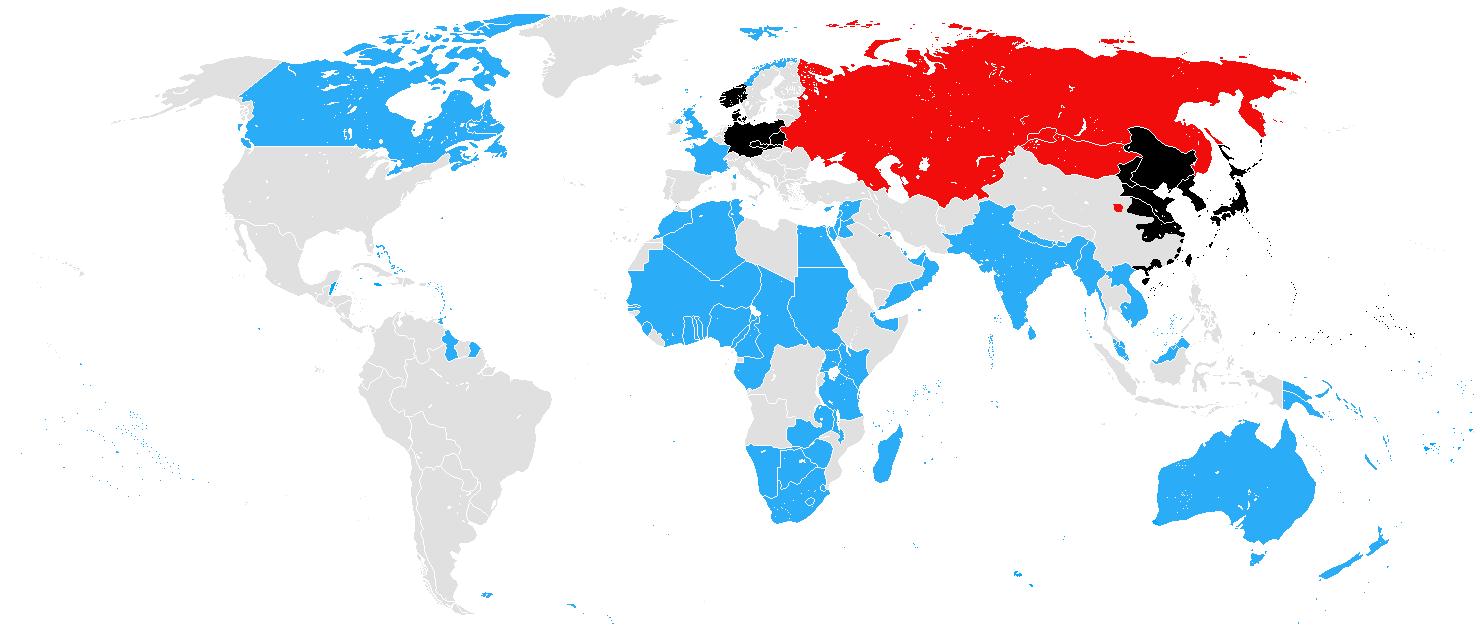
In military terminology, a two-front war occurs when opposing forces encounter on two geographically separate fronts. The forces of two or more allied parties usually simultaneously engage an opponent in order to increase their chances of success. The opponent consequently encounters severe logistic difficulties, as they are forced to divide and disperse their troops, defend an extended front line, and is at least partly cut off from their access to trade and exterior resources. However, by virtue of the central position, they might possess the advantages of the interior lines.
The term has widely been used in a metaphorical sense, for example to illustrate the dilemma of military commanders in the field, who struggle to carry out illusory strategic ideas of civilian bureaucrats, or when moderate legal motions or positions are concurrently opposed by the political Left and Right. Disapproval and opposition by the domestic anti-war movement and civil rights groups as opposed to the bloody military struggle of the late Vietnam War has also been described as a two-front war for the US troops, who fought in Vietnam.
During the 5th-century BCE First Peloponnesian War the Greek polis of Athens had been embroiled in a drawn out struggle with the poleis of Aegina and Corinth among others and its primary enemy Sparta. Aware of the dangers of a battle with the superior Spartans, Athens concentrated on the conquest of Boeotia and thus avoid a prolonged two-front war.
On several occasions during the third century BCE, the Roman Republic engaged in two-front conflicts while clashing with the Gauls and Etruscans to the north and also campaigning in Magna Graecia (the coastal areas of Southern Italy). When Rome was enmeshed in the Second Punic War against Carthage, Hannibal, formal ally of the Sicilian city of Syracuse, intrigued with Philip V of Macedon in 215 BCE, who promptly declared war on Rome. After the establishment of the Roman Empire and the consolidation of its frontiers under Augustus, the Roman legions regularly battled multiple enemies, most notably Germanic tribes on the Rhine and the lower Danube and the Parthian Empire in Syria and Mesopotamia. Various emperors, such as Septimius Severus and Aurelian forcibly led large armies to the opposite ends of the empire in order to deal with the various threats. Beginning in the third century the Roman - and its eastern successor the Byzantine Empire, trying to preserve its territories in Italy, struggled with the Sassanid Empire to the east for a period of more than 400 years. Large-scale incursions of Germanic tribes, such as the Goths and Hunnic raids in the west began during the fourth century and lasted for more than a hundred years.
During the Napoleonic Wars, the Grande Armée of France regularly maintained multiple fronts. In the seven year long Peninsular War (1807–1814) imperial French contingents and Spanish and Anglo-Portuguese armies wrestled for control of the Iberian Peninsula in numerous battles. Nonetheless, in 1812 as French military presence in Iberia had begun to decline, emperor Napoleon Bonaparte personally lead an army of more than 600.000 troops to the east into Russia, seeking to decisively defeat the Russian Empire and force Tsar Alexander I to comply with the Continental System. Great Britain was also present on multiple fronts of the Napoleonic Wars in Europe and the Canadian, the Chesapeake Bay and Louisiana theaters of the War of 1812 in North America.
During World War I, Germany fought a two-front war against France, Great Britain, Italy, Belgium and later also American forces on the Western Front and Russia and later Romania on the Eastern Front. Russian participation in the war ended with the 1917 Bolshevik October Coup and the peace treaty with Germany and Austria-Hungary was signed in March 1918.
Its central location in Europe and (currently) borders with nine neighboring nations fundamentally define Germany's politics and strategy. Bismarck successfully integrated Germany in his elaborate system of alliance of the European powers from 1871 until he was dismissed in 1890 by the new Emperor Wilhelm II. Wilhelm embarked on an imperialist great power political course, neglected the alliances and his irrational expansion of the Imperial Navy triggered an arms race and seriously damaged the relations with France and Great Britain. By 1907, France had established an alliance with Great Britain and Russia. The German Empire found itself encircled and isolated.
German military strategists had to adapt to the new strategic situation and developed the Schlieffen Plan. A series of military operations, that were to counteract being surrounded and, if exacted ruthlessly, will lead to victory. Under the Schlieffen Plan, German forces would invade France via Belgium, Luxembourg, and the Netherlands (the idea to go through the Netherlands was abandoned because of its neutrality), quickly capturing Paris and forcing France to sue for peace. The Germans would then turn their attention to the East before the Russian army could mobilize its massive forces. The Germans failed to achieve the plan's objectives.
Hub AI
Two-front war AI simulator
(@Two-front war_simulator)
Two-front war
In military terminology, a two-front war occurs when opposing forces encounter on two geographically separate fronts. The forces of two or more allied parties usually simultaneously engage an opponent in order to increase their chances of success. The opponent consequently encounters severe logistic difficulties, as they are forced to divide and disperse their troops, defend an extended front line, and is at least partly cut off from their access to trade and exterior resources. However, by virtue of the central position, they might possess the advantages of the interior lines.
The term has widely been used in a metaphorical sense, for example to illustrate the dilemma of military commanders in the field, who struggle to carry out illusory strategic ideas of civilian bureaucrats, or when moderate legal motions or positions are concurrently opposed by the political Left and Right. Disapproval and opposition by the domestic anti-war movement and civil rights groups as opposed to the bloody military struggle of the late Vietnam War has also been described as a two-front war for the US troops, who fought in Vietnam.
During the 5th-century BCE First Peloponnesian War the Greek polis of Athens had been embroiled in a drawn out struggle with the poleis of Aegina and Corinth among others and its primary enemy Sparta. Aware of the dangers of a battle with the superior Spartans, Athens concentrated on the conquest of Boeotia and thus avoid a prolonged two-front war.
On several occasions during the third century BCE, the Roman Republic engaged in two-front conflicts while clashing with the Gauls and Etruscans to the north and also campaigning in Magna Graecia (the coastal areas of Southern Italy). When Rome was enmeshed in the Second Punic War against Carthage, Hannibal, formal ally of the Sicilian city of Syracuse, intrigued with Philip V of Macedon in 215 BCE, who promptly declared war on Rome. After the establishment of the Roman Empire and the consolidation of its frontiers under Augustus, the Roman legions regularly battled multiple enemies, most notably Germanic tribes on the Rhine and the lower Danube and the Parthian Empire in Syria and Mesopotamia. Various emperors, such as Septimius Severus and Aurelian forcibly led large armies to the opposite ends of the empire in order to deal with the various threats. Beginning in the third century the Roman - and its eastern successor the Byzantine Empire, trying to preserve its territories in Italy, struggled with the Sassanid Empire to the east for a period of more than 400 years. Large-scale incursions of Germanic tribes, such as the Goths and Hunnic raids in the west began during the fourth century and lasted for more than a hundred years.
During the Napoleonic Wars, the Grande Armée of France regularly maintained multiple fronts. In the seven year long Peninsular War (1807–1814) imperial French contingents and Spanish and Anglo-Portuguese armies wrestled for control of the Iberian Peninsula in numerous battles. Nonetheless, in 1812 as French military presence in Iberia had begun to decline, emperor Napoleon Bonaparte personally lead an army of more than 600.000 troops to the east into Russia, seeking to decisively defeat the Russian Empire and force Tsar Alexander I to comply with the Continental System. Great Britain was also present on multiple fronts of the Napoleonic Wars in Europe and the Canadian, the Chesapeake Bay and Louisiana theaters of the War of 1812 in North America.
During World War I, Germany fought a two-front war against France, Great Britain, Italy, Belgium and later also American forces on the Western Front and Russia and later Romania on the Eastern Front. Russian participation in the war ended with the 1917 Bolshevik October Coup and the peace treaty with Germany and Austria-Hungary was signed in March 1918.
Its central location in Europe and (currently) borders with nine neighboring nations fundamentally define Germany's politics and strategy. Bismarck successfully integrated Germany in his elaborate system of alliance of the European powers from 1871 until he was dismissed in 1890 by the new Emperor Wilhelm II. Wilhelm embarked on an imperialist great power political course, neglected the alliances and his irrational expansion of the Imperial Navy triggered an arms race and seriously damaged the relations with France and Great Britain. By 1907, France had established an alliance with Great Britain and Russia. The German Empire found itself encircled and isolated.
German military strategists had to adapt to the new strategic situation and developed the Schlieffen Plan. A series of military operations, that were to counteract being surrounded and, if exacted ruthlessly, will lead to victory. Under the Schlieffen Plan, German forces would invade France via Belgium, Luxembourg, and the Netherlands (the idea to go through the Netherlands was abandoned because of its neutrality), quickly capturing Paris and forcing France to sue for peace. The Germans would then turn their attention to the East before the Russian army could mobilize its massive forces. The Germans failed to achieve the plan's objectives.